A commercial submission rarely arrives as one clean file. It’s a PDF application, three follow-up emails, a spreadsheet of prior loss runs, and a scanned inspection report from a mobile inspector. A claim file looks the same way: an intake form, a recorded phone statement, and a handful of photos taken on someone’s phone at the scene.
None of that has been easy to automate, because none of it is structured data. That’s exactly why generative AI insurance applications have moved from pilot projects to production workloads faster than almost any other technology insurers have adopted. Generative AI insurance refers to AI systems that can read, summarize, and generate text, images, and documents from an insurer’s own unstructured material, rather than simply scoring structured records the way older machine learning tools do.
This guide breaks down what generative AI actually does inside underwriting, claims, and distribution in 2026, with named carriers and vendors attached to each claim. It also does something most insurance AI content skips: it treats brokers and independent agents as a distinct audience with distinct workflows, not an afterthought to the carrier story.
What is generative AI in insurance, exactly?
Generative AI in insurance is the layer of AI that understands and produces unstructured content: policy language, claim notes, emails, and images. It sits between two other technologies that get lumped in with it, and the distinction matters for anyone trying to figure out what to actually buy.
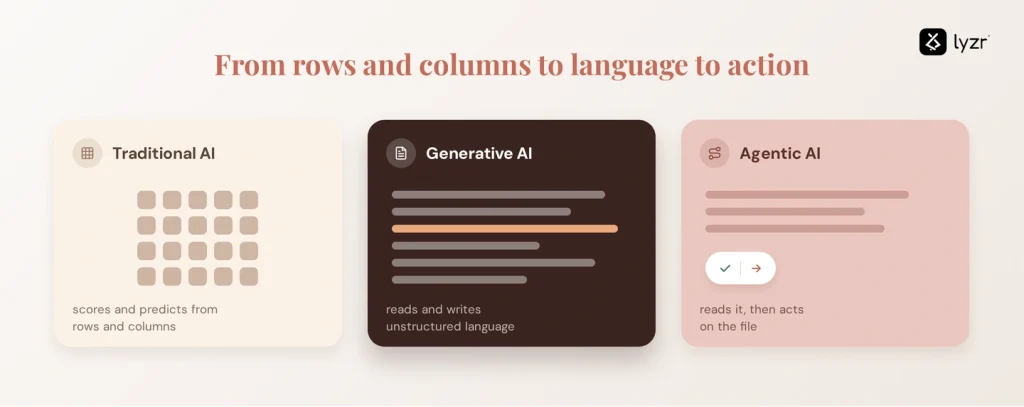
Traditional AI and machine learning score and predict against structured data. It’s the engine behind a pricing model or a fraud score, and it needs clean fields to work.
Generative AI reads and writes unstructured material. It can summarize a 600-page underwriting guide, extract clauses from a policy wording, or draft a renewal letter, because it works from language rather than rows and columns.
Agentic AI takes that understanding and acts on it. An agent doesn’t just summarize a claim, it checks the claim against the actual policy, flags what’s missing, and routes the file for approval.
The generative AI insurance market in 2026
Adoption has moved past the pilot stage. A 2025 Conning industry survey found generative AI adoption among insurers jumped close to 100% year over year, with 55% reporting early or full deployment, while claims, underwriting, pricing and quoting already account for 58% of disclosed use cases.
Regulators are tracking the same shift. A 2025 NAIC survey found 84% of health insurers report they currently utilize AI/ML in some capacity, and looking across lines of business, AI adoption rates sit at 92% for health insurers, 88% for auto insurers, 70% for home insurers and 58% for life insurers, according to Fenwick’s tracking of NAIC data.
The generative AI insurtech sector has grown around this demand. Vendors like Sixfold, Sprout.ai, and Shift Technology now sell purpose-built generative AI tools directly into underwriting and claims workflows, rather than insurers building everything internally. On the size of the opportunity, estimates point to the market potential of generative AI reaching $15 billion by 2025 and $32 billion by 2027 in the insurance and finance industries alone, according to Allianz Commercial.
The opportunity is therefore shifting from standalone GenAI experiments toward systems embedded directly into underwriting, claims, distribution, and compliance workflows.
Generative AI insurance use cases
The pattern across every real deployment is the same: extract information from a document, check it against a policy or guideline, flag what’s missing, and hand a clean package to a human for judgment.
Use case summary
| Use case | What GenAI does | Human stays responsible for |
|---|---|---|
| Underwriting | Extracts submission data, flags missing info, drafts risk summaries | Final pricing and bind decision |
| Claims | Reads FNOL, notes, and photos; drafts assessment summaries | Liability determination, payout |
| Policy intelligence | Compares wordings, extracts clauses and exclusions | Legal interpretation for the client |
| Customer service | Answers coverage questions, drafts explanations | Escalated or sensitive conversations |
| Fraud & compliance | Surfaces anomalies, assembles audit evidence | Investigation and final findings |

Generative AI in insurance underwriting
This is where the volume problem is worst. Allianz UK built a generative AI tool called BRIAN specifically because underwriters were navigating lengthy guidance documents of up to 600 pages to answer basic appetite questions. The tool has processed 13,000 queries since its January rollout and saved an estimated 135 working days. On the submission side, underwriting-AI vendor Sixfold built a research agent that enables insurers to answer 30% more questions during the underwriting process and saves underwriters at least two hours per submission, a system that had surpassed one million underwriting submissions processed across more than 40 insurance lines by December 2025.
Gen AI in insurance claims
A claim file is the messiest document set in the business, and that’s precisely why generative AI has landed here fast. Allianz’s Insurance Copilot, launched for auto and property claims in Austria, automates key tasks such as data gathering from claims and contracts, analyzing documents and images, and drafting contextually accurate communications. MetLife took a similar path by expanding its partnership with Sprout.ai in mid-2025 to enhance claims processing across major markets including the U.S., Asia, and Latin America, streamlining decision-making while keeping the human element of empathy. For the multi-agent architecture behind claims automation, see our guide to AI agents for insurance claims.
Policy and document intelligence
Underwriters and brokers both spend hours comparing wordings across carriers to find where coverage actually diverges, not just where price does. Generative AI turns that into a direct question-and-answer exercise instead of a manual read-through, pulling the specific clause, exclusion, or sub-limit that matters for the case in front of you.
Customer service and policy assistance
Helvetia was the first insurer in the industry to launch a direct customer contact service based on ChatGPT technology, and its chatbot Clara has since become one piece of a broader AI program spanning claims processing, fraud identification, underwriting and marketing. Lyzr built a similar workflow for a large carrier’s service team: an agentic email triage and case management system that automated the entire process from inbox to resolution, connecting directly to the insurer’s CRM so cases were created or updated in real time instead of waiting on manual triage.
Fraud detection and compliance
Fraud teams use generative AI to connect information across claims that a single reviewer would never cross-reference by hand.
“Generative AI has made it possible to leverage that information at scale, with both speed and accuracy.” – Shift Technology, Chief Data Scientist
The AI builds the investigation summary; it does not make the fraud determination. On the compliance side, New York Life’s partnership with Norm Ai is aimed at expanding into additional insurance regulatory frameworks and compliance use cases, using AI to track regulatory language rather than replace legal sign-off.
Knowledge management and operations
Every agency and carrier has someone who “just knows” how a process works. New York Life turned that into searchable infrastructure: its internal tool Scribe grew from a 40-person pilot program to enterprise-wide implementation after the company evaluated over 200 potential GenAI use cases for business impact and risk before committing to a rollout.
Generative AI for insurance brokers and independent agents
| Workflow | What GenAI handles | Human role |
| Submission preparation | Extracts and organizes client information | Reviews completeness |
| Carrier appetite matching | Matches risk against carrier guidelines | Chooses market |
| Coverage comparison | Surfaces exclusions, limits and differences | Advises client |
| Renewals | Drafts renewal communications and identifies gaps | Makes recommendation |
Brokers see less of the enterprise attention than carriers do, but they arguably have more to gain from generative AI for insurance broker workflows, because so much of the job is manual document handling with no automation layer underneath it.
Carrier appetite matching. Instead of calling three markets to see who’ll write a frame-construction restaurant in a flood zone, a broker can feed the risk details into a tool trained on appetite guides and get a ranked list back in seconds, the same underlying mechanic Sixfold sells to underwriters.
Quote and coverage comparison. The value isn’t spotting the cheapest quote, it’s spotting where the actual coverage differs, a sub-limit here, a broader business-interruption trigger there, and being able to explain that difference to the client in plain language.
Submission and proposal prep. This is the single biggest time sink for a small shop: turning a client’s scattered emails, financials, and prior policies into a complete, ACORD-ready submission package.
Renewal and cross-sell prompts. Generative AI for independent insurance agents shows up most often here, drafting renewal letters that surface coverage gaps or cross-sell opportunities instead of just restating the new premium.

For a five-person agency, the realistic starting point this quarter isn’t a custom build. It’s using an approved, secure tool for internal tasks: summarizing loss runs, drafting first-pass renewal language, prepping talking points before a client call. GenAI for insurance broker use should stay internal-facing until there’s a governed system in place to ground it in real policy documents.
That governance point isn’t optional. An agent who lets a general-purpose model paraphrase coverage terms directly to a client is creating a real E&O exposure: if the model gets a sub-limit or exclusion wrong and the client relied on that explanation, the misrepresentation risk sits with the agent, not the AI vendor. Grounding any client-facing output in the actual policy document, and keeping a record of exactly what was sent, is the difference between a productivity tool and a liability problem.
Where generative AI ends and AI agents begin
Generative AI understands and drafts. It cannot act on what it understands, and that’s the line between GenAI and an AI agent.
Take a claim. Generative AI reads the incoming FNOL and photos and produces a summary. An agent goes further: it pulls the policy record, checks the claim against actual coverage terms, notices a police report is missing, drafts the request for it, and routes the full file to an adjuster for sign-off. The model provides the understanding; the agent provides the action, with a human still approving the outcome.

That progression, from copilot to agent to coordinated workflow, is the throughline of AI agents across the insurance value chain, and the difference between a generic AI agent and one built for insurance is largely about whether it has permissions, audit trails, and approval gates built in.
What has to be true before it ships
In a regulated industry, the operative question isn’t whether a model can produce an answer. It’s whether the organization can show how that answer was reached, what data informed it, and who signed off on it.
Hallucination on policy language is the sharpest risk: a model that invents an exclusion or misstates a limit is a compliance and E&O problem, not just a bad output. That’s why grounding tools in an insurer’s own verified documents, rather than general training knowledge, has become table stakes. By late 2025, 23 states and Washington, D.C. had adopted the NAIC’s AI Model Bulletin, which requires insurers to document governance and risk controls around AI use. Human review gates for underwriting, claims, and compliance decisions aren’t a nice-to-have here, they’re what keeps an examiner satisfied.
How Lyzr fits
Most insurers and agencies are past the experimentation phase and stuck on the same problem: turning a working GenAI pilot into a governed workflow that a compliance team will actually sign off on. That’s the gap Lyzr’s Agent Studio is built to close, with human-in-the-loop approval gates, permission controls, and full audit logging built into every agent rather than bolted on afterward.
For insurance specifically, Lyzr’s insurance agent suite, Benjie, packages claims processing, underwriting support, partner quality assurance, and compliance monitoring as agents that work together instead of requiring separate point tools. If you want a working blueprint before you build anything, our guide to AI agents across the insurance value chain is a reasonable place to see what’s already running in production.
Book a demo to see how a governed agent workflow would look against your own claims or underwriting queue.
Where this leaves you
Generative AI in insurance stops being interesting the moment it just writes better emails. It becomes worth building around when it can read a submission, a claim file, or a policy wording well enough to move the work forward without waiting on a person to type it into a system first.
That’s true whether you’re an underwriter buried in guidance documents, a claims handler juggling four data formats on one file, or a broker trying to get a proposal out before a client loses interest. The question worth asking isn’t whether generative AI belongs in your workflow. It’s which document you touch most often that a model could read for you first.
Frequently asked questions
Generative AI in insurance is AI that reads, summarizes, and generates unstructured content like policy documents, claim notes, and client communications, rather than just scoring structured data. It’s used across underwriting, claims, customer service, and distribution to cut down manual document work.
It extracts data from submissions and loss runs, flags missing information, and summarizes risk profiles for the underwriter to review. Tools like Allianz’s BRIAN and Sixfold’s research agent are built specifically to cut the manual document-search time out of the process.
It reads FNOL reports, adjuster notes, and damage photos, then drafts case summaries and initial assessments for the adjuster. Carriers like MetLife have expanded AI claims partnerships specifically to speed up decision-making while keeping a human in the approval loop.
Brokers use generative AI for carrier appetite matching, comparing coverage differences across quotes, and assembling submission packages from scattered client documents. The gain is time back on repetitive prep work, not replacing broker judgment on which market or price is right for the client.
Yes, and the safest starting point is internal-facing tasks like drafting renewal language or summarizing loss runs rather than unsupervised client communication. Any output that reaches a client needs to be grounded in the actual policy and reviewed by the agent first, to avoid E&O exposure.
Estimates put the market potential of generative AI at $15 billion by 2025 and $32 billion by 2027 across insurance and finance combined, according to Allianz Commercial. Adoption data backs that trajectory, with a 2025 Conning survey finding generative AI adoption jumped close to 100% year over year among insurers.
Yes. By late 2025, 23 states and Washington, D.C. had adopted the NAIC’s Model Bulletin on AI use, which requires insurers to document governance, testing, and risk management around AI systems. Enforcement infrastructure is still being built out, with a formal examination tool piloting in early 2026.
Public, general-purpose AI tools are not safe for sensitive policyholder or claims data, since that data can be used to train the underlying model. Enterprise platforms built for insurance keep data within the insurer’s own environment and apply access controls, which is the baseline requirement before any client data touches an AI system.
Book A Demo: Click Here
Join our Slack: Click Here
Link to our GitHub: Click Here