Generative AI in healthcare uses large language models and generative systems to draft clinical notes, answer patient questions, design drug candidates, and automate administrative workflows. In 2026, US health systems are deploying it for ambient documentation, care coordination, and drug discovery, balanced against strict HIPAA and FDA compliance requirements.
Key takeaways
- Generative AI in healthcare is deployed at scale for ambient clinical documentation, with named health systems reporting measurable adoption gains.
- Drug discovery use cases span target identification, molecule design, and clinical trial optimization, each already producing checkable pharma and biotech results.
- HIPAA compliance is not automatic. It requires signed business associate agreements, PHI safeguards, and auditable logging from every AI vendor.
- The FDA’s January 2025 AI-enabled device guidance introduced total product lifecycle requirements that clinical AI tools must now meet.
- Hallucination, bias, and over-reliance remain measurable risks, with 2025-2026 benchmarks showing mitigation helps but doesn’t eliminate the problem.
What is generative AI in healthcare?
Generative AI in healthcare refers to AI systems, most often large language models and diffusion-based models, that create new clinical text, images, or molecular structures rather than simply classifying existing data.
Unlike a rules-based clinical decision support tool, a generative model can draft a discharge summary, answer a patient’s question in plain language, or propose a novel drug compound based on patterns learned from millions of documents, images, and molecules. That creative capacity is what separates it from earlier “predict a score” AI, and it’s why the compliance questions around it look different too.

How generative AI is used in healthcare
US health systems are moving generative AI in healthcare use cases out of pilot mode and into daily workflows. Below are eight applications with named, checkable deployments.
You can also check out a deeper library of agentic AI use cases for healthcare.

Ambient clinical documentation
Ambient AI listens to the patient-clinician conversation and drafts a structured note directly in the EHR, cutting the minutes clinicians spend typing after each visit. UCHealth followed a successful nine-month pilot with 250 providers in 2025 by scaling Abridge so that over one-third of about 6,000 UCHealth doctors, nurse practitioners, and physician assistants are now using it. Abridge was awarded Best in KLAS for Ambient AI in both 2025 and 2026.
Patient-facing virtual assistants and chatbots
A healthcare virtual assistant answers routine patient questions, schedules visits, and triages symptoms so staff can focus on higher-value calls. Mount Sinai Health System deployed Sofiya, an agentic AI assistant in its cardiac catheterization lab that calls patients before stenting procedures to walk through logistics and preprocedural instructions, handling up to 15–16 calls simultaneously and saving nursing staff more than 200 hours in five months.
Autonomous AI agents for care coordination and operations
Beyond chat, AI agents for healthcare now run multi-step workflows: verifying insurance, routing referrals, and following up with patients automatically. Platforms like Keragon connect EHRs, scheduling systems, and communication tools so a single agent can manage a referral from intake to confirmed appointment without a staff member re-entering data by hand.
Telehealth and online GP appointments
Generative AI strengthens telehealth by summarizing visits, translating in real time, and prepping clinicians before a call starts. It also supports newer care models like DPC, where AI-assisted intake and follow-up help small practices manage patient panels, and platforms offering online GP appointments use it to streamline booking and post-visit instructions.
Predictive analytics for disease prevention and population health
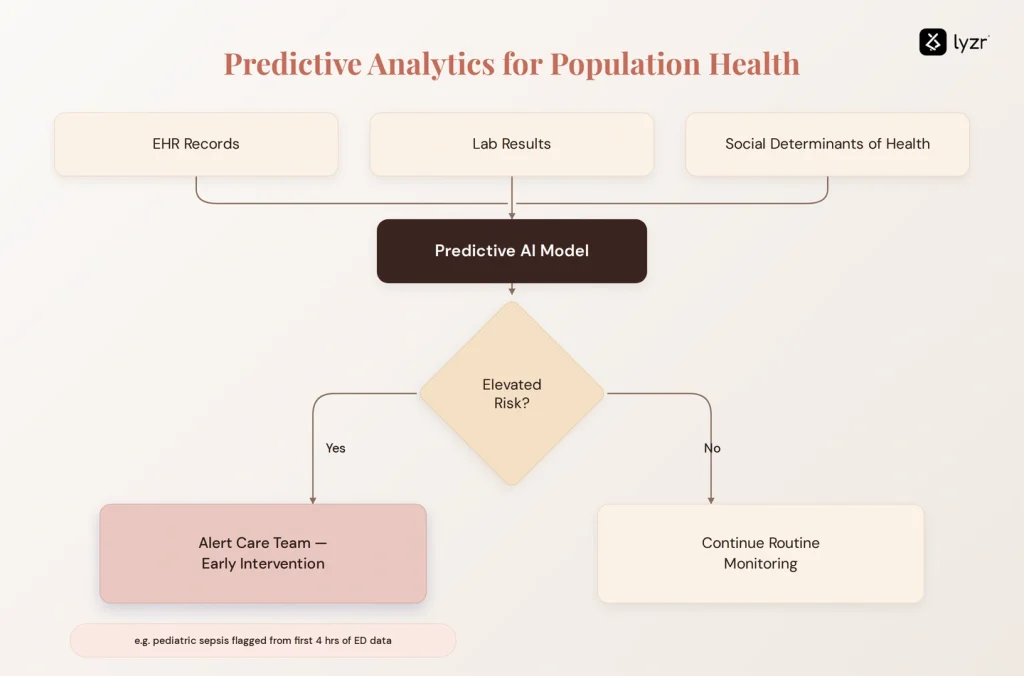
By combining EHR data, labs, and social determinants of health, predictive models flag patients at rising risk before they deteriorate. Researchers at Northwestern University Feinberg School of Medicine and Lurie Children’s Hospital, working across five health systems in the Pediatric Emergency Care Applied Research Network, built machine-learning models that flag children at high risk of sepsis using just the first four hours of emergency department data, so clinicians can intervene before organ dysfunction sets in.
Digital twins and simulation in precision medicine
Generative AI can simulate a patient’s physiology to build a digital twin, letting clinicians test how a treatment might perform before it’s given. Mayo Clinic announced separate collaborations with Microsoft Research and Cerebras Systems to develop foundation models combining multimodal radiology images with genomic sequencing data.
As Dr. Matthew Callstrom, chair of Mayo Clinic Radiology and medical director for Generative AI and Strategy, put it, “multimodal foundation models hold immense promise in tackling significant roadblocks across the radiology ecosystem.” Lyzr’s data analyzers support this same pattern, helping teams surface signal from imaging and lab data faster than manual review allows.
Remote patient monitoring
AI reviews the constant stream of data from wearables and home sensors to catch early signs a chronic condition is worsening. Philips builds AI into its remote monitoring devices to flag abnormal vitals, and dedicated remote patient monitoring companies now offer platforms purpose-built to route those alerts to care teams before a hospitalization is needed.
Administrative and operational automation
Generative AI also automates the paperwork behind care: coding claims, managing denials, and reading pathology slides. Paige.AI holds FDA authorization for AI-assisted prostate cancer detection from digitized pathology slides, helping pathologists move through casework faster while keeping diagnostic sign-off with the physician.
AI in drug discovery
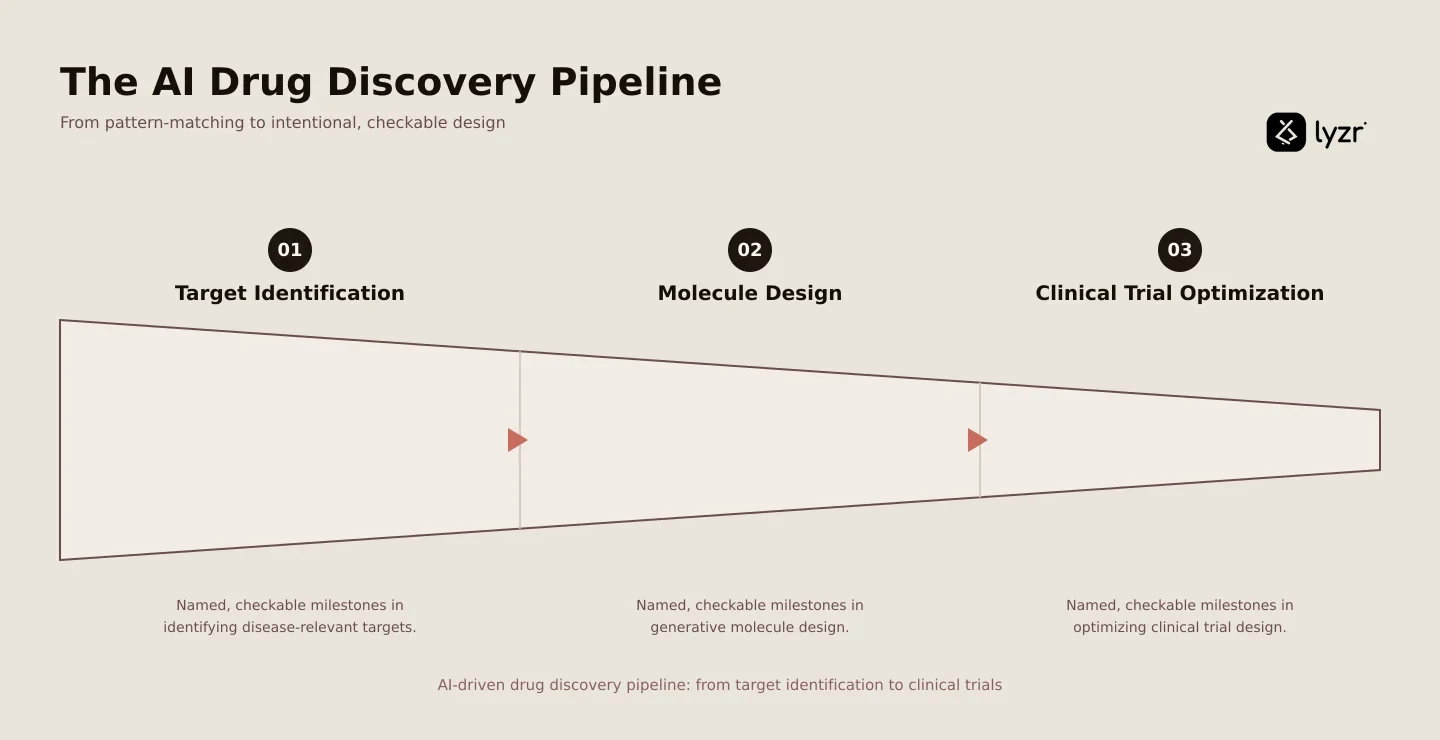
AI in drug discovery has moved from pattern-matching to intentional design, and the last two years produced named, checkable milestones across target identification, molecule design, and clinical trial optimization.
Target identification
Insilico Medicine used its PandaOmics platform to identify TNIK as a novel fibrosis target, then designed the resulting molecule with its generative chemistry engine. On June 3, 2025, Nature Medicine published what the company describes as the industry’s first proof-of-concept clinical validation of AI-driven drug discovery, reporting Phase IIa results for Rentosertib, a TNIK inhibitor for idiopathic pulmonary fibrosis. Insilico has since initiated a Phase III trial for Rentosertib expected to enroll 320 participants across 47 centers in China.
Molecule design
Chai Discovery signed a license agreement to deploy its AI-driven drug discovery platform within Pfizer’s research and development operations, marking one of the first major pharmaceutical deployments of Chai’s technology. Its newest model, Chai-3, doubles the success rate of its predecessor in AI-driven antibody design, producing antibodies that meet required therapeutic standards.
Clinical trial optimization
City of Hope built HopeLLM, an in-house clinical trial matching tool that has supported feasibility for more than 200 trials, rapidly identifying eligible patients across all City of Hope locations while keeping physicians and study coordinators as the decision-makers.
HIPAA compliance and regulatory considerations
Generative AI can be HIPAA compliant, but no model is compliant by default. Compliance depends entirely on how a vendor and health system configure data handling, contracts, and access controls around protected health information.

Any vendor touching PHI must sign a business associate agreement that spells out administrative, physical, and technical safeguards. Encryption, minimum-necessary access, and audit logging of every AI interaction with patient data are baseline expectations, not extras. Teams building this into procurement often start with Lyzr for Compliance Teams and private AI agents that keep PHI inside the health system’s own environment rather than a third-party cloud.
FDA AI medical device guidance is evolving quickly. In January 2025 the FDA issued draft guidance on lifecycle management and marketing submission recommendations for AI-enabled device software, intended to give developers a consistent set of considerations across a device’s total product lifecycle. That same month, the International Medical Device Regulators Forum finalized 10 guiding principles for Good Machine Learning Practice, meant to promote safe, effective, high-quality AI/ML medical devices across their full lifecycle. Together they signal that a clinical AI tool’s safety case doesn’t end at initial clearance, it continues through every model update.
Data privacy adds a layer beyond HIPAA itself: state privacy statutes, patient consent for ambient recording, and de-identification standards for any data used in model training or fine-tuning all need their own sign-off before a generative AI healthcare tool touches real patient conversations.
Risks and limitations of AI in healthcare
The risks of AI in healthcare center on five issues: hallucination, bias, liability, data quality, and over-reliance. Each now has a measurable 2025-2026 benchmark behind it, not just a theoretical concern.

A 2025 MedRxiv study measured hallucination rates on clinical case summaries at 64.1% without mitigation prompts, falling to 43.1% with a structured mitigation protocol, a meaningful improvement that still leaves real error on the table. ECRI, the independent patient-safety nonprofit, ranked AI chatbot misuse as the single greatest health technology hazard for 2026, noting that tens of millions of people now consult general-purpose chatbots for health information daily, outside any clinical oversight.
A recent cross-sectional analysis of FDA-authorized machine learning devices found that even as PCCP adoption expanded, transparent performance and demographic reporting remained limited, a gap that makes it hard to know how a model performs across race, age, or sex before it reaches full-scale deployment.
Liability is still unsettled: when an AI-assisted note or recommendation contributes to harm, health systems and payers are still working out how responsibility splits between vendor, institution, and clinician. Poor EHR data quality limits any model trained on it, and over-reliance, letting an AI draft substitute for clinical judgment, is exactly why credible deployments keep a human reviewer in the loop. Lyzr’s approach to responsible AI and AI risk management frameworks both treat that human review as a control, not a courtesy.
Implementing generative AI in healthcare: build vs. buy
Choosing to build vs. buy generative AI in healthcare depends on how differentiated the use case is. Standardized needs, like ambient documentation or a support chatbot, usually favor buying from an established vendor with compliance already built in. Highly specific clinical or research workflows more often justify custom development.

Organizations without in-house AI capability often partner with a healthcare software development company or a team offering custom healthcare software to scope a HIPAA-ready build from day one, defining exactly which data sources, models, and outputs the system will touch. Whichever path you choose, integration with the existing EHR is the real test: even the best EHR for private practice needs an AI layer that respects existing permissions and documentation workflows rather than working around them.
A growing number of teams use agentic platforms like Lyzr, built with Lyzr Studio, to prototype a compliant agent quickly rather than starting from a blank canvas. You can see examples of what’s been built in the showcase or walk through it in the video demos.
Ready to see how healthcare-specific AI agents handle documentation, compliance, and operations end to end? Book a Lyzr healthcare agents demo.
FAQs
Generative AI drafts clinical notes from ambient audio, powers agentic patient outreach like Mount Sinai’s Sofiya, automates care coordination and administrative workflows, and designs drug candidates in R&D. US health systems including UCHealth, Mayo Clinic, and Northwestern Medicine use it daily for documentation, imaging research, risk prediction, and operations, always alongside human clinical review.
Examples include Abridge’s ambient documentation at UCHealth, Mount Sinai’s Sofiya assistant handling pre-procedure patient calls in its cardiac cath lab, Paige.AI’s FDA-authorized pathology AI, Insilico Medicine’s AI-discovered drug Rentosertib, and Mayo Clinic’s foundation-model radiology research with Microsoft Research. Each is a named, checkable deployment rather than a generic proof of concept.
Generative AI can be HIPAA compliant, but no tool is compliant automatically. It requires a signed business associate agreement, PHI-specific safeguards like encryption and access controls, and audit logging built into how the vendor and health system configure the deployment together.
The main risks are hallucination, algorithmic bias, unclear liability, poor data quality, and over-reliance on AI output. A 2025 study found clinical case summaries hallucinated 64.1% of the time without mitigation, and ECRI ranked AI chatbot misuse the top health technology hazard for 2026, underscoring why human review remains essential in every deployment.
AI identifies novel targets, designs candidate molecules, and optimizes clinical trial matching. Insilico Medicine used generative AI to discover and design Rentosertib for pulmonary fibrosis, now in Phase III trials; Chai Discovery’s platform, licensed to Pfizer, designs therapeutic antibodies; and City of Hope’s HopeLLM has supported feasibility for over 200 trials.
No. AI can flag patterns, summarize data, and suggest possibilities, but a licensed clinician makes the diagnosis. FDA-regulated diagnostic AI tools, like pathology or imaging software, are authorized as clinical decision support, not autonomous decision-makers, and are designed to work alongside physician judgment.
Book A Demo: Click Here
Join our Slack: Click Here
Link to our GitHub: Click Here