Key takeaways
- AI in energy runs on three layers: predictive AI for forecasting and maintenance, generative AI for querying documents and operational knowledge, and agentic AI for coordinating multi-step actions.
- Every real use case has a mechanism: SCADA and PMU data for grid anomalies, load and weather data for demand forecasts, vibration and thermal signatures for maintenance.
- AI adds electricity demand through data centers and helps absorb it through smarter grid management, the same story from two directions.
- Deployment friction lives in integration and governance, not model accuracy: legacy systems, fragmented data and unclear sign-off on AI-triggered actions decide whether a pilot reaches production.
- The bigger opportunity isn’t optimizing single assets, it’s coordinating millions of distributed, variable assets across the grid in near real time.
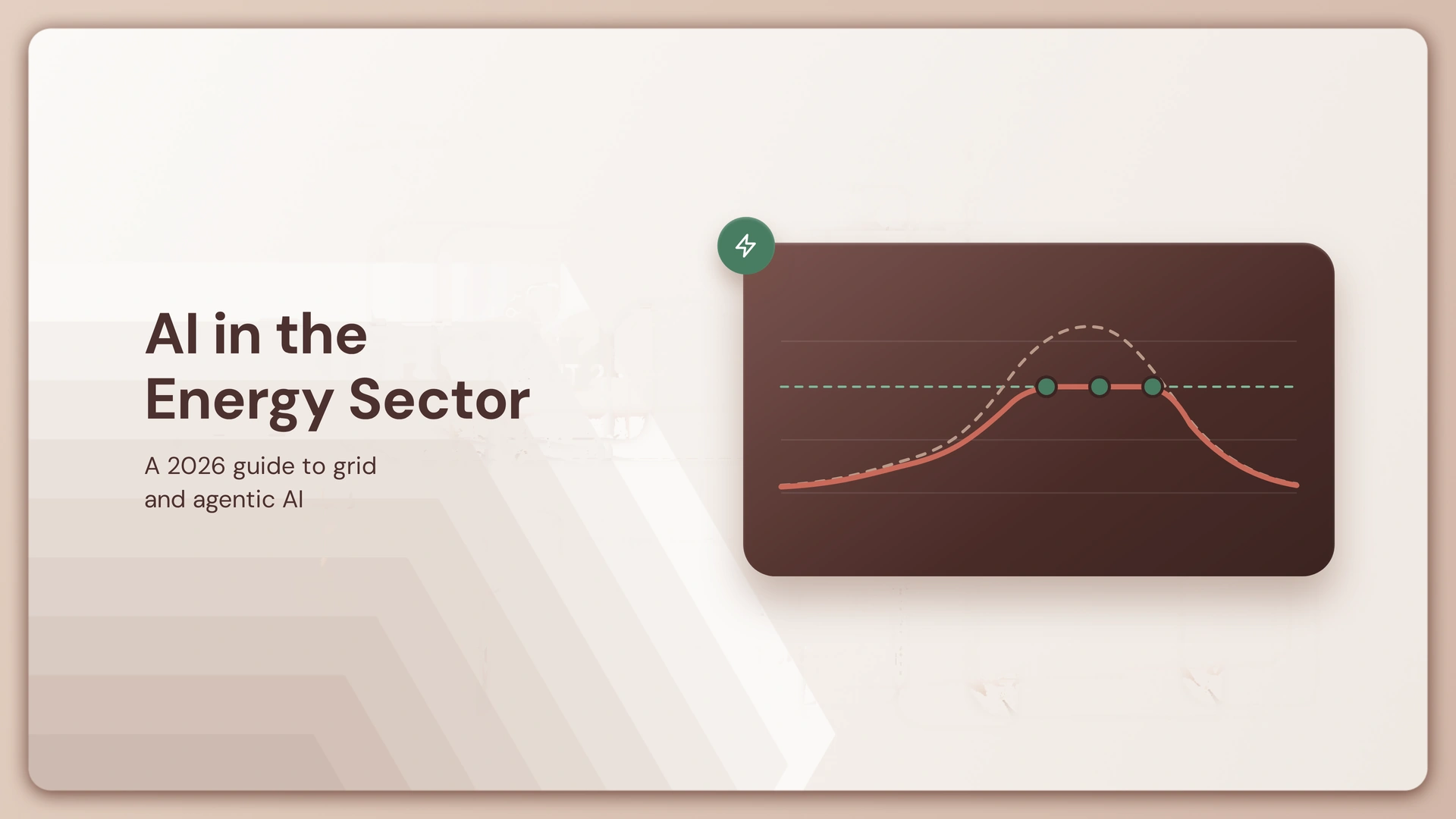
AI is adding real load to the electric grid at the same time it’s becoming one of the better tools for managing that load. Data centers training and running AI models are pulling gigawatts onto grids that weren’t sized for them, while the same statistical and machine learning techniques help utilities forecast that demand, stabilize voltage, and catch a failing transformer before it fails.
AI in energy sector is three layers, not one capability. Predictive AI, the most deployed, runs load forecasting, anomaly detection and equipment monitoring on structured sensor data. Generative AI, the fastest-growing, turns technical documents and filings into plain-language answers. Agentic AI, just reaching production, coordinates both into multi-step workflows under human-controlled permissions.
This guide covers what each layer does, the data and models behind it, and what it takes to move from pilot to production.
What is AI in the energy sector, and how does it work across the value chain?
AI in the energy sector means applying statistical models, machine learning and, more recently, generative and agentic systems to the data an energy company already generates: sensor telemetry, smart meter reads, weather feeds, maintenance logs, market prices and technical documents. What changes stage to stage is which data feeds the model and what decision it produces.

- Generation. Predictive models forecast wind and solar output from weather and turbine-level sensor data, covered in more detail under renewable energy forecasting below, while generative systems let engineers query equipment manuals by fault code instead of searching PDFs.
- Transmission. Anomaly-detection models trained on grid telemetry flag instability before an operator would spot it on a dashboard.
- Distribution. Predictive models turn market and demand signals into a forecast, with a generative layer increasingly summarizing that alongside news and filings into a scenario a trader can act on.
- Storage. Time-series models forecast market prices and grid needs to schedule battery charge and discharge cycles for revenue or reliability, per the asset owner’s priority.
- Consumption. Building management systems and industrial controllers use occupancy, price and weather signals to adjust HVAC and manufacturing loads without manual scheduling.
- Trading and operations. Predictive models turn price, weather and demand signals into a forecast, and a generative layer increasingly turns that plus news and filings into a scenario summary a trader can act on.
Generative AI use cases in the energy sector
Predictive AI is the workhorse behind the value chain above. What’s actually new for 2026 is the layer sitting on top of it, and the gen AI use cases for top industries pattern shows up clearly in energy: unstructured knowledge finally becomes queryable. Below are the Gen AI in energy use cases worth understanding in enough detail to evaluate for your own operation, each tagged to the AI layer it belongs to.
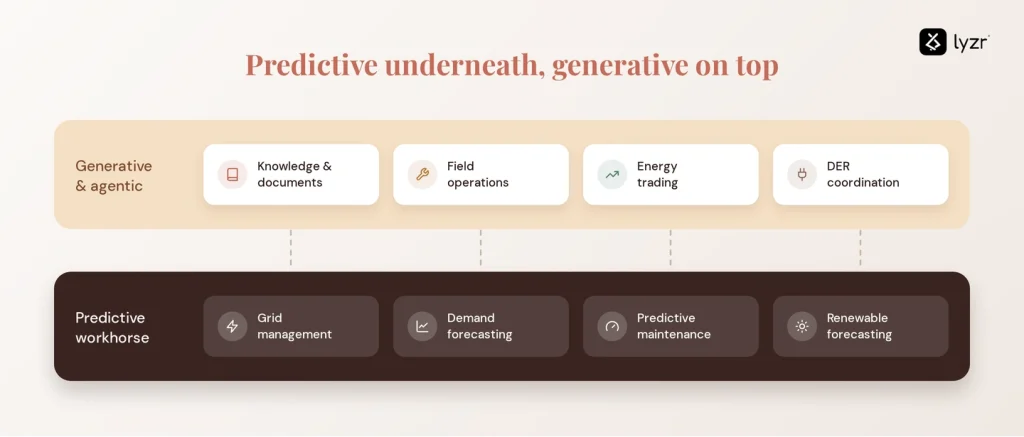
Grid management and optimization (predictive AI)
Grid management keeps voltage and frequency inside safe bounds, reacting to faults in seconds rather than minutes, the difference between a flicker and a multi-hour outage for a VP of grid operations. SCADA telemetry, PMU data and smart-meter reads feed anomaly-detection models trained on normal voltage and load patterns, flagging deviations and recommending switching or reconfiguration to an operator.
Energy demand forecasting (predictive AI)
Demand forecasting predicts electricity needs hour by hour, a CIO’s concern since a one-point forecast error means over-generation costs or emergency market purchases hitting the P&L directly. Historical load data, weather forecasts and calendar data train models from regression to LSTM, producing the hourly load curve used for generation scheduling and market bidding.
Predictive maintenance (predictive AI)
Predictive maintenance flags equipment likely to fail, shifting spend from reactive repairs to planned interventions, the basis of the documented cost case for predictive versus preventative maintenance, and extending the working life of aging transformers and turbines for an asset management lead without a blanket replacement program. Vibration, thermal, acoustic and oil-analysis data, layered on SCADA readings and failure history, train anomaly-detection models that catch deviation from a normal signature and auto-generate a work order.
Renewable energy forecasting (predictive AI)
Renewable forecasting predicts wind and solar output minutes to days ahead, letting a portfolio manager avoid under-delivery penalties and capture better prices when output is high, a trend Apricum Group has flagged as a growing AI investment area. Weather prediction data, satellite irradiance and turbine-level SCADA output feed ML models producing short-term and day-ahead generation curves for dispatch.
Distributed energy resource coordination (predictive plus agentic AI)
This aggregates thousands of small assets, rooftop solar, home batteries, EV chargers, into something that acts like one coordinated power plant, turning unpredictable behind-the-meter generation into a grid service utilities can count on. Inverter and charger telemetry, price signals and grid constraint data feed optimization algorithms that schedule charge, discharge or curtailment to shave a peak.
Energy trading and market analysis (predictive plus generative AI)
Trading desks run predictive models on price, weather and demand data, the same approach used in AI in financial forecasting, then layer generative summarization on top to turn those signals and news sentiment into a written scenario a trader can act on.
Knowledge and document management (generative AI)
This is natural-language access to regulatory filings, engineering manuals and incident reports that used to require manual search. bp announced it is expanding generative AI, via Copilot for Microsoft 365, across its global workforce, an early example of Copilot-style tools at enterprise scale. The mechanism is retrieval-augmented generation: an indexed document corpus is queried, and a language model generates a cited answer instead of a document dump.
Field operations and employee assistance (generative AI)
The same RAG approach, scoped to a technician’s specific asset or work order and delivered by mobile or voice, cuts repeat truck rolls and shortens how long a junior technician takes to troubleshoot independently.
AI in utilities
Utilities are structurally suited to AI: vast, sensor-rich networks, enormous data volumes from smart meters and grid sensors, and heavy regulatory oversight give AI models more to work with than most industries offer. The adoption gap isn’t model quality. According to IEA, 2026, “the lack of digital skills is the single largest barrier to greater AI adoption in the energy sector.” Procurement cycles tied to multi-year rate cases mean a pilot ready in six months can still take 18 to 24 months to reach production.
AI and the growing electricity demand from data centers
Data centers built for AI training and inference are now a measurable line item in national electricity forecasts. According to IEA, 2026, “data centers’ total electricity consumption could reach more than 1,000 terawatt-hours in 2026,” a figure the report compares to Japan’s entire electricity use. For a utility capacity planner, that demand concentrates in specific interconnection queues, often years long, forcing transmission buildout decisions on timelines utilities didn’t plan for a decade ago. Efficiency gains from smarter industrial controls and building management systems absorb some of that pressure, but only partially.
Can AI make the energy sector more efficient?
Yes, most strongly where AI shifts optimization from a single asset to the whole system. Volt/VAR optimization adjusts distribution-grid voltage to cut line losses. Predictive dispatch runs the lowest-cost generation source first each hour. Predictive maintenance cuts unplanned downtime and emergency-repair costs. As McKinsey, 2024 puts it, “the energy and materials sector is uniquely well-positioned to benefit from these advancements,” given how data-rich and optimization-heavy its operations already are.
How can AI help reduce energy emissions?
AI cuts emissions mainly by letting more renewable power onto the grid without destabilizing it. Better wind and solar forecasts reduce curtailment, discarding usable output because the grid can’t absorb it. Smarter battery dispatch stores cheap renewable power for peak hours, displacing fossil-fueled peakers. Demand-response programs shift consumption away from peak hours. The counterpoint: IEA, 2026 reports “the global electricity demand of data centres grew by 17% in 2025, while electricity consumption from AI-focused data centres surged 50%.” AI isn’t net-zero by default, its impact depends on what it displaces.
From generative AI to agentic AI in energy, and what this means going forward
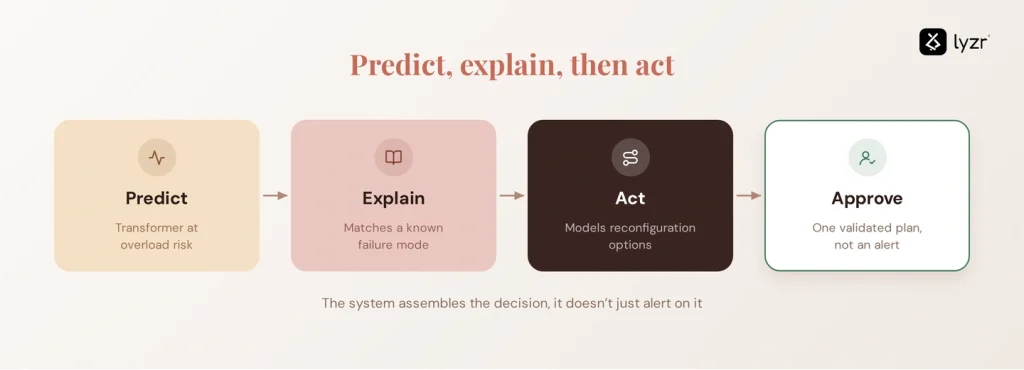
The progression follows a simple logic: predict what will happen, generate an explanation of why, then act on both. A predictive model flags a transformer at elevated overload risk during a heatwave. A generative layer pulls its maintenance history and confirms the risk matches a known failure mode. An agentic layer, inside defined permissions, models reconfiguration options, checks capacity on adjacent circuits, and presents one validated plan for operator approval, rather than just raising an alert.
That’s agentic automation in practice: a system that assembles the decision, not just alerts on it. It requires agent orchestration that coordinates multiple models without becoming an unauditable black box, the problem Lyzr was built to solve for regulated, operationally critical environments. Through Lyzr’s developer documentation, a utility’s own data team can stand up a scoped agent against existing SCADA or CMMS data using Lyzr Agent Studio, no multi-year platform buildout required.
Single-asset optimization gains are mostly captured. What’s left is coordinating a grid with millions of variable, distributed assets in near real time, a coordination problem before it’s a modeling problem.
Real-world AI deployments in energy
Duke Energy’s self-healing grid technology detects a fault and reroutes power before most customers notice an outage. In Wayne County, North Carolina, it prevented more than 12,600 outages in 2025, now covering “more than 75%” of customers there, over double 2022’s coverage.
Xcel Energy has deployed AI-driven wildfire detection cameras across its Western territories. The Pano AI network expanded into Wisconsin in 2026, following earlier rollouts in Minnesota, Colorado, Texas and New Mexico, giving continuous visual monitoring instead of relying solely on ground patrols.
In India, clean energy provider Amplus has joined forces with Microsoft to remotely monitor its renewable portfolio with AI, catching underperforming assets across a distributed fleet without a site visit.
What are the limitations of AI in energy, and what does it take to actually deploy it
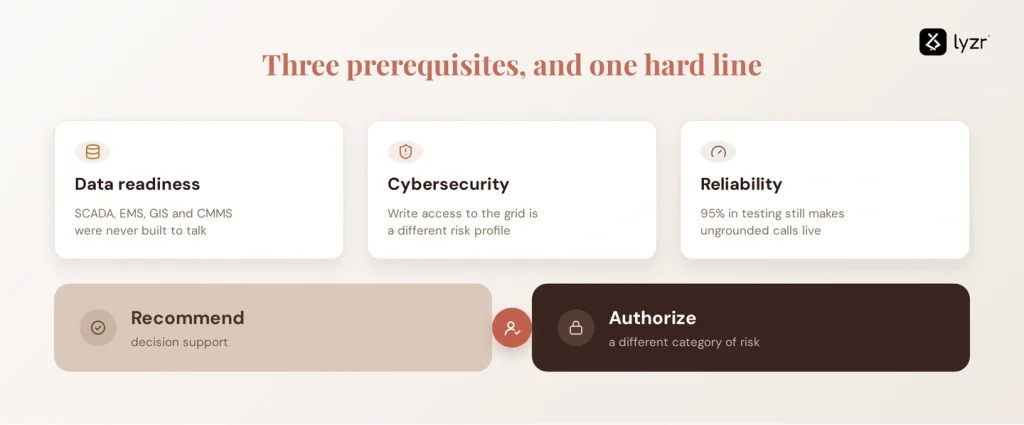
Data quality and legacy OT/IT integration. Most energy companies have data scattered across SCADA, EMS, GIS and CMMS systems that were never built to talk to each other. A real data readiness assessment, not a slide deck, has to precede any pilot: what fields exist, how clean they are, and what will connect them to a model.
Cybersecurity. Any system with write access to grid operations is a target, and an AI agent that can trigger an action carries a different risk profile than a dashboard that only displays information.
Model reliability and explainability. A model accurate 95% of the time in testing can still make confusing or ungrounded calls on live data.
Recommend versus authorize. This distinction determines deployment scope. A system recommending a switching action to an operator is decision support, one authorized to execute it is a different category of risk, and that sign-off typically sits with senior grid operations or risk leadership, not the team that built the integration.
AI safety, regulation and governance in energy
Governance starts from the recommend-versus-authorize line above and builds outward. Permissioning defines what data an agent can read and what actions, if any, it’s cleared to take without a human in the loop. Auditability leaves a traceable record for every recommendation or action, which matters for AI agents for compliance checks when a regulator like NERC or FERC investigates a reliability event. Model monitoring catches drift as grid conditions change. None of this replaces regulatory alignment with NERC or FERC rules, it makes that alignment demonstrable rather than assumed.
Ready to move a specific workflow from recommendation to coordinated action?
Explore how Lyzr can help build and orchestrate energy AI agents, see how a leading energy provider put this into production, or review deployment guides for building energy AI agents on AWS, Azure, Google Cloud, Oracle Cloud, IBM Cloud or NVIDIA.
You can also browse AI in energy management resources, check out a demo, or book time with the team here.
Frequently Asked Questions
Generative AI is mainly used to make unstructured operational knowledge searchable in plain language, covering technical manuals, regulatory filings, maintenance histories and incident reports. It’s also used to summarize market intelligence and to power employee-facing copilots for routine office tasks.
The core use cases are predictive maintenance on aging assets, demand and renewable forecasting for grid balancing, grid optimization to prevent and shorten outages, and generative AI tools that give field technicians and engineers instant access to documentation.
AI analyzes real-time SCADA and PMU data to detect instability, congestion or faults faster than manual monitoring allows, then recommends or, within defined permissions, automatically executes switching actions to restore stability.
Machine learning models trained on historical load data, weather forecasts and calendar effects produce hourly and day-ahead demand curves, which utilities use to schedule generation and bid into wholesale markets more precisely than manual forecasting allows.
AI improves wind and solar output forecasts using weather and satellite data, which lets grid operators integrate more variable renewable generation without destabilizing the system, and it optimizes battery storage to shift that renewable output to when it’s actually needed.
Beyond utilities, oil and gas companies use AI for subsurface interpretation and drilling optimization, trading desks use it for market analysis, and industrial energy users apply it to cut the energy intensity of manufacturing processes.
AI training and inference are genuinely energy-intensive, and data center electricity demand is rising quickly as a result. At the same time, AI applications across forecasting, grid optimization and demand response are widely expected to produce efficiency gains that offset a meaningful share of that new consumption, though the two effects aren’t guaranteed to net out evenly at every grid.
Book A Demo: Click Here
Join our Slack: Click Here
Link to our GitHub: Click Here