TL;DR
- Ten real LangChain alternative options exist, split into four groups: retrieval frameworks, multi-agent frameworks, stack-specific SDKs, and low-code builders.
- If retrieval is your problem, use LlamaIndex. For fast multi-agent prototypes, CrewAI. For low-level graph control inside the LangChain ecosystem, LangGraph.
- Nine of the ten options are frameworks. You still own deployment, observability, evaluation, and governance regardless of which one you pick.
- Lyzr is the tenth option, and it’s not a framework. It’s a platform for running agents (built on any framework) in production under governance.
- Full comparison table, two working code samples, and a decision framework are below.
You aren’t thinking of leaving LangChain because you got bored of it.
You’re leaving because the demo worked, the pilot mostly worked, and then production traffic found every seam in the abstraction at once. Now you’re staring at a search results page with ten different tools claiming to be the fix, and half of them are just LangChain with a different import statement.
This is a comparison of all ten, honestly. LlamaIndex, Haystack, CrewAI, AutoGen, Semantic Kernel, PydanticAI, Mastra, Flowise, Langflow, and LangGraph, LangChain’s own successor and the single most-searched comparison in this category. Then Lyzr, which answers a different question than the other nine, and by the end of this article you’ll know exactly which one that is and whether it’s yours.
Why teams leave LangChain
LangChain is the most widely adopted framework for building LLM applications, and it earned that position. Its integration library is enormous, its documentation ecosystem is mature, and a large number of production systems run on it successfully today. A page that treats it as simply bad isn’t giving you useful information. Here’s where it actually stops fitting.
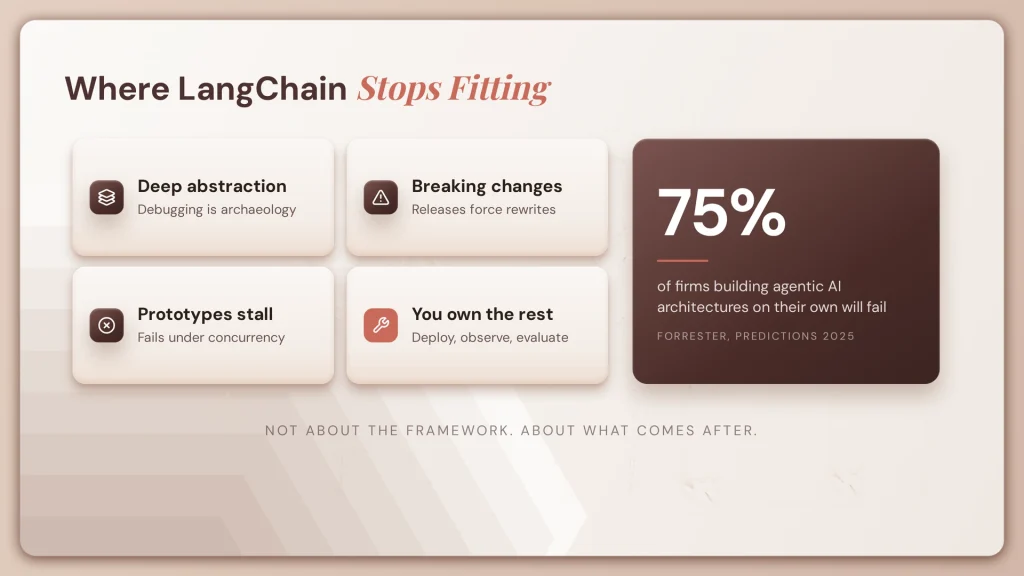
The abstraction runs deep. When a chain fails three layers into an agent’s execution, tracing the failure means reading framework internals, not your own code. Debugging becomes archaeology.
Versions break things. Breaking changes across releases have forced rewrites on teams that had nothing to do with their own code quality. This is the single most common complaint in the developer community around the framework.
Prototypes don’t survive contact with production. An agent that handles your ten test cases cleanly can fail unpredictably against real concurrency, malformed inputs, and edge cases nobody scripted for. Production RAG systems in particular fail silently more often than they fail loudly, and most real-world applications require more than just prompting a model, they need access to company data, third-party tools, memory, and logic that has to hold up under load, not just in a notebook.
You still own the hard part. Swap LangChain for a different framework and deployment, observability, evaluation, and governance are still yours to build.
According to Forrester’s Predictions 2025 report,
75% of firms that build aspirational agentic AI architectures on their own will fail.
That number isn’t about which framework they picked. It’s about what happens after the framework decision is made, and it’s the reason this article spends as much time on operations as it does on syntax.
That last point is the spine of everything that follows.
The 10 alternatives at a glance
Nine of these are frameworks or SDKs. One is a platform. The “governance built in” column is the line that separates them, and it’s a difference in category, not a quality judgment.

LangChain alternatives comparison table
| Tool | Best for | Type | Language | Open source | Self-host | Governance built in |
|---|---|---|---|---|---|---|
| LangGraph | Low-level graph control | Framework | Python, JS | Yes | Yes | No |
| LlamaIndex | Data ingestion and retrieval | Framework | Python, TS | Yes | Yes | No |
| Haystack | Production search and RAG pipelines | Framework | Python | Yes | Yes | No |
| CrewAI | Role-based multi-agent prototyping | Framework | Python | Yes | Yes | No |
| AutoGen | Conversational multi-agent research | Framework | Python | Yes | Yes | No |
| Semantic Kernel | Microsoft and .NET stacks | SDK | C#, Python, Java | Yes | Yes | Partial |
| PydanticAI | Type-safe agent logic | Framework | Python | Yes | Yes | No |
| Mastra | TypeScript and web stacks | Framework | TypeScript | Yes | Yes | No |
| Flowise / Langflow | Visual, low-code building | Visual builder | n/a | Yes | Yes | Limited |
| Lyzr | Enterprise production and governance | Platform | Python, API | SDKs open | Yes | Yes |
Frameworks built for data and retrieval
LlamaIndex is the strongest option here for document parsing, indexing strategy, and retrieval quality. This is the honest answer to the LlamaIndex vs LangChain question: if retrieval is your core problem, LlamaIndex generally wins it. Its limitation is scope. It’s a retrieval library, not an agent runtime, so teams often pair it with something else for orchestration. Traditional RAG follows a linear retrieval path, one lookup, one answer. Agentic reasoning replaces that with an observe-plan-act loop that adapts to what it finds instead of stopping at the first retrieval.
Haystack, from deepset, takes a pipeline-first approach to production search and RAG. It’s the right pick when search is the actual product, not a feature bolted onto a chatbot. It carries more setup overhead than LlamaIndex for simple use cases, which is the trade for its production-oriented architecture.
Frameworks for multi-agent systems
CrewAI is the fastest route from idea to a working multi-agent prototype. Its role-based abstraction, agents with jobs, working in a crew, maps naturally to how people already describe teams. The cost of that speed is control. The same abstraction that makes CrewAI fast makes deterministic, repeatable behavior harder to guarantee.
AutoGen, from Microsoft Research, is built for conversational multi-agent systems where agents (and sometimes humans) talk through a problem. It’s strong in research and simulation contexts. Managing open-ended conversation loops reliably in production is its known operational difficulty.
LangGraph deserves the most care of the nine, because LangChain vs LangGraph is the highest-volume search in this entire cluster. LangGraph is LangChain’s own answer to orchestration: agentic workflows defined as explicit state graphs, with real control over branching, cycles, and state. If you want that level of control and you’re staying in the LangChain ecosystem, it’s the correct move. The trade is that you’re now the one designing the graph, and graph design becomes a discipline of its own that your team now owns.
Stack-specific and type-safe options
Semantic Kernel, Microsoft’s SDK, is the natural pick for teams already committed to C# and .NET, with secondary support for Python and Java.
PydanticAI gives Python teams type safety and clean debugging without LangChain’s abstraction depth. It’s deliberately minimal, which makes it a genuine lightweight LangChain alternative for teams that want structure without the weight.
Mastra exists because a Python-first framework is a non-starter for teams building on Node.js or Next.js. It’s the most established TypeScript-native option for agents and workflows in that stack.
Mature native frameworks are thinner in Rust, Go, Java, and PHP. The common pattern in those stacks isn’t adopting a Python library, it’s calling an agent platform over a standard HTTP API and letting the platform own the runtime instead.
Low-code and visual builders
Flowise and Langflow are open-source, drag-and-drop canvases for building LLM applications without writing chain code. Both are strong for demos and for teams with mixed technical depth. Both share the same limitation: a visual canvas makes simple things fast and complex things awkward, and versioning a canvas is harder than versioning a git repository.
The framework versus platform question
Nine of the ten options above are frameworks. Swap LangChain for any of them and you’ve changed your abstraction. You haven’t changed what you own.
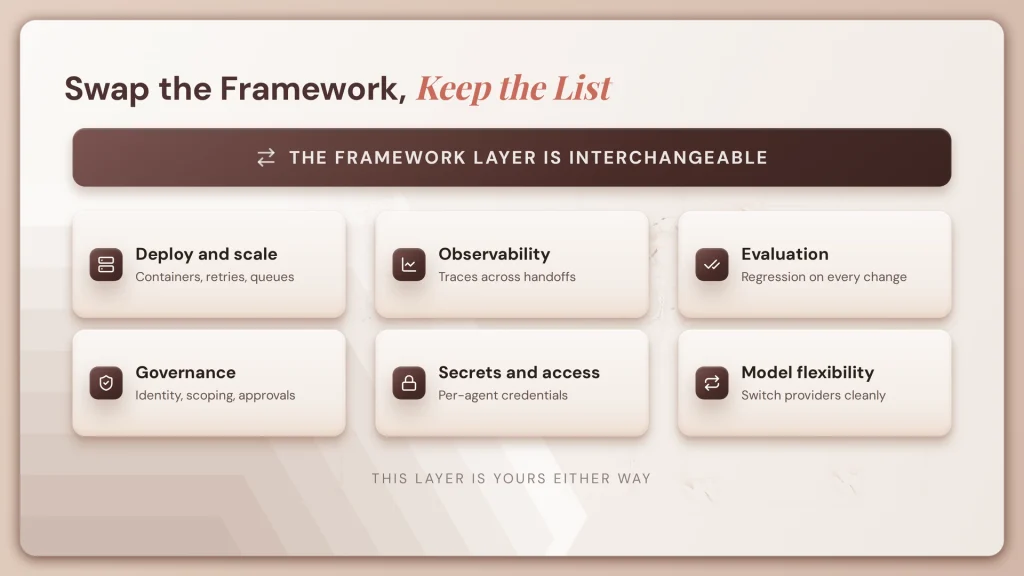
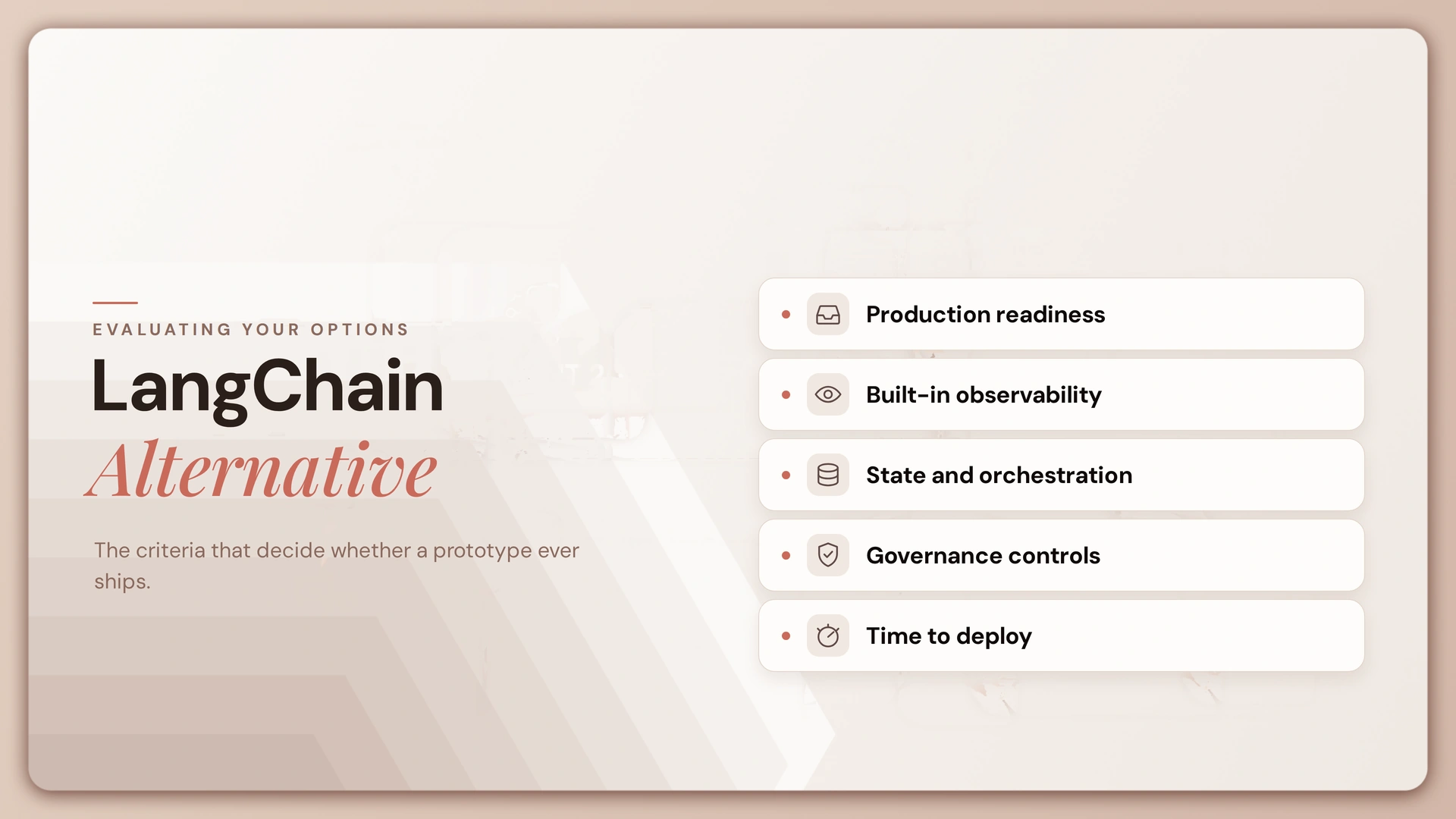
Here’s what stays on your plate no matter which framework wins:
- Deployment and scaling. Containers, autoscaling, rate limits, retries, request queuing.
- Observability. Tracing a request across multiple agent handoffs, attributing latency, diagnosing why a specific run failed.
- Evaluation. A fixed test set and regression checks every time a prompt, model, or tool changes, the kind of discipline covered in a proper enterprise agent evaluation process.
- Governance. Agent identity, permission scoping, decision traces, human approval gates on high-stakes actions.
- Secrets and access. Per-agent credential scoping instead of one shared API key everyone touches.
- Model flexibility. Switching providers without rewriting the application around a new SDK.
You can build all of this yourself around any framework. Plenty of teams do. It’s also genuinely several engineer-months of work with an ongoing maintenance tax attached, and it’s a large part of why 62% of enterprises report no clear starting point for scaling AI past a pilot. A platform provides this layer already built, in exchange for some architectural constraint. That trade lines up with a broader shift Sequoia Capital has described as Service-as-Software: buying an outcome instead of assembling the tool that produces it. The buy-versus-build calculus here is close to what we’ve laid out for agent platforms more broadly, and the difficulty of getting orchestration right on your own is one reason so many teams underestimate the enterprise AI agent challenges that show up after the pilot, not before it.
Here’s the honest boundary. If you’re building a prototype, a side project, or a system where you want full low-level control and you have the engineering capacity to own the operational layer yourself, pick a framework. LangGraph or PydanticAI are good choices. Lyzr is the wrong tool for that job, and there’s no reason to pretend otherwise.
If the goal is agents running in production under governance, the calculation changes.
Lyzr as the production alternative
Lyzr AI isn’t a framework competing with LlamaIndex on retrieval or with Mastra on TypeScript ergonomics. It’s built for the enterprise AI environment where the framework decision was never the hard part.
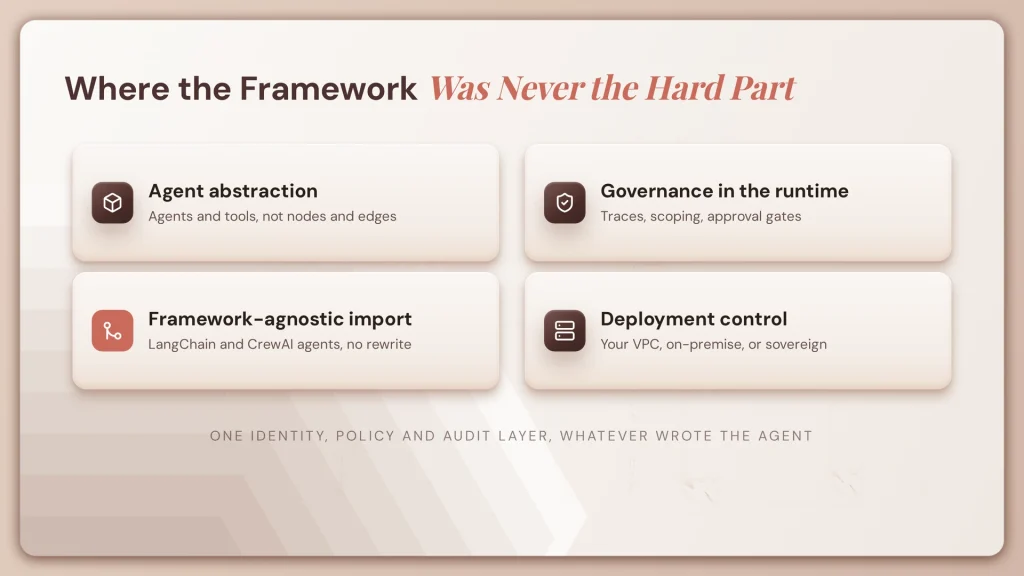
Agent abstraction over graph construction. Instead of wiring nodes and edges, you work with agents, tools, and inference calls as primitives. The Lyzr Agent Studio exposes a library of pre-built tools you attach directly, including things like Perplexity Search for real-time lookups, without writing the integration yourself. Beyond the built-in library, agents can also reach dynamic Tools and APIs, external systems the framework doesn’t need to know about in advance.
Governance in the runtime, not bolted on. Decision traces, permission scoping, human approval gates, and audit trails ship as platform features through the Control Plane, backed by Responsible AI guardrails and a Hallucination Manager. A static chatbot might reply, “Here is a summary of the indemnity clause.” A genuine Lyzr agentic response is distinct. It follows the reasoning path, not just the output, and the trace shows exactly how it got there.
Framework-agnostic import. This is the strongest point on this page for a developer reading it. Agents already built on LangChain or CrewAI don’t need a rewrite to get governed. Lyzr is designed as a framework-agnostic platform, so the Control Plane can register and manage agents built on any stack, LangChain, CrewAI, AWS, Azure, or custom code, from one registry, applying the same identity, policy, and audit layer regardless of what wrote the agent. See the direct Lyzr vs LangChain comparison for a feature-by-feature breakdown.
Deployment control. Your own VPC, on-premise, or a fully sovereign deployment, with any model provider, avoiding the lock-in that comes from betting an entire application on one vendor’s SDK.
Here’s the same task, built two ways. Both examples use current public API surfaces as of early 2026; verify against the latest release notes before shipping.
LangChain, written the way a competent developer actually writes it (tested against langchain==0.3.x):
from langchain_openai import ChatOpenAI
from langchain.agents import tool, AgentExecutor
from langchain.agents.format_scratchpad.openai_tools import format_to_openai_tool_messages
from langchain.agents.output_parsers.openai_tools import OpenAIToolsAgentOutputParser
from langchain_core.prompts import ChatPromptTemplate, MessagesPlaceholder

@tool
def search(query: str) -> str:
    """Looks up information on the web."""
    from duckduckgo_search import DDGS
    return DDGS().text(query, max_results=2)

llm = ChatOpenAI(model="gpt-4o-mini", temperature=0)
tools = [search]
llm_with_tools = llm.bind_tools(tools)

prompt = ChatPromptTemplate.from_messages([
    ("system", "You are a helpful research assistant."),
    ("user", "{input}"),
    MessagesPlaceholder(variable_name="agent_scratchpad"),
])

agent = (
    {
        "input": lambda x: x["input"],
        "agent_scratchpad": lambda x: format_to_openai_tool_messages(x["intermediate_steps"]),
    }
    | prompt | llm_with_tools | OpenAIToolsAgentOutputParser()
)

agent_executor = AgentExecutor(agent=agent, tools=tools, verbose=True)
result = agent_executor.invoke({"input": "What is the capital of France?"})
print(result["output"])
Lyzr, same task, using the public lyzr-python-sdk:
import os
from lyzr_python_sdk import LyzrAgentAPI

client = LyzrAgentAPI(api_key=os.environ["LYZR_AGENT_API_KEY"])

agent = client.agents.create_agent({
    "template_type": "single_task",
    "name": "Research Assistant",
    "agent_role": "Research Assistant",
    "agent_instructions": "You are a helpful research assistant.",
    "agent_goal": "Answer factual questions accurately.",
    "provider_id": "OpenAI",
    "model": "gpt-4o-mini",
    "llm_credential_id": "lyzr_openai",
})

response = client.inference.chat({
    "user_id": "dev@example.com",
    "agent_id": agent["agent_id"],
    "message": "What is the capital of France?",
    "session_id": "session-001",
})
print(response["response"])
The Lyzr version is shorter because tool orchestration, scratchpad formatting, and output parsing are handled server-side. The governance, tracing, and audit log that come with that same agent are not visible in either snippet, and that’s the actual point. In LangChain, you add that layer yourself. In Lyzr, it’s already running the moment the agent is created.
Proof, not projection
HFS Research, a global analyst firm, used Lyzr to turn static research archives into an interactive consultant, generating their data-intensive “HFS Pulse” dashboards in minutes instead of days of manual analyst work.
A leading HR technology company deployed a Lyzr-built AI hiring assistant to handle candidate outreach, screening, and scheduling, producing a 50% time saving for recruiters on their hiring workflow.
How to choose
- Retrieval is your core problem. LlamaIndex, or Haystack if search itself is the product.
- You want low-level orchestration control and you’re staying in the LangChain ecosystem. LangGraph.
- You need a multi-agent prototype fast. CrewAI.
- Your stack isn’t Python. Mastra for TypeScript, Semantic Kernel for .NET, or call a platform’s API directly.
- You need agents running in production with an audit trail and deployment control. Lyzr.
If you’re a developer, the fastest way to test any of this is to pull up Lyzr’s documentation and try Agent Studio directly. If you’re the person accountable for what happens after the pilot, book your first private AI agent build today and see what production actually looks like on a governed platform.
Frequently asked questions
What is better than LangChain?
It depends on the problem you’re solving. LlamaIndex for retrieval, CrewAI for multi-agent prototyping, LangGraph for orchestration control, and a governed platform like Lyzr when production and compliance are the actual constraint.
Is LlamaIndex better than LangChain?
For document ingestion, indexing, and retrieval specifically, yes, generally. LangChain has broader scope across tools and agent types. Many production systems use both together.
Will LangGraph replace LangChain?
No. LangGraph is the orchestration layer within the same ecosystem, not a replacement for it. LangChain components are commonly used inside LangGraph applications.
When should I use LangChain vs LangGraph?
LangChain for simpler linear chains and integration breadth. LangGraph when you need explicit state, branching, cycles, and deterministic control over execution.
What are the key differences between LangGraph, LangChain, and RAG?
LangChain and LangGraph are frameworks for building applications. RAG is a technique for grounding model output in retrieved data, and it fails quietly more often than people expect when retrieval quality isn’t monitored. You implement RAG using either framework.
What are the differences between LangChain and DSPy?
LangChain composes pre-defined components you configure manually. DSPy optimizes prompts and pipelines programmatically against a metric, a fundamentally different design philosophy.
Is there a lightweight LangChain alternative?
PydanticAI is deliberately minimal. Many teams also skip frameworks entirely for simple use cases and call a model API directly through a thin wrapper.
Is LlamaIndex free to use?
The open-source library is free under Apache 2.0. LlamaCloud, its hosted parsing and ingestion service, is commercial.
What is the best free LangChain alternative?
LlamaIndex, CrewAI, Haystack, AutoGen, PydanticAI, Flowise, and Langflow are all open source. Model inference is billed separately regardless of which framework you pick.
Is there a LangChain alternative for TypeScript?
Mastra is the most established TypeScript-native option. LangChain and LlamaIndex both ship JS/TS versions as well.
Can I use my existing LangChain agents inside Lyzr?
Yes. Lyzr’s Control Plane is built to register and govern agents written on LangChain, CrewAI, or custom code without requiring a rewrite.
You’ve now got the full field: what each of the ten actually does well, what it quietly leaves on your plate, and where the line between a framework and a platform actually sits. The question worth sitting with isn’t which library has the cleanest syntax. It’s who owns the on-call rotation when the agent you shipped starts handling real traffic at 2 a.m.
Book A Demo: Click Here
Join our Slack: Click Here
Link to our GitHub: Click Here