TL;DR: Agentic AI in HR means systems that break a goal into tasks and act across your HR stack, not chatbots that just answer prompts. The four use case areas that matter most are employee support, talent acquisition, onboarding, and workforce insights. Employee support is the lowest-risk, highest-volume place to start. Hiring and performance carry regulatory obligations that employee support doesn’t, which is why HR is arguably the most regulated place in the business to deploy an autonomous agent.
A résumé screener that quietly reproduces years of hiring bias doesn’t announce itself.
Neither does an onboarding process that loses a new hire’s laptop request in a ticket queue for two weeks.
Both are HR problems that automation was supposed to solve and mostly didn’t, because automation follows the path you designed. HR spends most of its time on the paths nobody designed for.
This is where the conversation about agentic AI in HR gets interesting, and where most of what’s published about it stops short. This piece covers where agentic AI genuinely fits across the employee lifecycle, with real examples, and the part almost nobody selling HR software wants to lead with: what the law requires before you point an autonomous agent at a hiring or termination decision.
What are the 3 properties of agentic AI in HR?
Agentic AI in HR is a system that reasons through a goal, plans the steps to reach it, and executes across your HR tools with minimal supervision, rather than waiting for a single prompt and returning a single answer.
Unlike traditional systems that just follow rules, an agent set to “onboard the new hire starting Monday” checks the HRIS for role and location, provisions the right system access, schedules orientation, and flags anything that doesn’t fit the standard template for a human to review.
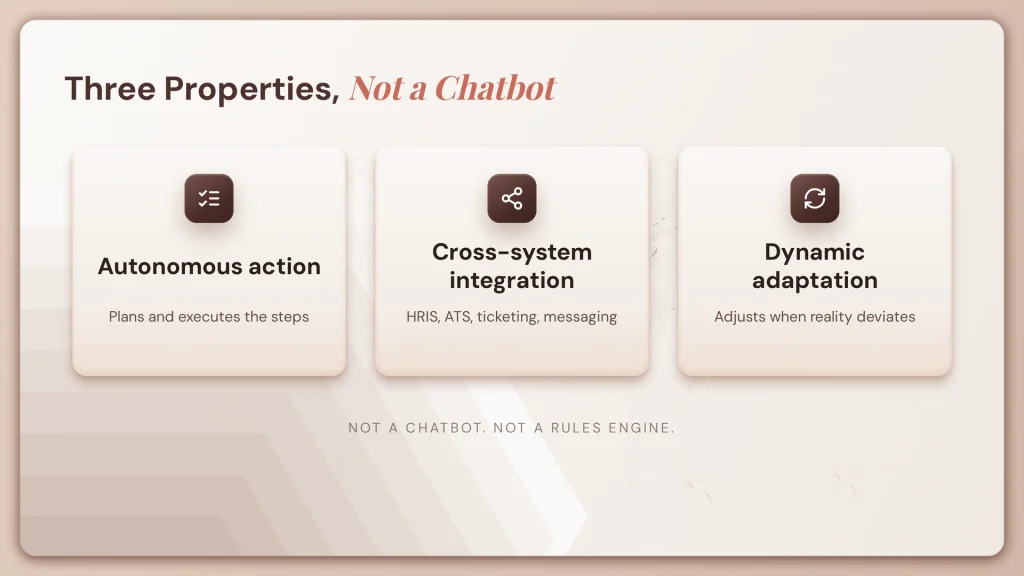
Three properties separate this from a chatbot or a rules engine:
- Autonomous action. The agent breaks a stated goal into a task sequence and executes it, rather than sitting idle until the next prompt arrives.
- Cross-system integration. It connects to the systems HR actually runs on, the HRIS, the applicant tracking system, the ticketing platform, the messaging tool, and completes a process end to end across all of them instead of handling one step in isolation.
- Dynamic adaptation. It adjusts based on what it finds in real time (an incomplete I-9, a scheduling conflict, an ambiguous policy question) instead of failing silently the moment reality deviates from the script.
None of this is one technology. It’s a composite: the execution speed of robotic process automation (RPA), the conversational fluency of natural language processing (NLP), the pattern-learning of machine learning (ML), the reasoning of large language models (LLMs), the forecasting of predictive AI, and the drafting ability of generative AI.
An AI agent is what you get when those capabilities are wired together around a specific job to be done, coordinated through agent orchestration rather than stitched together by hand.
Why HR needs more than automation
Automation handles the process you already mapped out. It does not handle the volume of HR work that never fits a flowchart in the first place, and that gap is where most HR teams are still stuck.
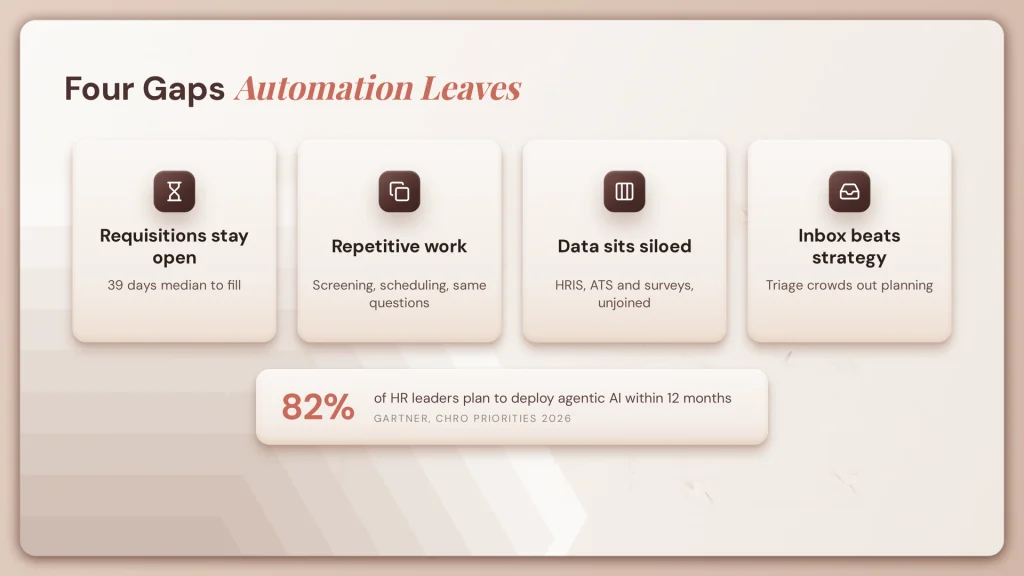
Four pain points show up in nearly every HR org, regardless of size.
Time-to-fill keeps stretching. According to SHRM’s 2026 Recruiting Executives Benchmarking report, the median time to fill dropped to 39 days for non-executive roles, down from 44 days in 2025, and sits at 45 days for executive roles, and that clock still keeps most requisitions open longer than the business planned for.
Recruiters and HRBPs lose time to repetitive work. Screening resumes, chasing interview availability, and answering the same handful of policy questions on repeat is where a meaningful share of a recruiter’s week disappears.
Decisions get made without the data that already exists. The information is sitting in the HRIS, the ATS, and last quarter’s engagement survey, but it’s siloed, and synthesizing it manually takes longer than most decisions can wait for.
Strategic work keeps losing to the inbox. Every hour spent on administrative triage is an hour not spent on retention strategy, workforce planning, or the culture work that actually shows up in HR trends for 2026.
Gartner’s CHRO Priorities 2026 research finds that 82% of HR leaders plan to deploy agentic AI within the next 12 months, which tells you HR leaders have already concluded that point solutions and static workflows aren’t closing this gap on their own. Automation handles the ticket you already anticipated. Agentic systems handle the ticket you didn’t, and in HR, that’s most of the volume, because employee questions and candidate situations rarely arrive in standard form. That’s the actual argument for moving beyond basic automation, not efficiency for its own sake.
Agentic AI use cases across the HR lifecycle
Four areas cover where agentic AI genuinely applies in HR right now: employee support, talent acquisition, onboarding, and workforce insights. They map onto the employee lifecycle in a specific order, and that order isn’t arbitrary. It’s a risk gradient, and it’s worth understanding before you pick a starting point.

Employee support and policy questions
This is where most deployments should start. An agent turns the employee handbook, benefits documentation, and internal policy library into something an employee can actually query, in plain language, at 11pm on a Sunday if that’s when the question comes up.
It handles leave balance checks, benefits eligibility, payroll questions, policy interpretation, and IT or facilities requests, and it escalates to a human the moment a question turns ambiguous or sensitive.
The reason this is the sensible entry point isn’t caution for its own sake. It’s the highest-volume category of HR work, it carries no meaningful regulatory exposure because it doesn’t make employment decisions, its impact shows up immediately in ticket deflection numbers, and it forces you to build the grounded knowledge base that every later use case depends on.
An agent that hallucinates a PTO policy is a worse outcome than no agent at all, which is why grounding matters here more than almost anywhere else. Lyzr’s Hallucination Manager exists specifically to keep answers tied to your actual source documents rather than a plausible-sounding guess. A dedicated employee support assistant agent is the fastest way to put this into production without building it from scratch.
Talent acquisition
Sourcing, résumé screening against defined role requirements, interview scheduling and rescheduling, candidate communication, and interview summarization all sit here. A candidate applies, the agent checks the résumé against the role’s actual requirements, coordinates calendars across three interviewers and a hiring manager, and sends the candidate a status update without a recruiter touching any of it manually.
Here’s the caveat that most vendor content skips entirely: screening and ranking candidates is an automated employment decision in a growing number of jurisdictions, and it carries audit and notice obligations that don’t apply to a handbook chatbot. That’s covered in full in the compliance section below, but it’s the reason talent acquisition isn’t where a new deployment should start.
Purpose-built blueprints for an AI hiring assistant, a resume screening agent, and an interview scheduler agent exist for teams ready to take this on with the right guardrails in place.
Onboarding
Onboarding is unusually well suited to agentic AI because it’s high-volume, spans multiple systems, and is almost entirely procedural. It doesn’t require judgment about a specific person’s fitness for a role. It requires precise, repeatable execution.
An onboarding agent provisions accounts and system access on the right schedule, sends orientation materials without a human remembering to trigger them, tracks document completion (I-9s, tax forms, policy acknowledgments), answers first-week questions, and checks in across the first ninety days to catch early signals before week twelve does. A dedicated employee onboarding agent handles this end to end.
Performance, engagement, and workforce insights
This category covers performance reviews and satisfaction surveys, then extends further: analyzing open-text feedback at scale, surfacing themes across hundreds of survey responses, and flagging attrition risk signals before they show up in a resignation letter.
Survey distribution itself has gotten easier with automated triggers, including QR codes or embedded links in emails and internal tools that collect responses without manual follow-up, and platforms like Uniqode’s round QR code generator or Adobe’s QR code tool make that distribution step simple. Traditional employee satisfaction surveys have historically suffered from low response rates and stale results by the time anyone reads them, and an agent that analyzes responses as they arrive changes that timeline substantially.
The boundary worth stating explicitly: analyzing engagement data and surfacing patterns is a reporting function. Using those patterns to make a decision about a specific individual, a promotion, a performance rating, a termination, is a different function with different obligations, and the next section explains why that distinction has legal teeth.
Blueprints exist for an AI performance review agent, an ESAT survey agent, and an AI L&D agent for teams building out this layer.
What compliance requires before you deploy
HR is the most regulated function in the enterprise to hand to an autonomous agent, because employment decisions carry specific statutory obligations that a marketing agent or a support ticket bot never encounters. This isn’t a reason to avoid agentic AI in HR. It’s the reason sequencing and documentation matter more here than almost anywhere else in the business.
Bias auditing for automated employment decision tools. Under New York City’s Local Law 144, one of the most prescriptive laws of its kind, covered employers must commission an independent annual bias audit of the tool, publicly post a summary of the audit results, and provide at least 10 business days’ notice to candidates before the tool is used in their evaluation. Treat the audit as a precondition to deployment, not a step you circle back to later.
High-risk classification under the EU AI Act. The EU AI Act classifies AI systems used in employment-related decisions as high-risk, covering tools used for recruitment, candidate selection, performance evaluation, task allocation, monitoring of workers, and decisions on promotion or termination. Many HR AI tools fall into this high-risk category, which triggers mandatory human oversight and transparency requirements toward employees and their representatives, with the core high-risk obligations for employment systems slated to take full effect around August 2026, though EU policymakers have been negotiating a possible phased delay for parts of the timeline.
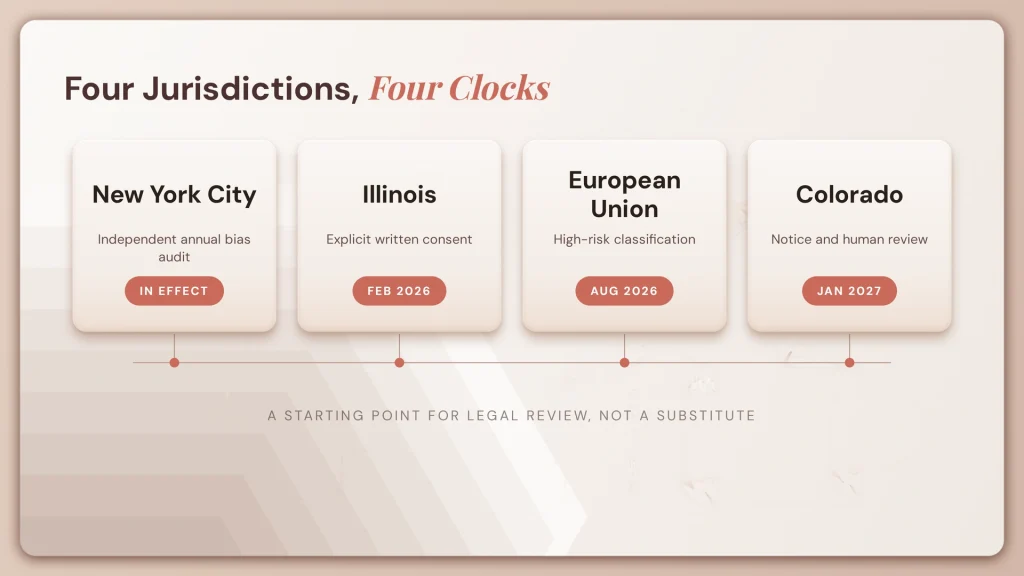
Disclosure and consent for AI-analyzed interviews. Illinois became the first U.S. state to enforce AI transparency requirements in hiring, with its Artificial Intelligence Video Interview Act taking full effect in February 2026. A 2026 amendment tightened the standard further: the amendment replaced implicit consent with explicit written consent, meaning candidates must affirmatively agree to AI analysis rather than having consent inferred from simply continuing the interview. The direction across jurisdictions is consistent even where specifics vary: candidates are increasingly entitled to know when a system, not a person, is doing the evaluating.
State AI law is moving, not settled. Colorado is the clearest example of how fast this ground shifts. Its original AI Act was once billed as the first comprehensive state law regulating employment AI, built around a “reasonable care” duty to prevent algorithmic discrimination. That original framework has since been substantially rewritten, eliminating the duty of care aimed at preventing algorithmic discrimination along with the earlier risk management program and impact assessment obligations. The revised law instead applies to automated decision-making that materially influences major employment decisions and requires clear notice to individuals, a structured human-review process for adverse decisions, and multi-year record retention, with the new effective date pushed to January 1, 2027. Treat any specific compliance date as a starting point for legal review, not a substitute for it, because this is exactly the kind of requirement that gets amended mid-cycle.
Disparate impact regardless of intent. Anti-discrimination law in most jurisdictions does not require proof of intent. An agent trained on historical hiring data can reproduce historical patterns of exclusion, and it can do so through proxy variables (a zip code, a graduation year, a gap in employment) without ever touching a protected characteristic directly. That’s a testing and monitoring problem, not a one-time check before launch.
Human accountability at the decision point. The organization deploying the agent carries the accountability, not the vendor and not the underlying model provider. Screening, ranking, and recommending can be automated. The decision to reject a candidate, promote an employee, or end an employment relationship should have a named human accountable for it. This is not legal advice, and requirements shift by jurisdiction, but the pattern above points the same direction: more transparency, more testing, more documentation, less room to treat the agent’s output as the final word.
Lyzr’s Responsible AI layer, Control Plane, and broader work on AI agent governance and European enterprise AI governance exist for exactly this layer of the problem. This is also the practical case for sequencing adoption the way the next section describes.
How HR leaders should sequence adoption
Get the order right and the regulatory exposure above stays manageable. Get it backwards, deploying a résumé screener before legal has weighed in, and you’re explaining an unaudited screening tool to a regulator instead of showing a ticket deflection chart to your CFO.
- Align internally first. Bring in IT, legal, compliance, and the HRBPs who’ll actually live with the tool day to day, not just the CHRO’s office. Ask what data the agent needs, who owns the escalation path, and specifically whether a bias audit is required before this use case goes live in any covered jurisdiction.
- Audit the existing HR tech stack. Most enterprises already have five to ten HR tools with overlapping functions and no shared data layer. Map what exists before adding an agent on top of it, or you’ll automate the redundancy instead of removing it.
- Start with employee support, not hiring. It’s the highest-volume, lowest-risk deployment, it’s measurable in ticket deflection within weeks, and it builds the grounded knowledge base that hiring and performance use cases will eventually need anyway.
- Move to onboarding next. It’s procedural, spans multiple systems, and doesn’t require making a judgment call about a specific person.
- Approach hiring and performance last, with the audit infrastructure already in place. These carry the regulatory weight described above, and they deserve to be the most deliberate deployment, not the first one.
Lyzr’s guide to taking agents to production and the AI-powered performance enablement playbook both walk through this in more operational detail.
Deploying HR agents with Lyzr
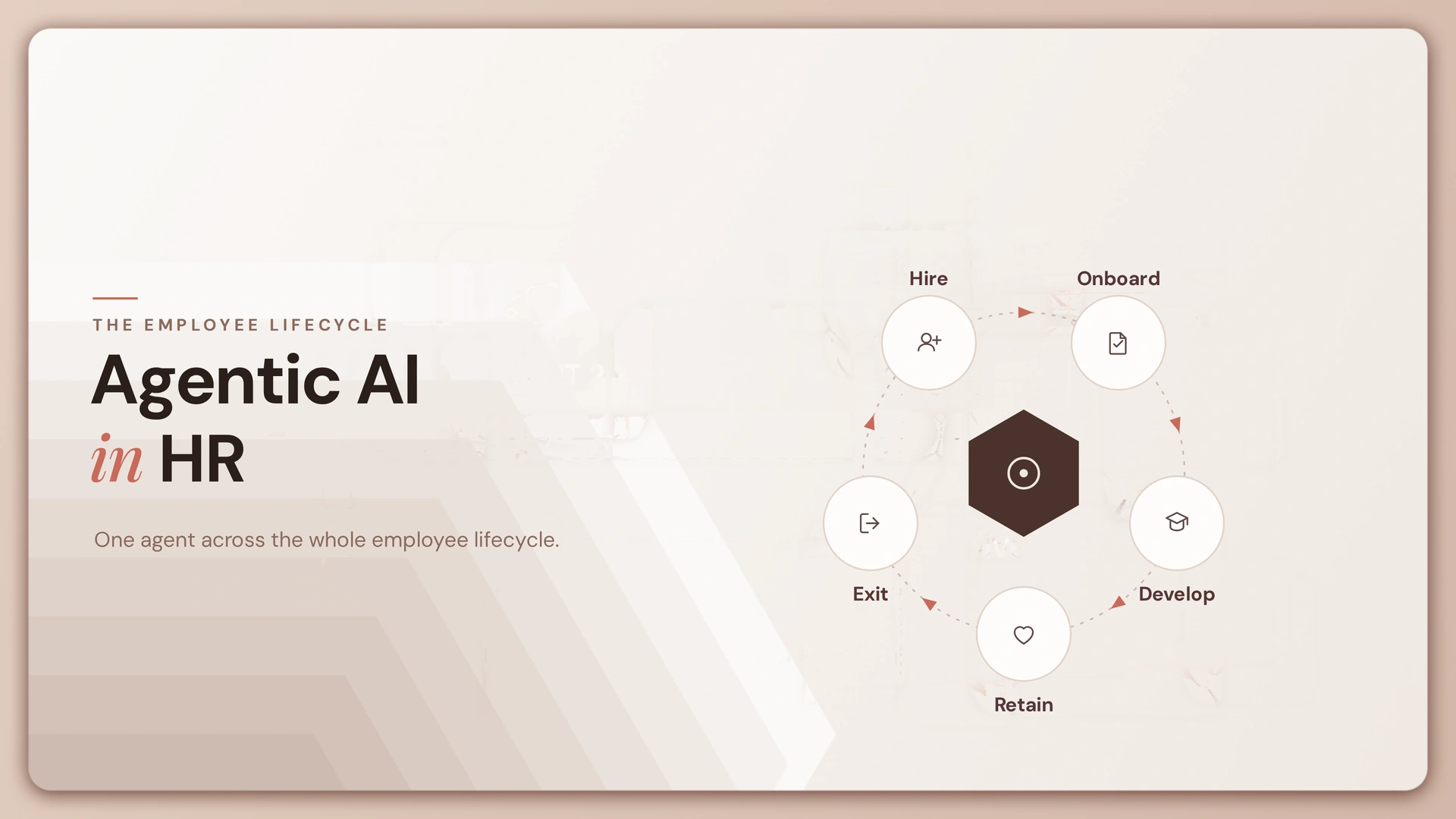
Diane is Lyzr’s HR agent, built to run across this entire lifecycle rather than bolt onto one piece of it. Where an HRIS is a system of record, Diane operates as a system of action: she reads the people data already sitting in your stack, runs hiring workflows in parallel instead of in sequence, and surfaces onboarding problems in week two instead of week twelve.
The strongest example of this in practice is hiring. A Lyzr-built AI hiring assistant workflow checks incoming résumés against role requirements, coordinates interview scheduling across calendars without a recruiter chasing availability, and drafts a summary for the hiring manager after each round, cutting the manual coordination load substantially without removing the human decision at the point that matters. The same underlying approach extends to onboarding provisioning and performance review preparation, each available as its own blueprint rather than a single monolithic tool.
Teams building out a broader agent program can start from the 101 AI use cases template or prototype directly in Lyzr Studio.
For a walkthrough of what a deployment looks like for your specific HR stack, book a demo.
Frequently asked questions
What is agentic AI in HR?
Agentic AI in HR refers to autonomous systems that reason, plan, and execute multi-step HR workflows across tools like the HRIS and ATS, with minimal human supervision, rather than simply answering a question when asked.
How can HR use AI agents?
For employee policy and benefits questions, résumé screening and interview scheduling, onboarding provisioning and check-ins, and analyzing engagement feedback at scale to surface patterns before they become attrition.
What are examples of agentic AI in HR?
An agent that answers handbook questions from your actual policy documents, schedules interviews across multiple calendars, provisions new-hire system access automatically, or summarizes open-text survey responses into themes a manager can act on.
How is AI used in HR?
Across the full lifecycle: sourcing and screening in recruitment, provisioning and scheduling in onboarding, self-service in employee support, and pattern analysis in engagement and retention work.
Which AI tools are used in HR?
HRIS platforms with embedded AI, applicant tracking systems, employee service desks, and dedicated AI tools for HR that connect across all of them through agent orchestration rather than sitting as isolated point solutions.
Is HR being replaced by AI?
No. Agents absorb transactional volume and information retrieval. Judgment calls, difficult conversations, culture work, and accountability for employment decisions stay with a human.
Is HR at risk with AI?
The transactional layer of HR work is changing substantially. The advisory, judgment, and relationship layers of the job grow in importance as the administrative load that used to crowd them out falls away.
What is the difference between agentic AI and an HR chatbot?
A chatbot answers a question and stops. An agent completes the task behind the question: checking a leave balance, filing the request, blocking the calendar, and confirming the outcome, all from one interaction.
Is agentic AI in HR regulated?
Yes, wherever it touches an employment decision. Bias audit requirements, disclosure obligations, and high-risk AI classifications apply in a growing number of jurisdictions, and the specifics vary by location and change frequently.
What are the four core HRM systems?
Commonly defined as recruitment and selection, performance management, learning and development, and compensation and benefits. Agentic AI applies across all four, though the regulatory weight isn’t distributed evenly among them.
Where this leaves you
The honest starting point for agentic AI in HR isn’t the use case with the biggest headline number. It’s the one that builds your knowledge base without putting an unaudited tool anywhere near a hiring decision.
Most of what gets published on this topic treats compliance as a footnote to capability. Flip that order and the deployment sequence writes itself: employee support first, onboarding next, hiring and performance last, with the audit trail already built before an agent touches either.
The question worth sitting with isn’t whether agentic AI belongs in your HR function. It’s which of the four use case areas your current tech stack and governance posture can actually support today, and which ones you’re not ready to automate yet no matter how much time they’d save.
If you want a clearer answer for your specific stack, that’s what a working session with Lyzr’s HR deployment team is for.
Book A Demo: Click Here
Join our Slack: Click Here
Link to our GitHub: Click Here