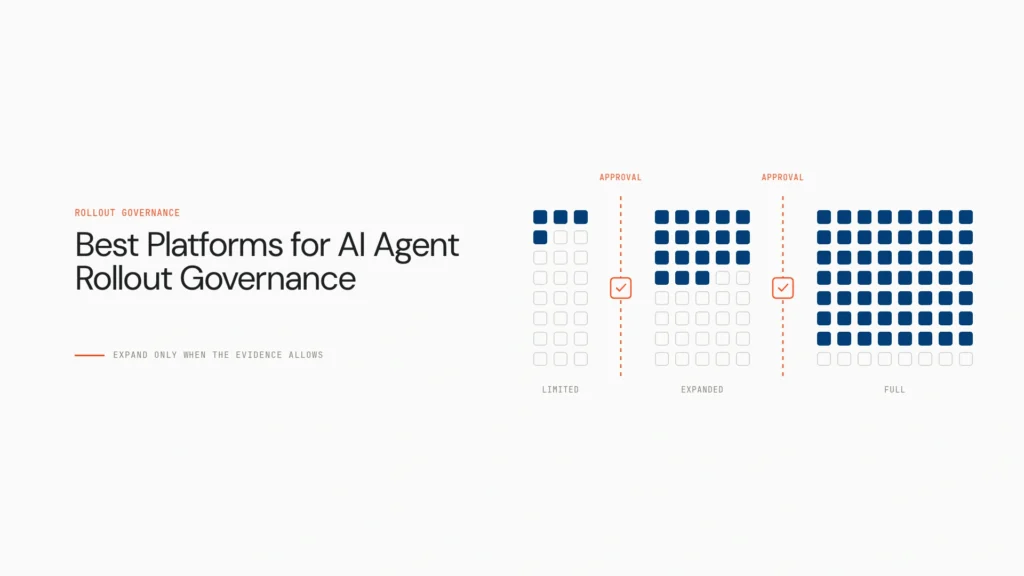
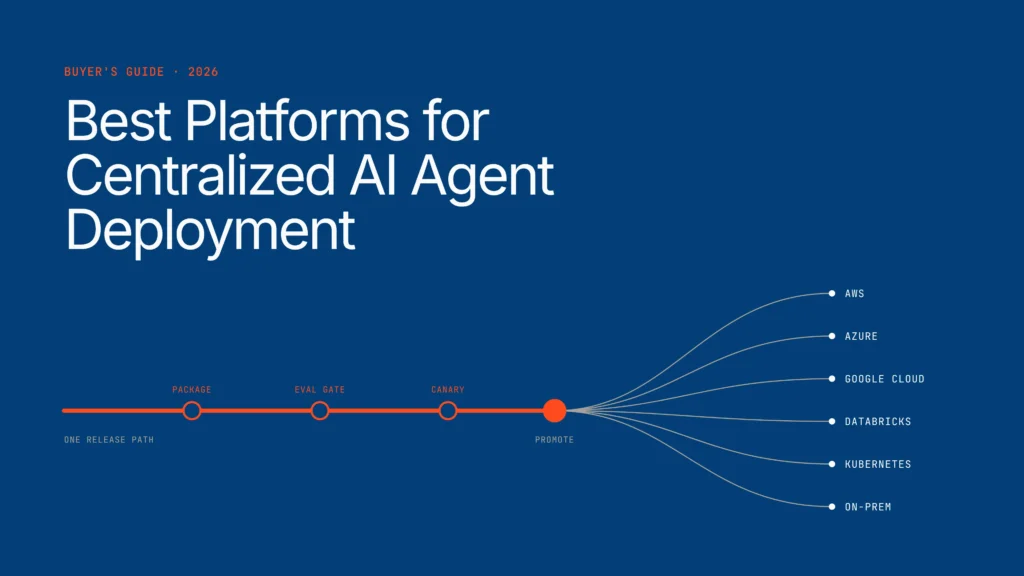
TL;DR: AI agent governance is the framework of policies, identity boundaries, and runtime controls for autonomous systems that plan and execute actions. It rests on four operational components: agent identity and registry, least-privilege access, human-in-the-loop thresholds, and runtime monitoring with kill switches. Security controls alone are not enough. A behavioral layer, covering grounding, decision traces, evaluation, and refusal behavior, catches problems that permission boundaries never will.
An agent can operate for months inside every permission boundary you set for it, trigger zero security alerts, and still be wrong in a way that costs you a customer, a regulator’s attention, or a material misstatement in a filing.
That gap is the reason AI agent governance has become a distinct discipline rather than a subset of AI ethics or IT security. Traditional AI governance was built for models that produce outputs: a classification, a summary, a score. An error there produces a bad recommendation someone reviews before acting on it.
Agents remove that review step. They take the recommendation and act on it: they send the email, file the claim, adjust the price, or approve the transaction. Forrester and Anaconda data suggest 88% of agent pilots never reach production, a number consistent with IDC’s separate finding that only about 12% of enterprise AI proof-of-concepts reach production at scale. Governance, or the absence of it, is a large part of why.
This piece lays out what a working AI agent governance framework actually contains: the four operational components security teams and regulators are converging on, the behavioral layer most frameworks skip, who should own each piece internally, and where to start if you are inheriting a fleet of agents nobody inventoried.
What is AI agent governance?
AI agent governance is the set of policies, identity controls, and runtime mechanisms that manage how autonomous agents access systems, make decisions, and take action across their operating lifecycle.
The distinction that matters is between systems that produce outputs and systems that take actions. A model that misclassifies a support ticket creates a routing error someone corrects. An AI agent built on an AI agent framework that autonomously misroutes a wire transfer or denies a claim creates an event in a system of record. There is no intermediate human step to catch it before it happens.
That single shift, from output to action, is why governance for agents needs its own framework rather than an extension of existing model governance. It also explains why regulators moved quickly. The EU AI Act’s obligations for high-risk systems, which include agents making decisions in credit, employment, and healthcare contexts, carry direct enforcement consequences, a reality covered in more depth in our review of European enterprise AI governance.
Why traditional governance frameworks do not transfer
Traditional IT and model governance frameworks assume a human sits at the point of action. Agent governance has to assume the opposite, and that single assumption breaks most of what came before it. It is also what separates securing autonomous AI workflows from securing the models inside them.
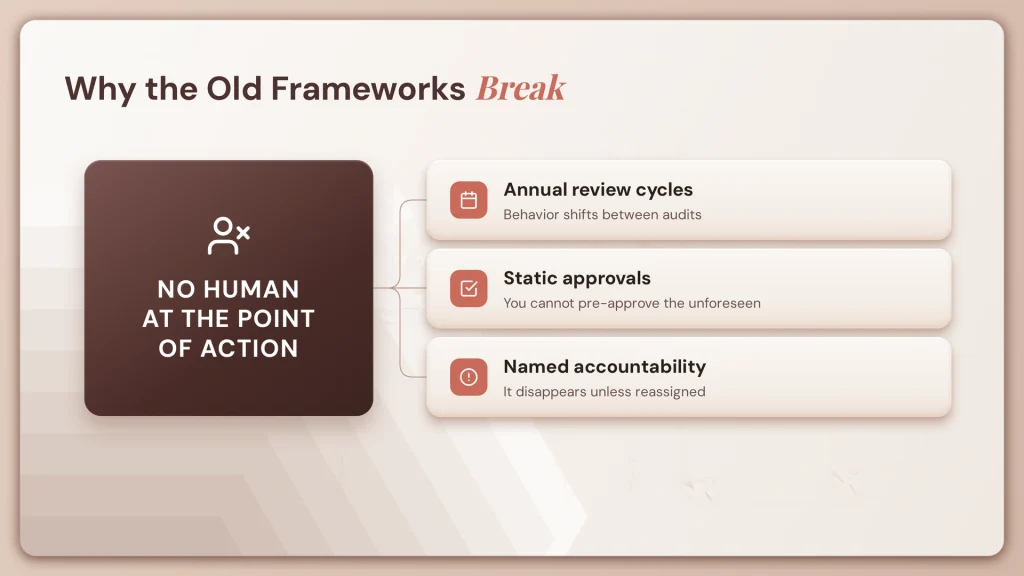
Annual or quarterly review cycles do not match systems whose behavior shifts continuously. A model deployed in January can behave differently by March as the data it retrieves changes, without a single line of code being touched. Gartner finds that at least 50% of generative AI projects were abandoned after proof of concept due to poor data quality, inadequate risk controls, escalating costs or unclear business value. Governance built on a yearly audit cadence cannot catch a failure mode that develops over six weeks.
Static approval workflows fail for the same reason. You can pre-approve a code deployment. You cannot pre-approve every action a contextual, goal-based agent might take in response to conditions that did not exist when the policy was written. Governance has to shift from approving specific actions to defining the boundaries an agent operates inside, a distinction that matters even more once an organization moves from one agent to multiple specialized agents working across departments with different risk profiles. Early AI agents for loan approval made technically correct decisions that turned out to be ethically or legally problematic precisely because the underlying policy had no mechanism for catching drift between the decision and its consequence.
The deepest break is accountability. Traditional controls assume a named person authorizes the consequential step. Remove that person from the loop and accountability does not transfer automatically to the agent, the vendor, or the model provider. It disappears unless someone reassigns it in writing, before deployment, not after an incident forces the question.
The four components of agent governance
Security researchers, cloud vendors, and standards bodies have converged on the same operational answer to what agent governance requires in practice. In early 2026, NIST, six national cyber agencies, and an ISO management standard converged on the same demands for AI agents: least privilege, a verified per-agent identity, a kill switch, and an audit trail. That convergence is the four components below.

1. Agent identity and registry
The foundation of all governance is inventory. You cannot govern what you have not counted. Every agent deployed within the organization must have a unique, machine-readable identity, a named human owner, a clearly documented purpose, and a record in a central registry. This is non-negotiable. Shared API keys or generic service accounts for agents are a direct path to untraceable actions and audit failure. Reviewing the different agent types in production inside an organization is usually the first step toward building that registry, because most enterprises discover agents running that no one on the governance team knew existed. Those shadow agents are the AI-era equivalent of shadow IT, and they are the first thing an auditor finds.
2. Least-privilege access
An agent’s value comes from acting across systems, which is exactly what makes least-privilege harder to enforce here than in conventional software. A joint guide from national cyber agencies is blunt on this point: privilege risks are a key concern for agentic AI, and it instructs teams to limit entitlements to the exact resources, operations, and timeframes needed. Scoping needs to happen per agent, not per application: credential scoping, time-bounded elevation for sensitive tasks, and explicit denial of standing access to anything irreversible. This matters most where agents touch external data or public models, a risk covered in detail in the risks of public LLMs when they are wired into autonomous workflows.
3. Human-in-the-loop thresholds
Full autonomy is not the goal; effective, safe automation is. Set the threshold by consequence, not by model confidence. Financial commitment, customer-facing communication, changes to a system of record, and any regulated decision, such as those an AI agent in commercial banking makes when denying a loan, should require a human checkpoint before execution. The same logic applies to lower-stakes but still consequential work: AI agents for lead qualification should have freedom to experiment with messaging and timing, but hard limits on what they can commit to on the company’s behalf. Reading, analyzing, and recommending can run autonomously. Committing should not, until the agent has demonstrated reliability at a specific task over a measured period.
4. Runtime monitoring, drift detection, and kill switches
Governance does not end at deployment. Agents do not behave like static software. Their performance changes as data distributions shift. A customer service AI agent that is reliable in January can start giving weird answers in March because the underlying corpus moved under it. Runtime governance requires tracing an agent’s reasoning path, including handoffs across a multi-agent architecture, measuring output quality against a fixed evaluation set, and maintaining both soft controls (pause, restrict scope) and hard controls (terminate). One 2026 industry forecast found that 60% of organizations cannot quickly terminate a misbehaving agent, and 55% cannot isolate AI systems from broader network access, which is precisely the gap this component is meant to close. Soft kill switches matter more in daily practice than hard ones, because most incidents call for containment, not shutdown.
These four are the mechanism. Transparency, accountability, and continuous oversight are the principles they exist to serve, not a separate set of pillars requiring their own controls. The Lyzr Agent Control Plane approach treats control as a dynamic system built to enforce these four continuously, not a static rulebook reviewed once a year.
The layer most governance frameworks miss
The four components above form a security layer. They control what an agent is permitted to do and contain damage when something goes wrong. They do not tell you whether the agent did its job correctly.
An agent can stay entirely inside its permission boundary, never touch a restricted system, and trigger no alert, while confidently retrieving the wrong document, degrading in quality as its underlying data shifts, or reaching a conclusion through reasoning nobody can reconstruct after the fact. Security governance would call that agent compliant. It would be wrong.

A complete framework adds four behavioral controls:
- Grounding verification. Does the output actually match what the agent retrieved? This check stops a hallucinated answer from becoming an operational action, and it is the specific function a Hallucination Manager is built to run continuously rather than as a one-time test.
- Decision traces. An action log tells you what happened. A decision trace tells you what was retrieved, what reasoning was applied, which policy governed the choice, and how confident the agent was. This is what an auditor asks for after an incident, and most deployments today cannot produce it. A Control Plane exists specifically to capture this at the point of execution, not reconstruct it afterward.
- Quality regression testing. Every change to a prompt, model, or underlying corpus can introduce a regression nobody notices until a customer does. Running a fixed evaluation set against every change, the practice covered in how context and accuracy degrade at scale, catches drift before it reaches production traffic.
- Refusal behavior. An agent that declines to answer when it lacks grounding is functioning correctly. An agent engineered to always produce a confident response, regardless of certainty, is a governance liability, and refusal rate should be a monitored metric, not an edge case handled ad hoc.
Security governance is table stakes now; most cybersecurity vendors active in this space sell some version of it. Behavioral governance requires visibility inside the agent runtime itself, which is why it tends to be a platform capability rather than a product wrapped around the outside of one. If your compliance walls stop at permissions, consider that only about 21% of enterprises have fully formed agent governance models in place today, and most of that gap sits in the behavioral layer rather than the security one.
Who owns AI agent governance
Governance ownership defaults, in most organizations, to whoever built the agent. That is almost always the wrong answer. The builder has the least incentive to constrain what they built.
Individual agent ownership should still stay close to the business unit that runs it day to day. The marketing team owns their AI agents for digital marketing. Finance owns their forecasting agents. But operational ownership is different from governance accountability, and a working model distributes that accountability across five functions:

Governance ownership by function
| Function | Owns | Example |
|---|---|---|
| Platform / AI engineering | Registry, identity provisioning, technical controls, monitoring infrastructure | Building the technical scaffolding behind Orchestration as a Service |
| Business process owner | Agent purpose, escalation thresholds, acceptable outcomes | Setting the HITL threshold for a lending decision |
| Risk and compliance | Policy boundaries, regulatory mapping, audit requirements | Mapping a denial decision to fair-lending requirements |
| Security | Access scoping, credential management, incident response | Scoping data access for a customer-facing agent |
| Executive sponsor | Accountability for deployed agents, sign-off on autonomy expansion | Approving expanded autonomy after a reliability track record |
This is not a theoretical distinction. When an AI agent in commercial banking denies a loan, there should be a clear chain of logic explaining why, not just a score. That chain exists only if the business process owner set the escalation rule, security scoped the data access, and compliance mapped the decision to regulatory requirements before deployment. If none of those roles was assigned in advance, the postmortem starts by figuring out who should have been accountable, which is exactly the wrong time to answer that question.
The head of AI typically coordinates across these functions, while the CIO or a dedicated chief AI officer usually holds the executive sponsor role. Establishing accountability up front focuses attention wonderfully, and this is especially important when working with an AI Development Company, where responsibility must be clearly defined across both internal teams and external partners.
Tools and platforms for agent governance
Solutions in this category fall into four types, and the right fit depends on what your organization has already standardized on rather than which vendor has the longest feature list.
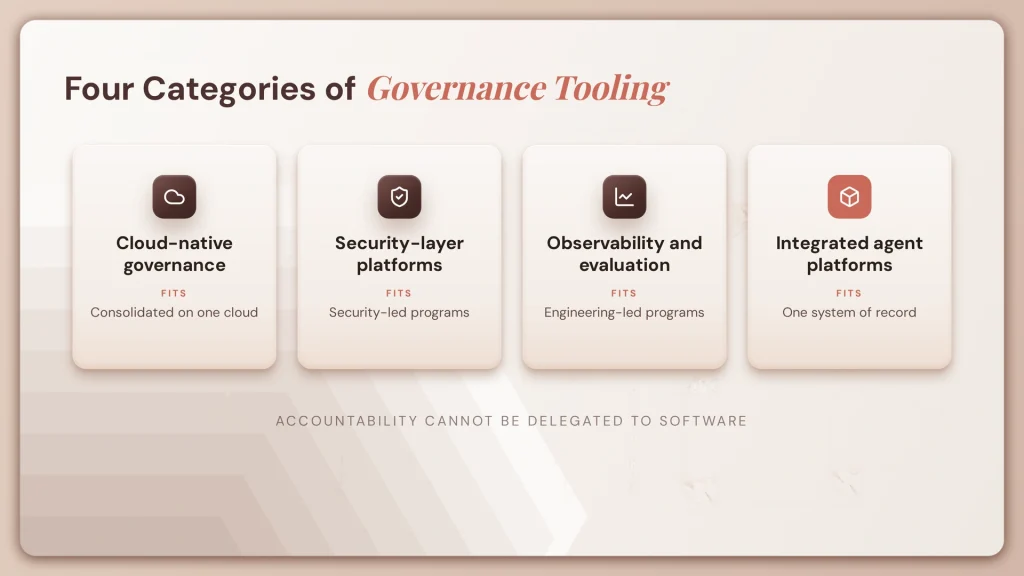
Cloud-native governance extends controls already built into a cloud platform’s adoption framework. It fits organizations heavily consolidated on one cloud provider that want to extend existing governance muscle to agents rather than adopt a new tool. Using platforms that deploy autonomous agents on AWS with governance built in from the start saves considerable rework later.
Security-layer platforms focus on agent identity, permission scoping, and runtime containment. They fit security-led programs where the primary concern is preventing misuse and limiting blast radius.
Observability and evaluation tooling covers tracing, drift detection, and evaluation, and tends to suit engineering-led programs with an existing evaluation practice that want deep visibility without replacing their runtime.
Integrated agent platforms build governance into the development and runtime environment directly, combining the security and behavioral layers instead of wrapping one platform around another. The most sophisticated setups use agent builder platforms with governance baked into the development workflow itself, so compliance checks happen as an agent is built, not after. This fits organizations that want a single system of record for both layers.
Whichever category you evaluate, ask six questions: does it provide an agent inventory, per-agent permission scoping, decision-level traces, automated evaluation and regression testing, both soft and hard kill switches, and deployment inside your own environment. When you’re building agents through Lyzr Agent Studio, governance guardrails configure alongside agent capabilities rather than as a bolt-on step afterward.
A growing category of tools, AI agents built specifically for AI governance, monitors other agents for policy violations and flags drift automatically. These meta-agents help scale oversight, but they do not remove the requirement for a human owner. Accountability cannot be delegated to software, regardless of how well it monitors.
Implementation sequence
Most governance programs start by writing a policy document. That document rarely gets implemented, because it was written before anyone confirmed what was actually running.
A better sequence starts with technical reality and builds outward from it:
- Inventory what is deployed, including shadow agents built outside any formal process. You cannot govern what you have not counted.
- Assign owners for every agent in the registry: a named business owner and a named technical owner, both accountable individually.
- Scope permissions down from whatever access currently exists to the minimum the task requires. This single step reduces more immediate risk than any policy change.
- Define human-in-the-loop thresholds with compliance in the room, not consulted afterward, and set them by consequence rather than confidence score.
- Instrument before expanding autonomy. Deploy monitoring and tracing first. Only extend what an agent can do after you can see what it is already doing.
Organizations that skip straight to step four routinely discover their real problem was never the agent’s capability at all. It was the absence of steps one through three.
Frequently asked questions
What is AI agent governance?
It is the framework of policies, identity boundaries, and runtime controls that manage autonomous systems taking actions, covering their access, decisions, and lifecycle from deployment to decommission.
What is the difference between AI governance and AI agent governance?
AI governance generally covers models producing outputs. Agent governance covers systems taking actions based on those outputs, which adds identity, permission scoping, and runtime containment requirements that model governance alone does not address.
What is an AI governance system?
It is the combination of policies, technical controls, monitoring, and ownership structures that keep AI deployments operating within organizational and regulatory boundaries, enforced continuously rather than reviewed periodically.
What are the five main types of AI agents?
Simple reflex, model-based reflex, goal-based, utility-based, and learning agents. Governance requirements scale with autonomy and with the number of systems an agent can act on directly.
What are level 3 AI agents?
Terminology varies across frameworks, but the term broadly describes agents that plan and execute multi-step tasks with limited supervision, distinct from single-turn assistants or fully autonomous systems operating without any human checkpoint.
Is ChatGPT an agent or an LLM?
By itself, it is an LLM interface. It becomes agentic once connected to tools, memory, and an execution loop, at which point identity, permission, and monitoring requirements apply the same way they would to any other deployed agent.
Do small companies need formal AI agent governance?
Yes, scaled to size. A registry and named owners matter at any deployment count. Formal committees and full audit programs scale with the number of agents and the regulatory exposure of what they touch.
How often should we audit AI agents?
Continuously, through runtime monitoring, with formal review triggered by any material change: a new tool, a model update, a corpus change, or an expansion of scope. Annual-only review does not fit systems that shift between review cycles.
Can AI agents govern other AI agents?
Partially. Agents can monitor, flag, and enforce policy checks against other agents. Accountability cannot be delegated to an agent, so a named human owner remains required regardless of how much monitoring is automated.
What happens if an AI agent violates regulations?
Liability sits with the organization that deployed the agent, not the model provider or the platform vendor. That is why assigning ownership and maintaining decision traces before deployment matters more than responding well after an incident.
To conclude
Governance is frequently framed as friction: the thing that slows an agent program down. In practice, it is closer to the reverse. The organizations moving agents into production fastest are the ones that built the registry, the permission model, and the monitoring before they scaled, not after.
The question worth sitting with is not whether your organization has an AI agent governance policy. Most do, on paper. The question is whether anyone could produce, on request, a current list of every agent running in production, who owns each one, and what it is permitted to touch. If that list does not exist, the policy document is not the missing piece.
That inventory is where the Lyzr Control Plane starts, and it is the fastest way to find out how far your current governance actually reaches versus how far you assume it does.
Book a demo to walk through what your own agent registry would look like once it exists.
Book A Demo: Click Here
Join our Slack: Click Here
Link to our GitHub: Click Here
Got a use case in mind?
8 weeks from use case to agents running in production.
Platform, people and FDEs, all in. Bring your environment. We'll co-build and stay until it's live.
Talk to UsFree resource
101 AI Agents Use Cases
100+ production-ready AI agent use cases across Marketing, Sales, HR, Banking, Insurance, Operations and a lot more
Download now