Financial planning and forecasting are still painfully slow inside most finance organizations. Annual planning can take months, and each forecast cycle in between eats weeks pulling data from disconnected systems, reconciling spreadsheets, and chasing business unit inputs.
By the time a forecast is finalized, the business has moved on: a customer churned, a supplier raised prices, a competitor cut theirs. The forecast reflects a version of the business that no longer exists.
AI in financial forecasting is the application of machine learning, predictive analytics, and natural language processing to turn historical data, live operational signals, and external market data into projections that update continuously instead of once a quarter. It doesn’t replace financial judgment, instead, it shortens the distance between what’s happening in the business and what finance knows about it.
This guide covers where AI genuinely improves forecasting, where GenAI and agentic AI fit in without becoming the whole story, and what a finance team needs in place before any of it works.
What Is AI in Financial Forecasting?
AI in financial forecasting means using machine learning, predictive analytics, and NLP together to analyze historical financials, real-time activity, and market conditions, producing forecasts that update as new data arrives instead of sitting static until the next planning cycle.
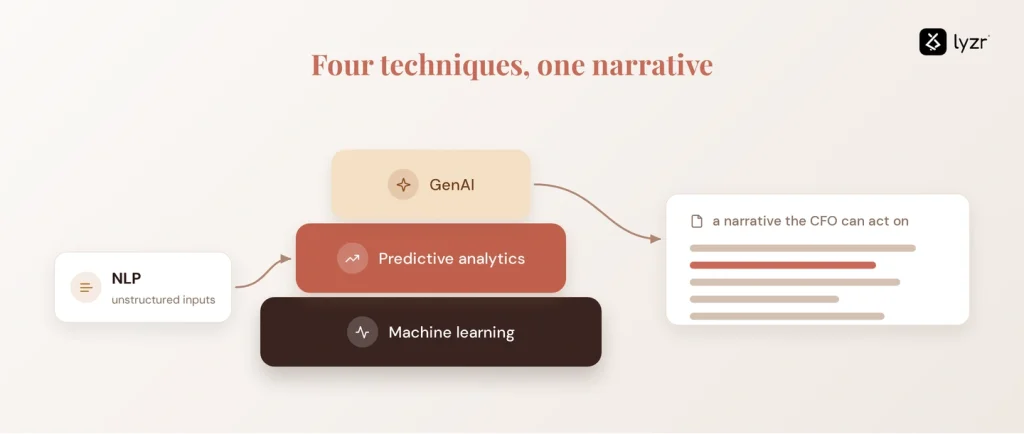
Machine learning, particularly time-series models, is the foundation: it learns from years of revenue, expense, and cash data to catch seasonality and trend patterns a spreadsheet formula won’t. Predictive analytics builds on that to model probability and risk across multiple outcomes. NLP reads unstructured inputs like vendor contracts or earnings commentary and turns them into usable signal. GenAI sits above all of it, translating model output into a narrative a CFO can act on without interrogating the math.
That impact extends across FP&A: AI-generated baselines for budgeting, automated root-cause tracing for variance analysis, GenAI-drafted narrative sections for board decks, and scenario simulation that gives leadership a probability-weighted view of a capital decision instead of a single guess.
How AI Changes Traditional Financial Forecasting
The shift isn’t cosmetic. It changes the operating rhythm of the entire forecasting process.
Traditional forecasting runs on a periodic cycle, monthly or quarterly snapshots that are outdated the moment they’re published. AI-powered forecasting runs continuously, updating as new transactional data lands.
Traditional forecasting is spreadsheet-heavy, with formulas and links that break the moment someone restructures a cost center. AI-powered forecasting is automated, pulling directly from source systems so the model, not a person, refreshes the numbers. That mirrors a broader pattern across finance, where teams are moving toward enterprise automation of repetitive, manual workflows.
Traditional forecasting is historical-only, extrapolating next quarter from last quarter. AI-powered forecasting blends internal and external signals, weighing pipeline data against interest rate movement or supplier lead times.
Traditional forecasting builds scenarios manually, one what-if model at a time. AI-powered forecasting runs automated scenario modeling across dozens of variable combinations in the time it takes to open a spreadsheet.
Traditional forecasting produces static reports that lock in the moment they’re exported. AI-powered forecasting produces dynamic insight, dashboards a controller can query directly. And where traditional forecasting relies on human-led data preparation that consumes most of an analyst’s week, AI-assisted analysis hands that prep work to the system and leaves interpretation to the person who understands the business.

How Is AI Used in Financial Forecasting?
Enterprises are applying AI for financial forecasting across a growing list of FP&A activities. For a broader view of how agents apply across finance functions, see this AI agent use cases guide.
Cash flow forecasting. AI models pull from accounts receivable aging, payables schedules, and payroll runs to project short and long-term liquidity. This is one of the most mature applications of cash flow forecasting AI, because AR and AP data is structured and readily available. Much of that receivables data now originates from payment platforms; Stripe is one of the leading payment processors feeding real-time transaction data into these models.
Revenue forecasting. Models weigh CRM pipeline data, from systems like Salesforce, against pricing changes, churn, and seasonality to project revenue by segment rather than a single company-wide number.
Expense forecasting. Historical spend, headcount plans, and vendor contract terms feed models that project fixed and variable costs with more granularity than a straight-line trend.
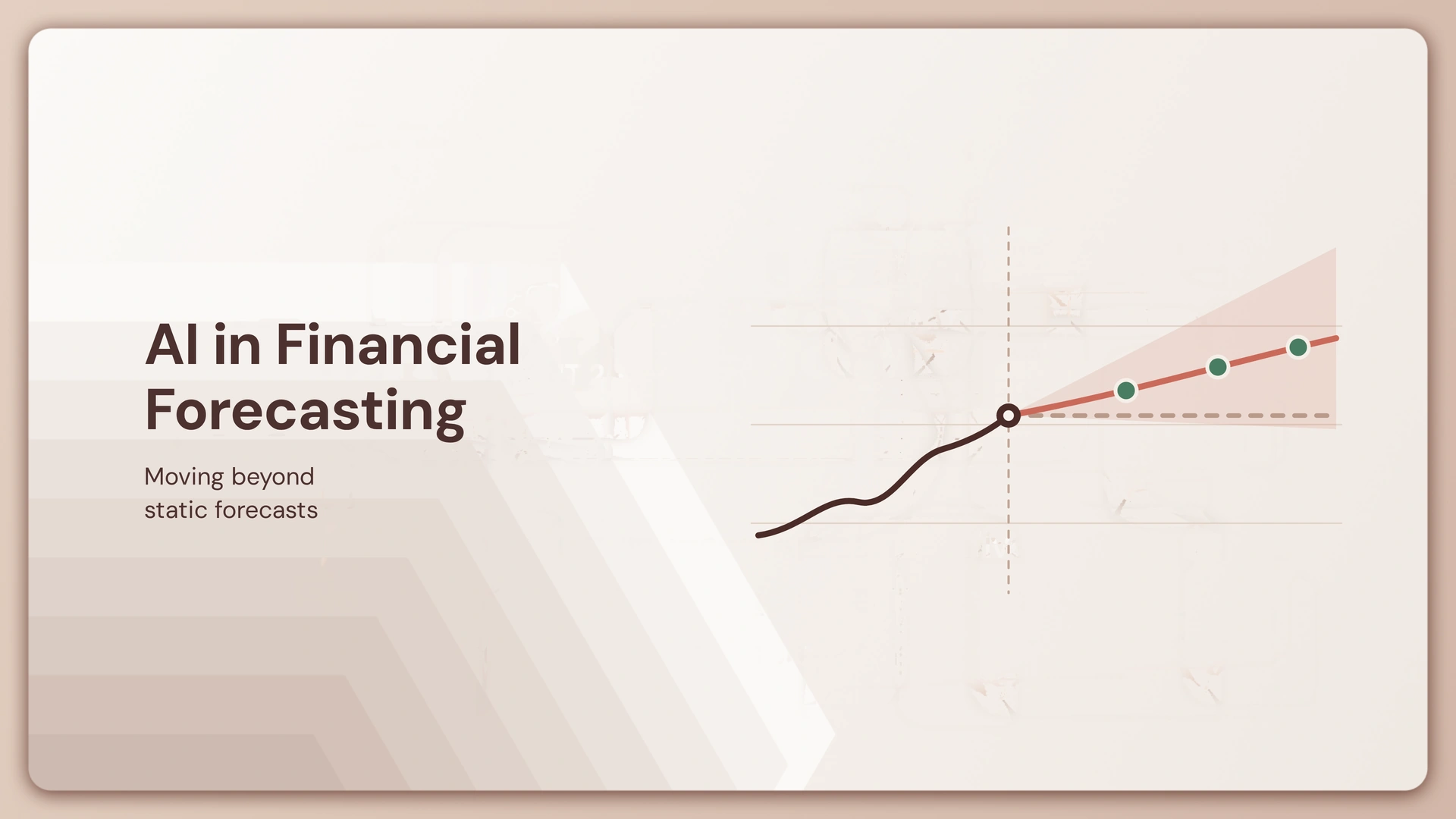
Rolling forecasts. Instead of a static annual budget, an AI rolling forecast keeps a rolling 12 to 18 month window current, automatically extending and adjusting as actuals come in. Rolling forecasts replace the “forecast once, revise never” pattern with something closer to a living model.
Scenario planning. Scenario planning AI runs interest rate shifts, demand shocks, or supply disruptions against the base forecast, testing dozens of combinations a manual model would only get through one at a time.
Variance analysis. Rather than just flagging that actuals missed plan, variance analysis AI traces the deviation back to specific accounts, customers, or cost centers.
FX forecasting. For multinational finance teams, AI-powered FX forecasting analyzes currency volatility and macro data, informing hedging decisions before exposure becomes a real loss.
Demand forecasting, working capital, anomaly detection, budget planning, and reporting. AI extends into aligning financial plans with operational demand, optimizing cash tied up in inventory and receivables, flagging unusual transactions before they become fraud or error, generating baseline budgets, and drafting the narrative commentary that accompanies management reports.
How does AI Improve Financial Forecasting?
AI improves financial forecasting primarily by compressing the time between raw data and a usable answer, not by guaranteeing a better number on its own. IBM research indicates that half of the businesses employing AI in budgeting and forecasting have managed to cut their overall error by at least 20%, with 25% of these companies achieving a reduction of at least 50%.
That’s a meaningful gain, but it’s conditional on the inputs: data quality, the model chosen for the pattern being predicted, how much history exists to train on, and whether governance catches drift before it compounds.
AI Technologies Behind Financial Forecasting
Three distinct layers do different jobs, and conflating them is where most vendor pitches go wrong.
Machine learning and time-series forecasting is the prediction engine. Models trained on historical revenue, expense, and cash data project forward, catching seasonality and trend that a linear formula misses.
Predictive analytics sits one layer up, using ML output to assess probability and risk across a range of outcomes rather than a single point estimate.
Generative AI doesn’t predict anything. It explains what the model already produced, drafts commentary for a board deck, and lets a controller ask why EMEA revenue dropped in March in plain language instead of building a new report. Models such as OpenAI’s GPT family are commonly used for this interpretive layer.
Agentic AI is the newest layer, and it isn’t the same thing as GenAI. Agents connect the forecast to action: pulling fresh data, investigating a variance, running a scenario, and routing the output for approval. This often relies on coordinated multi-agent systems, where one agent handles data collection, another handles analysis, and another handles reporting. For a deeper look at what these systems are, see this breakdown of what AI agents are and how they work. Agents execute workflows around the forecast. They don’t replace the predictive model underneath it.

How Are Enterprises Deploying AI in Financial Forecasting Today?
Most successful rollouts follow a sequence rather than a single big-bang project.
- Put the right data infrastructure in place. Forecasting models are only as reliable as the systems feeding them. That typically means connecting ERP platforms like SAP, CRM data from Salesforce, payment data from Stripe, market data from Bloomberg, and a warehouse layer like Snowflake, with model access often running through infrastructure such as AWS Bedrock.
- Identify the process with the most friction. Cash flow and revenue forecasting are common starting points because the data is structured and the pain is visible.
- Incorporate predictive models for that one process before expanding scope.
- Start with a single, focused use case rather than trying to overhaul the entire FP&A calendar at once.
- Generate insights and automate interpretation using GenAI to explain what the model produced.
- Add human review and governance, keeping a finance professional in the approval loop.
- Expand into rolling forecasts and scenario planning once the initial use case is stable and trusted.
- Measure business outcomes, cycle time, forecast-to-actual variance, hours saved, and use that data to justify the next phase.
Teams looking to go deeper on this sequencing, particularly where agents start taking on more of the workflow, can find a fuller breakdown in AI Agents for Finance: The 2026 Enterprise Deployment Guide.
Benefits and Limitations of AI Financial Forecasting
The benefits are real but not unconditional. AI brings speed and scale to data processing that no analyst team can match manually. It enables continuous updates instead of periodic snapshots. It detects patterns across large datasets that would otherwise stay hidden, supports far more scenario modeling than a manual process allows, and reduces the hours spent on data preparation.
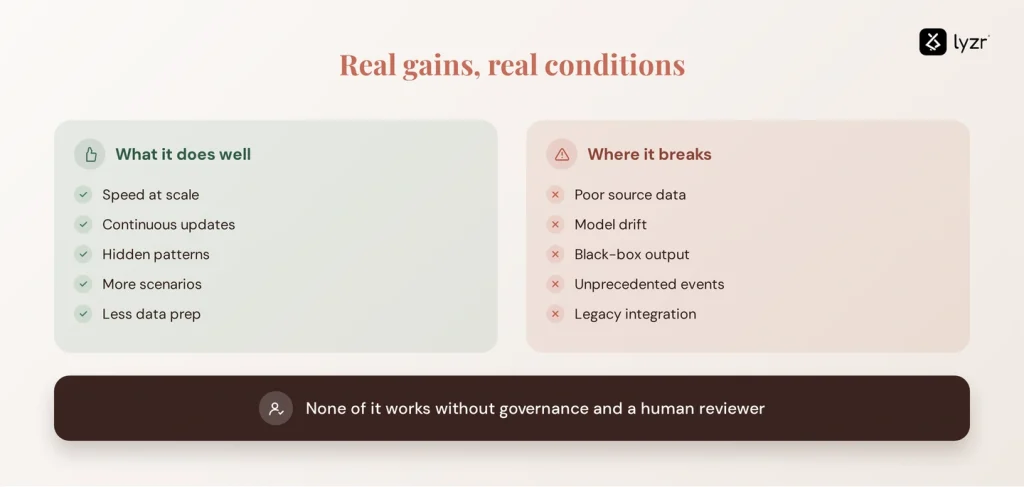
The limitations deserve equal attention. Poor-quality source data produces unreliable forecasts regardless of how sophisticated the model is. Models can drift when business conditions change faster than the training data reflects. Some models function as a black box, making it hard to explain why a specific number came out the way it did. Heavy reliance on historical patterns means AI struggles with genuinely unprecedented events. Integration with legacy finance systems can be slower than expected, and none of it works without governance and a human reviewer who understands the business context the model doesn’t have.
Budget discipline matters here too. Finance leaders weighing where AI spend actually pays off should review The CFO’s Guide to Enterprise AI Spending in 2026 before committing to a platform.
Build vs Buy vs Lyzr Hybrid
Finance leaders evaluating how to approach AI forecasting generally face three paths.
Comparing Build, Buy, and Hybrid Approaches
| Feature | Build (DIY) | Buy (Off-the-Shelf) | Lyzr Hybrid |
|---|---|---|---|
| Customization | High, tailored to internal logic | Low, limited to vendor roadmap | High, composable agents for specific workflows |
| Time to value | Slow, often 12-24 months | Faster, typically 3-6 months | Fastest, initial agent live in weeks |
| Cost | High, requires a data science team | Medium, license plus implementation fees | Lower entry point, scales with use |
| Integration | Complex, custom connectors required | Standard connectors, limited flexibility | SDKs and APIs for deeper, adaptable integration |
| Maintenance | High, ongoing model monitoring | Managed by vendor | Platform managed by Lyzr, logic owned by the team |
| Flexibility | Rigid once built | Locked into vendor ecosystem | Reconfigurable as processes change |
Building in-house gives full control but demands a data science bench most mid-market finance teams don’t have. Buying off-the-shelf gets a team moving fast but locks them into someone else’s roadmap for how forecasting logic should work. A hybrid approach, like Lyzr Agent Studio, tries to split the difference: a managed platform underneath, with finance-specific workflow logic that the team still owns and can adjust.
What Does the Future of AI Financial Forecasting Look Like?
The progression running through 2026 moves from static forecast to rolling forecast, to continuous forecasting, to scenario simulation, to agentic finance workflows that connect all of it to action.
Gartner predicts at least 15% of day-to-day work decisions will be made autonomously through agentic AI by 2028, up from 0% in 2024. That doesn’t mean forecasts replace judgment. It means the systems around the forecast start closing more of the loop themselves.
The biggest change AI brings to financial forecasting isn’t a better forecast. It’s a shorter distance between a business change and a financial decision.
A forecast that updates itself overnight is useful. A system that notices a variance, pulls the CRM data behind it, models the downstream cash impact, and drafts an explanation ready for the CFO before the Monday leadership meeting is a different order of value entirely. That’s the direction enterprise finance teams are actually building toward, not simply tighter error bars on next quarter’s number.
Governance frameworks matter more as this layer expands. Teams deploying agentic workflows in regulated environments should build compliance and audit trails in from the start; see Lyzr Academy for training on governed AI deployment patterns, and Lyzr’s compliance team resources for how audit-ready controls get built into agent workflows.
Where to Go From Here
Finance teams don’t need to rebuild their entire forecasting process to see value from this. The more realistic path is identifying one process, cash flow or revenue forecasting are common starting points, where manual work is heaviest and visibility is weakest, and removing the friction there first.
Explore how Lyzr Agent Studio helps finance teams build and deploy governed AI agents for forecasting, variance analysis, and reporting, backed by Case Studies showing how enterprise teams have put this into production.
Book a demo to see how it fits your forecasting stack.
If your forecasting work sits specifically within banking or lending, our Banking Playbook and the AI Agents for Banking Use Cases cover sector-specific patterns worth a look. Additionally, our banking agents can show you how these patterns extend to a full deployment.
Frequently Asked Questions
AI in financial forecasting is the use of machine learning, predictive analytics, and NLP to analyze historical and real-time data and produce forecasts that update continuously rather than on a fixed monthly or quarterly cycle.
AI improves financial forecasting mainly by automating data collection and enabling more frequent updates, which shortens the cycle from raw data to a usable forecast. Accuracy gains depend on data quality and governance, not the technology alone.
There’s no single best tool. The right choice depends on whether a team needs embedded forecasting inside an existing ERP, a standalone forecasting platform, or a flexible agent-building environment for custom workflows.
Yes. AI models analyze accounts receivable, accounts payable, and payment data to project short and long-term liquidity, making cash flow forecasting AI one of the most established use cases in finance today.
Accuracy varies significantly based on data quality, model choice, and how much reliable history exists to train on. As noted above, error reductions of 20% or more are common, but that outcome depends on proper implementation, not the tool alone.
A rolling forecast is a continuously updated projection covering a fixed future window, typically 12 to 18 months, that shifts forward each period instead of resetting once a year like a static annual budget.
AI is used to automate data ingestion from ERP and CRM systems, run predictive models on that data, and generate narrative explanations of the results, covering revenue, expense, cash flow, and scenario forecasting across the finance function.
Book A Demo: Click Here
Join our Slack: Click Here
Link to our GitHub: Click Here