Performance management is more than yearly reviews or occasional feedback; it’s about continuous, timely interventions that drive real growth. Yet, traditional methods often fall short. Feedback comes too late. Goals get lost in the shuffle. Recognition feels inconsistent.
Now, AI in performance management has changed this. It uses machine learning and governed AI agents, building on the broader shift toward AI in HR, to continuously collect and act on performance signals, from goals and check-ins to peer feedback and daily work. Instead of one annual review, it aggregates real-time data, drafts reviews, and personalizes coaching for every employee.
Key takeaways
- AI in performance management shifts the process from an annual event to a continuous, evidence-backed loop that runs in the background all year.
- The gap between what executives believe and what employees experience is the real adoption risk, not the technology itself.
- The strongest approach uses governed, multi-agent systems that pull from Slack, Zoom, and HR systems, not a single copilot bolted onto legacy review software.
- Fairness is a design choice, not a default. It depends on data quality, rubrics, and human-in-the-loop review, not the AI label on the box.
- AI can draft, aggregate, and flag. It cannot own the judgment calls that make a review fair, motivating, and specific to one person’s career.
What AI in performance management?
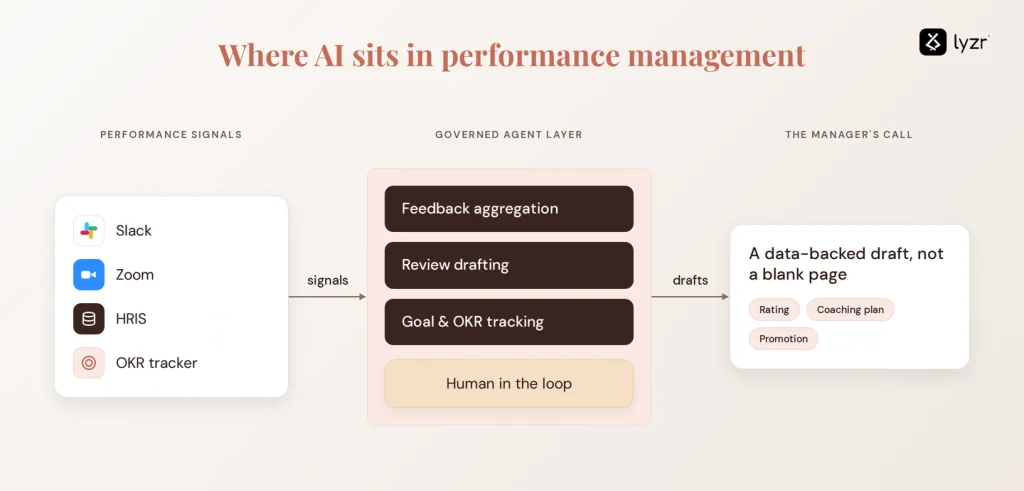
Decades of HR innovation have gone into fixing the performance review, and most of it still lands on managers scrambling to remember a year in three paragraphs. Traditional performance management systems were designed for predictability. Annual reviews, static goals, and delayed feedback made sense in a slower world.
But not anymore! Now, there are agents that capture defined signals from the work itself, goals hit, code shipped, feedback given, in real time instead of a form filled out months later.
AI Performance management is not the same category as legacy AI performance review software. Traditional tools are limited to digitizing a form and storing ratings. AI in performance management goes further: it reads project completions, peer notes, and goal progress to build a live, checkable picture of contribution, then routes that picture into a draft review before a manager opens a blank document.
That shift mirrors a broader move across HR toward data-driven decision-making rather than gut-feel ratings. Performance management AI, the practical kind, matters because it’s now expected to explain, not just score, every rating it produces.
Why performance management is shifting to AI
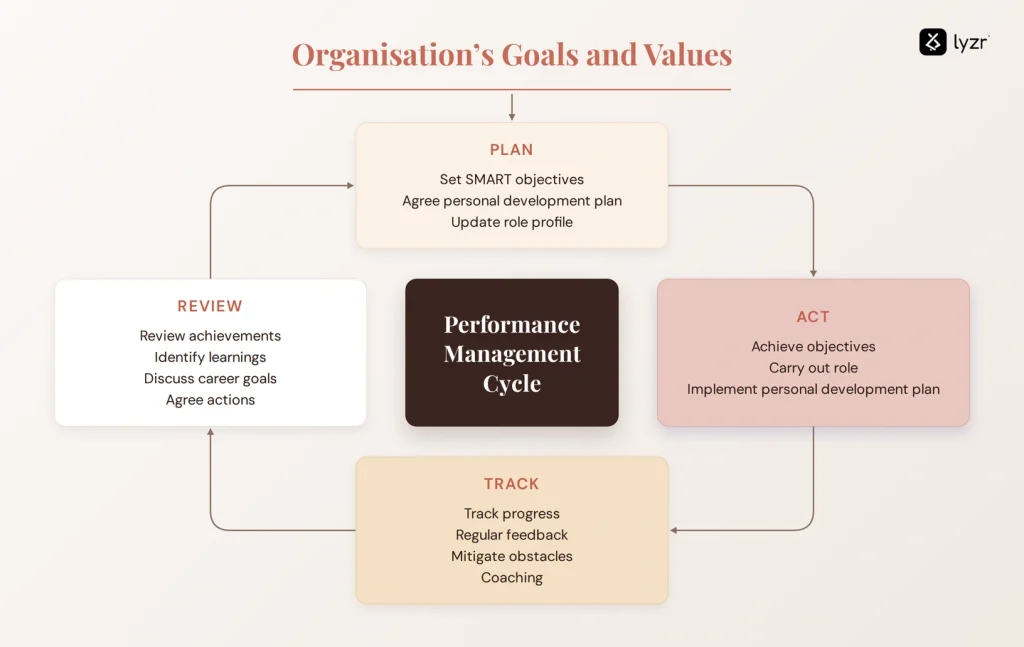
AI adoption in performance management is accelerating because the old cadence cannot keep up with how fast work itself is changing. AI makes performance management continuous, data-driven, and fair.
49% of HR leaders rank AI use as a top influencer on employee performance, according to Betterworks’ 2026 State of Performance Enablement Report. Yet fewer than 16% of managers and employees say their company has communicated a clear AI vision, and executives are 6x more likely than employees to believe performance reviews and goal-setting have kept pace with AI-driven work
That disconnect carries a retention cost. By 2027, half of enterprises lacking a comprehensive AI people strategy will lose their top AI talent to competitors who prioritize workforce enablement over basic adoption, according to Gartner. The same research found that only 27% of executives have a comprehensive AI strategy, and just 20% believe their workforce is truly AI-ready. As Gartner’s Senior Director Analyst in its HR practice put it:
“This ‘enablement illusion’ is hiding risks and draining ROI.”
Some companies are moving fast enough to make AI usage a formal review criterion. Meta plans to tie employee performance reviews to their “AI-driven impact,” starting from 2026, rewarding those who achieve “exceptional” results at an individual or team level. Internally, Meta’s Head of People framed it plainly:
“As we move toward an AI-native future, we want to recognize people who are helping us get there faster.”
The lesson for a cross-industry HR leader isn’t to copy Meta’s exact mandate. It’s that the review cycle itself needs to move at the speed of the work it’s measuring, which is what The AI-Powered Performance Enablement playbook lays out in more operational detail.
Benefits of AI in performance management
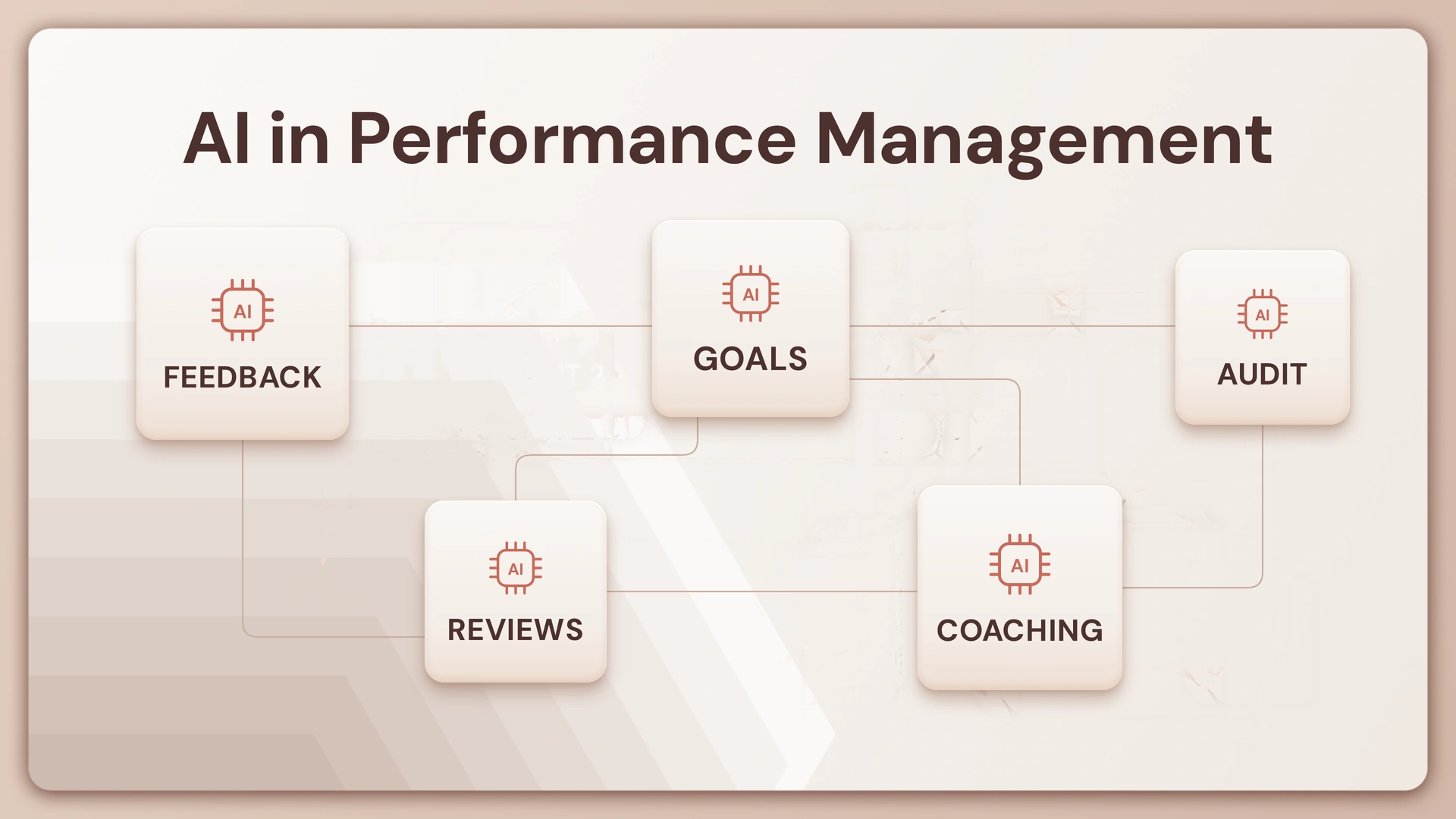
Most vendors pitch a single feature. The more durable pattern is a set of governed agents that share one data layer. At Lyzr, this runs as Diane, the Agentic OS for HR by Lyzr, and the pieces relevant to performance sit alongside the broader AI agents for performance management built on the same platform. Below are some of the remarkable benefits of such an integrated platform:
Continuous, real-time feedback feedback
Instead of waiting for a quarterly check-in, agents log feedback the moment it happens, whether that’s a manager’s Slack comment or a project sign-off. Example: a sales manager tags a rep’s deal-saving call in Slack, and that note is timestamped and attached to the rep’s file before the next 1:1.
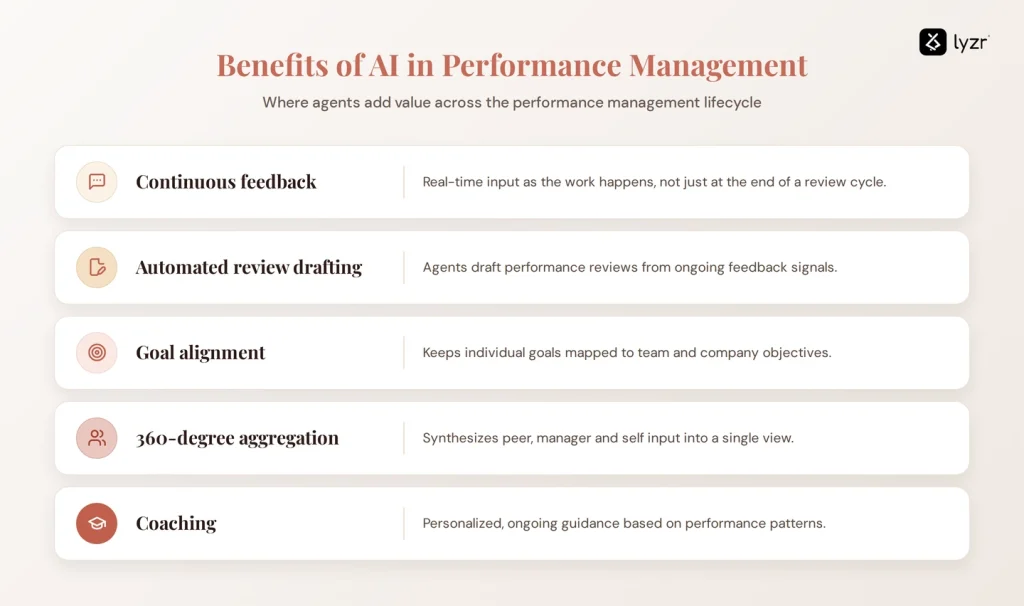
Automated performance review drafting
An AI performance review agent pulls the quarter’s evidence and produces a first draft, cutting the blank-page problem that eats manager time. That matters because 49% of managers already find it difficult to review a year’s worth of feedback as part of the annual review process, according to Lattice’s 2025 State of People Strategy Report. Managers who use AI for these tasks report saving an average of four hours across different parts of the performance management process, per a December 2025 Gartner survey of 1,622 respondents. For example: a draft review for an engineer cites three shipped features and two code review comments, all sourced automatically, ready for the manager to edit rather than write from scratch.
Goal setting and OKR alignment
AI goal setting agents check individual objectives against team and company OKRs and flag drift before it compounds. Example: a marketing associate’s Q3 goal falls out of sync with a shifted company priority, and the agent surfaces the mismatch two weeks into the quarter instead of at review time.
360-degree and multi-source feedback aggregation
Feedback-aggregation agents pull structured input from Slack, Zoom call summaries, and HR systems, alongside dedicated pulse tools, to build a 360-degree feedback AI profile rather than relying on a single manager’s memory. An ESAT Survey Agent runs the recurring pulse layer, while structured input from pulse survey software fills in the peer-to-peer gaps a manager can’t see. Example: a product manager’s review includes anonymized input from four cross-functional peers, aggregated and de-duplicated automatically.
Personalized coaching and development plans
An AI coach turns the same evidence trail into AI performance coaching, suggesting specific skill-building resources tied to a person’s actual gaps rather than a generic learning catalog. Example: an underperforming account executive gets three targeted objection-handling scenarios instead of a link to a 40-hour course.
Everything upstream of performance, hiring, onboarding, learning, and day-to-day HR questions, runs on the same agentic layer: an AI Hiring Assistant, an Employee Onboarding Agent, an AI L&D Agent, and an HR Helpdesk Agent feed the same profile that performance agents read from.
What should (and shouldn’t) become performance data
Pulling signals from Slack, Zoom, and project tools does not mean an agent treats every message as evidence. The scope has to be defined before rollout: which systems, which event types, and which categories of activity are explicitly out of bounds.
The data in scope would typically be goal and OKR progress, completed deliverables (shipped code, closed deals, published content), documented manager and peer feedback, and structured status updates already treated as work records today.
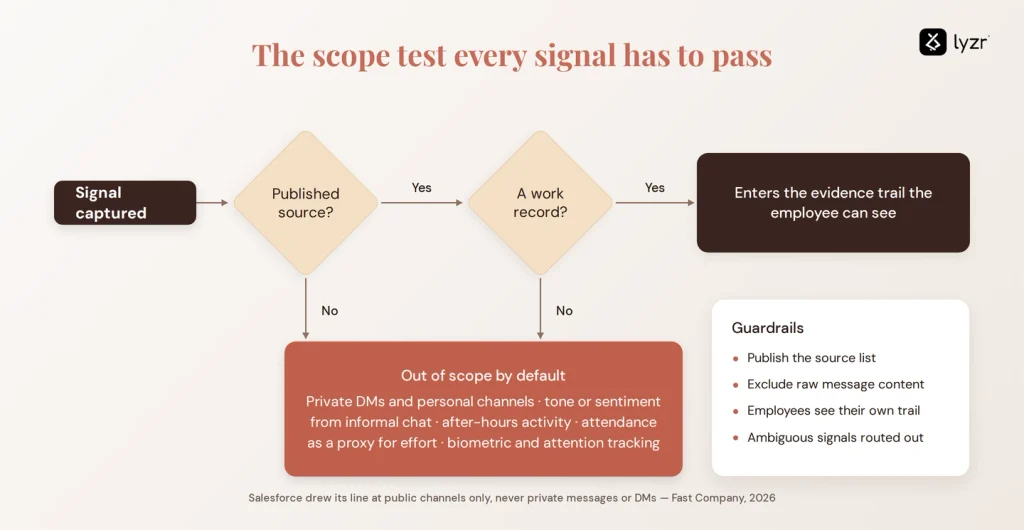
Out-of-scope data by default becomes private DMs and personal channels, tone or sentiment mined from informal chat, after-hours activity, meeting attendance used as a proxy for effort, and any biometric or attention-tracking data.
When Salesforce CEO Marc Benioff described using AI to analyze employee Slack activity, the company drew the line at public channels only, not private messages or DMs, an example of the kind of boundary a performance system needs before it touches any communication data at all.
Some practical guardrails to implement would be to publish the exact list of data sources and event types feeding the system, exclude raw message content and DMs by default, give employees visibility into their own evidence trail, and route ambiguous signals, like tone or sentiment, out of the model entirely rather than weighting them lightly.
Is AI in performance management fair?
AI in performance management is neither biased nor inherently fair. It reflects the data, rubrics, and human oversight built into the system around it.
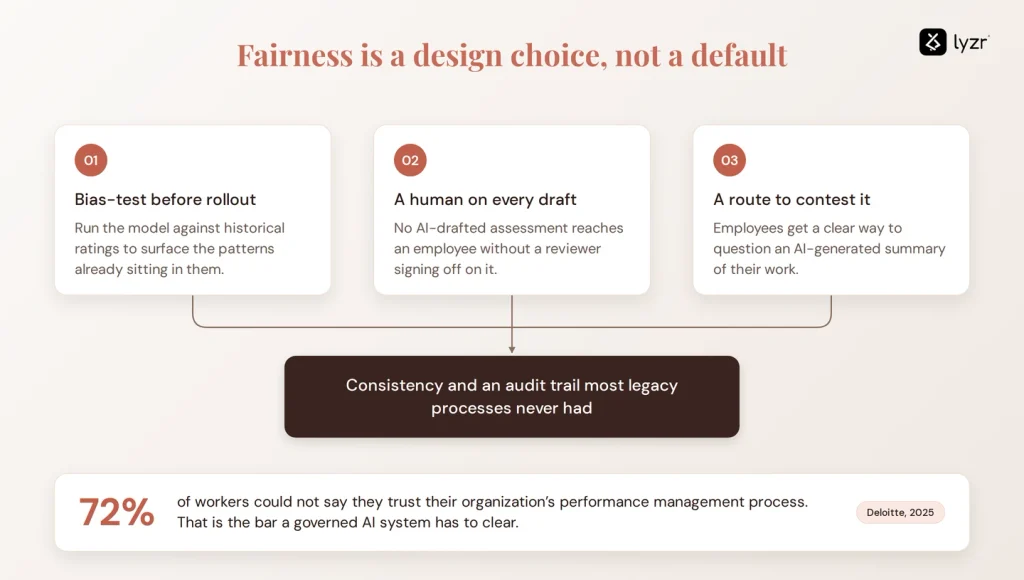
A well-governed AI performance management system, bias-tested, human-reviewed, and transparent to employees, can be fairer than the manual process it replaces.
Affinity bias, recency bias, and unconscious rating patterns show up in manager language and scores today: 72% of workers could not say that they trust their organization’s performance management process, according to Deloitte’s 2025 Global Human Capital Trends survey of nearly 10,000 business and HR leaders across 93 countries. AI doesn’t need to be perfect to improve on that; it needs to be more consistent and more accountable than what’s running today.
Fairness is a design choice made deliberately. That means bias-testing the model against historical ratings before rollout, keeping a human reviewer on every AI-drafted assessment, and giving employees a clear way to question or contest an AI-generated summary. This way, AI adds consistency and an audit trail that most legacy processes never had, which is worth checking your current stack against: see how it compares to modern engagement platforms, including the best culture amp alternatives, before assuming it already handles this well.
AI performance management tools and what to measure before you deploy
Most AI performance management tools now claim some version of “AI-powered feedback.” The differences that matter sit underneath that label.
- What data does it actually see? A review-form-only system draws from whatever a manager types in. A governed multi-agent system pulls from Slack, Zoom, and the HR system continuously, and can point to where each line in a review actually came from.
- How does it handle goals? Does it flag drift against OKRs mid-cycle, or just store what someone typed in at the start of the quarter?
- What happens when it’s wrong? Is there a human reviewer on every AI-drafted assessment and a visible audit trail, or does the output just appear, unexplained?
Run the before-and-after numbers, review-cycle time, feedback frequency, manager hours, through a performance management ROI calculator instead of taking a vendor’s word for it. For a side-by-side across the field, see Best AI Tools for HR in 2026: 15 Tools Compared by Use Case, and for where buyer expectations are headed next, HR Trends 2026: Why the HR Checklist Is Becoming a Trap.
Evaluating AI performance tools
Evaluating AI performance management tools comes down to whether a vendor is selling you a feature or a system. An agentic platform will aggregate data, draft, track goals, and flag bias, all under rules you configure. Teams that want to build or customize their own agents rather than use a fixed blueprint can do so directly in Lyzr Studio, regardless of which underlying LLM powers the agent. Getting the tone and consistency right on drafted feedback usually comes down to how well the team has worked through prompt engineering techniques for that specific use case.

Before rollout, screenshot this baseline and track it quarterly:
- Adoption and readiness: percentage of managers trained, weekly active usage, feedback events logged per employee.
- Review-cycle time: total days from cycle open to final sign-off, before and after deployment.
- Feedback frequency: average number of feedback data points captured per employee per quarter.
- Manager time saved: hours spent drafting reviews, measured directly rather than estimated.
How Lyzr helps with AI performance management
Lyzr’s answer to each of those questions is the same: build the agents on one shared data layer instead of stacking another feature onto the review form. The review-drafting, goal-alignment, and feedback-aggregation agents described earlier all read from and write to that same profile, so nothing has to be reconciled across separate tools after the fact.
In Lyzr Studio, building this looks like picking an LLM provider, connecting Slack, Zoom, and your HR system, and configuring each agent around your own review cycle instead of a vendor’s template. Nothing here requires waiting on someone else’s product roadmap to ship the feature you actually need.
The framework behind these agents is open-sourced on GitHub for teams that want to inspect the code before trusting it with performance data, and Lyzr’s Slack community is where people are already running this in production trade prompt patterns and implementation questions, so you’re not building it alone.
FAQs
What is AI in performance management?
AI in performance management is the use of AI agents to collect, analyze, and act on performance data continuously rather than once a year. It aggregates feedback from chat, calls, and HR systems, drafts reviews, tracks goals, and flags coaching needs, with a human approving outputs before they become part of an employee’s record.
How is AI used in performance reviews?
AI is used in performance reviews to draft summaries by pulling goal progress, peer feedback, and logged wins into one document before a manager starts writing. It also flags biased language, tracks OKR completion in real time, and surfaces themes across dozens of comments that a manager would otherwise read manually.
Can AI replace performance reviews?
No, AI cannot replace performance reviews, but it replaces the manual work inside them. AI agents handle data aggregation, drafting, and goal tracking, while managers retain full ownership of context, empathy, and the final judgment call. The review conversation itself stays a human responsibility.
Is AI performance management biased or fair?
AI performance management is only as fair as its design allows. Systems built with multiple data sources, explainable outputs, bias auditing, and mandatory human review can reduce bias compared to fully manual evaluations. Without those safeguards, AI can quietly repeat the same patterns found in past, biased reviews.
What are the best AI performance management tools?
The best AI performance management tools use a multi-agent architecture rather than a single chatbot bolted onto legacy software. Look for platforms offering dedicated agents for review drafting, feedback aggregation, and coaching, strong integrations with Slack and Zoom, and configurable governance rules rather than a black-box output.
How does AI help with employee goal-setting?
AI helps with employee goal-setting by cascading company-level OKRs into suggested, measurable targets for each team and individual. It tracks progress against those goals continuously, flags risk before a deadline is missed, and keeps goals visibly connected to company strategy instead of drifting into disconnected personal targets.
Most performance management software still asks a manager to remember an entire year in the final week of a cycle. The question worth sitting with isn’t whether AI belongs in that process, it’s whether your current system can even tell you, today, how many feedback data points exist on your highest performer.
Book a Lyzr performance agents demo to see how governed, multi-agent performance management works against your own review cycle.
Book A Demo: Click Here
Join our Slack: Click Here
Link to our GitHub: Click Here