TL;DR
- AI agents in insurance are autonomous systems that interpret data, reason through context, and execute multi-step workflows like claims triage, underwriting support, and policy servicing.
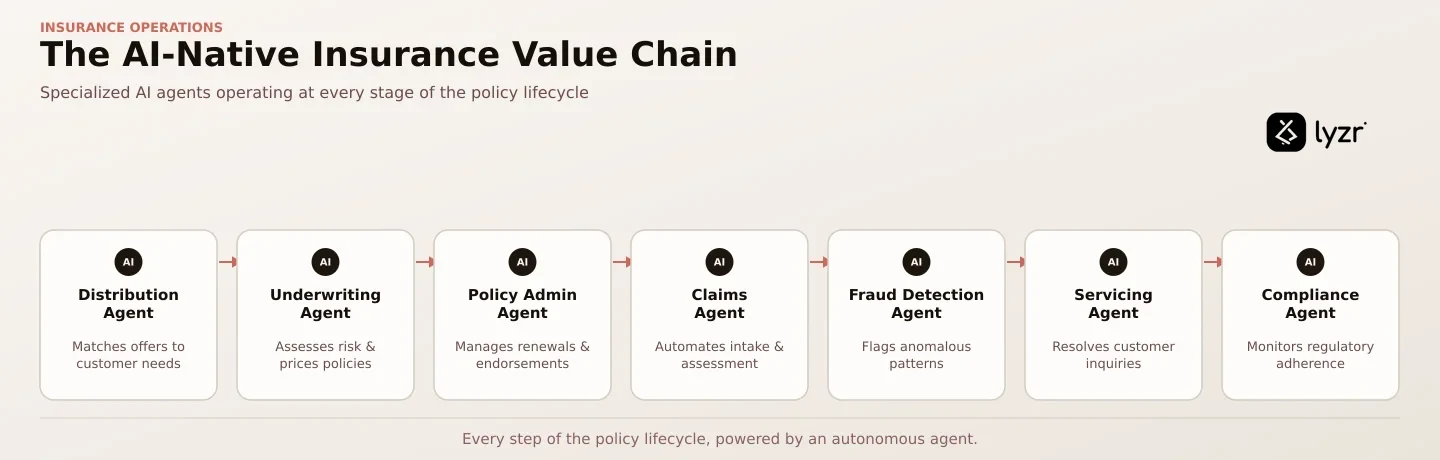
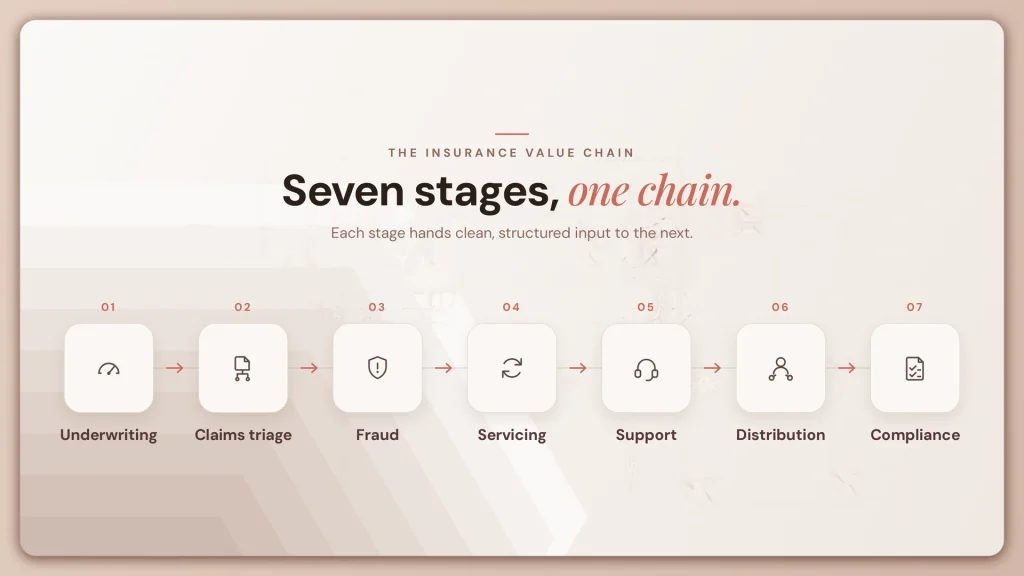
- They apply across seven value-chain areas: underwriting, claims, fraud detection, policy administration, customer support, distribution, and regulatory compliance.
- Insurance is a regulated industry where a wrong AI decision is a compliance event, not just an engineering bug.
- Successful deployment depends less on model capability and more on explainability, bias controls, audit trails, and data residency.
- The right first deployment is a bounded, high-volume process like claims intake, not underwriting or pricing.
A claims adjuster in a regional carrier’s office is staring at a first notice of loss that came in as a scanned PDF, a phone transcript, and three blurry photos of a dented bumper.
She has forty more like it in her queue this week.
Somewhere in a compliance office two floors up, someone is preparing documentation for a market conduct exam that will ask, in detail, how every one of those forty decisions got made.
That tension, speed on one side, defensibility on the other, is the actual story of AI agents in insurance right now. Not a hype cycle. Not a chatbot upgrade.
A genuine shift in how carriers process the unstructured, judgment-heavy work that has resisted automation for two decades, happening at the exact moment regulators are writing down what “responsible” AI use in insurance has to look like.
This guide covers where these agents create measurable value across the insurance value chain, what a production deployment actually looks like, and the governance requirements that decide whether a pilot becomes a permanent capability or a shelved experiment.
What are AI agents in insurance?
AI agents in insurance are autonomous or semi-autonomous systems that interpret data, make context-based decisions, and execute multi-step insurance workflows with minimal human intervention. An AI agent in this context is powered by an LLM (large language model, the reasoning engine behind the agent) for reasoning, connected to policy administration systems, claims platforms, and document repositories through APIs, and grounded in the insurer’s own data through retrieval rather than generic training knowledge.
That grounding detail matters more than it sounds. A generic chatbot answers from what it learned during training. An agent built for a specific book of business retrieves the actual policy wording, the actual underwriting guideline, the actual claims manual, before it answers or acts.
Buyers evaluating this space tend to conflate three different technologies. The distinction determines what a given tool can actually be trusted to do:
Rules-based automation vs. conversational AI vs. AI agents
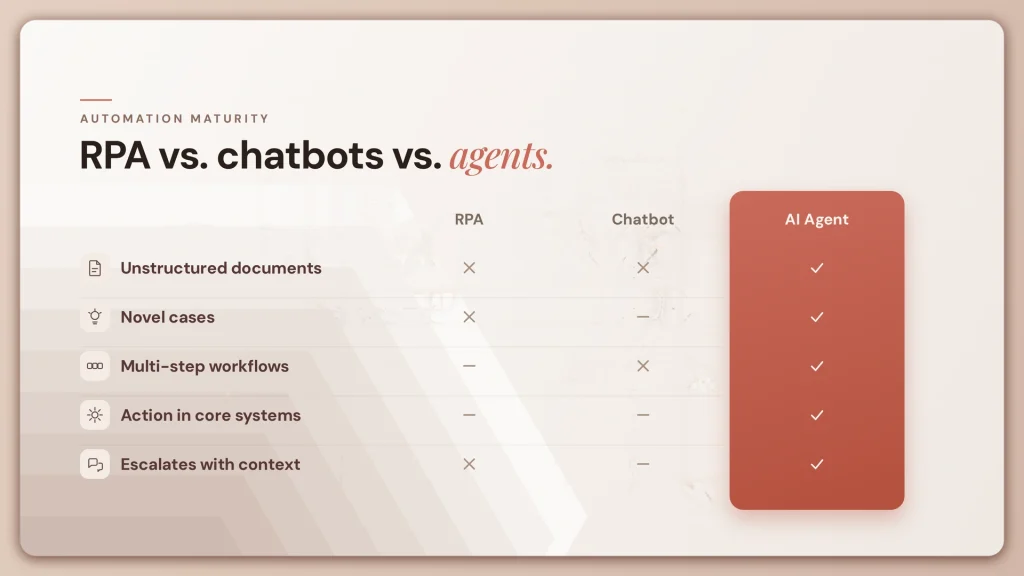
| Capability | Rules-based automation (RPA) | Conversational AI / chatbot | AI agent |
|---|---|---|---|
| Handles unstructured documents | No | No | Yes |
| Adapts to novel cases | No | Limited | Yes |
| Executes multi-step workflows | Fixed sequences only | No | Yes |
| Takes action in core systems | Yes, scripted | Rarely | Yes, reasoned |
| Escalates with context | No | Basic handoff | Full case context attached |
An RPA (robotic process automation) bot moves data between fields it was scripted to expect. A chatbot answers a question and stops. An agent, like Lyzr’s insurance agent Benjie, can read an unstructured FNOL (first notice of loss) submission, validate it against the specific policy, score severity, and hand it to the right adjuster with full case context attached. That last row, escalation with context, is the row most vendor demos skip and most operations leaders end up caring about most.
This is different from the broader category of generative AI in insurance, which covers content and drafting tasks. Agents act; generative tools draft.
Where AI agents work across the insurance value chain
The strongest deployments don’t sit in a single department. They map across the entire AI for insurance value chain, so the output of one stage becomes clean, structured input for the next. The pattern echoes what’s happening in adjacent regulated sectors covered in the broader AI agents for BFSI overview.
Underwriting and risk assessment
The agent aggregates submission data from brokers, loss runs, financial statements, and third-party risk feeds, normalizes it into a structured risk profile, and surfaces a recommendation with reasoning for the underwriter to approve. It replaces manual data entry and the back-and-forth of chasing missing documents. The Lyzr underwriting data aggregation agent and policy underwriting support agent handle this stage, along with an insurance premium optimization agent for pricing support. The outcome that matters here is submission-to-quote time and quote-to-bind ratio, not model accuracy in isolation.
Claims intake and triage
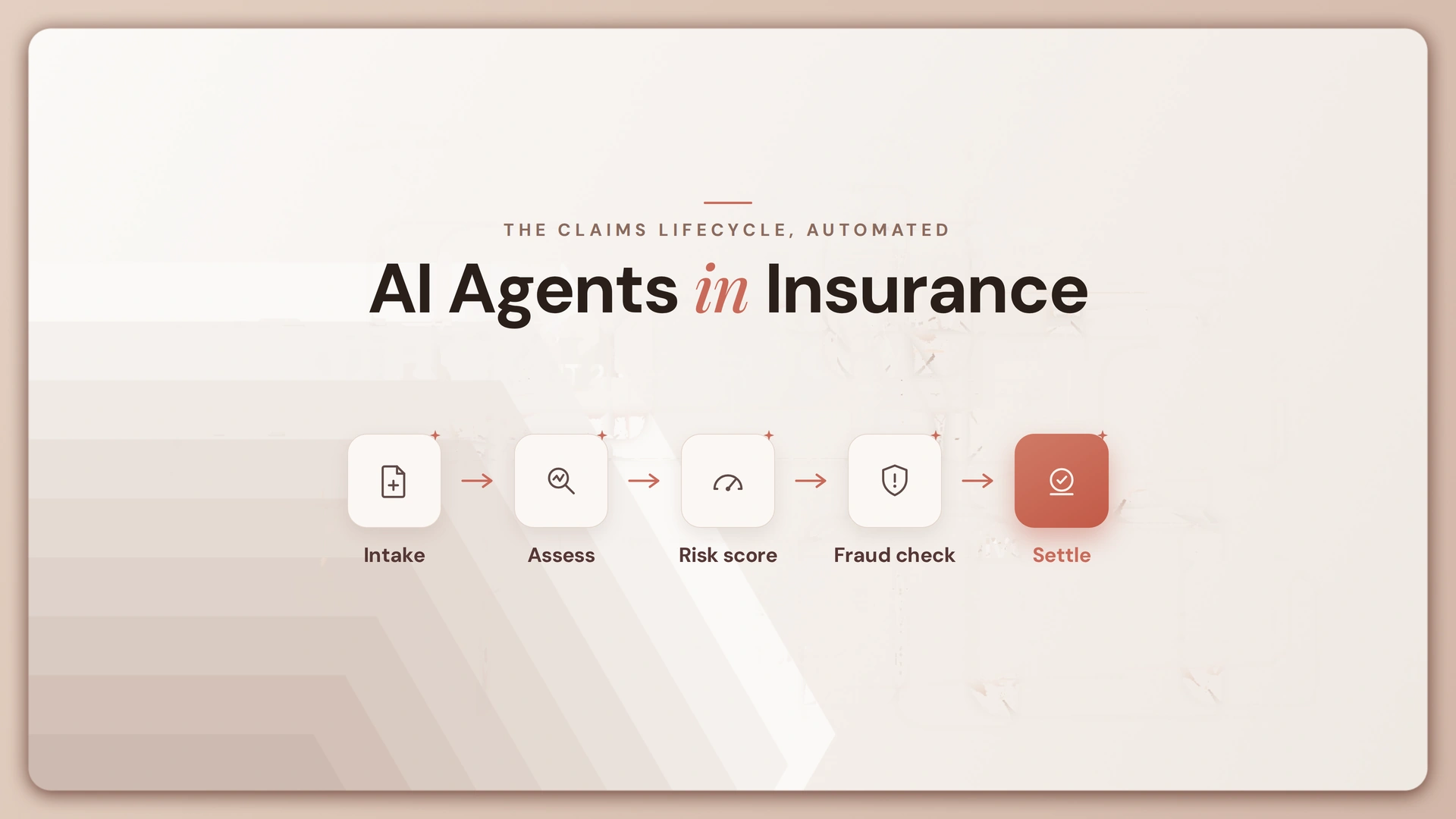
The agent ingests FNOL across every channel, extracts entities from unstructured documents and photos, validates coverage against the actual policy, assigns severity, and routes the case to the right adjuster queue. This is where machine learning pattern recognition and document extraction do the heaviest lifting. The claims severity prediction agent and the dedicated claims processing agent cover this stage, detailed further in AI agents for insurance claims. Cycle time and straight-through-processing rate are the metrics that track whether it’s working.
Fraud detection
The agent cross-references claim details against historical patterns, provider networks, and document authenticity signals to flag anomalies for special investigations. This is a meaningfully different capability from a legacy rules engine: the agent reasons over unstructured evidence, inconsistent phrasing in a statement, a mismatched timestamp on a photo, not just flagged fields in a database. Lyzr’s fraudulent document detection agent is built for this. SIU (special investigations unit) referral precision is the outcome worth tracking.
Policy administration and servicing
The agent processes endorsements, mid-term adjustments, renewals, and cancellations, the long tail of servicing requests that otherwise clogs a call center. AI agents also analyze data and renewal cycles to send timely reminders, keeping policies active without manual follow-up. Lyzr’s policy endorsement processing agent and insurance renewal churn predictor cover this ground. Watch servicing cost per policy and first-contact resolution rate.
Customer and policyholder support
The agent handles coverage questions, claim status, billing, and document requests across chat, voice, and email, using natural language processing (the technique that lets a system parse and respond to human language) to understand intent before it escalates with full case context. For ai agents in health insurance specifically, the healthcare claims validation agent verifies eligibility and plan terms before a human ever touches the ticket. Deflection rate, handle time, and CSAT are the numbers that matter here.
Distribution and agency support
This is where ai tools for insurance agents and ai assistant for insurance agents searches actually point. The agent acts as a real-time assistant to human brokers: instant policy lookup, coverage comparison, quote generation, and renewal prompts, all surfaced inside the workflow an insurance agent already uses. The same reasoning lets AI agents analyze customer behavior and preferences to suggest better-fitting policies rather than generic ones. Lyzr’s agent performance analytics assistant adds visibility into which brokers need support and where.
Regulatory compliance and reporting
The agent monitors filings, checks marketing and policy language against jurisdictional requirements, assembles audit evidence, and flags exposure before an examiner finds it. The regulatory compliance audit agent is built for this, and it connects directly to the broader discipline of AI in risk and compliance. Audit preparation time and finding rate are the outcomes to track.
What AI agents in insurance look like in practice
Two workflows illustrate the difference between a demo and a production deployment.
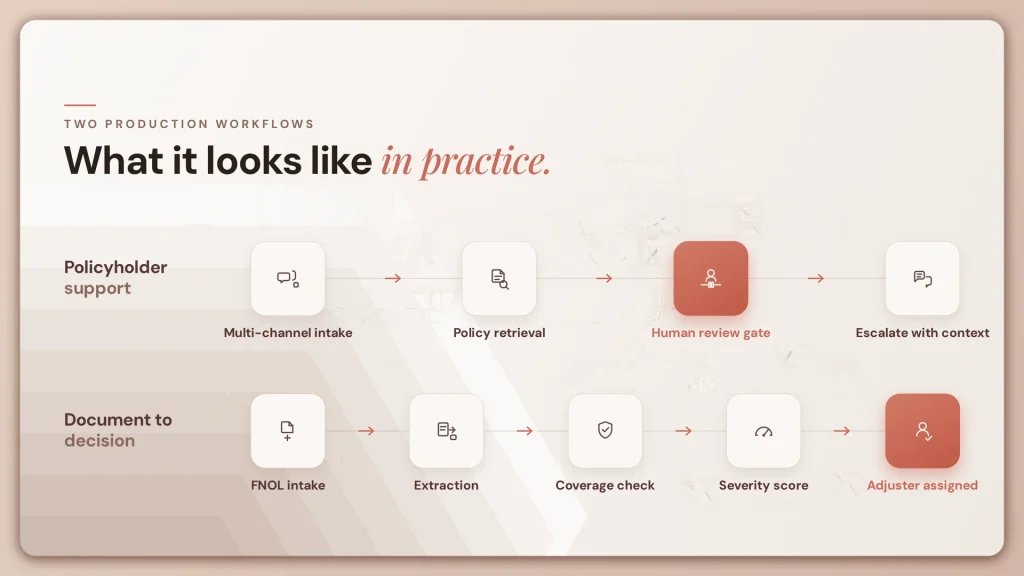
A global insurance provider needed to handle policyholder support across markets without adding headcount every renewal season. The workflow: multi-channel intake across chat, voice, and email; retrieval from the insurer’s own policy documentation rather than generic knowledge; a drafted resolution presented through a human review gate for sensitive requests; and escalation that carries the full case history forward instead of forcing the customer to repeat themselves. The operational shift wasn’t a headcount cut, it was reassigning human attention to the fraction of cases that actually needed judgment, detailed further in the global insurer customer service workflow case study.
The second pattern is document-to-decision claims routing: FNOL intake, document extraction, coverage validation against the specific policy, severity scoring, and adjuster assignment, all before a human opens the file. This is the same chain covered in the claims processing use cases above, and it’s the workflow most carriers should attempt first, for reasons the next section makes explicit.
Third-party platforms in this space, including Shift Technology for fraud analytics and various carrier-built assistants at firms like Lemonade, have shaped market expectations for what “fast” looks like. The differentiator for enterprise carriers isn’t speed alone, it’s whether that speed survives a regulatory audit.
What regulated deployment actually requires
This is the part most guides skip, and it’s the part that decides whether an agent stays in production. Insurance is one of the industries where “the model hallucinated” is not an engineering postmortem, it’s a compliance incident.
Explainability in underwriting and claims decisions. A model that declines coverage or denies a claim needs a reasoned, auditable rationale attached to it. “The model said no” doesn’t hold up in front of a regulator, an ombudsman, or a court. Production agents need decision traces recording what data was retrieved, what reasoning was applied, and what policy language was cited.
Bias and fair-pricing controls. Underwriting and pricing agents that ingest proxy variables can produce disparate impact even without touching protected attributes directly. Under the EU AI Act (Regulation (EU) 2024/1689), AI systems used for risk assessment and pricing in life and health insurance are classified as high-risk under Annex III. That compliance deadline was originally set for August 2, 2026. The deferral pushes compliance for standalone high-risk AI systems (Annex III) from August 2, 2026, to December 2, 2027, under the Digital Omnibus on AI, which entered into force on July 27, 2026. In the US, twenty-five states and the District of Columbia have adopted the NAIC Model Bulletin since December 2023, and its expectations extend across underwriting, rating, pricing, claims administration, and fraud detection. This section is factual guidance, not legal advice; confirm current obligations with counsel.
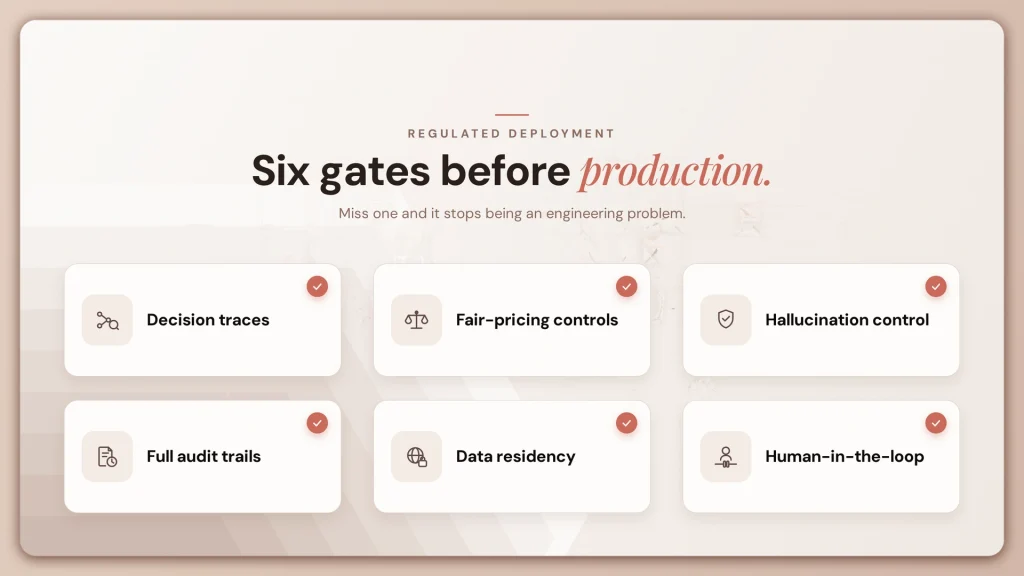
Hallucination control on policy language. An agent that paraphrases a coverage term incorrectly creates a misrepresentation exposure. Production agents need grounding in the actual policy wording, retrieval verification, and refusal behavior when confidence is low, which is the specific job of Lyzr’s Hallucination Manager.
Full audit trails. Every agent action, data access, and decision needs logging with timestamps and version metadata, retained per record-keeping requirements and retrievable on examination. This is the operational core of Lyzr’s Control Plane.
Data residency and deployment control. Policyholder data carries residency requirements that vary by jurisdiction, and health insurance layers HIPAA on top in the US. Agents need to be deployable in the insurer’s own VPC, on-premise, or in a sovereign environment, which is where Lyzr’s sovereign AI deployment model applies. Carriers running on major cloud stacks have specific patterns for this, covered in guides for Azure, AWS, Oracle Cloud, and IBM Cloud.
Human-in-the-loop gates at the right points. Not every decision should run autonomously. Escalation triggers need explicit definition: high-value payouts, conflicting evidence, fraud indicators above threshold, coverage disputes, vulnerable-customer flags, and any direct customer request for a human. The broader framework for this is covered in AI agent governance.
None of this is theoretical. Two-thirds of the $5.08 billion in annual insurtech funding in 2025 flowed to AI-focused companies, according to Gallagher Re’s Q4 2025 Global InsurTech Report, marking the most significant year for AI in the insurance sector yet. And the incumbents are moving too: ERGO Group AG, Munich Re’s primary insurance business, completed its acquisition of NEXT Insurance, a technology-first Property & Casualty insurer focusing on US small business owners, in July 2025, a deal valued 100% of NEXT Insurance’s shares at $2.6 billion.
How to start
Pick a high-volume, bounded process first. Claims intake and triage, or policy servicing, are the standard entry points because volume is high, the process is well-documented, and a mistake is recoverable. Underwriting and pricing should not be the first deployment; the regulatory surface there is the largest in the value chain.
Ground the agent in your own documentation before anything else. Policy wordings, underwriting guidelines, claims manuals, jurisdictional requirements, all pulled into a proper knowledge base rather than left for the model to infer. An agent grounded in generic training data will be confidently wrong about your specific coverage terms.
Instrument before you scale. Decide what you’ll measure (cycle time, straight-through rate, escalation rate, accuracy against a human-reviewed sample) and how you’ll log it, before the agent touches live volume. The opportunity is not small: a 2019 Business Insider Intelligence analysis projected that AI-driven solutions could save the insurance sector up to $400 billion, a seven-year-old projection that still frames why carriers keep investing, even if it shouldn’t be read as a current figure.
Define the escalation policy with compliance in the room, not after deployment. The escalation thresholds are a compliance artifact, not an engineering configuration decided in isolation. Lyzr’s agents to production playbook and the library of 100+ insurance agent use cases both walk through this sequencing in more depth.
Teams building their first agent can try out our platform now in Agent Studio: name the agent, choose your preferred LLM provider and model, and outline the instructions or idea to get started before connecting it to a live system. For a comparison of how this plays out in an adjacent regulated sector, the Banking Playbook offers a practical guide for scaling agentic AI from pilot to production. Lyzr’s broader platform, and Lyzr AI more generally, make it possible to start with one bounded agent and expand from there rather than committing to a full value-chain rollout on day one.
Frequently asked questions
What are AI agents in insurance?
Autonomous systems that interpret insurance data, make context-based decisions, and execute multi-step workflows like claims triage, underwriting support, and policy servicing with minimal human intervention.
What are examples of AI agents in insurance?
Claims intake and triage agents, underwriting data aggregation agents, fraud detection agents, policy endorsement processing agents, renewal churn predictors, and policyholder support agents.
Will AI replace insurance agents?
No. AI agents automate documentation, lookup, and routine servicing. Human agents retain relationship management, complex risk advisory, and judgment-dependent decisions. The role shifts toward advisory work rather than disappearing.
What is the best AI for insurance agents?
For individual brokers, tools that handle document processing, call transcription, and CRM updates. For carriers and enterprise agencies, a governed agent platform that integrates directly with core policy and claims systems.
How is AI used in insurance underwriting?
Agents aggregate submission data, normalize it into structured risk profiles, and surface recommendations with reasoning attached. The underwriter approves. Full autonomy in underwriting carries significant regulatory exposure under current rules.
What is conversational AI for insurance?
Chat and voice interfaces that handle policyholder inquiries in natural language. AI agents extend this by taking action in core systems, not just answering questions and handing off.
How do AI agents in health insurance work?
They handle claims validation against plan terms, prior authorization intake, eligibility verification, and member support. HIPAA compliance and data residency are gating requirements before any of this goes live.
Are AI agents in insurance regulated?
Yes. The EU AI Act classifies insurance pricing and risk assessment in life and health lines as high-risk. US insurers face NAIC model bulletin expectations and state-level requirements that vary by jurisdiction.
How long does it take to deploy an AI agent in insurance?
A bounded process like claims triage can reach production in weeks. Timelines depend on core system integration, data readiness, and compliance review, not model capability alone.
What is the difference between AI agents and RPA in insurance?
RPA follows fixed scripts on structured data. AI agents reason over unstructured documents, adapt to novel cases, and escalate with context attached when confidence is low.
Where this leaves an operations leader
The insurers pulling ahead in 2026 aren’t the ones with the most agents deployed. They’re the ones who can produce, on demand, a defensible answer for why every agent made the decision it made. That capability is what turns a pilot into permanent infrastructure.
The question worth sitting with isn’t whether your organization should deploy AI agents in insurance. It’s whether your compliance team could survive an audit of the one you’d deploy first. Start there, pick the bounded process, and build the audit trail before you build the scale.
See how Lyzr deploys governed AI agents for insurers. Book a demo.
Book A Demo: Click Here
Join our Slack: Click Here
Link to our GitHub: Click Here