Your prospect has probably already compared your product against two competitors, watched a demo on a review site, and pinged a colleague on Slack to ask “has anyone used this?”
Your CRM doesn’t know any of that happened yet.
This is the gap that breaks most sales funnels in 2026. Not because the concept is outdated, but because the mental model most teams still use assumes a buyer who waits patiently at each stage for a rep to move them forward. That buyer doesn’t really exist anymore, if it ever fully did.
The funnel itself isn’t dead. The linear version of it is.
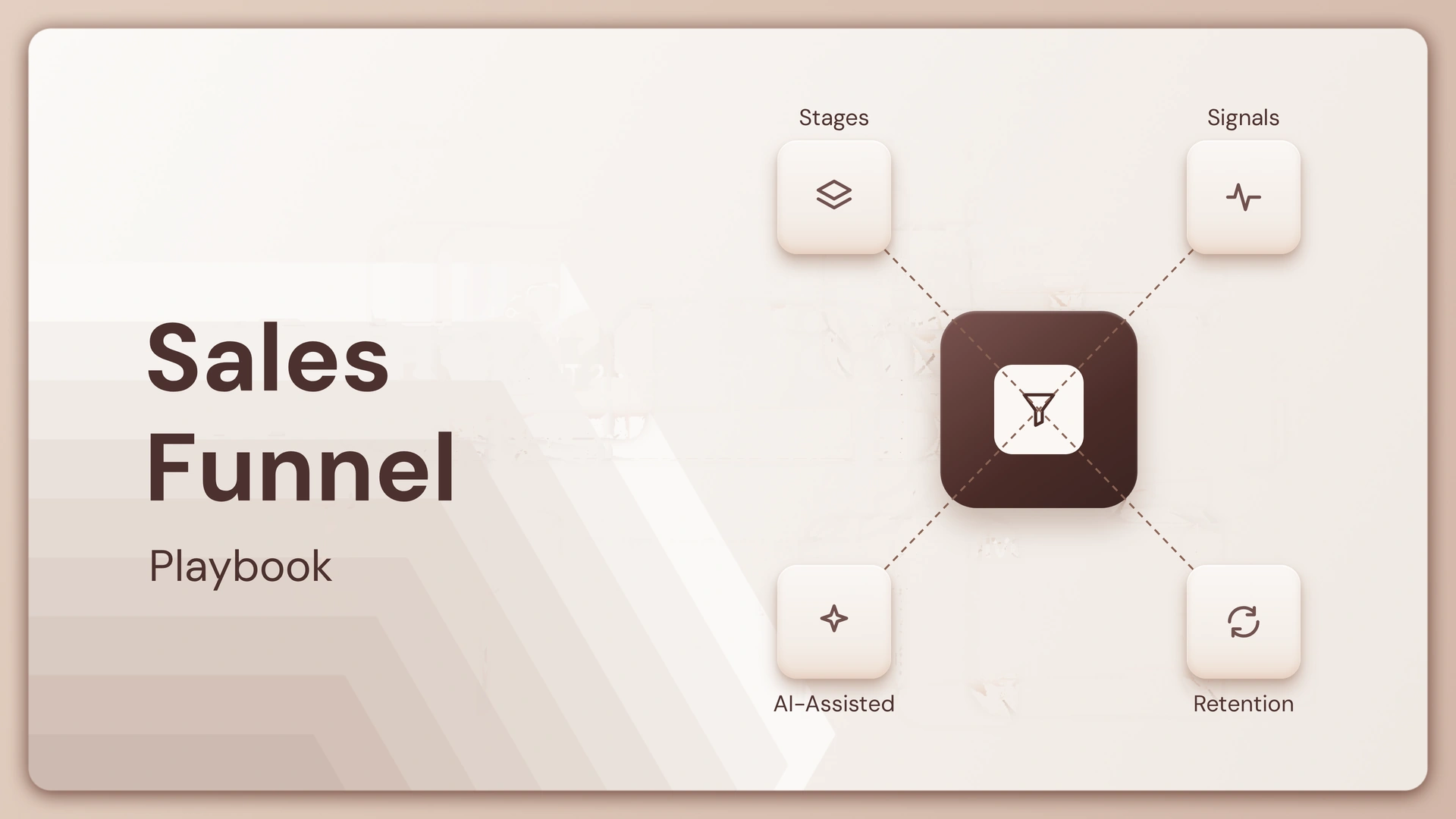
This guide walks through what a sales funnel actually is, how the traditional stage model works, why the 2026 buying journey looks more like a loop than a chute, and where AI genuinely helps, without pretending it replaces the humans running the deal.
A sales funnel is a framework for how potential buyers move from initial awareness of a problem toward evaluation, purchase, and retention. In 2026, that movement rarely happens in a straight line. Buyers research independently, loop back between stages, involve multiple stakeholders, and expect self-service options long before they talk to a sales team.
What is a sales funnel?
A sales funnel is a model that represents how prospects move from first learning about a solution to becoming a paying, retained customer. It gives marketing and sales a shared vocabulary for where a buyer stands and what has to happen next.
The funnel matters for three practical reasons. It lets you measure conversion between stages instead of just counting closed deals. It exposes where prospects drop off, so you know whether the problem is lead quality, messaging, or a stalled evaluation. And it gives sales teams and marketing a common reference point instead of two separate views of the same buyer.
Marketing typically owns the top of the funnel. Sales typically owns the middle and bottom. The funnel is the handoff map between them, which is exactly why it breaks down when buyers stop moving through it in order. As the initial pool of prospects narrows on the way to a decision, the funnel is what lets you see where that narrowing is happening and why.
Sales funnel stages
Before looking at what has changed, it helps to have the foundation everyone is working from. Most teams today describe the funnel in seven stages, an expanded version of the classic awareness-interest-decision model:
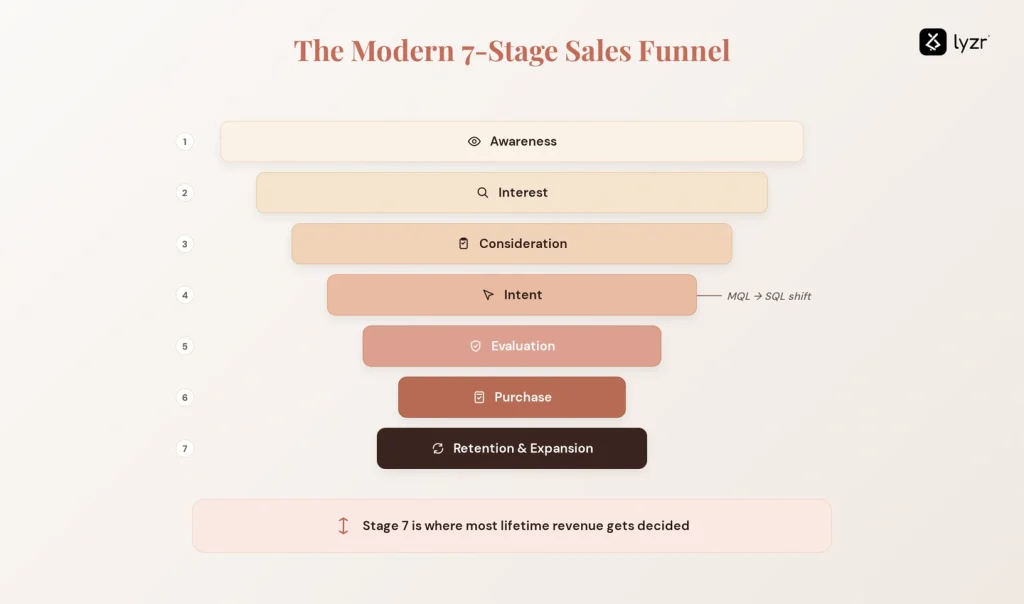
Awareness – the prospect recognizes a problem or opportunity and becomes aware that solutions exist.
Interest – they start actively researching, reading content, and forming an initial point of view on what “good” looks like.
Consideration – they narrow the field to a shortlist and begin comparing options against their requirements.
Intent – stronger signals appear: a demo request, a pricing page visit, a free trial signup. These signals often mark the shift from marketing-qualified to sales-qualified leads, prospects actively researching a specific solution and ready for more targeted outreach.
Evaluation – the buyer, often a group of buyers, validates capability, security, pricing, and implementation effort.
Purchase – procurement, negotiation, and the final decision.
Retention and expansion – onboarding, adoption, renewal, and the opportunities to expand or lose the account after the deal closes.
That seventh stage is the one legacy funnel diagrams left out entirely, treating the sale as the finish line. In a subscription or usage-based business, it’s often where the majority of lifetime revenue actually gets decided.
How the sales funnel has changed from then to now
The stages haven’t disappeared. The way buyers move between them has changed.
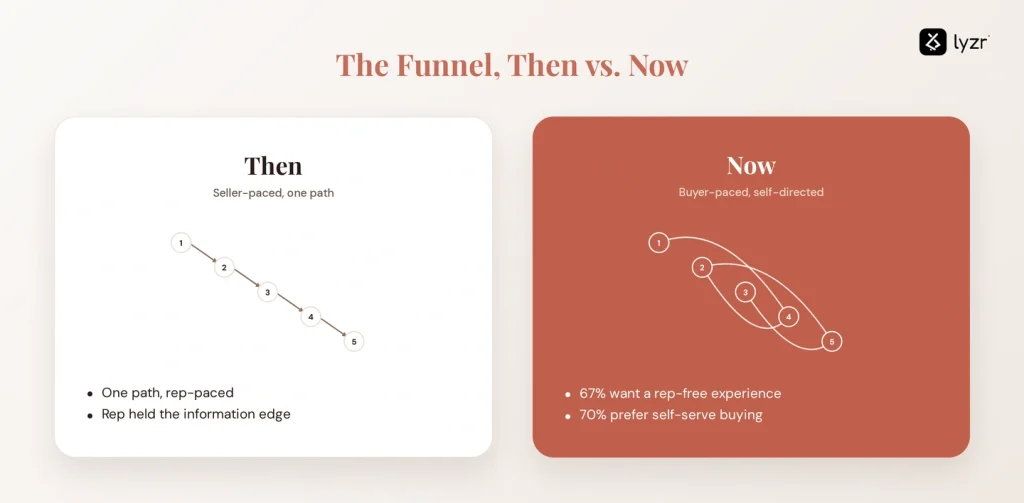
The traditional funnel assumed a seller-controlled sequence: a rep qualified the lead, controlled what information the prospect received, and walked them stage by stage toward a decision. Information was scarce enough outside that conversation that the rep held real leverage.
That leverage has shifted. Buyers now arrive at a sales conversation already having formed opinions from vendor websites, review sites, peer conversations, and content they found without any sales involvement. A prospect can watch a recorded demo, read a comparison page, and consult two colleagues before your team logs a single touchpoint.
That’s not a minor tweak to the model. It means a buyer can jump from Awareness straight into a self-directed Evaluation, then loop back to Consideration when a new stakeholder joins the deal and raises a requirement nobody had flagged. Sixty-seven percent of buyers prefer a sales rep-free experience, while 70% prefer a completely digital, self-service buying experience, according to Gartner’s research presented at its 2026 CSO & Sales Leader Conference. A linear, seller-paced funnel simply doesn’t describe how that buyer behaves.
What does a modern sales funnel look like?
The 2026 funnel is better understood as a loop than a chute: Awareness and signals, Interest and education, Consideration, Intent, self-service evaluation, buying committee engagement, Purchase, and Retention and expansion, each stage capable of feeding back into an earlier one.
A buyer might move from Awareness directly into self-service evaluation, downloading a spec sheet and running a trial with no sales contact at all. An Evaluation can send the deal back to Consideration the moment a security or procurement stakeholder joins and applies a requirement the original champion never mentioned. A Purchase can open straight into a new buying journey, when the account expands into a different team or use case and effectively restarts at Awareness for a new buyer.

Enterprise deals make the committee stage especially visible. A B2B sale involving multiple stakeholders rarely has one buyer moving through the funnel; it has several, each entering and re-entering at different points, which is a large part of why longer enterprise buying cycles feel harder to forecast than the funnel diagram implies.
What makes a modern sales funnel data-driven?
A data-driven sales funnel treats buyer behavior as a signal source, not just a stage label. Instead of assuming everyone in “Consideration” is at the same point, it looks at what they’ve actually done.
Relevant signals include website behavior, content engagement, email opens and clicks, product usage for trial or freemium users, demo activity, third-party intent data, CRM history, firmographic details like company size and industry, and how many stakeholders from one account are engaging at once.
Revenue teams use those signals to prioritize which leads a rep should call first, spot intent before a prospect fills out a form, personalize outreach based on what someone has actually looked at, find the exact stage where the funnel is leaking prospects, and forecast conversion with more precision than a stage-based guess. Data-driven tools that uncover patterns and trends across large volumes of behavioral data can surface leakage points a manual review would miss entirely.
This is also the context for Gartner’s most frequently cited prediction in this space. By 2026, 65% of B2B sales organizations will transition from intuition-based to data-driven decision making, using technology that unites workflow, data and analytics, according to Gartner’s original 2022 forecast. That’s a prediction about direction and pace, not a claim that two-thirds of sales orgs have already arrived. Most are still mid-transition.
How AI is transforming the sales funnel
AI doesn’t replace the funnel. It makes the funnel more observable, personalized, and responsive, by turning raw signals into something a marketing or sales team can actually act on before the moment passes.
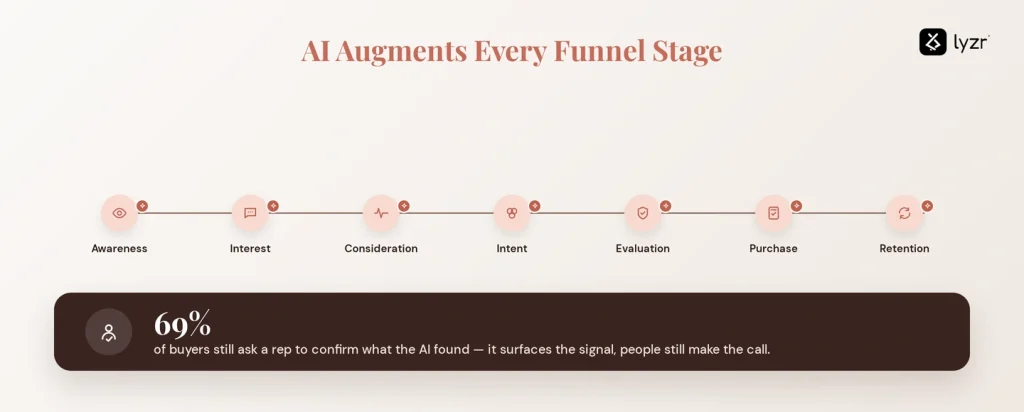
Mapped stage by stage:
Awareness – AI helps identify which audiences are showing early problem-aware behavior and personalizes top-of-funnel content to match.
Interest – AI recommends relevant content based on what a visitor has already engaged with, and can answer initial questions through a chat interface.
Consideration – AI analyzes engagement patterns across a shortlist of prospects to flag which ones show real buying momentum versus casual browsing.
Intent – AI cross-references signals, a pricing page visit plus a demo request plus multiple visitors from one company, that a human reviewing one channel at a time would likely miss.
Evaluation – AI supports research and qualification with faster, more consistent answers, and can help reps prepare for stakeholder-specific conversations.
Purchase – AI assists with follow-up drafts, deal summaries, and automation of the administrative work around closing, freeing reps to focus on negotiation itself.
Retention – AI monitors product usage and engagement signals to flag accounts at risk of churning or ready for expansion.
Jazon, Lyzr’s AI SDR, is a concrete example of this working inside the outreach and qualification stages: it scores and routes leads based on fit and behavior, then hands off warmer conversations to a human rep rather than trying to close the deal itself. A separate documented case study on automating IT sales outreach shows the same pattern: AI compresses the time spent on repetitive qualification work, not the judgment calls that close deals.
Every one of those AI functions still depends on a rep or marketer deciding what to do with the signal. Gartner found that 69% of buyers still turn to a salesperson to validate the insights AI gave them, at critical moments in the journey. AI surfaces the signal faster. People still make the call. That is broadly consistent with how the State of AI Agents in Enterprise: 2026 report describes where AI agents are actually landing inside revenue workflows this year, augmenting judgment rather than replacing it.
AI sales funnel vs traditional sales funnel
An AI sales funnel isn’t a different structure from a traditional one. It’s the same seven stages, with AI applied at specific points to make the underlying process faster and more visible.
Traditional funnel vs AI-powered funnel, side by side
| Traditional | AI-powered |
|---|---|
| Manual lead scoring | AI-assisted scoring |
| Batch campaigns | Dynamic personalization |
| Manual follow-up | Automated workflows |
| Static segmentation | Behavioral signals |
| Limited visibility | Real-time signals |
| Sales-led qualification | Data-assisted qualification |
| Reactive engagement | Predictive, proactive engagement |
| Disconnected tools | Orchestrated workflows |
None of this makes the right-hand column automatically better. An AI-powered funnel built on incomplete CRM data, disconnected tools, or no governance around what AI is allowed to send unreviewed will underperform a well-run manual process. The benefit depends on data quality, integration, workflow design, and how much human oversight stays in the loop.
How to build a data-driven sales funnel
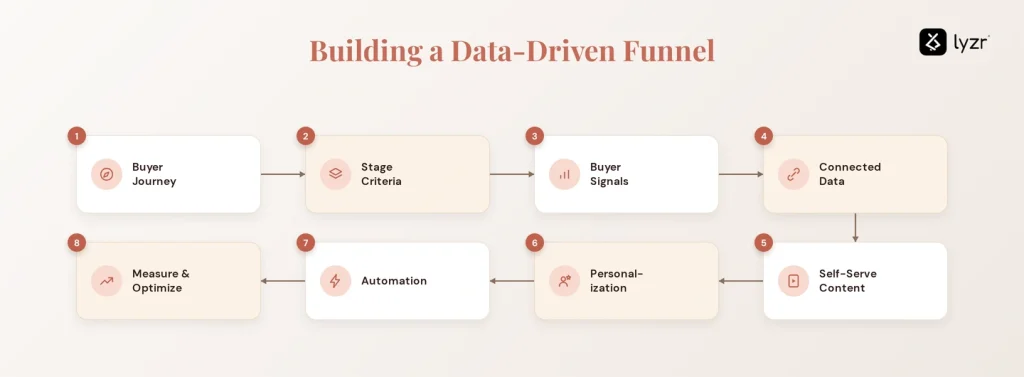
Eight steps, roughly in order:
- Define your buyer journey. Who actually buys, why, and what information do they need at each point.
- Define funnel stages with clear entry and exit criteria, not just labels everyone interprets differently.
- Identify the buyer signals that indicate movement between stages, not just form fills.
- Connect your data. CRM, marketing automation, product usage, and support data need to talk to each other, or every downstream step is guessing.
- Build self-service resources. Pricing pages, blog content that answers real questions, product demos, comparison pages, ROI calculators, and trials. Video created with an AI video maker or through dedicated software video production services can turn a static demo request into something a buyer watches on their own schedule, and an AI infographic generator helps translate a technical capability into something a non-technical stakeholder on the buying committee can digest quickly. Sharing a trackable link PDF of specs or security documentation also lets evaluation-stage buyers self-serve the exact detail procurement needs.
- Personalize engagement using actual buyer context, industry, role, prior engagement, rather than one generic sequence for everyone in a segment.
- Automate the repetitive workflows where AI genuinely adds speed: lead routing, outreach sequencing, and follow-up drafts. This is exactly where a sales enablement approach and AI tooling overlap, and where well-timed email marketing campaigns keep a self-directed buyer engaged between touchpoints.
- Measure and optimize conversion between stages and where prospects loop back, not just the final close rate.
For teams still building the trust layer of that self-service stage, many SaaS companies now pair a free trial or demo with proof of value before asking for a subscription commitment, precisely because buyers want to validate a claim before a sales conversation, not during one.
How to measure sales funnel performance
Don’t try to track everything. Focus on the metrics that tell you where the funnel is actually breaking.
Funnel-level: lead-to-opportunity conversion, opportunity-to-customer conversion, overall funnel conversion, sales cycle length, pipeline velocity.
Stage-level: stage conversion rate, average time spent in stage, drop-off rate, and re-engagement rate for prospects who loop back after going quiet.
Revenue-level: customer acquisition cost, customer lifetime value, average deal size, and expansion or retention rate.
Conversion rate is the metric most teams over-index on, but it only tells you the funnel worked, not where it nearly didn’t. Stage-level drop-off and time-in-stage are usually more diagnostic. A shorter cycle and higher stage conversion generally point to a streamlined process, which shows up in both revenue and customer satisfaction downstream.
Common sales funnel mistakes
- Treating the funnel as strictly linear, so reps get confused when a buyer “skips” a stage that was never really skipped.
- Optimizing for lead volume instead of lead quality or fit.
- Ignoring intent signals that don’t fit neatly into a form field.
- Failing to account for buying committees, and pitching one champion as if they’re the only decision-maker.
- Pushing buyers into a sales conversation before they’ve done enough self-service research to have real questions.
- Hiding pricing when transparency would have shortened the evaluation stage.
- Fragmenting buyer data across marketing, sales, and product tools that never sync.
- Automating outreach without the context to make it feel relevant, which is exactly the behavior buyers say they actively avoid.
- Measuring only the final conversion number and missing where prospects actually drop off.
- Ignoring what happens after the sale, and losing the retention and expansion revenue that funnel was supposed to protect.
The future of the sales funnel through 2030
This section is forecast, not fact. Treat it as a reasonable direction, not a roadmap.
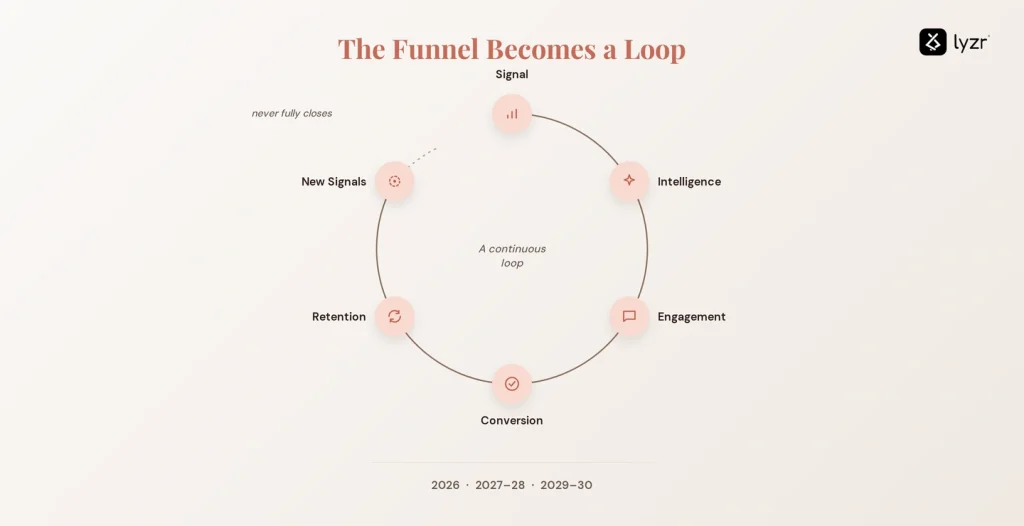
2026: data-driven funnels and AI-assisted workflows move from early-adopter territory into mainstream GTM practice, largely because the underlying data infrastructure, CRM, product usage, intent data, has matured enough to support it.
2027 to 2028: expect more real-time buyer signal detection, tighter loops between marketing and sales data, and journeys personalized to the individual account rather than the segment.
2029 to 2030: deeper orchestration across marketing, sales, customer success, and AI agents working alongside human teams, less a handoff between departments and more a continuous system.
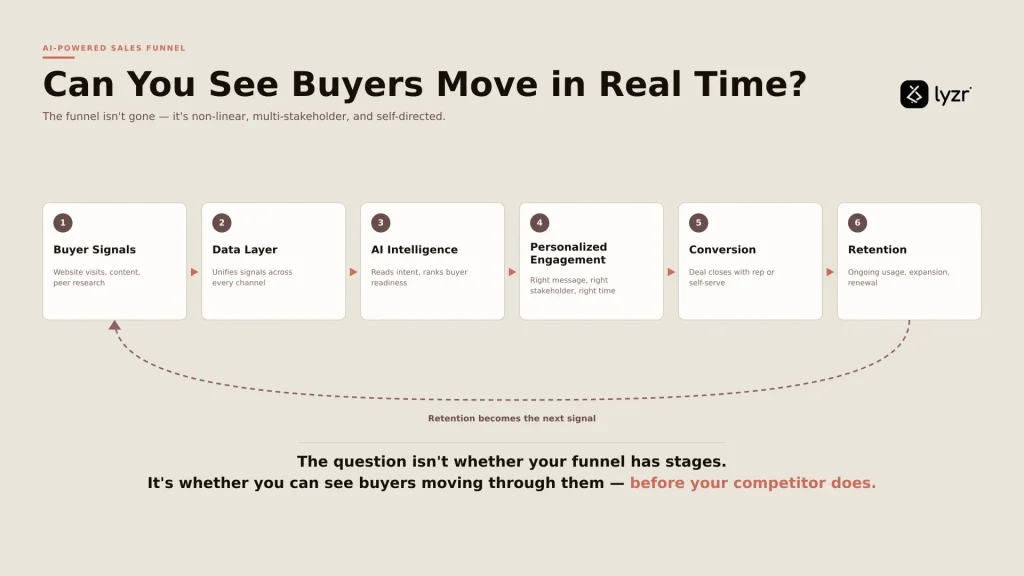
The underlying shift is from Marketing → Sales → Customer as separate departments passing a lead along, toward Signal → Intelligence → Engagement → Conversion → Retention → New signals, a loop that never fully closes.
Don’t want to build this yourself?
Some GTM teams have the engineering bandwidth to connect CRM, product, and intent data into a working AI-assisted funnel from scratch. Most don’t, and the build-versus-buy decision usually comes down to how much of that infrastructure work is actually differentiating for your business versus just table stakes to get started.
Lyzr helps revenue teams set up a data-driven, AI-assisted funnel without that build. AI sales agents like Jazon connect to your existing CRM and outreach tools to handle scoring, routing, and follow-up drafting, while keeping a human in the loop for the decisions that need judgment. It’s the same approach behind Lyzr for Revenue and Sales Team: infrastructure that plugs into what you already run, rather than a rip-and-replace of your stack.
The goal isn’t a funnel that runs itself. It’s a funnel your team can actually see into and act on, faster than a spreadsheet and a gut check would allow.
Book a demo to see how it fits your current stack before deciding whether to build or buy.
Frequently asked questions
What is a sales funnel?
A sales funnel is a framework showing how potential buyers move from awareness of a problem toward evaluation, purchase, and retention. It gives marketing and sales a shared way to track where a prospect stands and measure conversion between stages.
What are the stages of a sales funnel?
Most funnels today use seven stages: awareness, interest, consideration, intent, evaluation, purchase, and retention and expansion, though the exact number varies by business model and deal complexity.
How has the sales funnel changed in 2026?
The stages themselves are largely the same. What’s changed is that buyers now move between them non-linearly, researching independently, looping back after new stakeholders join, and reaching Evaluation before a rep even knows they exist.
What is an AI sales funnel?
An AI sales funnel is a standard funnel enhanced with AI at specific points, lead scoring, behavioral signal analysis, personalized content, and follow-up automation, rather than a fundamentally different structure.
How does AI improve a sales funnel?
AI improves a sales funnel by surfacing buyer signals faster and more consistently than manual review, enabling more personalized engagement and quicker response times. It supports the humans running the funnel; it doesn’t replace their judgment on when and how to engage.
What is a data-driven sales funnel?
A data-driven sales funnel uses signals like website behavior, product usage, email engagement, and CRM history to prioritize leads, personalize outreach, and identify where prospects are dropping off, instead of relying on assumptions about where a buyer “should” be.
What is the difference between a sales funnel and a sales pipeline?
A sales pipeline is the seller’s internal view of deals and the actions needed to move them forward. A sales funnel is the buyer’s view of their own journey from awareness to decision, measured by stage conversion rather than rep activity.
How do you measure sales funnel performance?
Track stage-level conversion and time-in-stage to find where the funnel breaks, funnel-level metrics like lead-to-opportunity conversion and sales cycle length for overall health, and revenue metrics like CAC and LTV to connect funnel performance to business outcomes.
How do you build a sales funnel?
Start by defining your buyer journey and funnel stages with clear entry and exit criteria, identify the signals that indicate real movement between stages, connect your data sources, build self-service resources, and then automate and measure from there. This is also where a clear marketing strategy and a defined sales funnel approach need to be built together rather than in isolation, and where a lead generation motion feeds directly into how the funnel gets prioritized.
What are the biggest sales funnel mistakes?
The most common mistakes are treating the funnel as strictly linear, chasing lead volume over lead quality, ignoring buying committees, and measuring only the final conversion rate instead of where prospects actually drop off along the way.
Where this leaves you
The sales funnel isn’t a relic you need to replace with something entirely new. It’s a model that needs updating to match how your actual buyers behave, which for most B2B companies now means non-linear, multi-stakeholder, and partly self-directed before a rep ever gets involved.
The question worth sitting with isn’t whether your funnel has stages. It’s whether you can actually see a buyer moving through them, in real time, across every channel they’re using, before your competitor does.
Book A Demo: Click Here
Join our Slack: Click Here
Link to our GitHub: Click Here