A rep who spent four hours a day on research and CRM entry six years ago spends maybe forty minutes on it now.
The tools that got them there weren’t dramatic. Lead scoring models. Auto-generated call summaries. A chatbot that qualifies a website visitor before a human ever sees the lead.
That was AI in sales for most of the last decade: useful, bounded, assistive. It sped up what a person was already doing.
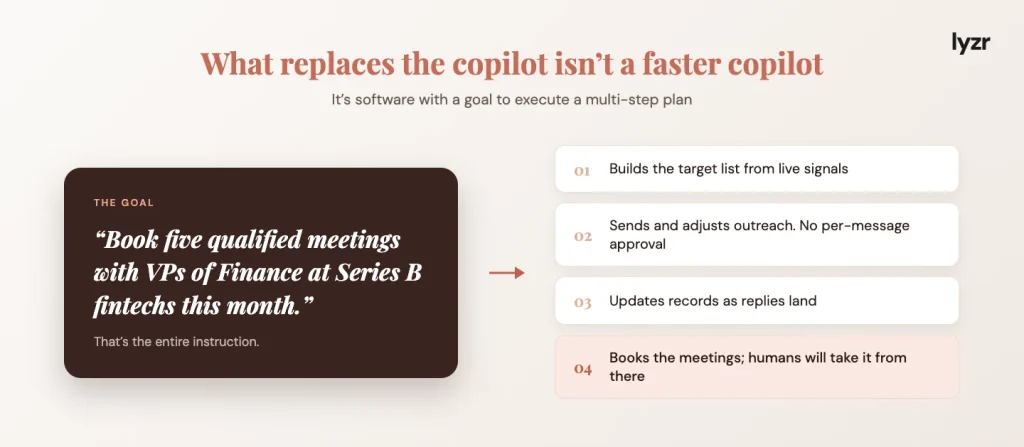
That era is ending. What’s replacing it isn’t a faster copilot. It’s software that can be handed a goal, “book five qualified meetings with VPs of Finance at Series B fintechs this month,” and go execute a multi-step plan against it, updating records and adjusting outreach without a person approving every message. That’s the shift this piece is built around, and it’s also the shift Lyzr’s blog on enterprise AI agents tracks across every revenue function.
The question worth sitting with isn’t whether AI helps sales teams anymore. Almost everyone has answered that. It’s this: once an agent can act on its own inside a live pipeline, who decided it was allowed to, and how would you know if it went wrong.
TL;DR
- AI in sales has moved past chatbots and dashboards into agentic systems that plan, act, and update the CRM without a human triggering every step.
- The useful question isn’t “what can AI help with” anymore. It’s what AI should execute, what a human must own, and how that execution gets governed.
- 87% of sales organizations currently use some form of AI for tasks like prospecting, forecasting, lead scoring, or drafting emails, but adoption and production-readiness are not the same thing.
- Buyers evaluating an AI sales tool need a framework for human-agent boundaries and governance, not another feature list.
What is AI in sales?
AI in sales is the application of machine learning, natural language processing, and increasingly autonomous software agents to sales tasks like prospecting, qualification, forecasting, and customer communication. It replaces manual pattern-matching and repetitive execution with systems that learn from historical deal data and act on it.
It matters now because the volume problem in sales has outgrown human bandwidth. Reps carry more accounts, buyers expect faster and more relevant outreach, and pipeline data sits scattered across a CRM, an inbox, and a call recorder that nobody fully reconciles.
87% of sales organizations currently use some form of AI for tasks like prospecting, forecasting, lead scoring, or drafting emails.
As adoption climbs, the scope of AI sales keeps expanding, from scoring and drafting to autonomous execution across the funnel. The rest of this piece is about what happens after that adoption number, when “using AI” starts to mean letting it act.

The evolution of AI in sales: from automation to agents
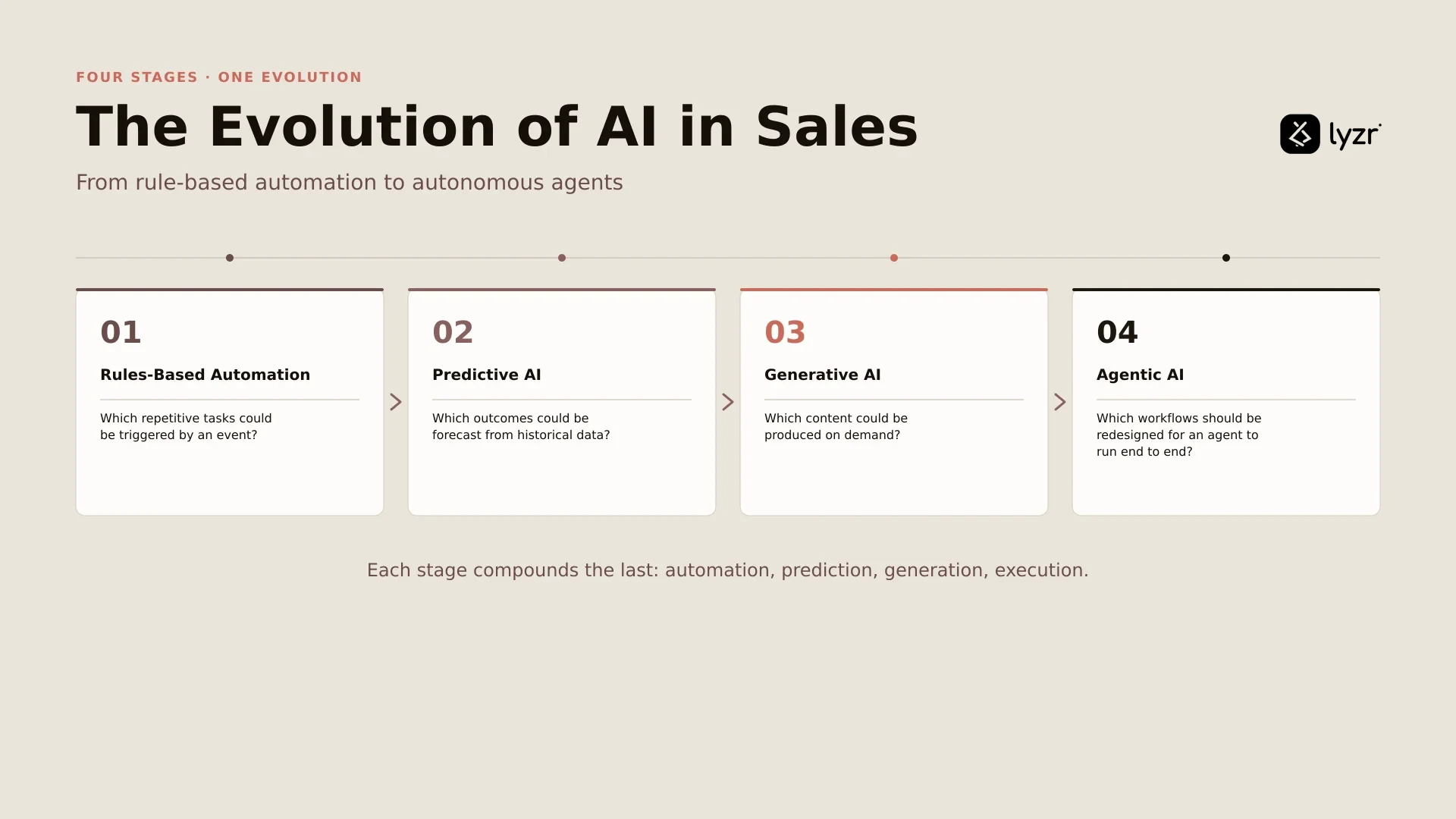
Every wave of AI in sales changed a different question sales leaders had to answer. Four stages, each building on the last:
Rules-based automation asked which repetitive tasks could be triggered by an event. A stage change fires a follow-up email. A form fill triggers a Slack alert. No learning, no judgment, just if-this-then-that logic running a CRM workflow.
Predictive AI asked which outcomes could be forecast from historical data. Lead scoring models learned from thousands of closed-won and closed-lost deals to rank which new leads looked like past winners. This is where sales forecasting AI earned its seat at the revenue table, because it turned gut-feel pipeline reviews into probability-weighted numbers.
Generative AI asked which content and communication could be produced on demand. Draft this email. Summarize this call. Write three subject line variants. It didn’t decide anything, it produced material for a human to review and send.
Agentic AI asks a different question entirely: which workflows should be redesigned so an agent runs the whole thing, end to end, inside defined boundaries.
Gartner predicts up to 40% of enterprise applications will include integrated task-specific agents by 2026, up from less than 5% today.
That’s not a prediction about smarter chatbots. It’s a prediction about software that plans and executes without waiting for a prompt at every step, the definition that separates an AI agent from a tool that merely assists one.
Practical use cases of AI in sales
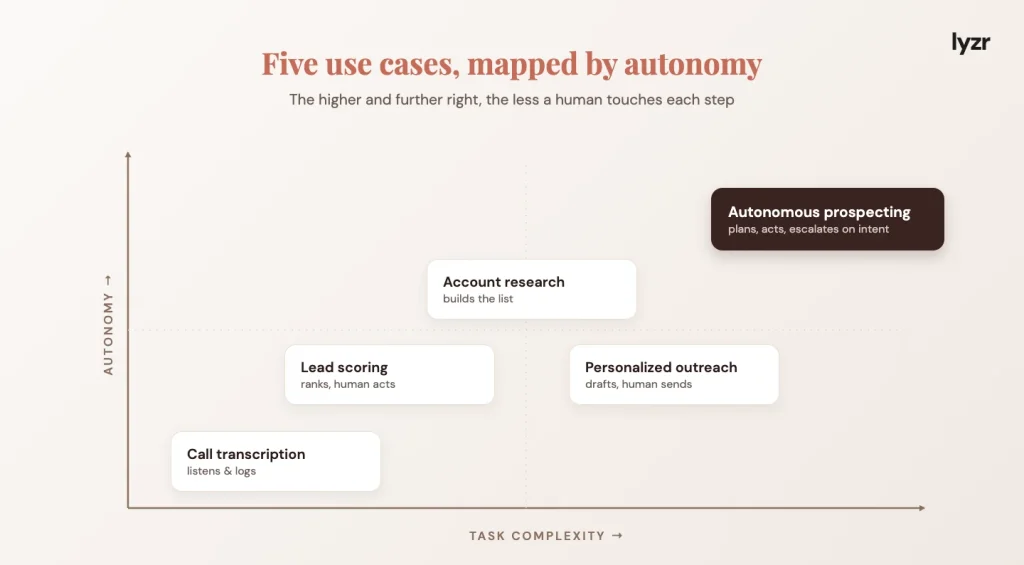
Five sales motions show the actual range of AI capability today, from tasks a model just speeds up to tasks an agent now owns outright. This is the operational core of AI sales, not a bolt-on feature.
Account and prospect research
AI does the work of finding and qualifying target accounts. A model ingests firmographic data, funding events, and hiring signals, then ranks companies against an ideal customer profile. A rep who used to spend a day building a target list can get a scored, sourced spreadsheet in minutes. The outcome is time reclaimed, not a better list in theory, an actual list a rep starts working from that morning.
Lead scoring and prioritization
AI does the ranking work reps used to do by instinct. A predictive model trained on closed deals weighs signals like page visits, title, and company size, then surfaces which leads deserve a senior AE’s time today instead of next week. Get this wrong and reps burn cycles on leads that were never going to close, which is exactly the failure mode that pushed teams toward AI lead generation scoring in the first place.
Personalized outreach at scale
Generative AI drafts messages informed by real signals, a funding round, a leadership change, a specific pain point from a case study. A rep prompts for an opening line referencing a prospect’s recent announcement instead of writing twenty near-identical emails by hand. The outcome is a higher reply rate, because the message reads like it was written by someone who looked the prospect up.
Sales-call transcription and summarization
AI listens, transcribes, and extracts commitments, objections, and next steps from a call, then writes them into the CRM automatically. A rep walks out of a discovery call and the deal record is already updated with a summary and a next action, no typing required.
Autonomous prospecting and follow-up
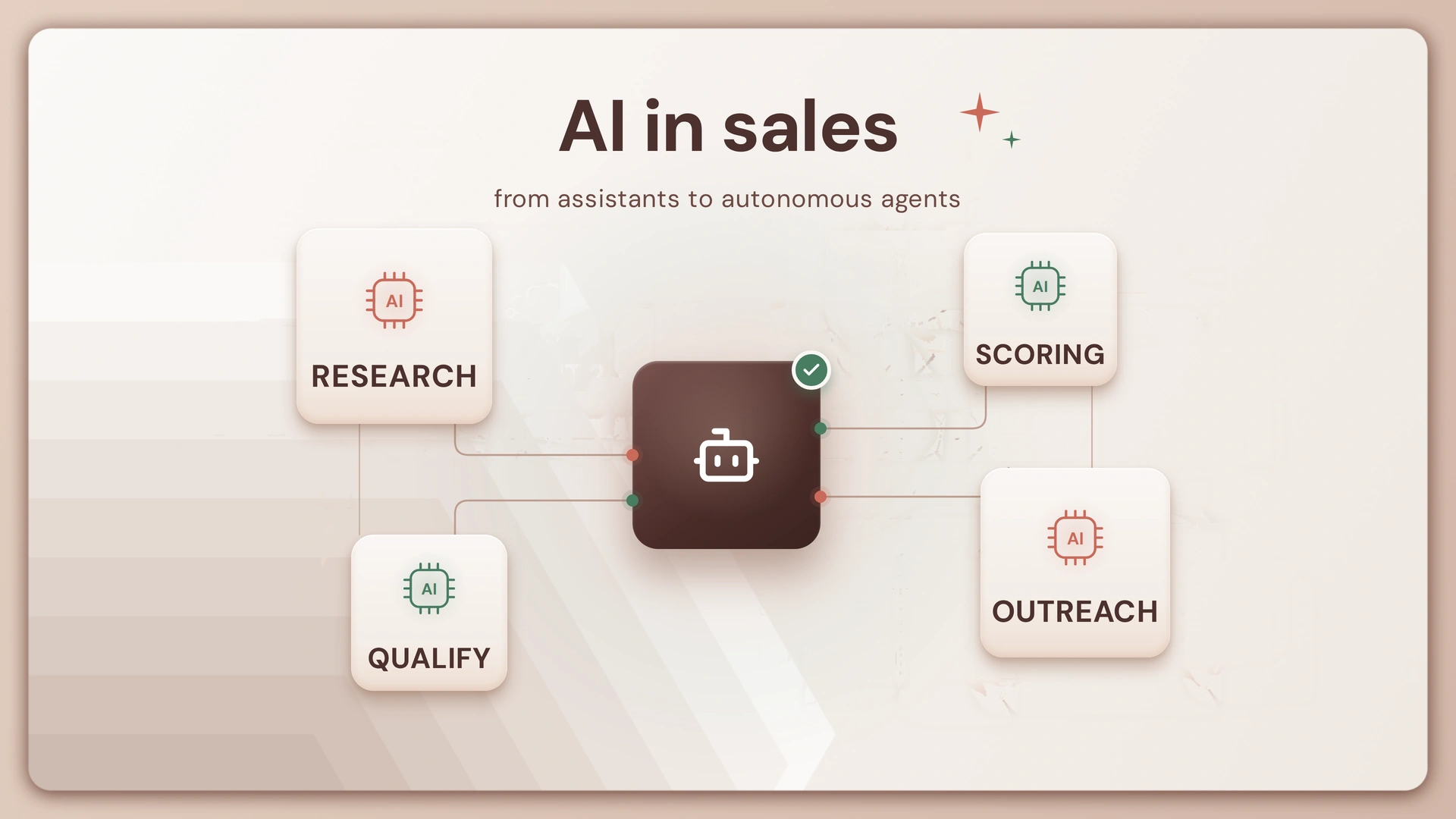
This is where the agent stops assisting and starts executing. An AI agent, functioning like a digital Sales Development Representative (SDR), can research a target account, draft and send outreach, interpret a reply, handle a “not now” objection with a scheduled follow-up, and only escalate to a human once a prospect shows real buying intent. Lyzr’s Jazon is built around exactly this motion, running research-to-outreach as one continuous workflow instead of five separate tools a rep has to stitch together.
The pattern across all five: the earlier examples make a task faster for a person. The last one removes the person from the loop until a decision actually matters.
AI assistants vs. AI agents: what’s the difference?
An assistant waits for a prompt at every step. An agent works toward a goal across several steps without one.
Assistants vs. agents at a glance
| Capability | AI assistant/copilot | AI agent |
|---|---|---|
| Trigger | Human prompts each action | Given a goal, plans its own steps |
| Autonomy | Low, one task at a time | High, chains tasks toward an outcome |
| Memory | Limited to the current session | Persists context across a workflow |
| Tool use | Usually one interface | Calls multiple tools: CRM, email, calendar, search |
| Output | A draft for a human to approve | A completed action, logged for review |
| Failure mode | Wrong draft, low cost | Wrong action taken at scale, higher cost |
Take one scenario: fifty webinar attendees asked questions during a live session and now need follow-up. An assistant drafts one email at a time when a rep asks it to, and the rep still copies, personalizes, and sends each one. An agent, given the goal “follow up with every attendee who asked a question, personalize based on their question, and offer a meeting to anyone who responds positively,” researches each attendee, sends the outreach, reads the replies, books meetings on qualified responses, and surfaces only the ones worth a human’s judgment. Both use AI sales agents language in their marketing. Only one of them removes the manual step in the middle.

Where should AI make decisions vs. where should humans?
AI should own the decisions that are data-heavy, repetitive, and reversible. Humans should own the decisions that are ambiguous, relational, or expensive to get wrong.
The human-agent decision framework
| Decision area | AI executes and decides | Humans own and decide |
|---|---|---|
| Pipeline research | Account research and signal aggregation | Deal strategy and negotiation posture |
| Deal economics | Lead scoring and prioritization | Pricing exceptions and contract terms |
| Buyer conversations | Repetitive outreach sequencing | Reading unspoken tension in a buying committee |
| Account records | CRM data entry and call summarization | Escalation calls with an unhappy customer |
| Data judgment | Pattern recognition across large data sets | High-stakes, low-frequency judgment calls |
This is the boundary question that actually keeps CROs up at night, not “should we buy an AI sales tool” but “which of these ten decisions in our pipeline are we comfortable letting software make on its own.” Gartner’s own 2026 guidance points at the tension underneath that question:
Through 2026, atrophy of critical-thinking skills, due to GenAI use, will push 50% of the global organizations to require “AI-free” skills assessments.
This is a sign that fluent AI output and genuine judgment are not the same thing, and organizations are already building processes to tell them apart. A sales leader who can’t articulate where the line sits for their own pipeline is the one most likely to find an agent has drifted past it.

The business impact, risks and limitations of AI in sales
The upside is real and increasingly specific.
Sellers expect agents to cut prospect research time by 34% and email drafting by 36%, giving sales teams meaningful time back in their day.
That time doesn’t vanish, it moves toward selling.
85% of sales reps with agents say AI frees them to focus on higher-value work.
At the economic level, McKinsey’s modeling suggests sales productivity could increase by approximately 3-5% of current global sales expenditures, a modest-sounding figure that compounds fast at enterprise scale.
The risks sit right next to the upside, not somewhere abstract:
- Hallucination in customer-facing content. A generative model can invent a feature, a price, or a case study detail with total confidence. Unreviewed, that’s a compliance problem, not just an embarrassment.
- Data quality as the ceiling. An agent trained on messy CRM data will score, prioritize, and act on messy assumptions. Garbage in doesn’t just mean garbage out anymore, it means garbage acted on.
- Over-automation and brand tone. AI tools that send at scale without guardrails can make outreach feel mass-produced exactly when personalization was the point.
- Governance gaps. Gartner has warned that by the end of 2026, “death by AI” legal claims will exceed 2,000 due to insufficient AI risk guardrails, and a pipeline running autonomous outreach without oversight is precisely the kind of exposure that prediction describes.
None of this argues against AI in sales. It argues against buying it the way teams bought a CRM add-on, install it and hope.

What does production-ready AI in sales look like?
Production-ready means the system can be trusted with a live pipeline, not just a demo. That trust comes from six specific things a buyer can actually check for, not a feature checklist:
- Governance. Who can launch an agent, what can it touch, and what’s its spend ceiling. Fine-grained permissions, not a single admin toggle.
- Observability. Real-time visibility into what an agent is doing right now, not a weekly summary report after the fact.
- Audit trails. An immutable log of every action, every tool call, every decision an agent made, because when something goes wrong, “we’re not sure what happened” is not an acceptable answer to a compliance team.
- Guardrails. Hard limits, message frequency caps, do-not-contact enforcement, content filters, so autonomy has edges.
- Human-in-the-loop checkpoints. Defined moments where a person approves before an agent proceeds, not everywhere, but somewhere deliberate.
- Data and integration depth. Secure, two-way connections into the CRM and communication stack the agent actually needs to act inside, evaluated with the same AI agent framework rigor a buyer would apply to any other production system.
This is where the evaluation conversation stops being about the flashiest demo and starts being about which vendor can answer these six questions with specifics instead of marketing language. Any team shopping AI sales software should be asking for this list before a contract, not after an incident.

The future of AI in sales: from AI tools to AI-native sales systems
The next shift isn’t more AI features bolted onto a CRM. It’s sales teams built around agents as a structural layer, not an add-on.
In that structure, a human sets strategy and owns the boundary decisions from the framework above. AI agents run the volume work, research, sequencing, qualification, handing off only when a conversation crosses into judgment territory.
Gartner’s best case scenario projects agentic AI could drive approximately 30% of enterprise application software revenue by 2035, surpassing $450 billion, up from 2% in 2025.
That’s not a forecast about better tools. It’s a forecast about a different operating model for revenue teams.
How Lyzr enables this shift
Lyzr’s approach starts from the governance layer, not the demo layer, permissions, audit trails, and guardrails built into the agent runtime rather than added afterward. Jazon runs on AWS infrastructure to handle the autonomous prospecting motion described earlier, researching accounts, sequencing outreach, and logging every action back to the CRM, while a sales leader keeps the boundary decisions where they belong. The goal isn’t a faster assistant. It’s a workflow a CRO can hand real pipeline to and still explain, to a board or a regulator, exactly how it’s controlled.
That’s the actual evaluation question for 2026: not which AI sales tool has the best interface, but which one you could defend in an audit.

Lyzr for Revenue and Sales Team
Frequently asked questions
How is AI used in sales?
AI is used across prospecting, lead scoring, personalized outreach, call summarization, forecasting, and increasingly, autonomous execution where an agent runs a multi-step workflow like research-to-outreach without a human triggering each step.
What is the 30% rule in AI?
It’s an informal industry heuristic, not a regulation or standard, suggesting AI should handle a defined slice of repetitive, data-heavy work while humans keep the rest for judgment and oversight. It’s not a regulation. There’s no ISO standard or legal requirement behind the number. In sales, it’s better read as a prompt to define your own boundary deliberately rather than a fixed target to hit.
Can AI do a sales job?
AI can execute large parts of a sales role, research, qualification, sequencing, follow-up, but a full sales job also involves negotiation, trust-building, and reading a room, which remain human work.
Will AI replace salespeople?
Not the role itself, but it is replacing the manual research and admin work inside that role. The bigger risk is a rep who doesn’t build fluency in directing agents, not the agent itself.
How to learn AI sales?
Start by using generative AI for drafting and research, then study how agentic workflows differ from single-prompt tools, and practice defining which decisions in your own pipeline you’d actually delegate.
How to use AI in retail sales?
Retail applies the same building blocks differently: personalized product recommendations, chatbot-driven customer service, inventory and demand forecasting, and behavior-based promotions at the point of sale.
How can AI boost sales?
AI boosts sales by shortening the time between a signal (a page visit, a funding event, a call insight) and an action (outreach, prioritization, follow-up), and by giving reps back the hours that used to go to research and CRM entry instead of selling.
If your pipeline already runs on more tools than anyone can fully audit, the next conversation worth having is about where the boundary sits in your own workflow, not which feature to add next.
Book a demo to walk through what production-ready looks like for your sales motion specifically.
Book A Demo: Click Here
Join our Slack: Click Here
Link to our GitHub: Click Here