TL;DR
- An AI recruiter agent executes and coordinates a recruiting workflow, a traditional AI tool only assists with one task at a time.
- The workflow spans sourcing, screening, outreach, scheduling and recruiter handoff, though not every platform covers every step.
- Lyzr AI, Paradox, HireVue, SeekOut, Moonhub and Greenhouse each own a different slice of the agentic recruiting category in 2026.
- The real evaluation question isn’t whether a tool is “AI-powered,” it’s how much of the workflow it owns and what permissions and audit trails govern it.
- AI automates a large share of repetitive recruiting work, but judgment, relationships and final hiring decisions still belong to the recruiter.
An AI recruiter agent doesn’t wait for a recruiter to tell it what to do next. It sources the candidate, drafts the outreach, books the interview, and only comes back to a human when a decision genuinely requires one.
That’s the functional difference between an AI recruiter agent and the AI recruiting tools most talent acquisition teams already have. A tool recommends. An agent acts, inside permissions your team defined in advance.
For Talent Acquisition teams evaluating this category in 2026, that distinction changes the buying question: no longer whether a tool has AI in it, but which parts of the hiring workflow an agent should be trusted to run on its own. The pressure is real, finding qualified candidates remains recruiting’s top pressure point in 2026, cited by 49% of recruiting executives according to SHRM’s 2026 Recruiting Executives Priorities and Perspectives report, against an average of 250 applications per corporate role.
That gap is a big reason the HR solutions space has moved so fast toward agentic tooling. This guide covers what an AI recruiter agent actually is, how the workflow works, how named platforms compare, and where the compliance line sits. For the broader picture of AI across recruiting, see our guide to AI in recruitment.
What is an AI recruiter agent?
An AI recruiter agent is an autonomous system that coordinates a recruiting workflow, not just one task, sourcing candidates, screening profiles, sending outreach, scheduling interviews, and handing off qualified candidates, working from goals a human set up front. It’s the latest stage in a shift from AI tools that generated content or ranked candidates, to automation on single tasks, to agents now coordinating multiple steps at once.
Conventional software does one thing well, like parsing a resume; an AI agent chains those actions together across your ATS, calendar and outreach channels so a candidate moves from sourced to interview booked without manual pushing. What makes it “autonomous” is the absence of a manual trigger at each step, not oversight: permissions your team configures still bound which channels it uses, which decisions need sign-off, and where it must escalate.
AI recruiter agent vs. traditional AI recruiting tools
The difference is category-defining, not cosmetic. A traditional tool assists with a task; an agent executes a workflow.
- The difference is category-defining: a tool assists with a task, an agent executes a workflow.
- Task assistance vs. workflow execution. A tool scores a resume, an agent takes that score and moves the candidate into outreach.
- Recommendations vs. action. A tool hands over a shortlist, an agent messages it directly.
- Single-task vs. multi-step. A tool automates one stage, an agent chains sourcing, screening and scheduling together.
- Human-triggered vs. autonomous. A tool waits for a click, an agent runs the moment a requisition is approved.
- Limited integrations vs. orchestration. A tool reads one system, an agent writes back across ATS, calendar and messaging.
- Basic outputs vs. traceable handoffs. A tool gives a list, an agent hands off full interaction history.
Treating this technology as just a smarter work scheduling app undersells what’s changed. An agent doesn’t wait to be operated. It operates the workflow.

How does an AI recruiter agent work?
An AI recruiter agent moves a requisition through a defined sequence, though coverage varies by platform.
- An AI recruiter agent moves a requisition through a defined sequence, though coverage varies by platform.
- Hiring requirement. The agent receives a role as a structured ATS requisition or a plain-language brief, like “find five senior backend engineers in Austin with Go and AWS experience.”
- Sourcing. It searches internal talent pools, resume databases and external sourcing platforms for matching candidates.
- Screening and qualification. It scores candidates against the requirement and, on some platforms, asks knockout questions before a recruiter sees the profile.
- Outreach. It drafts and sends personalized messages across approved channels, referencing the role and the candidate’s background.
- Candidate interaction. It answers routine questions about the role, timeline or process, any hour, in real time.
- Interview scheduling. It checks recruiter and hiring-manager calendars, books time, and sends reminders.
- Recruiter handoff. At a predefined point, usually once an interview is booked, it hands the candidate to a recruiter with full conversation history attached.
Not every AI recruiter agent covers all seven steps. Some are built purely for scheduling. Others focus on sourcing and stop before outreach. Knowing which segment of the workflow a given platform actually owns is the first question in any evaluation.
Key AI recruiter agent use cases
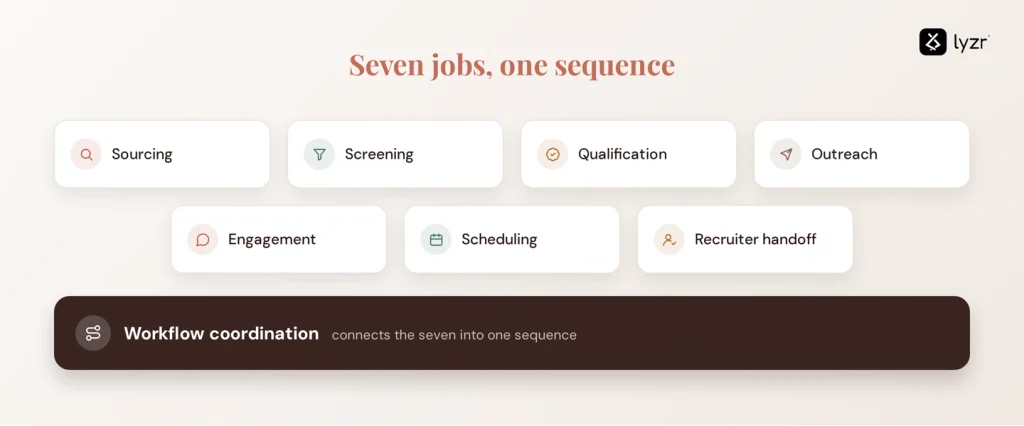
Candidate sourcing
Finds candidates from a natural-language brief instead of a manual boolean search.
Resume screening and matching
Scores profiles against defined requirements and surfaces the closest fits first.
Candidate qualification
Confirms baseline criteria, like work authorization or availability, before a recruiter spends time on the profile.
Personalized outreach
Drafts and sends messages that reference the candidate’s actual background, at a volume no recruiter could match manually.
Candidate engagement
Answers repeated questions about role details or process status around the clock, in a way that shapes the candidate’s read on your employer brand.
Interview scheduling
Coordinates multiple calendars and removes one of the biggest administrative bottlenecks in recruitment.
Recruiter handoffs
Escalates qualified candidates at the right moment, with context attached, similar to how a well-designed HR helpdesk agent routes complex questions to a human.
Workflow coordination
Connects the steps above into one sequence, rather than treating each as a standalone automation someone has to stitch together manually. For a closer look at how screening and sourcing mechanics work specifically, see our guide to AI agents for candidate screening.
What makes an AI recruiter agent genuinely useful?
Plenty of products call themselves “AI-powered.” Few actually orchestrate a workflow. What separates the two: chaining multiple actions together, understanding a plain-language brief instead of rigid fields, writing back into your ATS and calendar rather than just reading from them, and letting you configure where a human must approve before the agent moves forward, plus candidate memory, a full audit trail, and workflows shaped around your process, not a vendor’s default.
Done well, this combination produces measurable results. A BCG report found 92% of firms using AI in HR are already seeing benefits, and a study highlighted by Recruitment Smart tied AI-powered resume screening to a 50% increase in diverse hires. None of that happens by default, it happens because the system was configured, reviewed and audited, which is where compliance enters the picture next.
Best AI recruiter agents and tools in 2026
Lyzr
Lyzr’s AI recruiter agents are built for teams that want a purpose-configured hiring workflow rather than a fixed feature set for sourcing, screening, outreach, and scheduling logic. It’s assembled around how your team actually hires, orchestrated through Lyzr Agent Studio. It’s strongest for teams that need the agent shaped to their own criteria and systems rather than a one-size platform, and it asks more upfront setup than a plug-and-play tool.
Paradox (Olivia)
Paradox is the most established conversational agent in high-volume hiring. Olivia screens against knockout questions, books interviews by syncing calendars, and answers candidate questions around the clock in more than 100 languages. Workday’s roughly $1 billion acquisition of Paradox, closed in October 2025, made 2026’s biggest story about the platform its ownership rather than a new feature. It’s strongest for retail, hospitality, and other frontline hiring at scale, and weaker for niche technical searches where precision sourcing matters more than speed.
HireVue
HireVue pairs video interviewing with AI scoring and has added agent-style features that rediscover past applicants and re-engage them automatically. It suits enterprises with an existing HireVue investment, though video-based scoring carries more auditability questions than text-based agents, since explaining a video score is harder than explaining a transcript.
SeekOut
SeekOut combines AI-driven candidate discovery with diversity and skills data. Its natural-language search builds candidate lists directly from a plain-English brief, making it a strong fit for teams whose main bottleneck is finding hard-to-reach passive talent rather than managing inbound volume.
Moonhub
Moonhub operates more like an AI-enabled recruiting partner than a self-serve platform, automating sourcing and vetting for hard-to-fill roles. It’s best suited to lean talent teams that want a recruiting capability rather than another system to configure, though its workflow coverage narrows once a candidate reaches later interview stages.
Greenhouse and Lever
Greenhouse and Lever, as established ATS platforms, have layered agent-style features onto structured hiring workflows. Greenhouse’s 2026 release added a Job Kickoff Agent and a Candidate Insights Agent that turn kickoff notes into a structured job setup and surface source-linked answers about a candidate. Both platforms are worth evaluating if your team wants agentic capability layered onto an ATS you already run, rather than a separate standalone agent.
How to evaluate an AI recruiter agent
The platform comparison above tells you what each tool does. This is about whether it fits your operation.
Use the checklist below to evaluate an AI recruiter agent.
AI Recruiter Agent Evaluation Checklist
- Workflow coverage: Does it handle only scheduling, or also sourcing and screening?
- Sourcing & screening quality: Test it against a real requisition, not a vendor demo.
- Integrations: Do integrations write data back into your systems, or only read from them?
- Customization: Can you adapt workflows to your employer voice and processes?
- Human oversight: Where are approvals required, and who owns them: RecOps, Head of TA, or Legal?
- Auditability: Ask to see the audit log format before signing.
- Scalability & cost: Does pricing still make sense as requisitions and hiring volume grow?

Can AI replace recruiters?
No. AI replaces the repetitive coordination work between hiring decisions, not the decisions themselves. McKinsey estimates it can automate 60 to 70% of that administrative burden, a meaningful share of the week but not the whole job.
What stays human: reading an unclear hiring manager, navigating a candidate weighing competing offers, negotiating comp, representing the employer brand in a sensitive conversation, and making the final call on a borderline candidate, judgment built from context an agent doesn’t have.
The more useful question for 2026 isn’t whether AI replaces recruiters, it’s which parts of the funnel an agent should own versus a person, a decision made deliberately, not by default. The agent takes the low-value work, screening, scheduling, follow-ups, freeing recruiters for the high-touch work only they can do.
How Lyzr fits
Most AI recruiter agents on the market today are built for one slice of the funnel, sourcing, scheduling, or screening, packaged as a fixed product. Lyzr Agent Studio takes a different starting point: build the AI recruiter agent around your own workflow instead of adapting your process to someone else’s.
That’s the design behind Diane, Lyzr’s HR Super Agent Suite. Its recruiting module, the AI Hiring Assistant, is built to run the top-of-funnel workflow this guide covers: define hiring criteria, source and screen candidates, run outreach, coordinate interviews, and escalate to a recruiter at the point you define. With robust integrations, it connects into your existing ATS and HRIS rather than replacing them, and every action runs with configurable permissions and a full audit trail attached, consistent with the Responsible AI principles built into the platform. That approach, defined workflows plus human checkpoints, is the same foundation behind Lyzr’s HR Automation playbook.
Diane’s scope extends past hiring too, into employee onboarding, performance enablement, and exit interviews, giving teams one system across the employee lifecycle. For how these agent types work together beyond recruiting alone, see our guide to agentic AI in HR. Our case studies show what these agents look like once they’re actually running in production, and our guide to getting agents to production covers what that rollout typically involves.
If you’re evaluating what an AI recruiter agent built around your own workflow would look like, explore Lyzr’s broader agent usecases or book a demo of Lyzr Agent Studio.
Frequently asked questions
An AI recruiter agent is an autonomous system that executes and coordinates multiple recruiting steps, sourcing, screening, outreach, and scheduling, within permissions and checkpoints a human sets, rather than assisting with just one task at a time.
It takes a hiring requirement, sources and screens candidates against it, sends personalized outreach, answers candidate questions, and books interviews, escalating to a human recruiter once a candidate is qualified and engaged.
No. AI automates a large share of the repetitive coordination work in recruiting, but judgment calls like hiring-manager alignment, negotiation, and final decisions still sit with the recruiter.
Lyzr AI, Paradox (Olivia), HireVue, SeekOut, and Moonhub each lead in a different part of the workflow, from high-volume scheduling to passive sourcing, while Greenhouse and Lever are adding agent-style features on top of established ATS platforms.
Pricing varies widely and most enterprise platforms, including Paradox, quote deployments individually rather than publishing a rate card, so cost depends on hiring volume, workflow coverage, and integration scope.
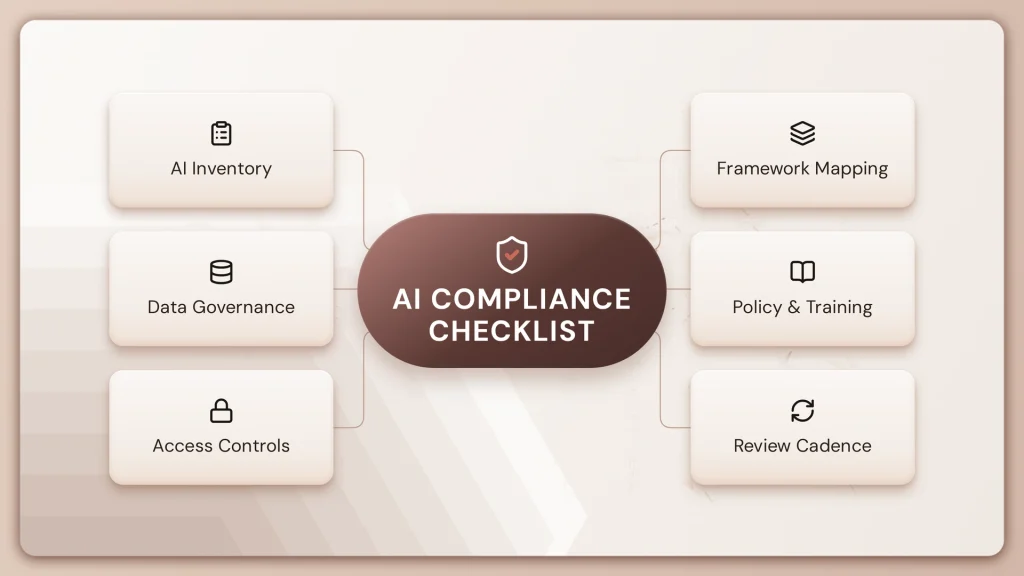
It can be, but compliance isn’t automatic. Employers using these tools on NYC candidates need an independent bias audit under Local Law 144, and roles touching the EU fall under the AI Act’s high-risk obligations starting August 2026.
The strongest options are the ones that cover the most of your actual bottleneck, whether that’s sourcing, screening, or scheduling, while offering configurable human approval points and a full audit trail.
Recruiters are using AI to source and screen candidates faster, automate outreach and scheduling, and handle routine candidate questions, freeing time for relationship-building and complex hiring decisions.
It depends on the function. For recruiting specifically, an AI recruiter agent that can own multiple workflow steps under defined permissions, like Lyzr’s AI Hiring Assistant, tends to deliver more than a tool built for a single task.
Book A Demo: Click Here
Join our Slack: Click Here
Link to our GitHub: Click Here