Somewhere between the moment a resume lands in your inbox and the moment a new hire’s laptop actually works on day one, hiring can become a series of disconnected handoffs. Not because nobody can find candidates, but because what happens between each stage often depends on manual coordination.
AI agents for hiring are built for that gap. They’re a coordinated set of autonomous systems that operate across the full hiring pipeline, not a single tool that finds people faster. Sourcing and screening are part of the story. They are not the whole story.
What are AI agents for hiring? They’re a network of specialized AI systems that execute tasks across the entire hiring process, from candidate entry through offer and onboarding handoff, passing information between each other and taking action inside your existing HR systems instead of just producing recommendations for a human to act on manually.
That distinction matters more than it sounds like it should. A tool that screens resumes well but leaves scheduling, feedback collection, and offer routing exactly as broken as they were before hasn’t fixed hiring. It’s fixed one stage of it.
AI Agents vs. AI Recruiter vs. ATS: Who Owns What
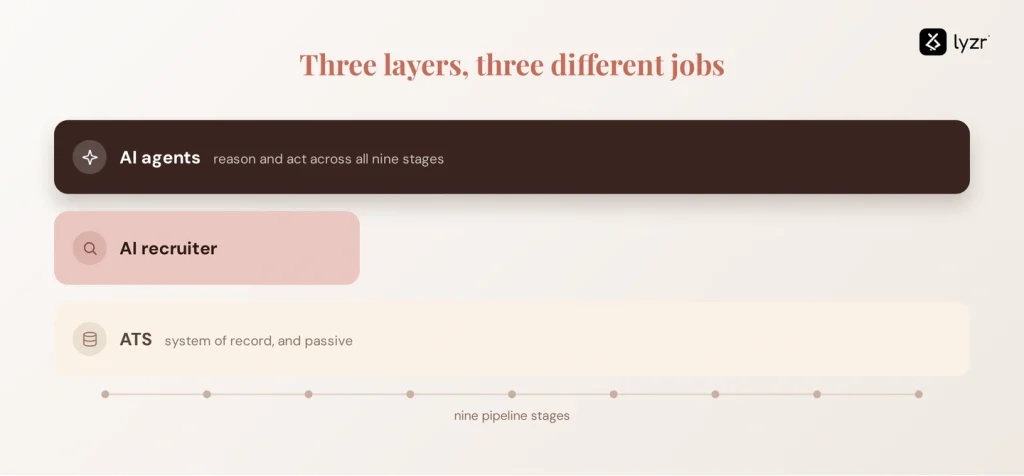
An applicant tracking system, an AI recruiter, and a coordinated agent workflow are not competing for the same job. Each owns a different layer of the stack, and confusing them is where most hiring tech evaluations go wrong.
Your ATS (applicant tracking system) is the system of record. It stores candidate data, job requisitions, and application history. It’s essential for compliance and reporting, but it’s passive. It doesn’t move a candidate forward on its own.
An AI recruiter agent sits one layer up. It’s a specialized tool focused on finding, screening, and engaging candidates, the top-of-funnel work of recruiting. That’s a distinct problem with its own set of tradeoffs, and it’s covered in depth elsewhere.
AI agents for hiring, as a category, describe something broader. AI agents are software systems that combine reasoning with the ability to act across connected tools, not just surface a suggestion for someone to copy and paste. A hiring workflow built on them coordinates scheduling agents, communication agents, assessment agents, and offer agents so they hand work to each other and execute multi-step workflows without a person manually bridging every step. Some people call this space AI agents for recruiting, but that label undersells it. The value isn’t in one smarter recruiting tool. It’s in what happens across all nine stages of the pipeline once the candidate has already been found.
AI Hiring Agents vs. Traditional Hiring Workflows
A traditional hiring process runs on handoffs between people, and every handoff is a place where things wait. A resume waits for a recruiter to review it. An interview slot waits for someone to check three calendars by hand. An offer waits in an inbox for an approver who hasn’t opened Slack yet.
An agentic workflow removes the waiting, not the judgment. The outcome shows up in specific ways: fewer candidates dropped from silence, less time spent on scheduling logistics and status chasing, faster movement from stage to stage, and a clear record of exactly where every candidate sits at any moment. According to SHRM, 2026, the four most common recruiting AI use cases today are writing job descriptions, screening resumes, sourcing, and candidate communication, which tracks with where most teams start. The bigger gain sits in what connects those tasks to each other.
The 2026 guide to AI in recruitment: why faster hiring hasn’t made hiring easier
Where AI Agents Fit Across the Hiring Workflow
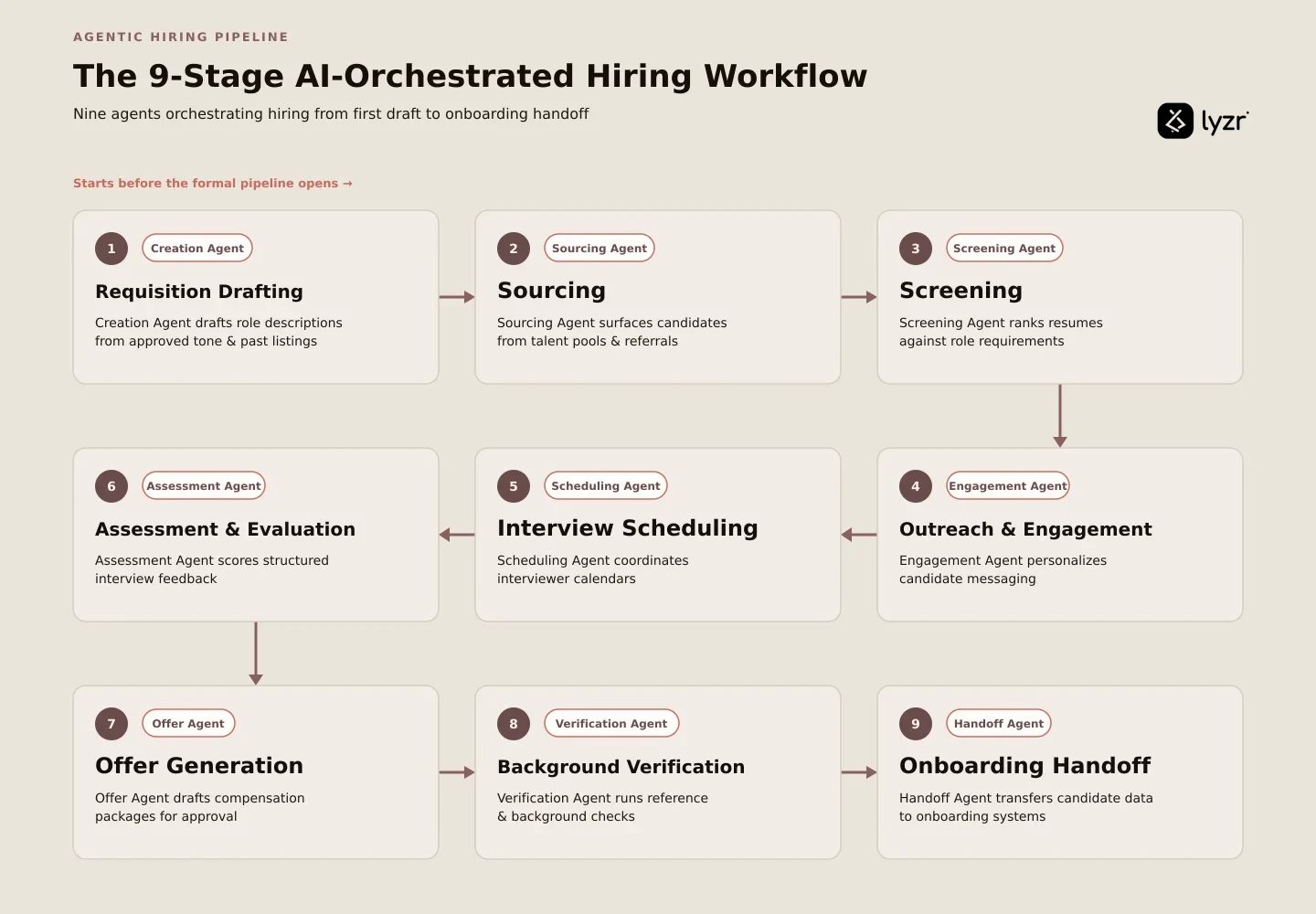
Before the formal pipeline even opens, agents are already at work. Writing job descriptions is one of the most common entry points, with a Creation Agent drafting role descriptions from approved tone and past listings so requisitions go live faster and more consistently.
Sourcing and Candidate Discovery
An agent identifies potential candidates across job boards, internal databases, and referral networks. This works best paired with job post optimization, which shapes how a role is written so the right people see it. It matters most for high-volume roles, like employers hiring for work from home customer service jobs, where a slow pipeline loses candidates to faster competitors within days.
Resume Screening and Qualification
Once applications arrive, a screening agent that screens candidates against role-specific criteria surfaces the strongest applicants for human review, rather than making the call itself. For the mechanics of how sourcing and screening actually work as a recruiting function, that’s exactly the ground our AI Recruiter Agent article covers. This piece is about everything that happens once that stage hands off.
Interview Scheduling
This is where hiring visibly stalls. An Interview Scheduler Agent checks interviewer calendars, matches them against candidate availability, and books the slot without the usual seven-email thread.
Candidate Communication
A communication agent answers routine questions, confirms times, and sends status updates on its own schedule, not whenever a recruiter finally clears their inbox. Candidates left waiting a week for a reply tend to accept somewhere else.
Interview Preparation and Support
Before the interview happens, an agent can push the panel a structured brief: resume, role requirements, and a shared scorecard. It sends the candidate a matching packet on interviewers and what to expect, so neither side walks in cold.
Assessments and Evaluation Workflows
For roles that need a skills test or technical exercise, an assessment agent sends the right assessment based on the role, tracks completion, and routes results to the hiring manager automatically, closing a step that otherwise sits in someone’s task list for days.
Interview Feedback Collection
Chasing interviewers for notes is one of the most tedious parts of recruiting coordination. A feedback agent sends the request the moment the interview ends, follows up if it’s ignored, and centralizes every response in one place instead of scattered across email threads.
Offer Generation and Coordination
An offer agent drafts the letter from approved salary bands and role data, then routes it through the actual approval chain, hiring manager, HR, finance, before it ever reaches the candidate. This is often where a strong process quietly loses days to nobody realizing an approval is sitting unread.
Preboarding and Onboarding Handoff
Once an offer is signed, an agent can pass candidate data to the HRIS, notify IT to provision equipment, and start welcome communications. This matters even more when hiring remotely or in India, where an Employer of record keeps onboarding compliant without adding legal headcount to manage it.
Lyzr Agent Studio makes building secure, reliable AI agents seamless, integrate them into your workflows, automate tasks, and customize them to fit your business goals.
How AI Hiring Agents Work Together
The nine stages above describe what happens at each point in the pipeline. What actually changes outcomes is what happens between them.
Each agent typically runs on an LLM (large language model, the underlying engine that gives it language understanding) paired with permissions to act inside a specific system, whether that’s a calendar, an ATS, or an HRIS. Individually, agents can work on a single task. Orchestrated, one agent’s completed action becomes the next agent’s trigger.

Here’s what that looks like in sequence. A candidate submits a technical assessment and passes. That single event, logged automatically, triggers the scheduling agent to check panel availability and send the candidate open slots. Once confirmed, the communication agent sends a confirmation with interviewer names and prep material. After the interview, the feedback agent requests structured notes from the panel without anyone remembering to ask. If feedback clears the bar, an approval workflow routes to the hiring manager, and the offer agent drafts the letter the moment approval lands.
No recruiter touched a calendar, chased an interviewer, or manually queued the offer. They reviewed the assessment score and the finished offer letter, which is exactly where their judgment belongs.
AI Interview Agents: What They Can and Can’t Do
An AI interview agent can run structured, pre-approved question sets for initial screening conversations, administer live skills assessments, answer a candidate’s questions about the role or process, and schedule the next round automatically. It gathers consistent, structured data at a scale no recruiter’s calendar allows.
What it shouldn’t do is make the final call. According to Pew Research, 71% of Americans oppose letting AI make the final hiring decision, and that instinct tracks with how these tools are actually meant to function: they collect and structure information for a human to weigh, not replace the weighing itself.
How to Evaluate an AI Hiring Agent
Before choosing a platform, check what it actually connects to and controls, not just what it promises to automate.
Does it integrate with your existing ATS, HRIS, and calendar tools, or does it require replacing them? Does it cover the full pipeline, or just one stage dressed up as a platform? Can a non-technical HR team adjust workflow rules without opening a ticket with engineering? Is there a clear audit log for every action an agent takes, and can you insert a mandatory human approval step wherever the stakes require it?
It’s also worth looking at whether a vendor has already solved your edge cases. Browsing a library of ready-made options, like a Resume Agent trained on past shortlisting outcomes, shows whether the groundwork already exists. Accuracy on those edge cases tends to improve over time through feedback loops and prompt tuning, not a one-time configuration you set and forget.
Best AI Tools for HR in 2026: 15 Tools Compared by Use Case
The Future: From Hiring Tools to an AI Hiring Workflow
According to Gartner, 2025, forty percent of enterprise applications will be integrated with task-specific AI agents by the end of 2026, up from less than 5% today. Most of that adoption so far has landed on individual tasks, not connected workflows, which is exactly the gap this piece has been arguing about.
The shift worth planning for isn’t one smarter tool replacing a recruiter’s judgment. It’s a coordinated system handling the friction around that judgment, so the humans in the loop spend their time on the decisions that actually need them.
Lyzr Agent Studio gives teams a way to design and connect that kind of system across their existing HR stack. Lyzr’s AI Hiring Assistant blueprint, part of Diane’s broader HR agent suite, is one starting point for teams mapping this out. Lyzr also offers pre-built AI agents for tasks like screening, scheduling, and offer coordination, so a team can start with a working stage instead of a blank canvas.
Activate Your Autonomous Workforce Today. See how a coordinated hiring agent workflow could work across your existing HR stack. Book a Demo
Frequently Asked Questions
AI agents for hiring are a coordinated system of autonomous programs that operate across the entire hiring pipeline, from sourcing through onboarding handoff. They automate scheduling, communication, assessments, feedback collection, and offer routing, passing work between each other instead of requiring manual coordination at every stage.
They remove the administrative friction that slows recruitment down, beyond just finding candidates faster. That includes coordinating interview schedules across multiple calendars, sending candidates instant updates instead of days of silence, collecting structured feedback from interviewers automatically, and routing offer approvals through the right chain without anyone tracking it manually.
An ATS is a passive system of record that stores candidate and job data. An AI recruiter is an active tool focused on finding and screening candidates to fill that system. A coordinated hiring agent workflow goes further, automating the stages that happen after sourcing and screening across both systems and others, like scheduling, offers, and onboarding.
Yes, for structured, pre-approved formats like initial screening conversations and skills assessments. They gather consistent data at scale, but later-round interviews and final hiring decisions should stay with human interviewers, both for judgment quality and for the oversight regulations around high-risk hiring AI now require.
Yes, when implemented with the right safeguards. That means human oversight at consequential decision points, documented bias audits, candidate data handled under applicable privacy law such as GDPR or CCPA, and compliance with region-specific rules like the EU AI Act’s high-risk classification for recruitment AI.
Book A Demo: Click Here
Join our Slack: Click Here
Link to our GitHub: Click Here