Operational inefficiencies that drain resources are holding enterprises back. Data is trapped in silos, inaccessible when needed most. Customers demand instant solutions while teams scramble to keep up.
But what if your enterprise could run like a well-oiled machine, where AI agents handle repetitive tasks, analyze data in real time, and deliver instant support. Productivity climbs. Costs drop. Customers? Happier than ever.
What are AI agents for enterprises?
AI agents for enterprises are software systems that reason, decide, and act across business applications, not just chat about them. If you’re new to the broader picture of AI agents and their use cases, the Lyzr blog covers many foundational concepts.
They differ from a basic chatbot or a scripted automation built on LLM reasoning and ML models. Where those tools answer a question or execute one rule, an AI agent plans a sequence of steps, calls the right systems, and adjusts when conditions change mid-task.
What’s newer is the maturity curve. Enterprise adoption has moved past the demo stage. IT, finance, and HR teams are now running AI agents in production, with audit trails and rollback plans built in, not just proofs of concept sitting in a sandbox.
Why enterprises are adopting enterprise AI agents now
Enterprises aren’t adopting agents for novelty. They’re adopting them because manual, multi-system coordination work no longer scales at the pace the business needs.
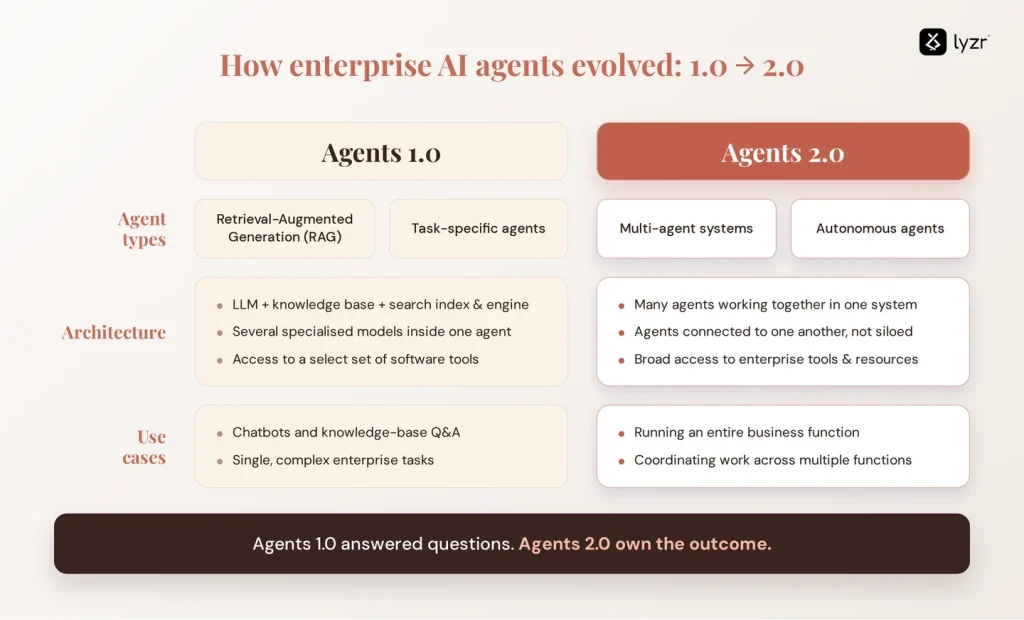
Three forces are converging. Labor costs for repetitive cross-system work keep climbing. Customer and employee expectations for instant resolution keep rising. And the average enterprise now runs its operations across dozens of best-of-breed systems that were never built to talk to each other.
Agentic AI closes that gap by acting as connective tissue between systems, not just another interface layered on top of them.
According to Gartner, cited in IBM’s November 2025 report on enterprise AI agents, 60% of IT operations will incorporate AI agents by 2028.
That’s not a distant forecast. It’s a signal that the shift from pilot to production is already underway, and boards are asking technology leaders exactly where their organization sits on that curve. The clearest way to answer that is to look at what these agents are actually doing today.
Examples of AI agents in enterprise
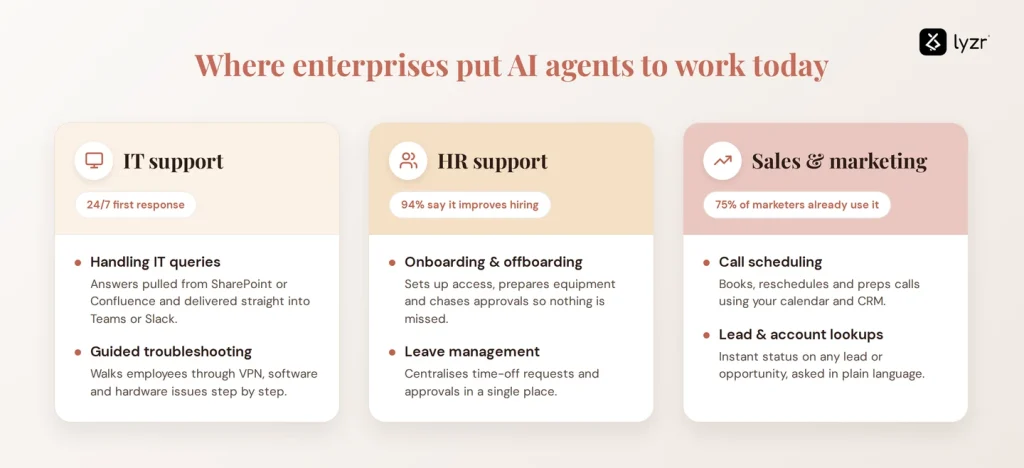
The value of enterprise AI agents becomes concrete once you look at how they run inside specific functions, not as a generic capability list. Here’s how five functions are actually using them, with more use cases catalogued in Lyzr’s 30 AI agent use cases guide.
IT support
When an employee logs a ticket, a team of AI agents springs into action instead of a single bot. Multiple specialized agents work together throughout the process, each owning a piece of the diagnosis. A platform like Lyzr Studio can cross-reference Active Directory permissions and reprovision access automatically, and when the root cause is network issues, agents can pinpoint the source and suggest a fix before a human touches the ticket. The result is a lighter service desk queue, though how much lighter it actually gets depends on measuring the AI impact on productivity across those teams, because deflected tickets only count as a gain if the recovered hours go somewhere productive.
HR
An onboarding agent provisions accounts, enrolls new hires in benefits and payroll, assigns training, and schedules first-week meetings. A large enterprise running this end to end can turn a multi-day, multi-department checklist into a same-day process, with HR staff reviewing exceptions instead of running every step by hand.
Sales and marketing
An account intelligence agent watches target accounts for buying signals such as leadership changes or funding rounds, then drafts personalized outreach for the account executive. Enterprises can also lean on a tool like a ScraperAPI alternative to pull structured signal data from multiple public sources in real time, feeding the agent fresher context than a quarterly refresh ever could.
Customer support
A support agent handles a return end to end: validating the purchase in the CRM, checking inventory for a replacement, triggering the shipment in the ERP, and confirming with the customer, all without a ticket reaching a human queue.
Finance and procurement
A vendor-vetting agent reviews a new supplier’s compliance documentation against internal policy, flags discrepancies for a human reviewer, and provisionally clears low-risk vendors in the procurement system, cutting a sourcing cycle that used to take weeks down to days.

The problems agents solve are manual, repetitive workflows eat the hours skilled staff should spend on judgment calls, not data entry across five systems.
Enterprises should be aiming for scale, not a chatbot pilot, but a system carrying real operational load. Before committing budget to a direction, it’s worth taking the time to map your own use cases with Lyzr’s agentic AI maturity assessment.
Business challenges AI agents solve
The problems agents solve are operational, not exotic. Manual, repetitive workflows eat the hours skilled staff should spend on judgment calls, not data entry across five systems.
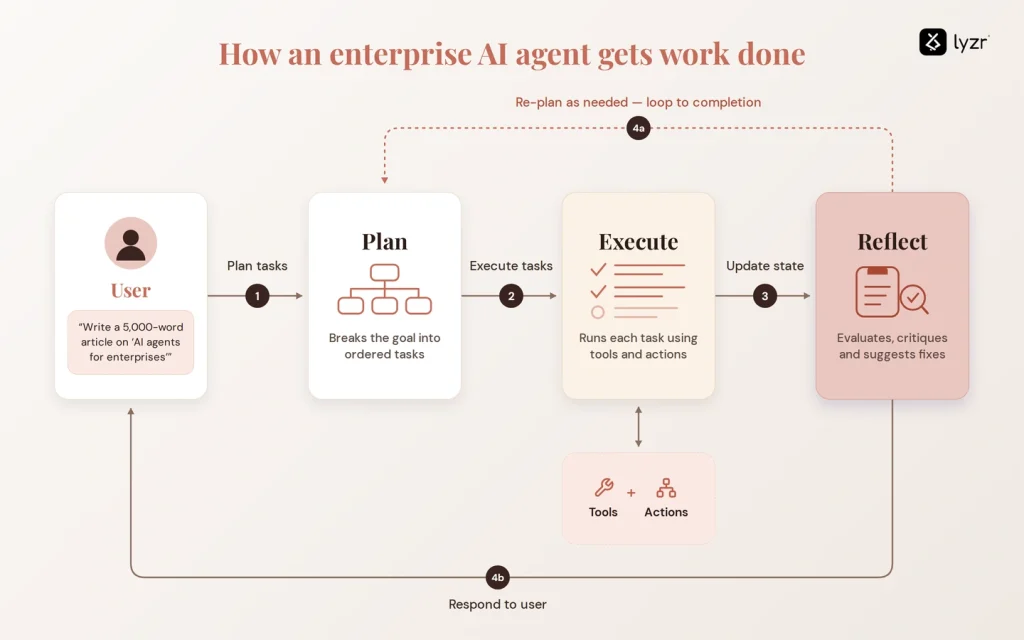
Response times suffer for the same reason: a request that needs input from three teams waits on the slowest one. Execution gets inconsistent once a process depends on which analyst happens to pick it up, and data stays siloed because the CRM, ERP, and HRIS were never designed to talk to each other.
According to IBM’s “Enterprise AI Agents: Beyond Productivity” (published November 21, 2025, authors Molly Hayes and Amanda Downie), IBM’s own AskHR tool automates more than 80 HR tasks and handles over 2.1 million employee conversations annually.
That’s the scale enterprises should be aiming for, not a chatbot pilot, but a system carrying real operational load. Before committing budget to a direction, it’s worth taking the time to map your own use cases with Lyzr’s agentic AI maturity assessment.
Best enterprise AI agent platforms
There’s no single best enterprise AI agent platform. There’s a best fit for your existing stack, your governance requirements, and the complexity of the workflows you’re automating.
Open frameworks like AgentGPT and foundation models like Claude show what’s possible at the experimentation layer, and they’re useful for prototyping before a procurement conversation even starts. Enterprise platforms take that same reasoning capability and wrap it in the access controls, monitoring, and integrations a production deployment actually needs.
Enterprise AI agent platform comparison at a glance
| Platform | Primary ecosystem | Best for / notable capability |
|---|---|---|
| Lyzr Studio | Model and cloud-agnostic | Orchestrating multiple specialized agents across systems, with governance built into the architecture |
| Salesforce Agentforce | Salesforce | Native CRM-centric workflows where agents operate independently within existing Salesforce data |
| Microsoft Copilot Studio | Microsoft 365/Azure | Extending Microsoft 365 and Dynamics 365 with low-code custom copilots |
| ServiceNow | Now Platform | Automating IT and employee service workflows inside an existing ITSM investment |
| IBM watsonx | IBM Cloud / hybrid | Governance-first agent development with model transparency for regulated industries |
| Google Vertex AI Agent Builder | Google Cloud | Conversational agents built on Google’s search and retrieval infrastructure |
Salesforce Agentforce works especially well for teams already living inside Salesforce, where agents can analyze data and execute tasks seamlessly within existing Salesforce deployments.
Google’s Vertex AI Agent Builder plays to Google’s strength in search, making it a natural fit for enterprises building conversational agents on Google Cloud data.
IBM watsonx leans into governance and model transparency for regulated industries, while Microsoft Copilot Studio and ServiceNow extend agents into the productivity suite and IT service management tools enterprises already run.
Lyzr Studio sits in this same evaluation set, built for teams that need to orchestrate multiple agents across systems rather than deploy a single assistant. For a broader look at how these systems stack up, see the guide to the best agentic OS platforms.
How enterprises deploy AI agents
Enterprises deploy AI agents in phases, starting narrow and adding scope only after governance keeps pace with capability.
The pattern that works: pilot a single function first and prove the workflow end to end. Then integrate the agent with core systems like the CRM, ERP, and HRIS so it can act on live data instead of a sandboxed copy, a step that turns a point solution into real enterprise workflow automation rather than a standalone tool. That integration is what separates an agent demo from genuine enterprise automation. Only after it holds up does the rollout scale to other departments.
Scaling is where governance has to lead, not follow. Production deployments need audit trails that record every action an agent takes, guardrails that constrain what it can do without approval, human-in-the-loop review for anything touching money, legal exposure, or personal data, and access controls scoped as tightly as they would be for a human employee with the same permissions. This same discipline extends to ethical AI standards that keep agent behavior auditable as deployments scale. For a full breakdown of what a governance framework needs to cover, see the guide to AI agent governance.

How Lyzr Studio fits an enterprise AI agent strategy
Lyzr Studio is built around the same criteria this comparison uses: integration depth, governance, and the ability to run more than one agent at a time.
Multi-Agent Systems are the default architecture here, not an add-on. Lyzr’s Multi-Agent Systems approach lets specialized agents hand off work to each other instead of one general-purpose bot trying to do everything. A dedicated agent builder handles the development side, while agent orchestration coordinates how those agents work together across a workflow.
The underlying agent framework integrates Safe AI & Responsible AI controls directly into the architecture, alongside role-based access, audit logs, and configurable guardrails, so security isn’t bolted on after a pilot succeeds. Join the Lyzr Slack community or explore Lyzr on GitHub to see the architecture firsthand.
FAQs
AI agents for enterprises are autonomous systems that reason through a goal, plan a sequence of actions, and execute those actions across business applications like a CRM or ERP. They differ from chatbots by completing entire multi-step workflows rather than just answering a single question.
Examples include an IT agent that diagnoses and resolves access issues, an HR agent that runs new-hire onboarding end-to-end, a sales agent that surfaces buying signals, a customer support agent that processes returns, and a finance agent that vets vendor compliance automatically.
AI agents address manual, repetitive workflows, slow response times when a task depends on multiple teams, inconsistent execution across people and departments, and data silos between systems like the CRM, ERP, and HRIS that were never built to share information.
Enterprises deploy agents in phases: pilot a single high-value function, integrate the agent with core systems so it can act on live data, then scale across departments. Governance, including audit trails and access controls, has to be in place before scaling begins.
Leading platforms include Lyzr Studio, Salesforce Agentforce, Microsoft Copilot Studio, ServiceNow, IBM watsonx, and Google Vertex AI Agent Builder. Each is credible for a different environment, so the right choice depends on your existing stack, governance needs, and workflow complexity.
Yes, when built on a platform with enterprise-grade controls. Secure deployments require role-based access, comprehensive audit trails, configurable guardrails, and human-in-the-loop review for sensitive actions, ensuring agent behavior stays within policy and compliance boundaries at scale.
Evaluating platforms on paper only goes so far. Seeing how multi-agent orchestration, governance controls, and system integrations actually behave against your own workflows is what turns a shortlist into a decision. Book a Lyzr Studio demo to walk through deployment, governance, and integration against the criteria your buying committee already cares about.
Book A Demo: Click Here
Join our Slack: Click Here
Link to our GitHub: Click Here