TL;DR
- Enterprise automation is the coordinated use of AI, RPA, and system integration to run processes across an organization under central governance, not a single tool or department project.
- Four types exist: basic automation, business process automation (BPA), robotic process automation (RPA), and intelligent/agentic automation.
- The first three execute logic that was specified in advance. Only agentic automation reasons about cases nobody predicted.
- Most programmes plateau because automated volume keeps climbing while the exception queue, the cases nobody wrote a rule for, stays flat.
- Governance decides whether an automation estate scales safely, not the number of bots or workflows deployed.
Somewhere in your organization right now, a process that was automated eighteen months ago is quietly generating a queue of exceptions nobody signed up to review.
That queue isn’t a rollout bug. It’s what happens to almost every enterprise automation programme once the easy processes are gone.
Enterprise automation has a reputation problem: it gets sold as a single technology and delivered as a patchwork of bots, workflows, and integrations that each solve one slice of the problem. This article works through what enterprise automation actually is, the four types you’ll find inside any mature programme, what the data says about the benefits, and the part vendors with RPA estates to protect tend to leave out: why automation programmes stop compounding and what changes when they don’t.
What is enterprise automation?
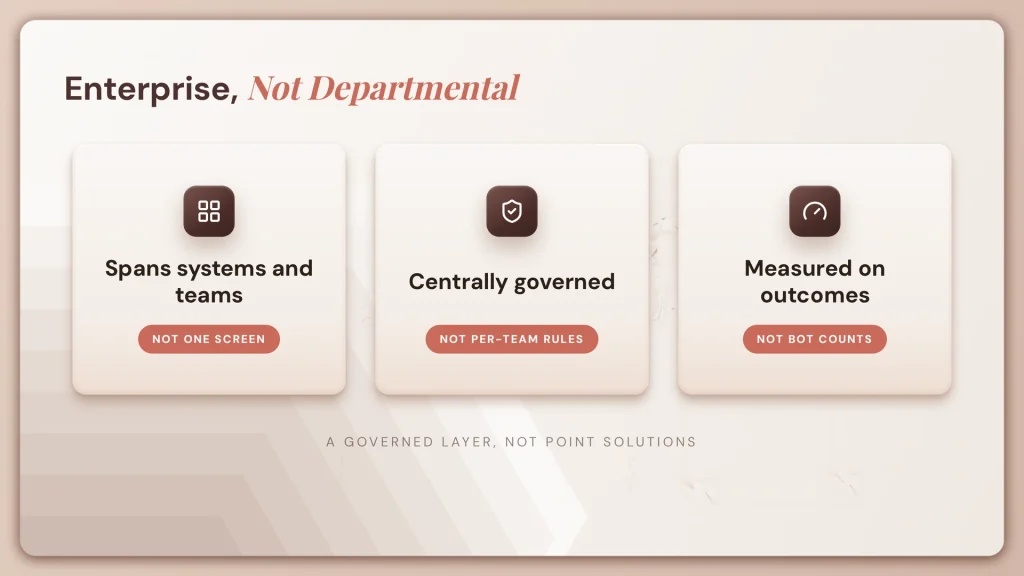
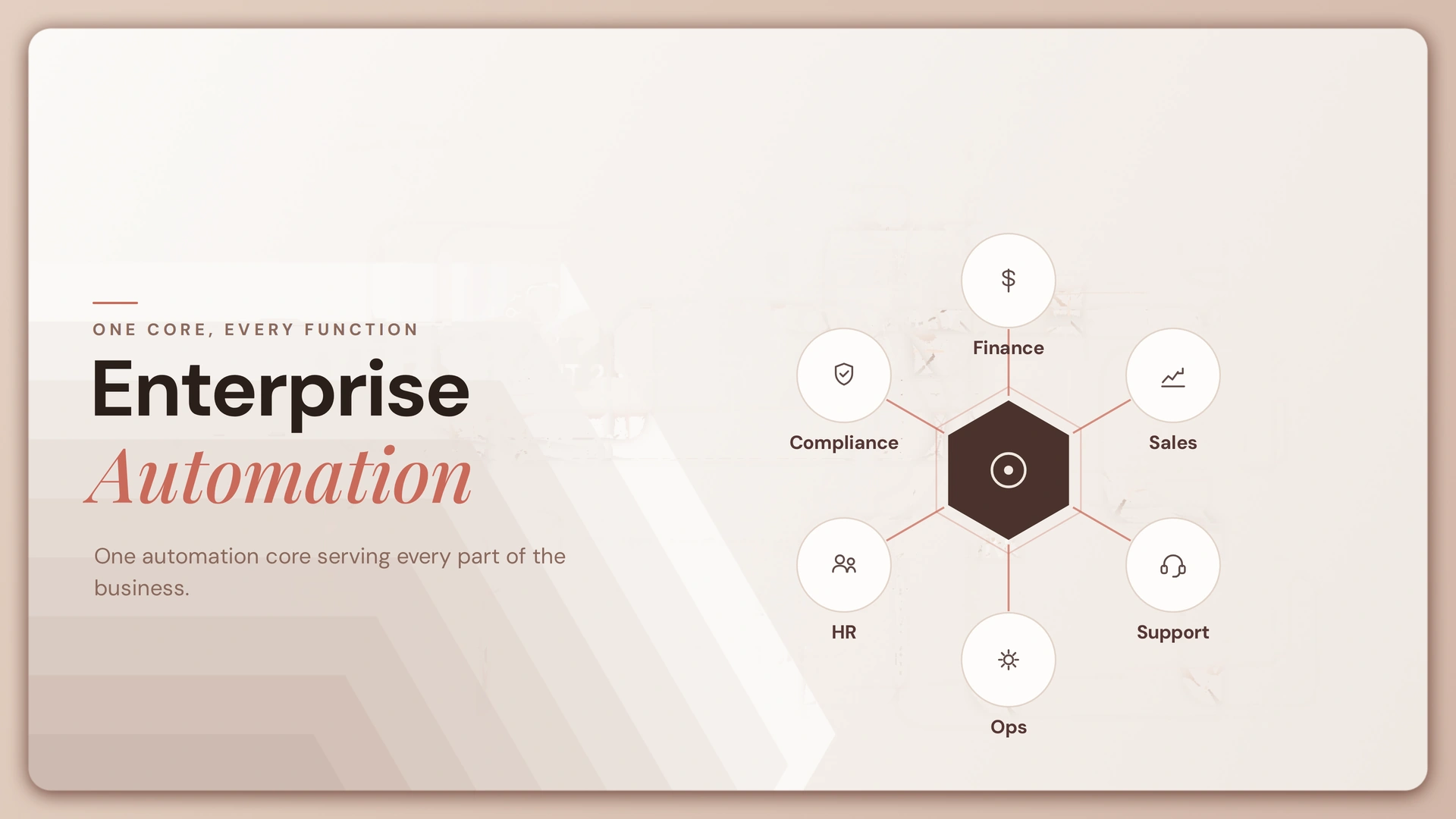
Enterprise automation is the strategic use of technology to integrate, streamline, and scale business processes across an entire organization, combining AI, robotic process automation, and system integration under centralized governance rather than isolated departmental tools.
That last part is the distinction that matters. A macro that files your expense reports is task automation. It solves one person’s Tuesday. Enterprise automation solves the procure-to-pay cycle end to end, across finance, procurement, and the ERP that all three departments touch, with a single owner accountable for how it performs.
Three things separate enterprise-grade automation from a departmental script:
- It spans systems and teams. It connects the applications a process actually touches, whether that’s an ERP, a CRM, or a homegrown database, rather than automating one screen in isolation.
- It is centrally governed. A common set of rules, security controls, and ownership structures apply across the estate, instead of every team building its own automation with its own standards.
- It is measured against outcomes, not task counts. Cycle time, error rate, and cost per transaction matter more than how many bots are deployed.
According to a 2026 industry analysis, organizations are now building end-to-end automated flows that span departments, systems, and data sources rather than automating isolated tasks. That shift, from point solutions to a governed layer, is what “enterprise” is doing in the phrase. Teams building this layer increasingly pair it with a broader enterprise AI strategy rather than treating automation and AI adoption as separate initiatives.
Why enterprise automation matters
It matters because manual coordination doesn’t scale, and firefighting isn’t a strategy. Enterprise automation replaces ad hoc manual glue between systems with a governed, repeatable layer, which is the difference between a process that degrades under volume and one that holds.
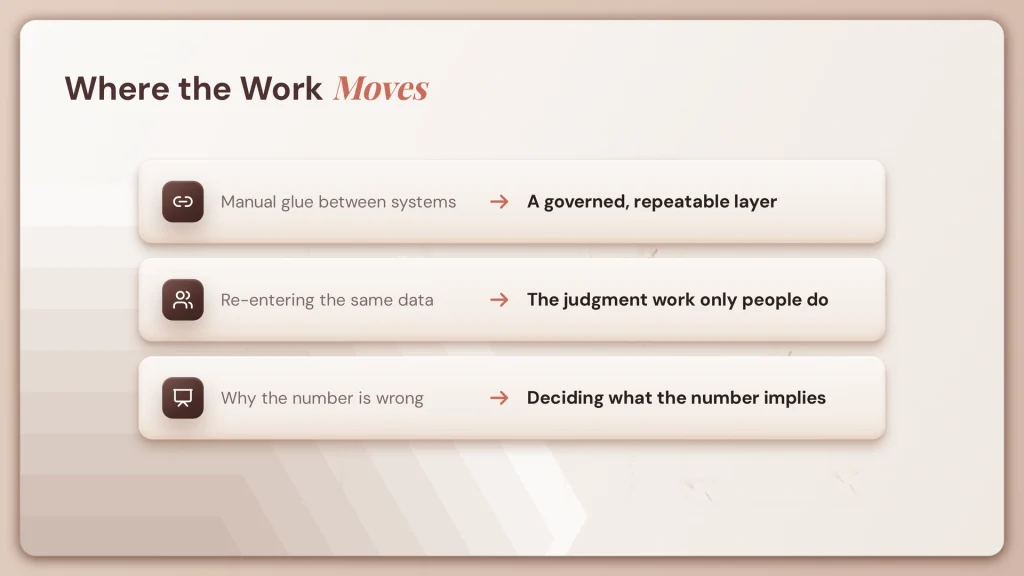
The direct effect is capacity. Employees stop re-entering the same data into three systems and start doing the judgment work those systems can’t do: exception handling, relationship management, and the decisions that actually require a person. Enterprise automation ROI extends to broader metrics such as improved employee experience, faster time-to-market, compliance improvements, and scalability across business units, which is a wider lens than the hours-saved math that RPA vendors usually lead with.
Operationally, this shows up in the meetings leadership runs. Teams that adopt structured review cadences, such as a Level 10 Meeting, find the conversation shifts from explaining why a number is wrong to deciding what the number implies. Automation is what makes that shift possible: it removes the manual reconciliation that used to eat the first twenty minutes of every review.
The four types of enterprise automation
Most vendor guides stop at three types and call RPA the ceiling. That’s outdated. There are four, and the fourth is the one most existing automation content skips.
Basic automation. Single, standalone, rule-driven tasks confined to one team or system: scheduled reports, automated replies, file transfers, data entry. Low complexity, fast payback, no cross-system coordination required. This layer often includes secure enterprise messaging for routing simple notifications, workload automation for scheduling batch jobs, and clearly scoped virtual administrative assistant roles for high-volume coordination tasks like appointment scheduling.

Business process automation (BPA). Multi-step workflows spanning teams and systems, with conditional routing, approvals, and handoffs, such as procure-to-pay, employee onboarding, or claims intake. The connective tissue that makes cross-system BPA possible is integration, the plumbing that lets a workflow automation engine talk to your ERP, your document store, and your purchase orders system without a human relaying data between them. Vendors evaluating this layer often compare it against enterprise content management software for how documents, records, and unstructured content move across the estate. A supplier onboarding agent is a good example of BPA at work: multiple approval steps, multiple systems, one governed flow.
Robotic process automation (RPA). Software bots that mimic human actions at the interface layer, typically where no API exists. RPA is the workhorse for legacy systems, and it’s genuinely good at high-volume, structured, repetitive work. It also has a well-documented constraint: RPA is static and fragile to change, while agentic AI is dynamic and resilient. Large RPA estates accumulate hundreds of bots over time, and each interface change somewhere upstream risks breaking a bot downstream, which is why bot maintenance becomes a standing line item rather than a one-time cost.
Intelligent and agentic automation. This is where the category actually is in 2026, and where most existing “types of automation” content stops one step short. Intelligent automation embeds AI components inside an otherwise deterministic workflow, for example invoice OCR (optical character recognition, reading text from scanned documents) feeding a classification step into a BPA flow, or an invoice matching agent pulling structured fields from a knowledge base of past transactions. Agentic automation goes further: AI agents that interpret unstructured input, reason about cases that match no predefined rule, and execute multi-step processes with limited supervision. The distinction matters because agentic AI interprets context, decides when bots should be triggered, and manages exceptions that would normally stall an RPA workflow. This is also where agentic automation, agentic workflows, and AI agents for enterprises as a category converge, and it’s the layer that most enterprise AI automation investment is now flowing into. Building this well often means bringing in enterprise software development services for the custom integration work that off-the-shelf tools can’t handle.
Comparing the four automation types
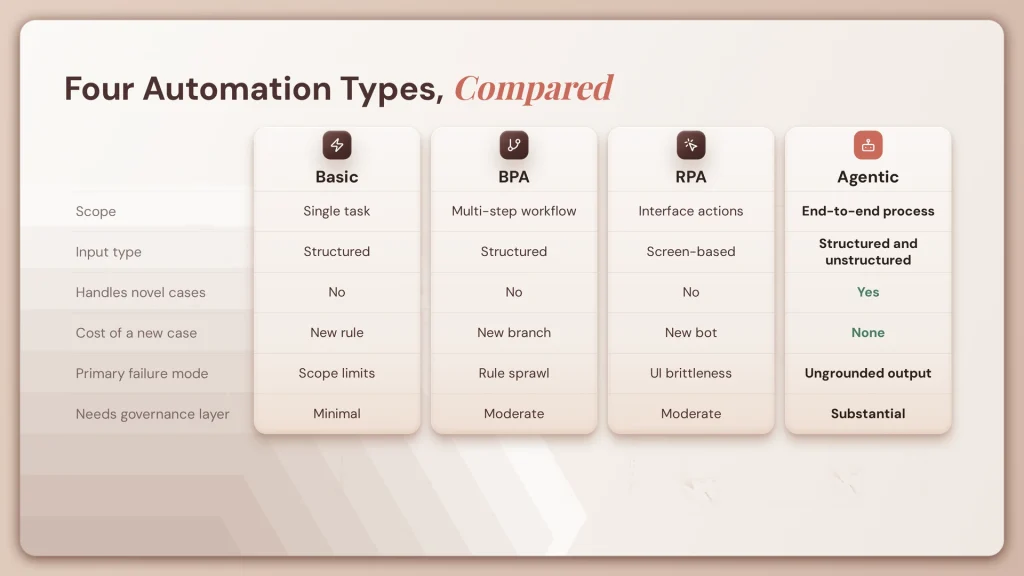
| Dimension | Basic | BPA | RPA | Agentic |
|---|---|---|---|---|
| Scope | Single task | Multi-step workflow | Interface-level actions | End-to-end process |
| Input type | Structured | Structured | Structured, screen-based | Structured and unstructured |
| Handles novel cases | No | No | No | Yes |
| Cost of a new case | New rule | New branch | New bot or rule | None |
| Primary failure mode | Scope limits | Rule sprawl | Brittleness to UI change | Ungrounded output |
| Needs governance layer | Minimal | Moderate | Moderate | Substantial |
What enterprise automation delivers
The honest version: benefits vary by process, but four patterns show up consistently across implementations.
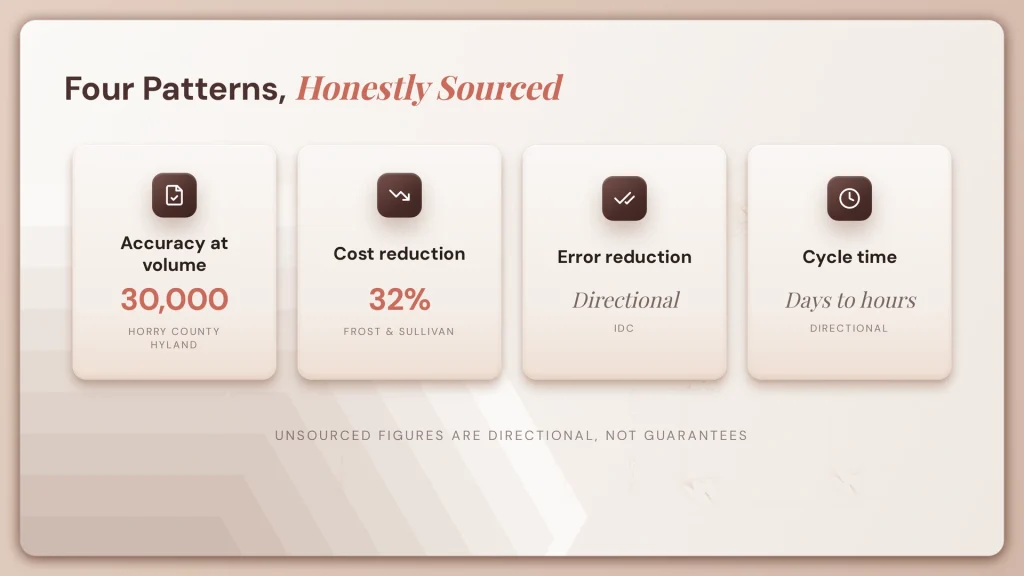
Accuracy at data volume. Horry County’s Auditor’s Office needed to process a backlog of manual tax return data entry. Hyland RPA processed 30,000 property tax returns without human interaction for Horry County, using conditional business rules to verify claims and flag exceptions for human review. Evaluating the same problem today often involves comparing RPA against dedicated tax compliance platforms for the parts of the workflow that touch regulatory logic directly.
Cost reduction. In a Frost & Sullivan report, 32% of respondents in companies averaging $10 million to $99 million in revenue declared “intense” usage of RPA across seven or more departments. That intensity correlates with organizational profitability, though the size of the saving depends heavily on process complexity and how much of the exception volume still requires manual handling.
Error reduction. Automating data entry and cross-checks removes the copy-paste step where most transcription errors originate. IDC studies on RPA paired with content services technology point to measurable gains in this area, though the exact figure depends on the specific process being automated.
Cycle time. Multi-step approvals that used to take days of email back-and-forth compress to hours when routing, validation, and escalation run on a governed workflow instead of an inbox.
Any number not tied to one of the sources above should be read as directional, not a guarantee. Automation vendors publish best-case figures more often than typical ones.
Enterprise automation examples by industry
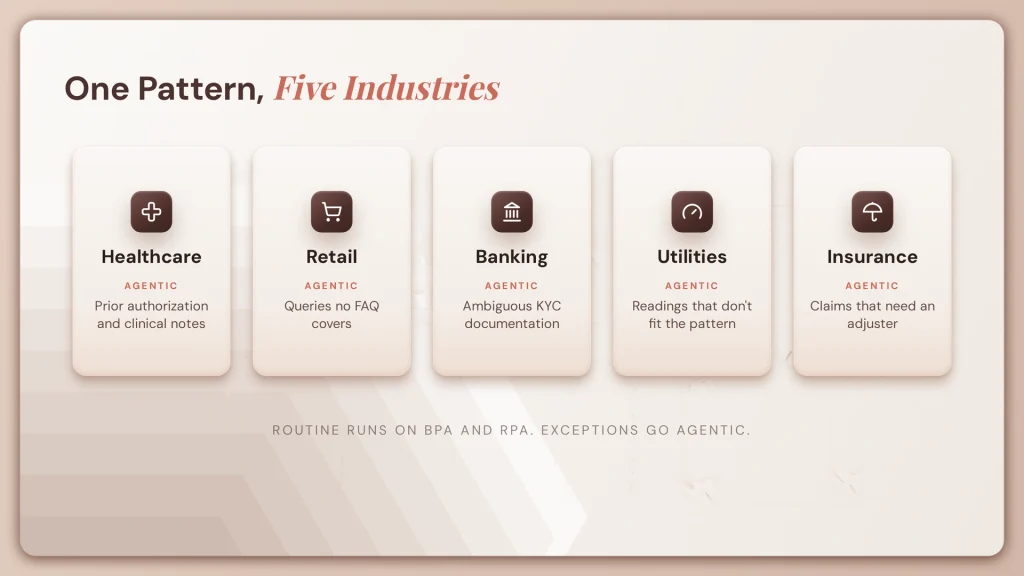
Healthcare. Intake forms, insurance verification, and appointment scheduling automate cleanly with BPA and basic automation, freeing clinical staff from administrative load. Healthcare agents extend this into prior authorization and clinical documentation, where unstructured notes need interpretation rather than a fixed template.
Retail and e-commerce. Inventory management software monitors stock levels and triggers reorders automatically, a BPA pattern with basic automation underneath it. Layered with e-commerce data analytics, the same infrastructure supports demand forecasting. Ecommerce agents handle the harder problem: customer queries that don’t match a return policy FAQ.
Banking. KYC compliance (Know Your Customer, the identity verification process banks run before onboarding a client) checks combine RPA data pulls with agentic review of ambiguous documentation. Banking automation and banking agents both sit on this pattern, and AI in banking and finance covers the regulatory context that makes governance non-negotiable here.
Utilities. Meter reading anomalies, outage routing, and billing reconciliation run on BPA and RPA today. The exception volume, readings that don’t match expected consumption patterns, is where agentic review adds the most value without full field intervention.
Insurance. Claims processing agents read submitted documentation, cross-check policy terms, and route only the ambiguous claims to an adjuster. AI agents in insurance, including named agents like Benjie, show what this looks like in production. A broader library of patterns across industries is catalogued in 101 AI use cases.
Where automation programmes plateau
The pattern is consistent enough to predict. Early wins come fast because the highest-volume, most standardized processes automate cleanly with basic automation and RPA. Then the curve flattens. Each additional process takes longer to build, delivers less incremental value, and adds a bot or workflow to a growing estate that someone now has to maintain. Teams respond by automating more processes, which grows the estate’s size without moving the metric that actually matters.
Here’s why it happens: the first three automation types are bounded by what was specified in advance. Every automated process routes its unhandled cases, the ones that don’t match the configured rule, to a human. As automated coverage grows, the automated volume grows with it, but the exception volume stays roughly constant, because exceptions are by definition the cases nobody anticipated when the rule was written. Rule sprawl compounds the problem: rule sets become undocumented, unowned, and risky to touch, which is one of the recurring enterprise AI agent challenges that shows up once an estate grows past a certain size. The metric worth tracking isn’t processes automated. It’s exception rate.

Agentic automation addresses a different problem than the automation layer solves, not the same problem faster. It reasons about inputs that match no predefined pattern: the non-standard document, the record that disagrees across two systems, the request missing the context a rule needs to route it. This is consistent with the sequencing most digital transformation teams eventually land on: automate the predictable path first. Rules-based automation is cheaper, faster to build, and more auditable than reasoning over cases where reasoning is unnecessary. Teams that skip straight to agents end up with something expensive and unreliable for work a simple rule would have handled better.
This is the layer Lyzr’s Agentic OS is built for: sitting above existing RPA and BPA estates rather than replacing them, handling the exception queue those estates were never designed to close, with the governance controls enterprise deployment actually requires. Teams evaluating this transition typically start with the agents to production playbook rather than a pilot with no operational plan behind it.
Governing automation at enterprise scale
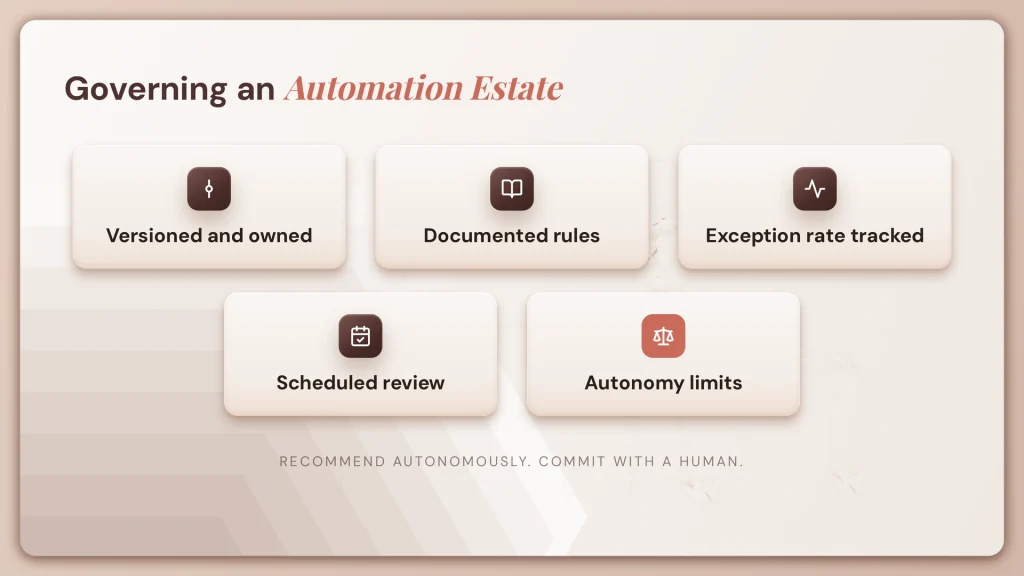
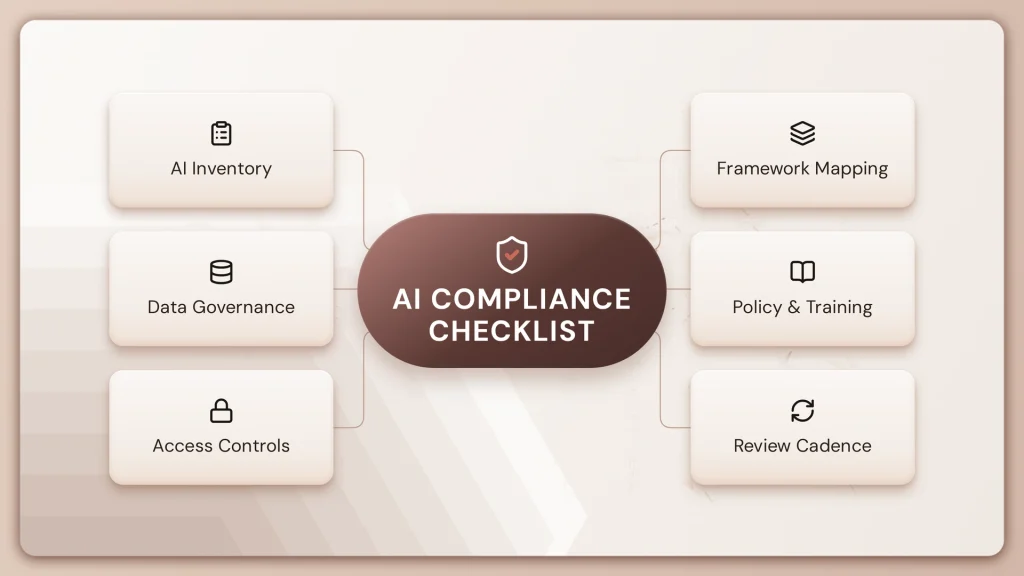
Governance is what separates an automation estate that scales from one that becomes a liability. Five controls do most of the work.
Workflow version control and ownership. Every workflow needs a named owner and a change history, the same discipline applied to production code.
Business rule documentation. Undocumented rules are the reason rule sprawl becomes dangerous rather than just messy.
Exception volume as a health metric. Track it the way you’d track uptime. A rising exception rate signals a process that has outgrown its automation, not a queue to hire around.
Periodic policy review. Rules and agent instructions drift from the business reality they were built for. Review cadence should match how fast the underlying process changes.
Explicit autonomy boundaries. Reading, analyzing, and recommending can run autonomously. Actions with financial, contractual, or customer-facing commitment should require human approval before execution.
This is the discipline behind AI agent governance, and it’s operationalized through a Control Plane, paired with Responsible AI controls and a Hallucination Manager for catching ungrounded output before it reaches a customer or a ledger. Most organizations assign this to dedicated AI and automation teams rather than leaving it to whichever department built the first bot.
How to choose an enterprise automation platform
Skip the ranked vendor list. What determines fit is which category of problem you’re actually solving, and most enterprises need more than one.
Integration and iPaaS platforms connect systems of record so data moves without manual re-entry. RPA suites handle interface-level automation where no API exists, still the fastest path for legacy system work. BPM and workflow platforms manage multi-step, approval-heavy processes with clear ownership and audit trails. Agentic layers sit above all three, handling the exception volume none of them were built to close, and are increasingly evaluated by CIOs as a distinct budget line rather than an RPA add-on.
Evaluate any enterprise automation platform against five criteria: integration depth with your actual systems of record, how it handles exceptions rather than just the happy path, configurability without ongoing vendor services, audit trail completeness, and deployment control, including on-premise or sovereign AI options where data residency matters. Orchestration matters as much as any single agent: an Orchestration as a Service layer is what lets basic automation, BPA, RPA, and agentic components work as one governed system instead of four disconnected tools. Teams evaluating enterprise automation tools and enterprise automation solutions hands-on typically start in Agent Studio rather than a sales deck.
Frequently asked questions
What is enterprise automation?
The strategic use of technology to integrate and scale processes across an organization, combining AI, RPA, and system integration under centralized governance rather than isolated departmental tools.
What are the four types of automation?
Basic automation, business process automation, robotic process automation, and intelligent or agentic automation. They differ mainly in whether they can handle inputs nobody specified in advance.
What is the best tool for enterprise automation?
It depends on the constraint you’re solving. Integration platforms connect systems, RPA handles legacy interfaces, BPM manages approval-heavy workflows, and agentic layers handle exceptions the other three can’t.
What are the top 5 automation tools?
The category matters more than the ranking. Evaluate by integration depth, exception handling model, configurability, and audit completeness rather than list position.
Is AI a type of automation?
They overlap without being identical. Automation executes predefined logic. AI infers from patterns. Agentic AI reasons about inputs no predefined logic covers.
Is automation replaced by AI?
No. AI extends automation to cases rules cannot cover. The predictable path is still cheaper and more auditable to automate with rules.
What is L1 and L2 automation?
L1 handles simple, single-step, rule-driven tasks. L2 handles multi-step processes with conditional branching. Neither reasons about inputs outside its configured logic.
Which AI is best for enterprise?
It depends on the workload and constraints involved. Model choice matters less than governance, integration depth, and deployment control at enterprise scale.
What are basic automation tools?
Scheduled scripts, form-driven data capture, automated notifications, file transfer utilities, and single-system macros.
What are 10 advantages of automation?
Cycle time, accuracy, cost, consistency, scalability, compliance traceability, employee experience, capacity headroom, process visibility, and reduced key-person risk.
What jobs will survive automation?
Roles centered on judgment, relationships, accountability, and novel problem-solving tend to change the least. Repeatable transaction processing roles change the most.
Is automation an IT job?
Increasingly not exclusively. Successful programmes pair business process ownership with platform engineering and compliance involvement rather than routing everything through IT.
What is another name for automation?
Business process automation, workflow automation, and intelligent automation are used near-interchangeably, though each denotes a different scope of the same underlying discipline.
Where this leaves your automation programme
The category isn’t short on definitions. IBM, SAP, and NetSuite will all give you a clean one. What most of those guides skip is the part that determines whether your programme actually compounds: the first three automation types get you to a plateau, and what you do about the exception queue at that plateau is the real decision.
Before adding another bot to the estate, pull your exception rate for your three highest-volume automated processes. If it’s flat or climbing despite more automation coverage, that’s not a maintenance problem. That’s the signal that the next investment belongs in the reasoning layer, not another rule.
If you want to see what that layer looks like running against a real process rather than a slide, book a demo and bring your worst exception queue with you.
Book A Demo: Click Here
Join our Slack: Click Here
Link to our GitHub: Click Here