TL;DR
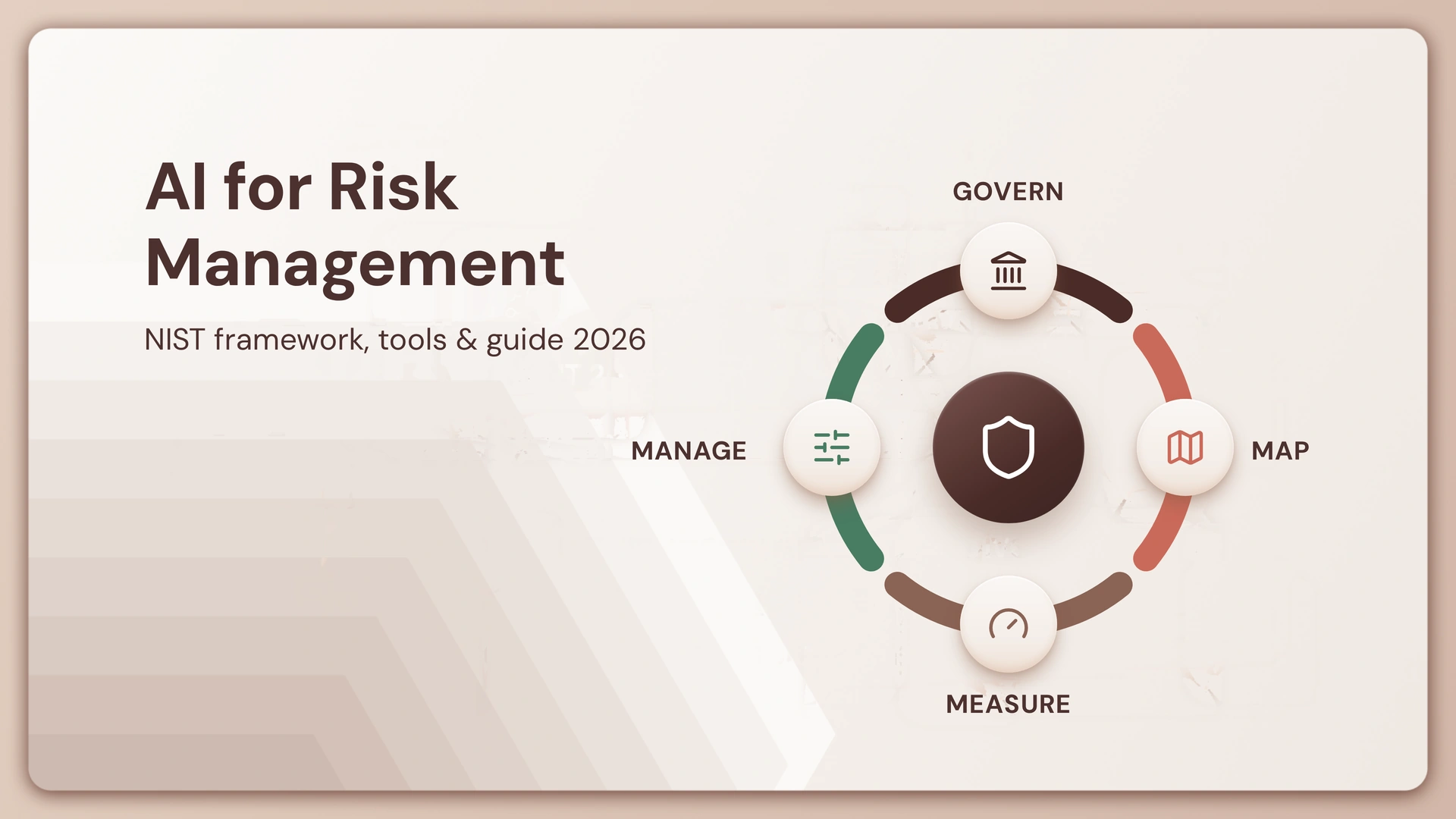
- AI for risk management follows the NIST AI RMF: Govern, Map, Measure, Manage.
- Two distinct dimensions matter: risks TO AI systems and AI used FOR managing risk elsewhere.
- Key regulations to track: EU AI Act, ISO/IEC 42001, ISO/IEC 23894, DORA, SR 11-7.
- Tool categories span GRC platforms, AI-specific governance, observability, and AI security.
- A production stack maps each NIST pillar to a concrete tool layer, including Lyzr’s governance infrastructure.
AI for risk management is the structured process of identifying, measuring, and mitigating security, operational, and ethical threats across an AI system’s lifecycle. Enterprises align this work with the NIST AI Risk Management Framework or binding rules like the EU AI Act, then apply it in two directions at once: controlling risk created by AI itself, and using AI to control risk everywhere else in the business.
What is AI for risk management?
AI for risk management covers every control an enterprise puts in place to keep AI systems safe, fair, and compliant while they operate. This includes governance policies, use case documentation, adversarial testing, and runtime guardrails applied across a model or agent’s full lifecycle, from design through retirement.
The discipline exists because AI adoption has outpaced AI oversight. According to McKinsey’s State of AI 2025 report, 62% of organizations are experimenting with AI agents, and 23% report scaling agentic systems in at least one business function. Governance has not kept pace with that speed. According to Deloitte’s State of AI in the Enterprise 2026 report, only 21% of companies have a mature governance model for autonomous AI agents, even though 73% cite data privacy and security as their top AI concern.
That imbalance is why a framework matters more than a single tool. The rest of this guide separates AI risk management into two dimensions, then builds out the NIST AI RMF as the spine for governing both.
Two dimensions of AI risk management
Two dimensions define a complete AI risk program, and most enterprise strategies blur them together. Separating them clarifies which controls, teams, and regulations apply where.
Dimension 1: Risks TO AI systems. These are the risks AI itself introduces once deployed. They include algorithmic bias, prompt injection, data poisoning, hallucination, model drift, and sensitive data leakage. This dimension is governed by the NIST AI RMF, the EU AI Act, and ISO/IEC 42001, the certifiable AI management system standard.
Dimension 2: AI FOR managing risk in other systems. This is AI applied to strengthen existing enterprise risk functions: fraud detection, credit risk scoring, cybersecurity threat detection, compliance monitoring, and market risk modeling. This dimension is governed by pre-existing regimes such as Basel III, SR 11-7 (the US Federal Reserve’s model risk guidance), and ISO 31000.
A mature program runs both simultaneously. As agentic workflows move from pilot to production, the two dimensions start to overlap: an agent built for fraud detection (Dimension 2) still carries prompt injection and drift exposure (Dimension 1). Sections below return to this split when covering use cases and tools.

The NIST AI RMF: Govern, Map, Measure, Manage
The NIST AI Risk Management Framework (AI RMF 1.0, NIST AI 100-1) is the closest thing the industry has to a shared operating standard for AI risk. Published January 26, 2023, and extended with a Generative AI Profile (NIST AI 600-1) in July 2024, it remains voluntary and non-certifiable, but it gives every function below a common vocabulary.
Govern. This function builds an AI risk-aware culture: clear ownership, AI ethics review, procurement standards, and enterprise-wide policy. It is the foundation the other three functions run through. Lyzr’s Responsible AI as a Service operationalizes this layer, and our Responsible AI glossary covers the underlying principles in more depth.
Map. This function documents context: intended use, data sources, system boundaries, and affected stakeholders. Every AI system gets an inventory entry and a risk classification, distinguishing high-risk uses from low-risk ones under EU AI Act categorization. Automated risk identification tools that predict exposure across workflows speed this step considerably.
Measure. This function tests what Govern and Map set up: bias audits, hallucination rate testing, adversarial robustness checks, and drift detection. Lyzr’s Hallucination Manager gives this pillar a production home for generative and agentic systems.
Manage. This function applies controls to the risks Measure surfaced: human-in-the-loop review, technical guardrails, escalation paths, and retraining triggers. Lyzr’s Control Plane unifies this function across every deployed agent rather than one model at a time.
Companion frameworks worth tracking alongside NIST: EU AI Act (GPAI provisions since August 2025, transparency provisions from August 2026), ISO/IEC 42001, ISO/IEC 23894 (AI-specific risk management, distinct from 42001), and DORA for EU financial services.

Key AI risks explained
Five risk categories cover most of what shows up in an enterprise AI risk register.
Data privacy and leakage. Sensitive corporate or personal data can surface through training data memorization, PII pasted into prompts, or unintended output leakage. Mitigation relies on data minimization, differential privacy techniques, and prompt filtering.
Algorithmic bias. Skewed training data or flawed model architecture produces discriminatory outputs, including sample bias, aggregation bias, and disparate impact on protected groups. Fairness testing and diverse training data are the standard controls, and an ethical AI review process should sit upstream of deployment, not after.
Security vulnerabilities. The OWASP Top 10 for LLM Applications names the sharpest of these: LLM01 prompt injection, LLM03 training data poisoning, LLM02 insecure output handling, and LLM10 model theft. Input validation, output filtering, and dedicated AI security tooling address each.
Operational drift. Model accuracy degrades as real-world conditions shift, whether through data drift (input distributions change) or concept drift (the relationship between input and output changes). Continuous monitoring and retraining triggers are non-negotiable at scale.
Hallucination and confabulation. Generative systems produce fluent, confident, and incorrect output. RAG grounding, output validation, and dedicated hallucination controls are the standard countermeasures. Testing these controls rigorously often means treating the exercise like formal statistical validation work, the kind of quantitative rigor covered in advanced coursework, including SPSS homework help resources for practitioners building out testing methodology.
See how Hallucination Manager addresses this risk directly in production.
AI for risk management: use cases in enterprise
This is Dimension 2 in practice: AI applied to strengthen existing risk functions rather than introducing new ones.
Fraud detection and AML. A bank evaluating fraud risk needs pattern detection that runs faster than a rules engine. JPMorgan Chase uses AI to refine credit assessments and catch anomalies that traditional credit scores miss, particularly for applicants with irregular income. Mastercard applies AI-driven fraud detection to intervene on suspicious transactions in real time. HSBC uses AI-driven compliance monitoring to strengthen its AML program and cut false positives. Platforms cataloged under AI finance software apply these behavioral models continuously.
Credit risk scoring. Machine learning evaluates creditworthiness using transaction history and behavioral signals rather than static credit scoring inputs alone, extending fair credit risk assessment to freelancers and small businesses that traditional models overlook.
Market and investment risk. Financial markets move faster than manual review cycles allow. Firms running investment strategies use AI-driven risk assessment to adjust exposure dynamically, and AI agents embedded in trading desks surface real-time hedging alerts.
Regulatory compliance monitoring. AI scans communications and transactions using natural language processing to flag potential violations, reducing manual review load. This is covered in more depth in AI in risk and compliance and AI agents for compliance checks.
Top AI risk management tools and platforms in 2026
Enterprise AI risk stacks now span four distinct tool categories, plus a fifth built specifically for agentic production.
GRC platforms. MetricStream, ServiceNow GRC, OneTrust, LogicGate, AuditBoard, and Riskonnect extend broad governance, risk, and compliance tooling to cover AI. Best fit for enterprises with existing GRC investment.
AI-specific governance platforms. IBM watsonx.governance, Credo AI, Fairly AI, Holistic AI, and Trustible are purpose-built around the NIST AI RMF framework, covering model inventories and documentation workflows.
AI observability platforms. Fiddler AI, Arize AI, WhyLabs, and Weights & Biases monitor drift, data quality, and performance degradation in production, feeding the Measure function directly.
AI security platforms. Robust Intelligence (now Cisco AI Defense), CalypsoAI, Protect AI, and HiddenLayer defend against prompt injection, data poisoning, and model theft.
AI-native governance infrastructure. For agentic systems, framework-agnostic infrastructure matters more than a single point tool. Lyzr’s Responsible AI as a Service, Hallucination Manager, and Control Plane govern agents directly, regardless of the underlying LLM, an approach detailed in framework-agnostic platforms. Lyzr Agent Studio lets enterprises build and deploy these agents without starting governance from scratch.
Building this stack often involves outside expertise: AI chatbot development services for conversational risk interfaces, AI consulting services for strategy and governance design, and a generative AI consulting company for aligning model capability with risk appetite. Adoption of generative AI technologies for this work continues to accelerate heading into 2027.
Regulatory landscape in 2026
Five regulatory tracks now shape AI risk strategy, and none of them move on the same clock.
NIST AI RMF (US, voluntary). Foundational and non-binding, but the de facto baseline for AI risk vocabulary and audit readiness in the US.
EU AI Act. General-purpose AI provisions took effect August 2025. Transparency obligations under Article 50 apply from August 2026. High-risk system obligations under Annex III, originally due August 2026, are deferred to December 2027 under the Digital Omnibus package politically agreed May 7, 2026, pending formal adoption. AI literacy duties under Article 4 have applied since February 2025 and are unaffected by the deferral.
ISO standards. ISO/IEC 42001 (certifiable AI management system) and ISO/IEC 23894 (AI-specific risk management) are increasingly named in enterprise procurement contracts.
BFSI-specific rules. DORA (EU operational resilience), Basel III, SR 11-7 and its companion OCC 2011-12 in the US, and PRA SS1/23 in the UK all apply model risk oversight to AI-driven financial models.
Sector rules. HIPAA and GDPR continue to govern healthcare and personal data use respectively, regardless of which AI framework an organization otherwise follows.
For regulated deployments, data residency requirements increasingly point toward Sovereign AI rather than standard cloud infrastructure.
Production governance stack
A production-ready AI risk program maps a concrete tool to each NIST AI RMF function, not a policy document to each.
Govern layer. Ethics review, enterprise AI policy, and procurement guardrails, supported by Responsible AI as a Service rather than left to spreadsheets and memos.
Map layer. An AI system inventory with documented use cases, data lineage, and risk classification. AI-specific governance platforms like Credo AI or watsonx.governance support this directly.
Measure layer. Bias testing, hallucination detection, and drift monitoring, combining observability platforms like Fiddler AI or Arize AI with a dedicated Hallucination Manager for generative accuracy.
Manage layer. Guardrails, human-in-the-loop checkpoints, and retraining pipelines, enforced through AI security tooling and a unified Control Plane rather than agent-by-agent configuration. Read the Control Plane pillar for how unified governance works across an entire agent fleet.
Sovereign layer. For BFSI and government deployments, the entire stack needs to run inside a VPC, on-premise, or sovereign region. Comparing deployment models is covered in on-premise AI vs cloud AI. A global payments company runs its AI agents across both public cloud and sovereign regions through a single Control Plane, keeping governance consistent regardless of where a given workload runs. More proof points are documented in Lyzr’s case studies and customer references.

Frequently asked questions
What is AI risk management?
AI risk management is the structured process of identifying, measuring, and mitigating security, operational, and ethical threats across an AI system’s lifecycle, typically aligned with the NIST AI RMF or regulatory guidelines like the EU AI Act.
What is the NIST AI Risk Management Framework?
NIST AI RMF is a voluntary US framework organized around four functions: Govern, Map, Measure, and Manage. Version 1.0 (NIST AI 100-1) was published in January 2023, with a Generative AI Profile added in July 2024.
What are the key AI risks?
The five main categories are data privacy and leakage, algorithmic bias, security vulnerabilities like prompt injection, operational drift, and hallucination. Each is measurable through testing and addressable through specific technical and governance controls.
How does AI help with risk management?
AI strengthens fraud detection, AML monitoring, credit risk scoring, cybersecurity threat detection, and compliance monitoring by processing large volumes of transaction and communication data in real time to surface patterns rule-based systems miss.
What are the best AI risk management tools?
It depends on the category. GRC: MetricStream, ServiceNow GRC. AI-specific governance: IBM watsonx.governance, Credo AI. Observability: Fiddler AI, Arize AI. AI security: CalypsoAI, Protect AI. Agentic production: Lyzr’s Control Plane.
What is agentic AI risk management?
It is governance for autonomous agents executing multi-step workflows. It adds risks like excessive agency and tool misuse beyond standard AI risks, requiring runtime guardrails, unified Control Plane oversight, and agent-specific audit trails.
How do banks use AI for risk management?
Banks apply AI to credit scoring, AML monitoring, fraud detection, market risk modeling, and regulatory reporting. JPMorgan Chase and HSBC are named examples, with US bank model use governed under SR 11-7.
What is the EU AI Act?
The EU AI Act is a risk-tiered AI law. GPAI provisions took effect August 2025, transparency rules apply from August 2026, and high-risk system obligations are deferred to December 2027 under the Digital Omnibus.
What is model risk management?
Model risk management is the discipline of overseeing risks from statistical and AI models, defined by regulators including the US Federal Reserve (SR 11-7) and the UK PRA (SS1/23). It requires documentation, independent validation, and ongoing monitoring.
How do I deploy AI risk management in production?
Implement the NIST AI RMF’s four functions with a specific tool at each layer: governance policy, an AI system inventory, observability and hallucination testing, and unified Control Plane enforcement, adding sovereign deployment for regulated industries.
Where to go from here
Pick the step that matches where your program actually stands.
If you are still building out Govern and Map, start with Responsible AI as a Service. If hallucination is the risk keeping production agents out of regulated workflows, look at Hallucination Manager. If your agent count has outgrown ad hoc oversight, read the Control Plane pillar linked above. If your industry demands data residency, read Sovereign AI. If you are past strategy and into rollout, follow the production playbook, and for banking-specific deployment patterns, the banking playbook is a faster starting point than building from scratch. When you are ready to see a governed agent stack in action, book a demo.
Book A Demo: Click Here
Join our Slack: Click Here
Link to our GitHub: Click Here