At a glance
- The gen AI use cases producing measurable results in 2026 aren’t the flashiest demos. They’re the ones wired into enterprise data, core systems, and existing workflows, from claims platforms to CRM to ERP.
- Adoption is heaviest in document-intensive, knowledge-dependent sectors: banking, insurance, healthcare, energy, and manufacturing all have large volumes of unstructured text that GenAI can now parse and act on.
- The biggest shift by 2026 isn’t more content generation. It’s GenAI combined with AI agents that retrieve information, reason across steps, and execute actions inside the systems people already use.
- Value shows up fastest where task volume is high, data is structured enough to trust, and a human can still review the output before it matters.
- Before rolling out a use case, weigh business impact against integration effort and risk. Most failed pilots skip this step and try to automate everything at once.
Ask ten enterprise leaders what “gen AI use cases” means and you’ll get ten different answers, most of them about writing faster. That’s the wrong frame for 2026.
The organizations getting real value from GenAI aren’t the ones generating more marketing copy. They’re the ones that connected a language model to their claims system, their contract repository, their support queue, or their ERP, and let it do something with what it found there.
AI agents are systems that can plan, use tools, and execute multi-step workflows autonomously, and they’re the reason a chatbot from a few years ago looks primitive next to what’s running in production now.
Gen AI use cases, in the enterprise sense, are the specific points where a generative model reads, summarizes, drafts, classifies, or reasons over your organization’s own information to change how a task gets done. The technology can produce text, code, images, and structured output from a prompt. What decides whether that’s useful is whether it’s connected to your data and your systems, or just floating next to them.
That connection is the argument of this guide. Enterprise GenAI has moved through three stages: standalone content generation, GenAI embedded into business applications, and now GenAI paired with agents that act across systems. Each stage builds on the last. The use cases below are organized so you can find your function or your industry and see where the real leverage sits, not where the demo looks best.

Enterprise GenAI use cases
“Enterprise use cases for generative AI” almost always cluster around the same handful of functions, but the value comes from where each one plugs in.
Core enterprise GenAI use cases by function
| Function | What GenAI does | Business outcome |
|---|---|---|
| Customer service | Drafts responses and triages tickets using account and policy data | Faster resolution, lower cost per contact |
| Knowledge management | Turns internal documents into a queryable assistant | Less time searching, better retention of institutional knowledge |
| Document intelligence | Extracts, summarizes, compares contracts and reports | Faster review cycles, fewer manual errors |
| Marketing and content ops | Produces on-brand copy and campaign variants at scale | More output per marketer, tighter brand consistency |
| Software development and IT | Writes, explains, and modernizes code; resolves tickets | Faster releases, lower legacy maintenance cost |
| Data analysis and research | Answers natural-language questions against live data | Faster decisions, broader data access |
| Sales and revenue ops | Drafts outreach, scores leads, summarizes calls | Higher rep capacity, shorter sales cycles |
| HR and employee workflows | Screens resumes, drafts policies, answers employee questions | Faster hiring, lower HR ticket volume |
| Compliance and risk | Flags anomalies, drafts filings, checks policy language | Fewer missed deadlines, lower audit cost |
| Operations automation | Monitors processes and triggers next steps | Reduced manual handoffs, faster cycle time |

Two of these deserve a closer look because they show the pattern most clearly.
Document intelligence rewards a closer look because the gap between “reads a document” and “does something useful with it” is bigger than it sounds. In financial services and insurance, GenAI can already review policies, filings, and regulatory documents, extract relevant information, and turn dense material into useful summaries. But Agentic AI can take that a step further: an agent can identify the relevant clauses, compare them against regulatory requirements, flag gaps, retrieve supporting evidence, and route the issue to the right person. The value shifts from simply understanding a document to using that understanding to move work forward.
Knowledge management shows the same progression. A GenAI system connected to company data can answer questions using internal documents instead of relying on a static training snapshot. An Agentic AI system can go beyond answering: it can find the latest version of a policy, cross-check information across multiple sources, surface the evidence behind its answer, and take the next action when the workflow requires it. For an employee, the difference is between getting an answer and getting something done.
That distinction is central to understanding AI agents. The agent isn’t valuable simply because it can talk. It’s valuable because it can understand context, retrieve information, make decisions within defined boundaries, take an action, and hand off to a human when judgment is required. This is where GenAI becomes part of a larger agentic workflow rather than the endpoint itself. A closer breakdown of this pattern lives in our AI agents use cases in enterprises guide, while firms mapping their own agent architecture against real use cases tend to move faster once they’ve worked through this distinction.
The same logic runs through AI agents generally: the agent isn’t valuable because it can talk. It’s valuable because it can look something up, take an action, and hand off cleanly when a human needs to step in. A closer breakdown of this pattern lives in our AI agents use cases in enterprises guide, and firms mapping their own agent architecture against real use cases tend to move faster once they’ve done this exercise.
Generative AI use cases by industry
The functions above show up differently depending on the industry’s data, regulation, and workflow shape. That’s where generative AI industry use cases actually differentiate.
Generative AI use cases in healthcare
Clinicians lose hours to documentation every day, and GenAI’s clearest win is giving that time back. It summarizes patient histories, drafts prior-authorization requests, and turns visit recordings into structured notes for the EHR. The business problem is administrative overload; the outcome is faster documentation and more time with patients.
Google Cloud’s collaboration with Mayo Clinic illustrates the model: “generative AI technology can enable healthcare organizations to automate repetitive tasks, streamline administration, and optimize workflows in new ways.”
“Unlock sources of information that typically aren’t searchable in a conventional manner… accessing insights more quickly and easily could drive more cures, create more connections with patients, and transform healthcare.”– Mayo Clinic CIO, on the appeal of the Google Cloud partnership
Read more in our guide to generative AI in healthcare, and see how the same logic applies to healthcare workflows more broadly, including efforts to improve patient outcomes and support better patient care.
Gen AI use cases in banking and financial services
Gen AI use cases in banking concentrate around research, compliance, and fraud, areas where the volume of documents and the cost of a missed anomaly both run high. Advisors and analysts use GenAI to summarize research reports and earnings calls instead of reading them cold; compliance teams use it to check filings against regulatory language before submission, helping with tracking compliance at scale.
Morgan Stanley built its version internally: “over 98% of advisor teams actively use AI @ Morgan Stanley Assistant, Morgan Stanley’s internal chatbot for answering financial advisors’ questions.” A companion tool, Debrief, “keeps detailed logs of advisors’ meetings and automatically creates draft emails and summaries of the discussions,” removing note-taking from the advisor’s day entirely. These systems also help teams provide accurate forecasts and generate real-time financial reports.
For a deployment-ready breakdown, see the Banking AI Use Cases template, which walks through use cases banks are running today.
Generative AI use cases in insurance
Claims and underwriting are both document bottlenecks, and both are where insurers are seeing quantifiable returns. GenAI extracts and verifies information from claim forms and reports, and helps underwriters compare coverage across complex commercial policies instead of reading each one line by line.
Zurich runs “AI across multiple areas of the business, including underwriting, claims, customer service, finance, and IT operations,” and its Sixfold tool “summarizes complex data in minutes, reducing manual work so underwriters respond faster and focus on expert analysis.” A separate pilot, CATIA, combined traditional and generative AI to tag catastrophe claims and “uncovered an additional 500 catastrophe claims for five natural catastrophe events across five countries, generating savings of $1.4m.”
More in our piece on generative AI in insurance, and on how AI in insurance customer support is changing claims-adjacent service work.
Generative AI use cases in retail and e-commerce
Retailers are using GenAI to close the gap between what a customer wants and what a search bar can find. That shows up in conversational shopping assistants, AI-written product descriptions tuned per segment, and merchandising tools that flag trends before a human would catch them, informed by analyzing shopping patterns and used to predict inventory needs.
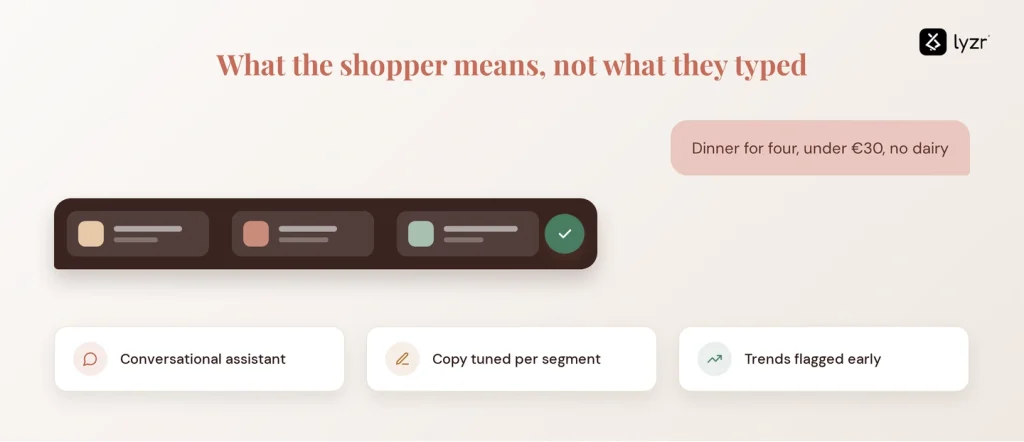
Carrefour’s Hopla assistant, “a chatbot based on ChatGPT which is now live on the Carrefour.fr website,” helps shoppers build baskets around budget and diet. By 2026 the company had extended that further, reflecting “a wider shift toward ‘AI shopping’ and conversational commerce, where consumers use generative AI tools to search, plan, and purchase goods.” Retailers are applying the same pattern to enhance the in-store experience alongside the online one.
See more in our AI in e-commerce coverage.
Generative AI use cases in energy
Energy operators sit on decades of technical manuals, survey data, and maintenance logs that are hard to search and harder to hand off as experienced staff retire. GenAI turns that archive into something field engineers and geoscientists can query in plain language, speeding up troubleshooting and preserving expertise the company would otherwise lose.
That pattern extends across the sector: mainframe and legacy technical systems in energy and other asset-heavy industries are being opened up the same way IT departments are opening up COBOL systems, discussed below.
More in our guide to AI in the energy sector.
Generative AI use cases in wealth management
Advisors spend a disproportionate share of their week on portfolio summaries, meeting prep, and compliance-driven documentation, which limits how many clients they can actually serve well. GenAI drafts follow-ups, flags life events buried in CRM notes, and summarizes portfolios before a call, giving advisors back time for the relationship itself.
Morgan Stanley’s Debrief tool, again, is the clearest public example, and firms across the sector are building similar internal copilots for the same reason: adoption above 98% happens when the tool removes real friction, not when it’s novel.
Explore AI in wealth management for a deeper breakdown of use cases and control points.
Generative AI use cases in IT and software
Every enterprise has a legacy system nobody wants to touch, and GenAI is finally making that problem tractable. It generates and explains code, writes test suites, and increasingly translates decades-old languages like COBOL into modern ones.
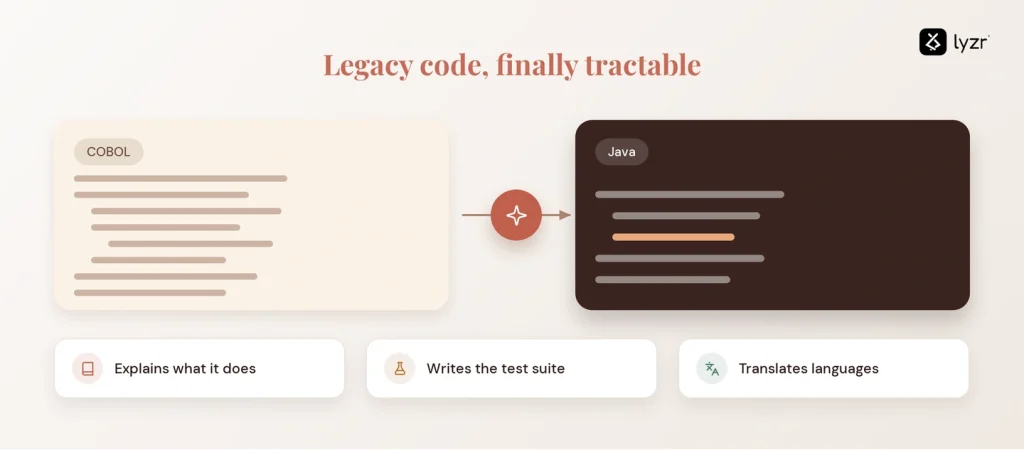
Google Cloud’s expanded partnership with Kyndryl is built around exactly this: “the partnership will help enterprises translate COBOL code to Java and migrate on-prem applications to cloud environments,” using Gemini models for the coding assistance layer. That’s a use case with a direct line to cost: fewer engineers maintaining brittle mainframe logic, more of them building on modern infrastructure. Platform teams evaluating a similar shift, including moving off other agent frameworks, can review how to migrate from AWS Bedrock Agents to Lyzr.
Generative AI use cases in manufacturing
Manufacturing’s GenAI wins sit in the gap between design and the shop floor: technical documentation, quality workflows, and engineering support all involve dense, specialized information that’s slow to search manually. Engineers use GenAI to generate design options against constraints and to query technical documentation during root-cause analysis on the line.
Siemens built this directly into its NX design software:
“Designcenter X NX Copilot is our engineering-focused generative AI assistant that brings innovation to life by turning natural language into action, leveraging industry best practices and Siemens knowledge to guide users through complex tasks.”
GenAI and business intelligence
BI dashboards answer questions you already knew to ask. GenAI is changing that by adding a conversational layer on top of the same underlying data, so a leader can ask why European sales came in below forecast and get a synthesized answer instead of a chart to interpret alone.
This isn’t a new standalone chatbot competing with your BI tool. It’s the same pattern running through this entire article: GenAI adding value by sitting inside a system your team already trusts, rather than replacing it.
Limitations and caveats
None of the use cases above are automatically production-ready, and the gap between pilot and production is wider than most teams expect.
“MIT’s State of AI in Business 2025 report found that despite $30 to 40 billion in enterprise investment into generative AI, 95% of initiatives fail to produce measurable business impact, with only 5% crossing into production,” a pattern the report attributes to brittle execution and shallow integration rather than weak models. On the adoption side, “McKinsey’s 2025 State of AI report, drawing on responses from nearly 2,000 companies, found only about 5.5% of organizations seeing real financial returns from their AI investments” at scale.
The recurring causes are consistent: hallucinated or unreliable outputs, sensitive data flowing into public models, a lack of enterprise context in out-of-the-box tools, integration work that gets underestimated, permissions that don’t match how the organization actually restricts access, and ROI that’s genuinely hard to measure without clear KPIs set up front.
These limitations also point to where enterprise AI is heading next. GenAI can generate, summarize, and answer, but production use cases increasingly need systems that can reason across enterprise context, make decisions within defined boundaries, take actions across connected systems, and involve humans when needed. That’s the shift from GenAI to Agentic AI: from AI that produces an output to AI that can carry a task through a workflow.
Agentic AI isn’t a replacement for GenAI. It builds on it. The model remains the reasoning and generation layer, while agents add the context, tools, permissions, orchestration, and human oversight needed to turn that capability into an operational workflow. For organizations trying to move beyond AI pilots, this is increasingly what taking GenAI into production looks like.
None of this is an argument against adoption. It’s an argument for moving beyond the idea that putting a GenAI model in front of a workflow is enough. It’s the reason the earlier sections keep pointing back to data, systems, and workflow integration rather than the model itself, that’s what actually determines whether a use case survives contact with production. Teams building governance structures around this should see the CIO playbook to AI agent governance, and organizations still relying on general-purpose chat tools may find it useful to review 100+ reasons not to use ChatGPT for enterprise before scaling further.
How to prioritize gen AI use cases
Don’t deploy GenAI everywhere it’s technically possible. Score each candidate use case against business impact, task frequency and volume, data availability, workflow complexity, integration requirements, and how easily the outcome can be measured. The risk and oversight questions from the limitations section above apply directly here: a use case with high business impact but weak data or heavy compliance exposure should start with a human tightly in the loop, not full autonomy.

The pattern that tends to work: pick a task done often, with data you already trust, where a wrong answer is annoying rather than dangerous. Prove it there before expanding scope. “McKinsey found 23% of organizations are already scaling an agentic AI system somewhere in their enterprise, with another 39% experimenting,” and the ones scaling successfully are almost always the ones that picked a narrow, well-bounded starting point.
If you want a structured way to sort your own list, Lyzr’s 101 Enterprise AI Use Cases playbook groups options by function and industry as a practical shortlist for exactly this kind of prioritization exercise. Teams that want a similar shortlist mapped specifically to their own industry can pair it with the GenAI Use-Case Shortlist by Industry, a companion worksheet for ranking opportunities before committing engineering time.
Getting from use case to production
Picking the right use case is only half the problem. Most teams underestimate what it takes to connect a model to real systems, real permissions, and real accountability.
Our guide on how enterprises can get started with GenAI adoption walks through that sequencing in more detail, and how to build your agentic AI roadmap in 2026 covers what comes after the first use case proves out.
Consulting and IT services firms building a practice around this shift face a related version of the same question, covered in how IT services firms can build a GenAI practice, alongside our Analyst Army Starter Pack for teams standing up research and analysis workflows. Saksoft’s own rollout, documented in our Saksoft case study, is a useful reference point for what that sequencing looks like in practice.
For a deeper look at where autonomous execution fits once a use case matures past a simple assistant, see 30 AI agent use cases already running in production. Revenue and platform teams specifically can also see how these use cases map onto their own function via Lyzr for revenue and sales teams and Lyzr for platform teams.
Where this goes next
The next phase of GenAI adoption isn’t about finding more things a model can generate. It’s about finding the workflows where AI can create measurable value, and connecting it to the data, systems, and controls required to run reliably at scale.
Every example in this guide, from Morgan Stanley’s advisor assistant to Zurich’s claims tooling to Siemens’ design copilot, works for the same reason: it’s wired into something real, with a human still positioned to catch what it gets wrong.
That’s the question worth sitting with before your next pilot: is this use case impressive because of what it generates, or valuable because of what it’s connected to?
Lyzr builds the infrastructure for the second kind, AI agents and applications that plug into your existing data, systems, and approval workflows instead of sitting beside them. Explore the Lyzr platform to see how enterprise teams are operationalizing the use cases above.
If you’re deciding which of the use cases above to try first, that decision usually starts with a shortlist, not a build.
Book a demo to walk through what that looks like against your own systems.
Frequently asked questions
The top use cases include internal knowledge search, document intelligence for contracts and reports, customer service automation grounded in account data, code generation and legacy modernization, and natural-language data analysis. Each works because it’s tied to a specific dataset and workflow, not because it’s a generic capability.
They follow each industry’s data and regulatory shape: fraud and research support in banking, claims and underwriting in insurance, clinical documentation in healthcare, technical knowledge retrieval in energy and manufacturing, and conversational commerce in retail. The function is similar across sectors; the data and workflow it plugs into is what changes.
In business, GenAI is used less as a creative tool and more as a productivity layer embedded in existing applications. It helps employees find information faster, serve customers with fuller context, review documents quicker, and write and maintain software more efficiently.
Generative AI is commonly grouped by output type: text generation (summaries, code, structured drafts), image generation, audio generation, and video generation. Most enterprise use cases in 2026 concentrate on text and code, because that’s where the data connections described throughout this guide are most mature.
Related reading and resources
The use cases in this guide are a starting point. If you’re exploring where GenAI fits into your organization, see Lyzr’s data-driven approach to decision-making, generative AI technologies, and resources on branding, market trends, and AI-driven marketing strategies.
For function-specific applications, explore AI in marketing, marketing campaign optimization, content creation, tailored marketing content, and autonomous content workflows with Skott and AI Marketing Agent use cases. Revenue and HR teams can explore personalized email content, sales conversion, Jazon, AI sales agents, AI chatbots, recruitment, customer support, and AI in HR technology.
The same patterns apply differently across industries. Relevant resources include AI in real estate, real estate agents, real estate marketing, AI for education, online math classes, learning German, investment analysis, supply chain, Sockeye maintenance scheduling, medical imaging, cybersecurity, pattern and anomaly detection, and AI-driven IT support.
For teams moving from GenAI to Agentic AI, this is where the next step becomes more practical. Explore 30 AI agent use cases, AI agents use cases in enterprises, agent architecture, the Agentic AI roadmap, and Lyzr’s resources for revenue and sales teams and platform teams. For prioritization and production, see the 101 Enterprise AI Use Cases playbook, enterprise GenAI adoption guide, GenAI practice guide for IT services firms, Analyst Army Starter Pack, and Saksoft case study. Specialized workflow resources include online proposal software, LinkedIn scheduling, AI clip generation, multilingual transcription, and an AI-powered low-code SaaS builder.
Finally, taking AI into production means thinking about governance, risk, and accountability. The CIO guide to AI agent governance covers these considerations, while 100+ reasons not to use ChatGPT for enterprise examines the risks of relying on general-purpose AI tools. Additional implementation resources include pre-revenue startup valuation, Salesforce accelerators, and AeroChat’s Shopify AI chatbot.
Book A Demo: Click Here
Join our Slack: Click Here
Link to our GitHub: Click Here