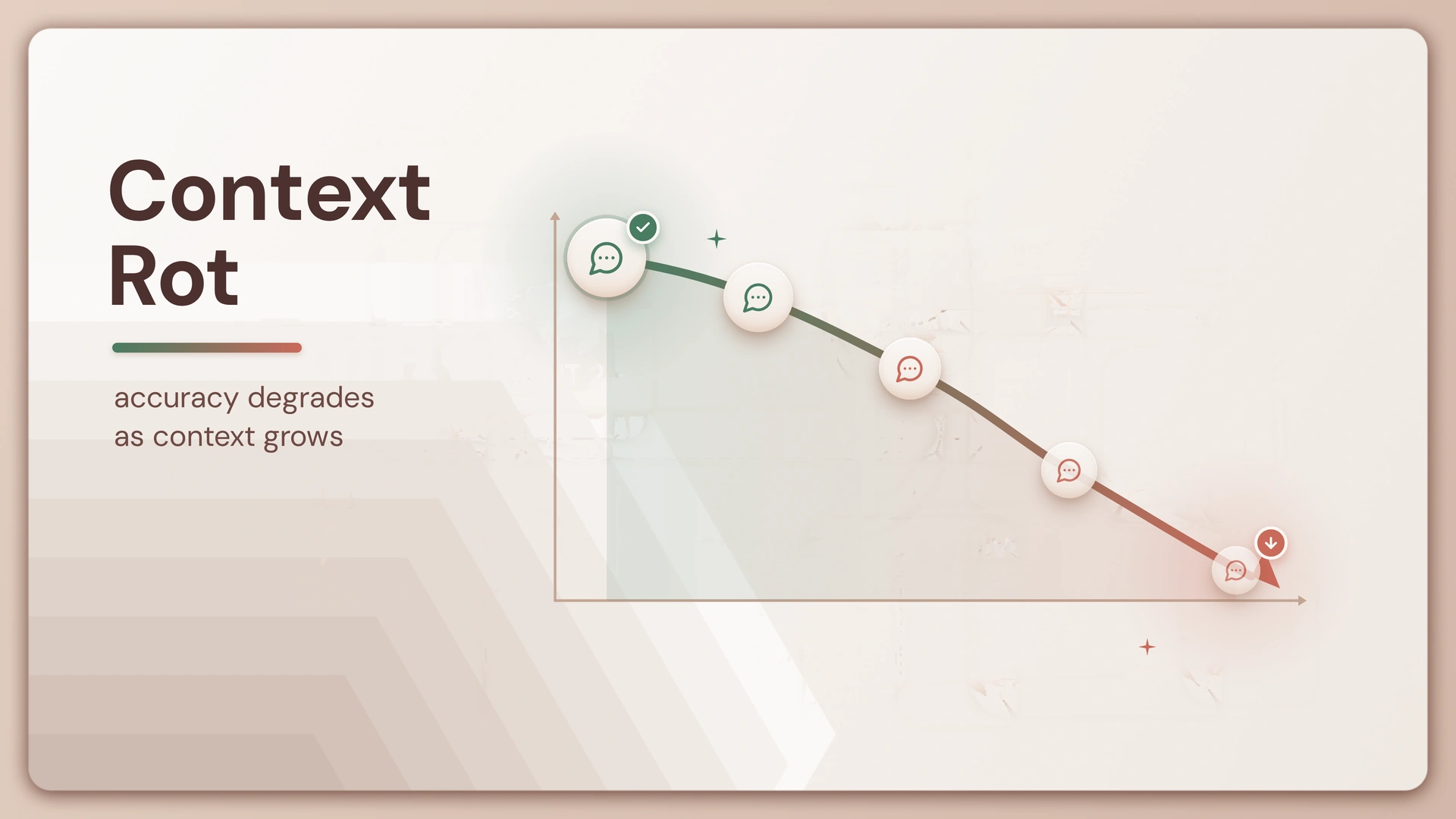
Context rot is the measurable decline in an LLM’s output accuracy as its input context grows longer, even when the relevant information is still technically present in the context window. It comes from how attention, positional encoding, and token competition behave inside a transformer, not from the window running out of room. Longer input is not automatically better input.
Key takeaways
- Context rot is a decline in output quality as input length grows, distinct from hitting a hard token limit.
- Four mechanics drive it: attention dilution, positional encoding limits, the lost-in-the-middle effect, and distractor accumulation.
- Degradation shows up well below a model’s advertised window size, often at a fraction of stated capacity.
- Detecting it requires needle-in-a-haystack and position-dependent accuracy testing, not token-count monitoring alone.
- Preventing it is the job of context engineering: retrieval, compaction, structured memory, and iterative prompting, not a bigger window.
What is context rot?
Context rot is the drop in an LLM’s answer quality that shows up as input length increases, independent of whether that input actually fits inside the model’s advertised window. A model can have 150,000 tokens of headroom left and still answer worse at 40,000 tokens than it did at 4,000, on the exact same underlying task. That pattern is documented across every major model family, and it is different enough from a capacity problem that it earned its own name and its own body of research from the Lyzr blog and elsewhere.
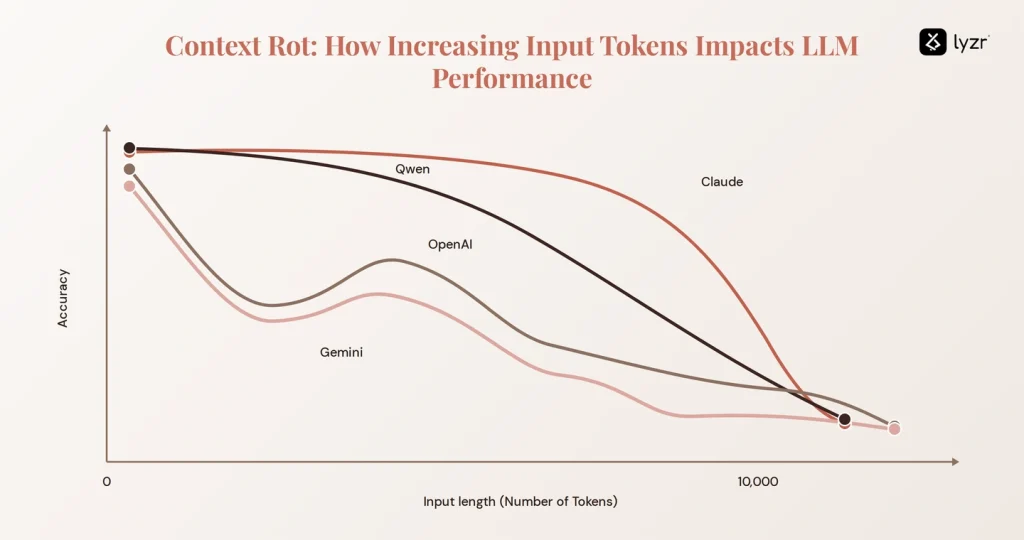
The term describes a testable phenomenon, not a vague complaint about a model “getting confused.”
Evaluation of 18 state-of-the-art models including GPT-4.1, Claude 4, Gemini 2.5, and Qwen3 across controlled experiments found that model reliability decreases significantly with longer inputs, even on simple tasks like retrieval and text replication.
The term itself was formalized by Chroma’s 2025 research, which systematically tested how 18 frontier models handle increasing context lengths.
If you are building or evaluating agents that hold long conversations, read long documents, or run multi-step tool loops, this is the failure mode that quietly caps how far those systems can scale.
What causes context rot
Context rot is not one bug. It is four separate mechanics that compound as input grows.
Attention dilution
A transformer’s attention mechanism distributes a fixed computational budget across every token in the input. Add more tokens and each one gets a thinner slice of that budget. Think of it as a spotlight with a fixed number of lumens rather than a floodlight: spread it across a bigger stage and every point gets dimmer, including the point that actually matters.
Positional encoding limits.
The root cause traces back to the attention mechanisms and positional encodings used by transformer-based models, including Rotary Position Embedding (RoPE, the scheme most modern LLMs use to encode token order), which introduces a decay effect that causes models to weight the start and end of a sequence more heavily than the middle.
The model is not ignoring the middle on purpose. Its position-aware weighting was never built to treat every token equally.
The lost-in-the-middle effect.
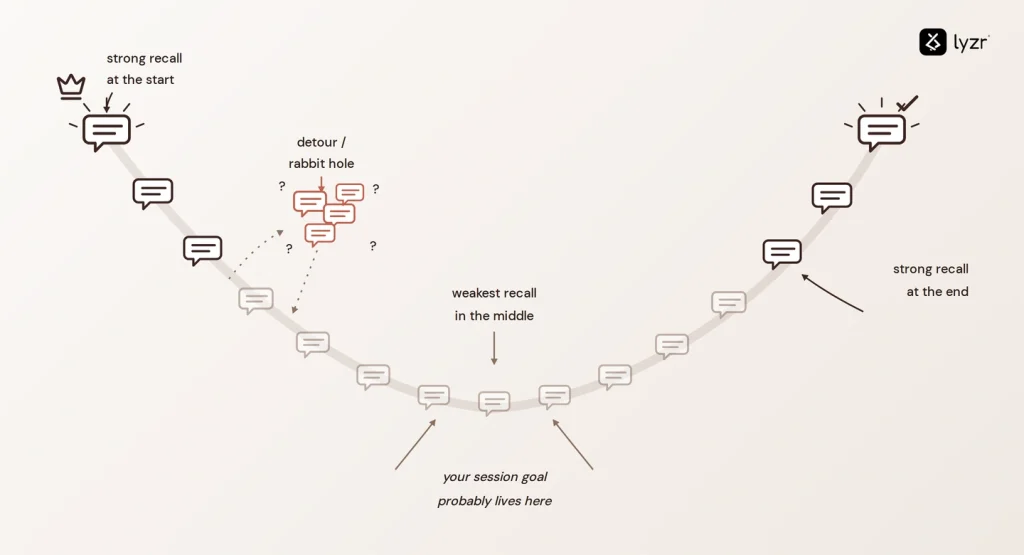
Models work best when relevant information sits at the very beginning or the very end of the context window, and struggle when that same information gets buried somewhere in the middle.
This positional degradation follows a U-shape: accuracy is high at the start and end of the input and 20 to 30 points lower in the middle.

Researchers also call the broader pattern long context degradation, the formal name for the same measurable decline, emphasizing that it scales continuously with input length rather than tripping only at a hard edge.
Distractor accumulation
Every irrelevant token in the context, whether it is boilerplate, prior tool output, or a semantically similar but wrong answer, competes for the same limited attention as the token that actually matters.
Even when task structure and needle-question similarity are held constant, changing the semantic similarity between the needle and the surrounding content can influence how well a model finds it, which means noisy or near-duplicate content does measurable damage even before the window is close to full.
Context rot vs. context window limits
A context window limit is a hard token ceiling: exceed it and the request fails or gets truncated. Context rot is a gradual accuracy decline that starts well before that ceiling, often at a fraction of the model’s stated capacity. Treating the two as the same failure mode is how teams end up debugging the wrong problem.
| Dimension | Context rot | Context window limit |
| What it is | A gradual decline in output accuracy as input grows | A hard token ceiling the model cannot exceed |
| When it starts | Well before the window fills; a model with a 200K token window can show significant degradation at 50K tokens | Only once input actually exceeds the model’s maximum token count |
| Failure pattern | Continuous decline, with no clear point where it “breaks” | A hard cutoff: the request is rejected or truncated |
| Root cause | Attention dilution, positional encoding limits, the lost-in-the-middle effect, and distractor accumulation | The model architecture’s fixed maximum sequence length |
| What it looks like | Answers get subtly less reliable or less precise, with no error thrown | The call fails outright, or the input is silently truncated |
| How you detect it | Needle-in-a-haystack position sweeps and position-dependent accuracy testing | Comparing token count against the model’s documented limit |
| How you fix it | Context engineering: retrieval, compaction, structured memory, iterative prompting | Use a model with a larger window, or split the input across calls |
The decline behind context rot is continuous, not a cliff, which is exactly why it is easy to miss in normal testing. A prompt that “still fits” can already be producing worse answers than a shorter version of the same prompt would, and no error message will tell you that.
How to measure context rot
Context rot shows up in benchmark testing and in live sessions alike, so measuring it takes more than watching a token counter. These are the criteria that catch it:
- Needle-in-a-haystack (NIAH) position sweeps: Plant a specific fact, the needle, inside a much larger body of text, the haystack, and ask the model to retrieve it, then slide the needle’s position from the start of the document to the end. That produces a position-accuracy curve instead of a single pass or fail score. Any context-rot LLM benchmark worth trusting pairs that positional sweep with a second axis, total input length, held at multiple checkpoints rather than one.
- NIAH scores alone don’t predict reliability: Chroma’s 2025 evaluation of 18 frontier models found that near-perfect needle-in-a-haystack scores do not predict real-world reliability. Standard NIAH tests measure a narrow capability, lexical retrieval, and models that ace it can still degrade sharply on tasks that require reasoning across the same context rather than simply locating one sentence in it. A model that retrieves a planted fact from a million-token document is not necessarily the model that can reliably reason across that document.
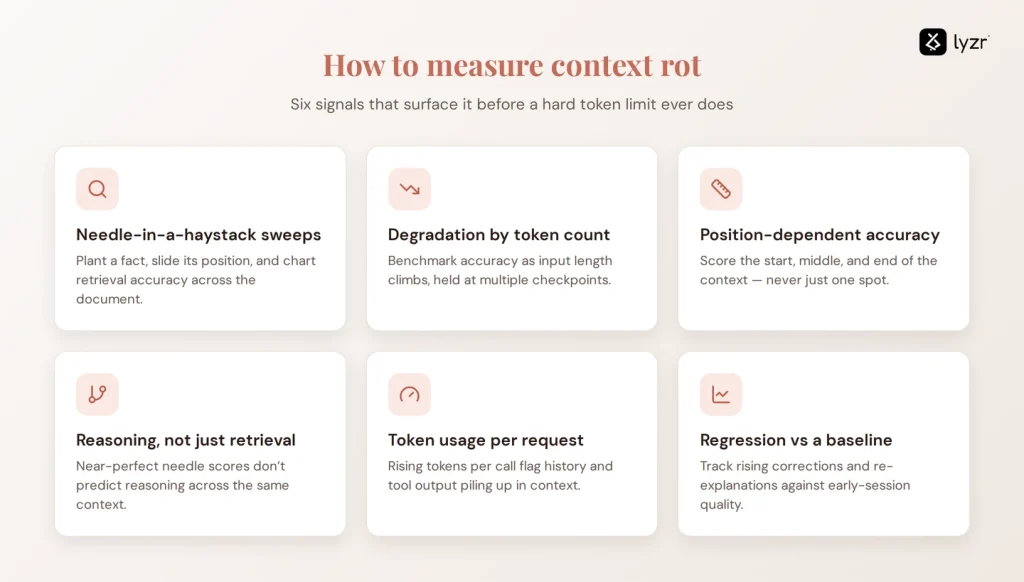
- Benchmarked degradation by token count: NoLiMa’s 2025 evaluation of 12 long-context models found that most had an effective context length of 2,000 tokens or less, well short of their advertised capacity, with degradation showing up even in the 2,000 to 8,000 token range. By 32,000 tokens, ten of the twelve models had dropped below half their short-context baseline score, and even GPT-4o, the strongest performer in the test, fell from a near-perfect 99.3% to 69.7%.
- Position-dependent accuracy: the distance-from-end pattern. Once context passes roughly the halfway point of the window, models tend to favor the most recent tokens, then middle tokens, over the earliest ones. Testing accuracy at multiple positions, not just one, is what surfaces this; a single end-to-end score will miss it entirely.
- Token usage per request: Track token consumption on every call within a live session. A rising token count per query, on the same class of task, is a proxy for how much unfiltered history or tool output is accumulating in context, and it usually moves before output quality visibly drops.
- Output quality regression against an early-session baseline: Set a quality baseline in the first few turns of a session, then watch for rising correction frequency, re-explanation requests, or editing time on the same class of task. A model that needed no correction at turn five and needs constant correction by turn fifty is showing context rot, even if any single response still looks reasonable in isolation.
Treat every benchmark figure above as a snapshot from a specific model version and test design; they will shift as models change, but the pattern they describe, degradation well before a hard limit, holds regardless of which model you’re running. Building this kind of testing into a deployment pipeline overlaps heavily with agent observability, since position-dependent accuracy is exactly the kind of regression that disappears the moment you stop watching for it.
How does context rot affect enterprise deployments?
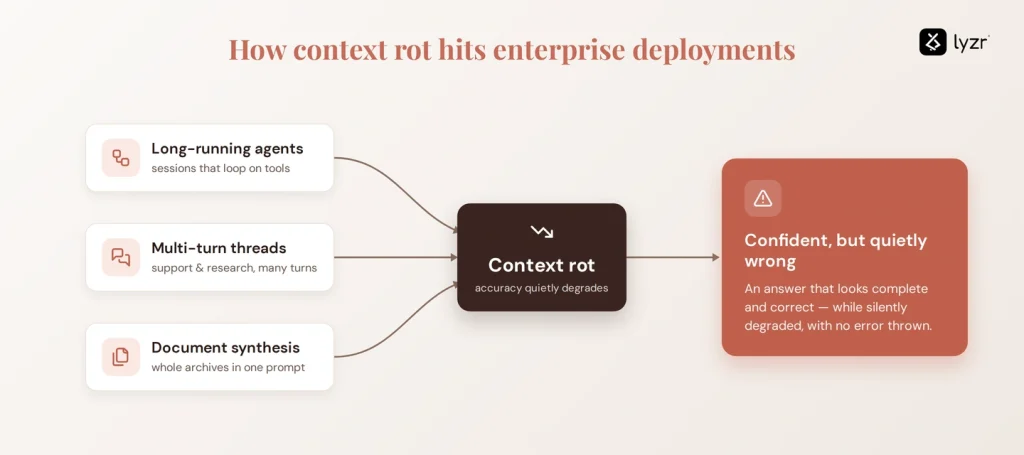
Context rot shows up wherever an application keeps accumulating context across turns, tools, or documents instead of resetting it. Three patterns cover most enterprise deployments.
Long-running agent sessions
An agent that plans, searches, and calls tools adds every intermediate result back into its own context.
The model is often smart enough to solve the task if its context stays clean, but context does not stay clean: agents accumulate noise during search, exploration, and backtracking, and that noise directly degrades every subsequent output.
For coding agents specifically, context rot is the primary failure mode, ahead of raw model capability or reasoning ability.
This effect gets worse, not better, once you move from a single prompt into a production agentic system.
Multi-turn support and research threads
A support conversation or an analyst’s research session that runs for dozens of turns accumulates history the same way. If an answer depends on connecting two facts introduced far apart in the conversation, the failure gets worse, not just more likely.
The longer the context got in controlled testing, the worse models tended to perform on questions that required connecting two separate facts across the document, showing that degradation compounds on tasks that require multiple reasoning steps, not just single-fact retrieval.
Document-heavy research tasks
Feeding a model an entire contract set, a compliance archive, or a multi-document case file and asking it to synthesize across all of it is the exact setup that triggers lost-in-the-middle failures, because critical clauses rarely sit conveniently at the start or end of the packet. A well-built RAG engine narrows what actually enters the prompt instead of dumping the whole archive in at once.
The business risk in all three cases is the same: an answer that looks confident and complete while being quietly wrong, in a system nobody is watching closely enough to catch it. That is the core argument behind why enterprise intelligence shouldn’t be a black box: a system that degrades silently as it scales is not one you can certify as reliable, no matter how good it looked in a demo with a short prompt.
How to prevent context rot
Preventing context rot means managing what enters the model’s context on every call, rather than maximizing how much you can technically fit.
Retrieval-augmented generation (RAG): Instead of loading a full document set into the prompt, retrieve only the passages relevant to the current query. A properly tuned RAG engine keeps the signal-to-noise ratio high by design, and extending that pattern into multi-step retrieval loops is what agentic RAG is built to handle.
Read more about One Shot RAG
Summarization and context compaction: Periodically compress conversation history or intermediate agent output into a shorter summary that preserves the decision-relevant facts and drops the rest. This keeps a long-running session from ballooning past the point where earlier mechanics start degrading it.
Iterative prompting: Rather than front-loading every fact a model might need, re-inject the specific facts relevant to the current step, close to where the model will use them. This is one of several prompt engineering techniques that predate context engineering as a discipline but still matter inside it.
Structured memory: Store state (user preferences, prior decisions, task progress) outside the raw prompt in a queryable memory layer instead of re-pasting it into every turn. Different AI agent memory types serve different jobs here, and picking the wrong one is a common reason teams still see rot even after adding retrieval.
None of these patterns require a smarter model. They require deciding, on every call, what earns a place in the context window.
Does a bigger context window fix it?
No. A bigger window increases how much text a model can technically hold, not how well it allocates attention across that text.
Research through 2025 and 2026 shows every frontier model gets measurably worse as context grows, well before the window actually fills up, which means the fix is not a bigger window but a disciplined budget.
Model vendors spent 2024 and 2025 racing toward million-token context windows, and it was tempting to assume the context problem had been solved by brute force.
It has not: capacity is the wrong metric, and signal-to-noise ratio inside the prompt is what actually determines output accuracy.
A model with more room to spare will still exhibit context rot if what fills that room is unfiltered history, redundant tool output, or documents padded with irrelevant sections.
Prompt engineering vs context engineering
Prompt engineering optimizes the wording of a single instruction to get a better response from a model. In contrast, Context engineering is the discipline of deciding what information, tools, and history actually enter a model’s context at each step of a task, not just how one instruction is phrased. It is the practice of deliberately designing what a large language model sees on every inference call, turn after turn, not a one-time prompt-writing exercise.
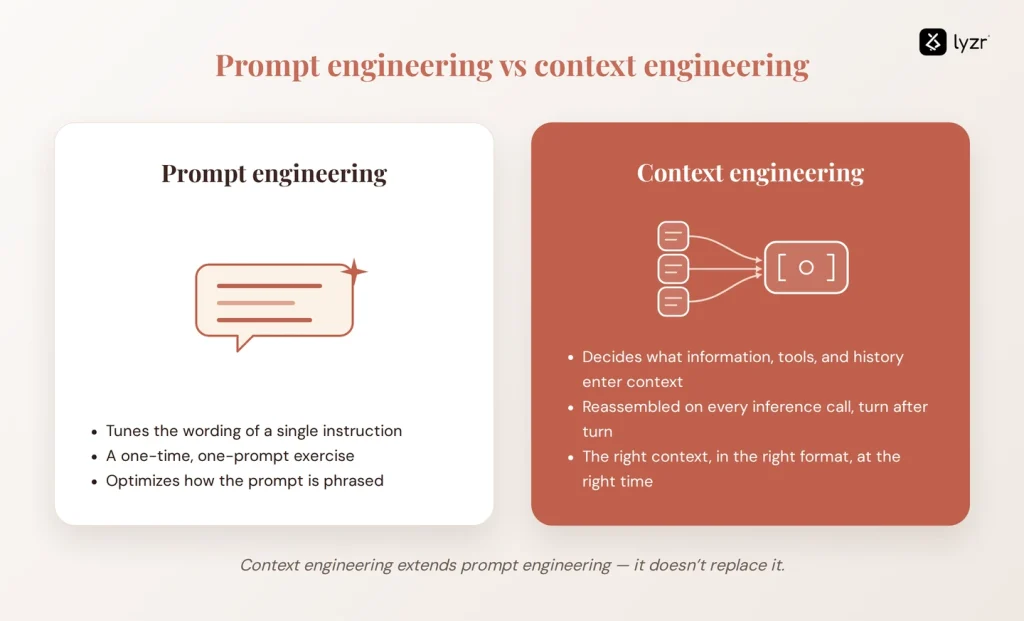
Phil Schmid, who helped popularize the term in mid-2025, describes it as designing dynamic systems that give a model the right information and tools, in the right format, at the right time, so it can actually accomplish the task.
The shift away from prompt-only thinking is not informal industry chatter.
In July 2025, Gartner stated that context engineering was in and prompt engineering was out, urging AI leaders to build context-aware architectures rather than optimize prompts.
In September 2025, Anthropic’s applied AI team published guidance on effective context engineering for AI agents, framing it as the natural next step after prompt engineering.
Lyzr’s prompt engineering solutions still matter inside this discipline; context engineering extends that work rather than replacing it.
A context control plane is one way to operationalize context engineering at the platform level: a governance layer that tracks what context each agent is fed, evaluates it before promotion, and gives teams a place to catch context rot before it reaches production rather than after a customer notices. It is an implementation of the discipline, not a different name for it.
Lyzr Studio is where that gets built in practice, from retrieval configuration to memory design to the evaluation checkpoints that catch position-dependent accuracy drops before they ship.
If your agents are already running long sessions, holding multi-turn conversations, or synthesizing across document sets, the question worth asking is not whether your context window is big enough. It is whether you can currently measure, at any given token count, how much of that window is actually helping.
Ready to solve context rot for your organization? Book a Lyzr Studio demo to see how measurement and prevention get built into a production agent pipeline from day one.
FAQs
What is context rot?
Context rot is the decline in an LLM’s response accuracy as the amount of input context increases, even when the model’s context window has room to spare. It is driven by attention dilution, positional bias, and accumulated distractor tokens, not by hitting a hard token ceiling.
What causes context rot in LLMs?
Context rot comes from four compounding mechanics: attention dilution spreads a fixed attention budget across more tokens, positional encoding schemes weight recent and early tokens more heavily, the lost-in-the-middle effect buries mid-context facts, and distractor accumulation adds irrelevant tokens that compete for the model’s attention. Each effect compounds as input grows.
How do you prevent context rot?
Preventing context rot means actively managing what enters the model’s context rather than maximizing how much fits. Effective patterns include retrieval-augmented generation to fetch only relevant passages, summarization and compaction to shrink history, iterative prompting that re-injects key facts near where they’re needed, and structured memory that stores state outside the prompt.
What is the difference between context rot and context window limits?
A context window limit is a hard token ceiling; context rot is a gradual accuracy decline that happens well before that ceiling is reached. A model with a large advertised window can show measurable context rot at a fraction of that capacity, because rot is about attention quality, not token capacity.
Does a bigger context window fix context rot?
No. A bigger window increases how much text a model can technically hold, but it does not change how the model allocates attention across that text, and research on frontier models shows degradation persists well inside advertised limits. Signal-to-noise ratio in the prompt, not window size, determines output accuracy.
What is context engineering?
Context engineering is the discipline of deciding what information, tools, and history actually enter a model’s context window at each step of a task, rather than crafting one ideal prompt. It treats context as a finite, competitive resource and applies retrieval, compaction, and memory design to keep it clean.
Book A Demo: Click Here
Join our Slack: Click Here
Link to our GitHub: Click Here