A policyholder calls about a car accident.
The rep pulls up the wrong endorsement, quotes a deductible that isn’t on the active policy, and promises a callback that never comes.
Nobody lied. The system just couldn’t surface the right document fast enough.
That gap, between what a policyholder needs to hear and what a rep can actually retrieve in the moment, is the problem AI in insurance customer support is built to close. It’s also a different problem than the one AI solves in retail or telecom support.
A support interaction in insurance is frequently a regulated communication. Telling someone what their coverage includes is a statement about a contract. Confirming a claim status sets an expectation they may rely on. Getting it wrong isn’t a bad review. It’s exposure.
This piece covers where AI actually fits across the support lifecycle, how a production-grade multi-agent stack is built, what changes by insurance line, and the six requirements of regulated deployment that most vendor content skips entirely.
TL;DR
- AI in insurance customer support covers four areas: FNOL claims intake, policy servicing and self-service, real-time agent assist, and voice-of-customer analytics.
- Agent assist, not full customer-facing autonomy, is the fastest-adopted and lowest-risk starting point, because a human still speaks.
- A support answer is often a regulated communication. An incorrect coverage answer creates misrepresentation exposure, not just a CSAT dip.
- Production deployments need grounding in actual policy wording, refusal behavior on low confidence, complete audit trails, and defined routing for complaints and vulnerable customers.
- Sequencing beats model selection: assist first, deflect the simplest queries second, keep coverage interpretation human-reviewed for now.
Where does AI actually fit in insurance customer support?
It fits in four places, and they don’t get equal attention on most vendor pages. Claims intake gets the most marketing. Voice-of-customer analytics gets almost none, despite being one of the four areas Google’s own AI Overview surfaces for this query.

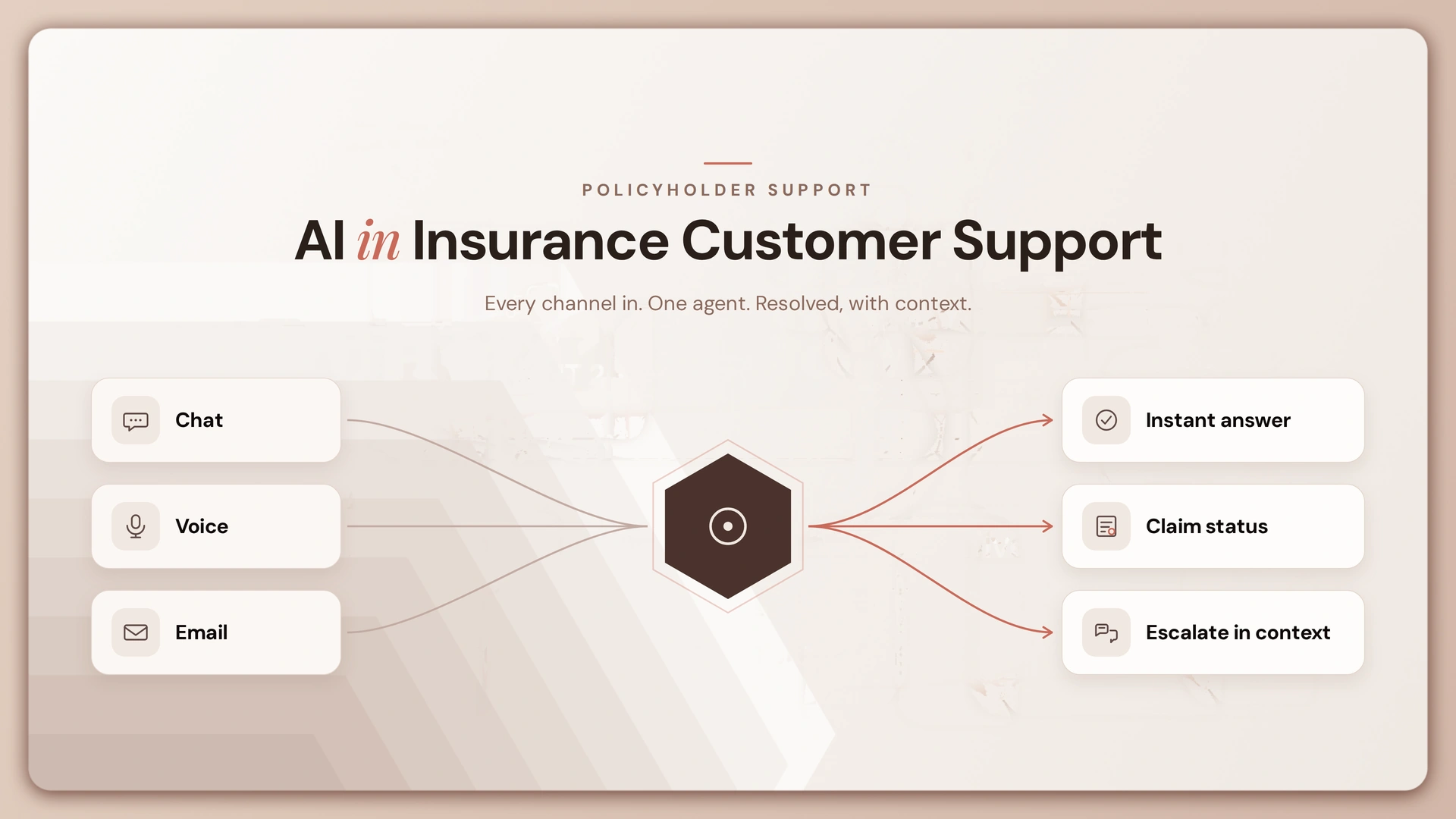
Claims intake and FNOL triage. An agent captures first notice of loss across chat, email, or voice, extracts entities from unstructured descriptions and uploaded photos, validates coverage against the active policy, and assigns a severity score before routing to the right adjuster queue. Simple claims resolve automatically. Everything else escalates with full context attached, instead of a bare case number. Lyzr’s claims processing agent and claims severity prediction agent are built for exactly this handoff.
Policy servicing and self-service. Endorsements, mid-term adjustments, billing questions, document requests, renewals. This is the long tail that eats contact-center capacity, and it’s where deflection economics are clearest. A policyholder using ai voice agents to check a billing due date at 11pm never touches a queue. This is also a meaningful upgrade over legacy IVR software, which routes by keypress rather than by understanding the actual request.
Agent assist for human staff. This deserves more weight than it usually gets. An assist agent surfaces the relevant policy clause mid-call, summarizes a customer’s prior claims before the rep even picks up, and drafts the follow-up email. It’s the fastest-adopted use case in insurance contact centers because the risk profile is different: a human still says the final word, so a wrong retrieval gets caught before it reaches the policyholder. Lyzr’s support interaction assistance agent and CRM case generator agent sit in this category.
Voice-of-customer analytics. Every transcript, email thread, and chat log is unstructured data nobody reads at scale. Parsing thousands of interactions surfaces recurring complaints, process bottlenecks, and early churn signals, turning support data from a monthly report into something closer to a live instrument panel.
According to McKinsey’s 2025 analysis of AI in the insurance industry, UK insurer Aviva rolled out more than 80 AI models to improve outcomes in its claims domain, cutting liability assessment time for complex cases by 23 days, improving the accuracy of routing claims to the appropriate teams by 30 percent, and reducing customer complaints by 65 percent. That’s not a customer-support statistic in isolation. It’s what happens when claims accuracy and support communication stop being separate systems.
How does a multi-agent support stack actually work?
It works as a chain of specialized agents, not one model trying to do everything. Three roles do most of the work.

The ingestion agent sits at the front door. It monitors chat, email, voice, and channels like WhatsApp CRM integration, standardizes the incoming query, and routes it downstream.
The retrieval agent is where the real work happens. Using retrieval-augmented generation (RAG, the technique of pulling live, specific documents into a model’s context instead of relying on its training data), it queries a version-controlled knowledge base built from policy wordings, claims manuals, and jurisdictional rules, not the open internet.
The resolution and orchestration agent synthesizes what’s retrieved into a single answer. Agent orchestration handles the case where a query needs two sources at once, say, policy terms and current claim status, without making the policyholder ask twice.
Two things matter more here than in a generic support stack. First, where the human gate sits. Some interactions auto-resolve, some get drafted for human review, some go straight to a person. That threshold is a compliance artifact, not just an engineering setting, because the line determines what the company is willing to say to a policyholder without a human checking first.
Second, what the agent is actually grounded in. An agent grounded in general model knowledge will be confidently wrong about your specific coverage terms, and confident wrongness is worse than an honest “I don’t know” in a regulated conversation. Retrieval built on vector indexing (the method of storing document meaning as searchable numerical representations) only helps if what it’s indexing is the carrier’s own approved documents.
What changes by insurance line?
The core technology stays constant. The workflows don’t. A life claim and a motor claim are different jobs wearing the same AI label.
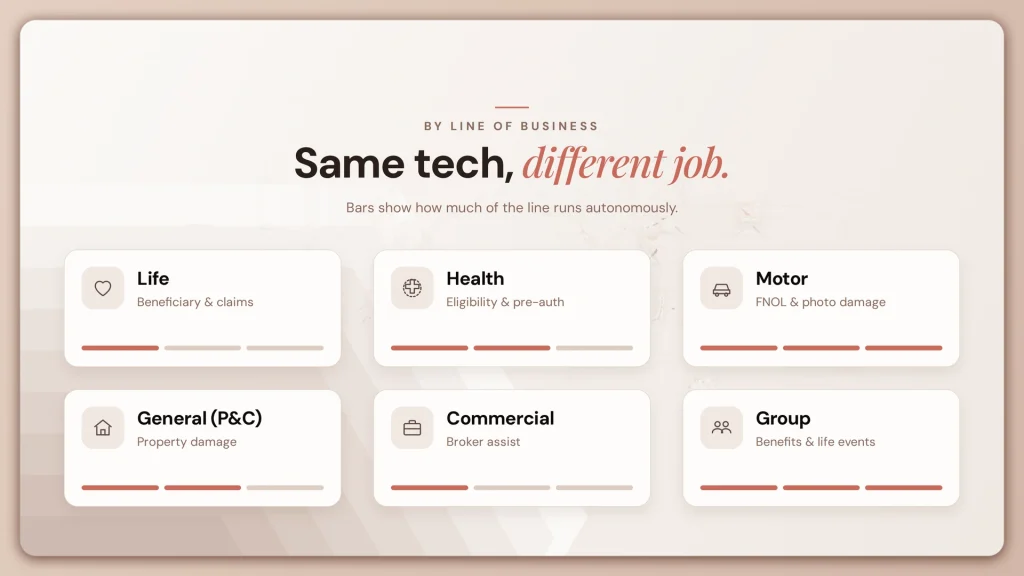
Life insurance. Beneficiary changes, premium queries, and policy loans dominate routine volume. The harder case is guiding someone through the early steps of a bereavement claim with the right tone, collecting documents before handing off to a trained human, which matters more in agentic AI in life insurance than almost any other line.
Health insurance. Eligibility checks, claim status, and pre-authorization questions. Lyzr’s healthcare claims validation agent automates network and coverage verification against the specific plan, not a generic benefits summary.
Motor insurance. High volume, high tolerance for automation. FNOL for accidents, damage photo processing, and self-service insurance quote options for renewals and driver changes.
General insurance (P&C). Home and property claims, where AI walks a policyholder through documenting water damage or wind loss, plus routine work like issuing certificates of insurance.
Commercial insurance. A different servicing profile entirely. Broker-mediated, lower volume, higher complexity. AI for commercial insurance mostly means agent assist: helping an account manager parse dense policy language or track a submission’s status, rather than a policyholder-facing bot.
Group insurance. Benefits questions, onboarding and offboarding, and life-event changes, usually through a self-service portal an employee can use without calling HR.
Lyzr’s renewal churn predictor and policy endorsement processing agent apply across several of these lines, and the fuller catalog of 100+ insurance agent use cases breaks each one down further.
What does regulated deployment actually require?
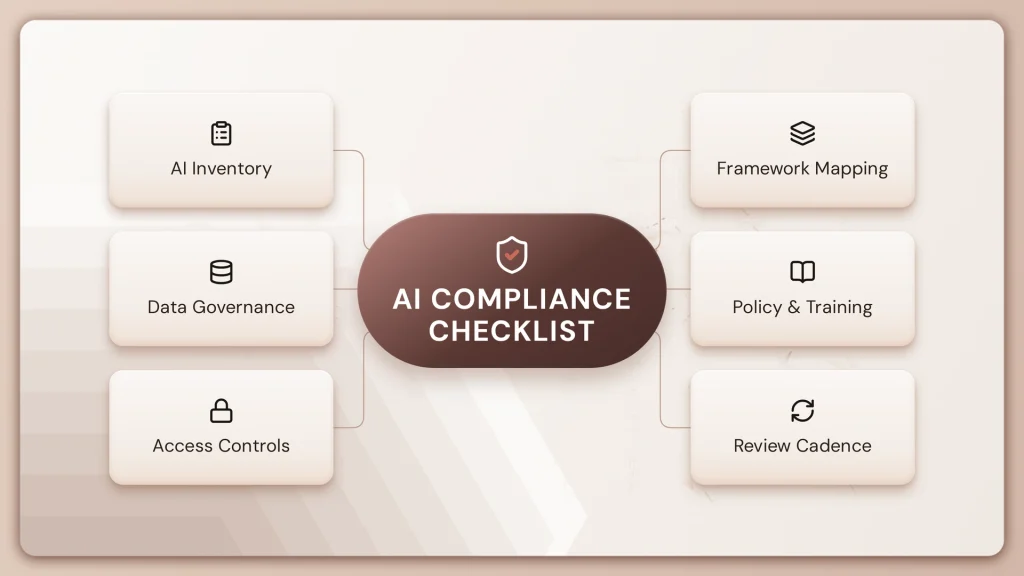
It requires treating a support answer as a compliance artifact, not just a customer-experience moment. Describing coverage is a statement about a contract. Confirming a claim status creates reliance. Six things follow from that.
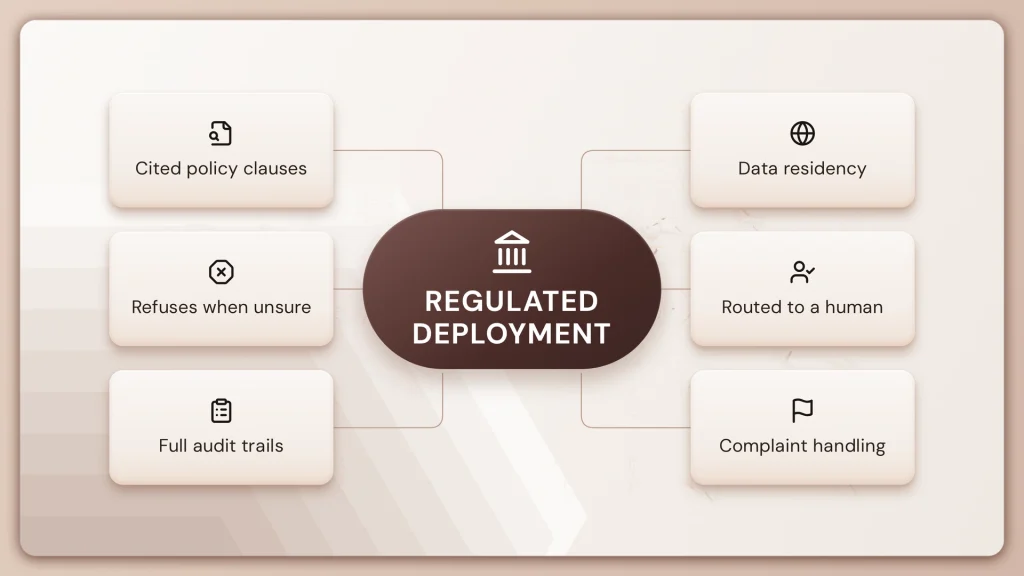
Grounding in actual policy wording. The agent retrieves and cites the specific clause. It doesn’t paraphrase from memory. A paraphrased coverage term that’s slightly wrong is a misrepresentation problem, not a UX bug.
Refusal behavior on low confidence. An agent that says “I’ll connect you with someone who can confirm that” is working correctly. One that guesses fluently is the actual failure mode. This is the job of a dedicated hallucination manager, not a prompt instruction hoping for the best.
Full audit trails. Every interaction logged: what was retrieved, what was said, what action followed, retained per applicable record-keeping rules and retrievable on examination. This lives in a control plane, not a chat log someone exports when asked.
Data residency and privacy. Policyholder data carries jurisdiction-specific residency requirements, IRDAI in India, GDPR in the EU, HIPAA for health lines in the US. Meeting them in practice often means a sovereign AI deployment rather than a single global instance.
Vulnerable customer handling. Regulators in multiple markets expect defined treatment for customers in vulnerable circumstances, bereavement claims being the clearest example. These conversations route to a human by policy, not by a confidence score that might not catch the signal.
Complaints handling. A complaint isn’t negative sentiment, it’s a category that triggers a defined process with statutory timelines in many jurisdictions. The NAIC’s Model Bulletin on AI, which takes effect in a given state only after that state’s insurance department adopts it, and by mid-2026 more than 20 US jurisdictions had done so, and requires insurers to maintain a written AI Systems Program with senior-management and board accountability, risk controls, and model validation and testing for errors, bias, and unfair discrimination. An agent has to recognize a complaint as a complaint and route it accordingly, not treat it as a service ticket.
This is the substance behind governable AI support for chat and voice, and it’s the foundation of responsible AI and working AI agent governance rather than a policy document nobody checks against production behavior.
Where should you start, and what should wait?
Start with agent assist, not customer-facing autonomy.
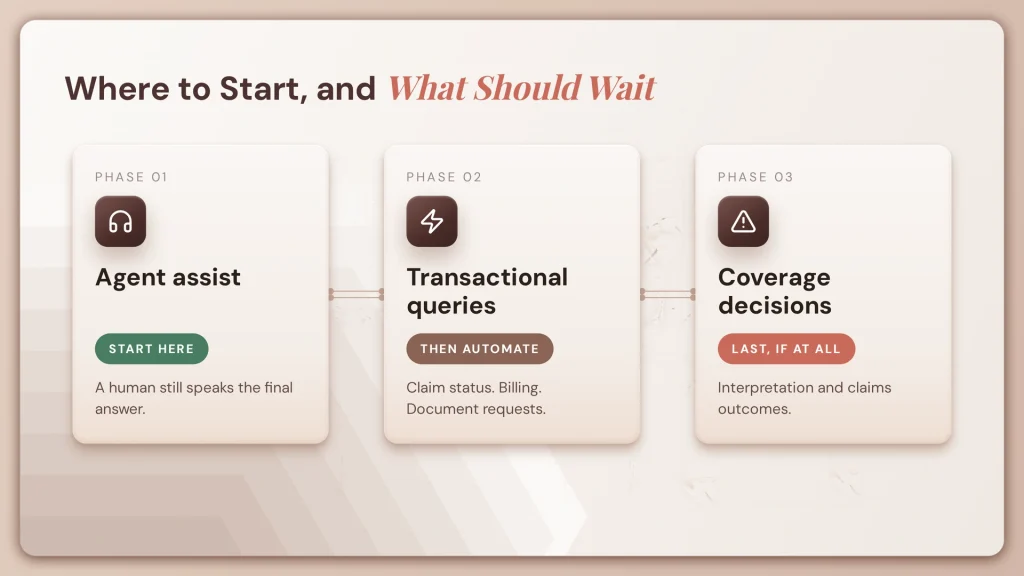
It delivers measurable handle-time improvement immediately. It carries close to no misrepresentation risk, because a human still speaks the final answer. And it builds the grounded knowledge base a customer-facing agent will eventually need anyway, so the work isn’t wasted when you move to the next phase.
From there, automate the highest-volume, lowest-ambiguity queries first: claim status, billing, document requests. These are transactional with unambiguous answers, which is exactly what makes them safe to deflect early.
Coverage interpretation and anything touching an actual claims decision should come last, if at all. That’s not caution for its own sake. It’s matching the automation to where a wrong answer costs the least. Teams that skip straight to full autonomy on complex queries tend to spend the following year walking it back.
You can build and test this sequence directly in Lyzr Agent Studio, including the AI cross-channel support agent, AI phone support agent, and email triage agent blueprints that map to each stage.
Why enterprises choose Lyzr for insurance support
Because the platform is built for the compliance requirements above, not retrofitted to meet them. A global insurer’s customer service workflow, built on Lyzr, runs FNOL intake and policy servicing through the same governed retrieval and audit layer described in this piece, rather than bolting a chatbot onto systems that were never designed to log what it did.
The platform combines a multi-agent architecture, RAG grounded in a carrier’s own version-controlled documents, a control plane for audit and governance, and hallucination management to stop confident guessing before it reaches a policyholder. Benjie, Lyzr’s insurance agent, and Jeff, Lyzr’s customer support agent, are both built on this same foundation, and the broader AI for insurance solution extends it across claims and underwriting, alongside a wider set of 50+ use cases already running across other functions. For teams starting with email-heavy queues specifically, the AI-driven email triage case study is a useful reference point.
See how this maps to your contact center by booking a demo.
Frequently asked questions
How is AI used in customer support in insurance?
For FNOL claims intake, policy servicing and billing queries, real-time assistance to human agents during calls, and analyzing transcripts to surface recurring issues.
What AI do insurance companies use?
Conversational agents for policyholder queries, document extraction for claims and underwriting, agent-assist tools in contact centers, and analytics run on support transcripts.
Is AI replacing customer service in insurance?
No. It handles routine, high-volume queries and supports human agents on complex ones. Coverage disputes, vulnerable customers, and claims decisions stay with people.
What is AI coverage in insurance?
A separate topic entirely: insurance policies that cover AI-related risks, such as model failure or algorithmic liability. Not the same as using AI inside support operations.
How can AI be used in claims?
Intake and triage, document extraction, coverage validation, severity scoring, fraud flagging, and status updates to policyholders. Claims decisions themselves typically remain human.
What is the role of AI in insurance underwriting?
Aggregating submission data, normalizing it into risk profiles, and surfacing recommendations with reasoning attached. Full autonomy in underwriting carries significant regulatory exposure.
What is the best AI for insurance agents?
For individual brokers, tools handling document processing and call summarization. For carriers, a governed agent platform that integrates with core policy and claims systems.
How can I use AI in my insurance agency?
Start with agent assist: knowledge retrieval during calls, call summarization, follow-up drafting. Move to customer-facing deflection on high-volume, low-ambiguity queries once that’s proven.
What software is best for insurance agents?
Depends on scale. Agency management systems for individual brokers. For carriers, evaluate on core-system integration, grounding quality, and audit completeness rather than feature count alone.
What is an AI insurance company?
A carrier built around AI-first operations from the start, using automation across underwriting, claims, and servicing rather than layering AI onto legacy processes after the fact.
What is the biggest challenge facing the insurance industry?
Varies by market, but commonly cited: claims cost inflation, legacy system constraints, talent turnover in claims and underwriting, and rising regulatory expectations on automated decisions.
Is conversational AI compliant for insurance?
It can be, given grounding in actual policy wording, refusal behavior on low confidence, complete audit trails, and defined escalation paths for complaints and vulnerable customers.
The real question isn’t whether AI belongs in insurance support
It’s which of the four application areas your contact center should automate first, and whether your current stack could even prove what it did if a regulator asked.
Most carriers already know the answer to the first question. Claims intake and policy servicing are the obvious volume plays. Fewer have an honest answer to the second, because audit trails and grounding get treated as a phase-two concern instead of the thing that determines whether phase one is allowed to scale.
Start narrower than feels ambitious. One queue, one agent-assist workflow, the escalation thresholds and audit logging switched on from day one, not added after the pilot works. That’s the sequence that survives contact with a compliance review, and it’s the one worth testing before committing to anything larger.
AI agents for insurance customer support
AI-Powered Customer Support Agent for a Global Insurance Provider
Book A Demo: Click Here
Join our Slack: Click Here
Link to our GitHub: Click Here