TL;DR
- LLM agents combine a language model core with planning, memory, and tools to run multi-step tasks without constant human input.
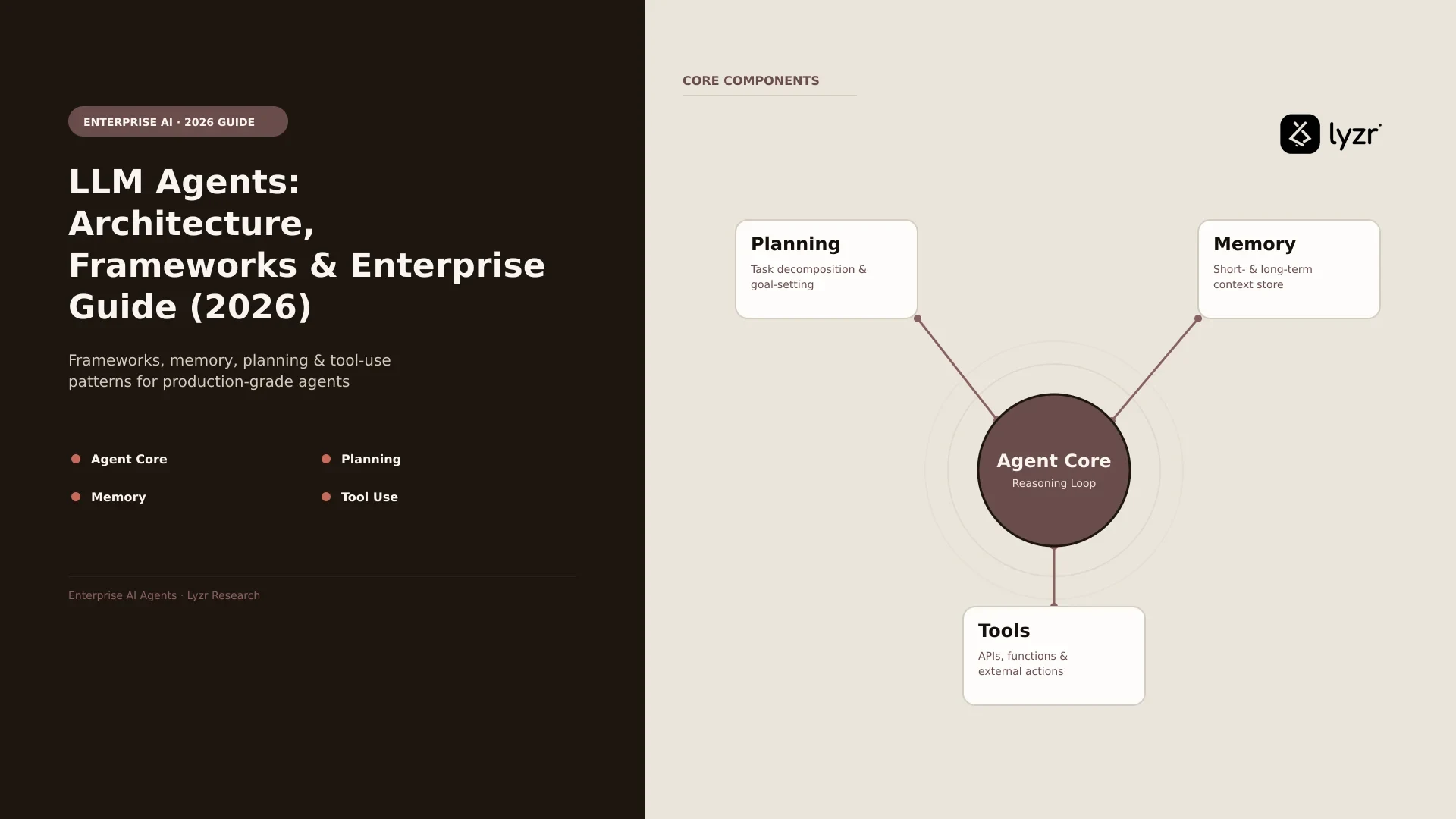
- The canonical structure comes from Lilian Weng’s four-component framework: Agent Core, Planning, Memory, Tools.
- Frameworks like LangChain, LangGraph, and CrewAI implement the same architecture in different ways; model choice (Claude 4, GPT-5, Gemini 2.5, Llama 4) depends on the task.
- Production deployment needs memory persistence, hallucination detection, and a framework-agnostic Control Plane, not just a working prototype.
LLM agents are AI systems built around a large language model that plans, remembers, and calls tools to complete tasks with multiple steps. That distinguishes them from a plain LLM, which only converts a prompt into a text response.
If you’re evaluating frameworks or trying to separate “LLM agent” from “AI agent” in vendor material, this guide gives you the architecture, the current model landscape, and what changes when you move from a demo to production.
What are LLM agents?
LLM agents are goal-driven systems that pair a large language model with planning, memory, and tools so the model can execute multi-step tasks on its own, rather than just answering a single prompt. The model still does the reasoning. What changes is everything wrapped around it.
The reference point for this architecture is Lilian Weng’s June 2023 post, “LLM Powered Autonomous Agents,” which frames an agent as four connected pieces: an Agent Core (the LLM itself), a Planning module, Memory, and Tools. Nearly every serious technical treatment of LLM agents since has used some version of this structure, and it’s the one we’ll build the rest of this guide around.
Enterprises are moving past the pilot stage on this. According to McKinsey’s State of AI 2025 report, organizations are experimenting with and scaling AI agents at a growing rate. The architecture below is what separates the ones scaling agents from the ones still experimenting.

LLM agents vs AI agents vs plain LLMs
An LLM agent is a large language model with planning, memory, and tools attached; a plain LLM has none of those; an AI agent is the broader category both terms sit inside. The distinction is architectural, not marketing language, and it matters when you’re scoping a build.
A plain LLM takes text in and produces text out. No memory between calls. No ability to invoke a tool. No autonomy over what happens next, a human decides that by writing the next prompt.
An LLM agent adds the three missing pieces. It plans a sequence of steps, retrieves and writes to memory, and calls external tools when the task requires something outside the model’s own knowledge. This is what lets it handle a task with five steps instead of one.
An AI agent is the wider category: any autonomous system that senses its environment, reasons about a goal, and acts, regardless of whether the reasoning engine is an LLM, a rules engine, or a reinforcement-learning policy. Our AI agents glossary entry covers this broader definition in more depth. For a wider look at the category itself, see AI agents as a standalone topic.
An autonomous agent describes a capability rather than an architecture: it operates for stretches of time without human intervention. LLM agents and autonomous agents overlap heavily but aren’t synonyms, an LLM agent that pauses for human approval on every action is still an LLM agent, just not a fully autonomous one.
The one-sentence version: every LLM agent is an AI agent, but not every AI agent uses an LLM. If you want the fuller picture of that broader category, see what AI agents are and how agentic AI fits above both.
The four core components of an LLM agent
The Lilian Weng framework breaks an LLM agent into four parts, and each one is a real engineering decision, not a conceptual label.
Agent core (brain)
This is the LLM that reads input, interprets intent, and decides what happens next. It’s also the single biggest lever on cost, latency, and reasoning quality. For reasoning-heavy work, Claude 4 Sonnet is a strong default. For agents that lean on tool use, GPT-5 handles function calling reliably. Gemini 2.5 Flash is the pick when latency matters more than depth, and Llama 4 covers on-premise deployments where the model has to run inside your own infrastructure.
Planning
This is task decomposition plus self-reflection, breaking a goal into steps and checking whether those steps are working. Chain of Thought (CoT, Wei et al. 2022) prompts step-by-step reasoning. Tree of Thoughts (ToT, Yao et al. 2023) explores several reasoning branches instead of one. Reflexion (Shinn et al. 2023) adds a self-critique pass after each attempt. The ReAct pattern (Reasoning and Acting, Yao et al. 2022) interleaves reasoning with action in a single loop, and it’s the pattern most production agents are actually built around.
Memory
Short-term memory lives in the model’s context window and holds the current conversation state. Long-term memory lives outside the model, typically in a vector database, Pinecone, Weaviate, Qdrant, Chroma, or Milvus, so the agent can recall information across sessions instead of starting from zero each time. Lyzr’s Cognis handles this memory layer at enterprise scale, where embedding refresh and retrieval accuracy start to matter as much as the model itself.
Tools
Tools are how the agent reaches outside the model, APIs, databases, code execution, browsers, invoked through structured function calling or tool calling. MCP (Model Context Protocol) is becoming the standard way to wire tools into an agent regardless of which LLM provider sits behind it, which matters if you don’t want to rebuild your tool integrations every time you swap models.
How LLM agents work: perception, reasoning, action
An LLM agent runs on a perception-reasoning-action loop, and understanding that loop is the fastest way to debug one that isn’t working. It’s the same three-stage cycle underneath every framework we cover in the next section.
Perception. The LLM parses the incoming input, extracts the intent and any relevant entities, and figures out what the task actually requires.
Reasoning. The model applies a planning technique, Chain of Thought or Plan-and-Execute, for example, to decide its next move. If the step needs external information, it queries memory. If it needs to do something the model can’t do on its own, it picks a tool.
Action. The model produces output: a structured tool call formatted to that tool’s schema, a memory write, or a final response. A reflection step often checks the result, and if the task isn’t done, the loop runs again.
Take a support agent that receives: “I can’t log into my account, and my password reset isn’t working.” Perception identifies the intent (login failure) and the entities (account, password). Reasoning plans two steps, check account status, then check the reset flow. Action calls the account lookup tool first, then the auth service, before generating a response. That’s four stages of the loop running in under a second, and it’s the reason a single bad retrieval early in the chain can derail everything that follows it.

LLM agent patterns and frameworks
Named patterns give agents their reasoning strategy; frameworks give you the code to implement it. You’ll typically pick one of each, not build either from scratch.
Patterns worth knowing: ReAct (interleaved reasoning and acting), Reflexion (self-critique loop), Chain of Thought (step-by-step reasoning), Tree of Thoughts (branching exploration), Plan-and-Execute (separate planner and executor), and CodeAct (using generated code as the action itself, rather than a fixed tool call).
Framework comparison
| Framework | Best for | Architectural style |
|---|---|---|
| LangChain | Broad ecosystem coverage | LCEL (LangChain Expression Language) chaining |
| LangGraph | Complex, cyclic agent loops | State machine |
| LlamaIndex | Retrieval-heavy agents | Query engines |
| CrewAI | Multi-agent orchestration | Role-based crews |
| AutoGen | Multi-agent conversation | Conversational agents |
| Anthropic Claude Agent SDK | Native tool use, computer use | Structured outputs |
| OpenAI Agents SDK | Agent handoffs, guardrails | Tracing built in |
| Google ADK | Multi-model orchestration | Vertex AI native |
Seven frameworks, one underlying architecture. In practice, most enterprises don’t standardize on a single one, a support team builds in LangGraph, a data team builds in LlamaIndex, and a platform team wraps both in custom code. That’s less a problem to solve inside any one framework and more a reason to route governance through a framework-agnostic platform instead. For a closer look at how these patterns combine into full workflows, see our breakdown of agentic workflow patterns. If you’re weighing orchestration approaches for several agents at once, our notes on the multi-agent framework landscape and broader AI agent framework selection cover the tradeoffs in more depth.
Read agentic workflows patterns
Choosing the right LLM for your agent
The model behind the Agent Core should match the job, not a leaderboard score. Here’s how that breaks down in 2026.
- Reasoning-heavy tasks (contract review, financial analysis, complex planning): Claude 4 Sonnet or Opus, or GPT-5 with reasoning mode enabled.
- Latency-sensitive tasks (support triage, routing): Claude 3.5 Haiku or Gemini 2.5 Flash.
- Tool-use-heavy tasks: GPT-5 for native tool calling, Claude 4 Sonnet through the Claude Agent SDK, or Gemini 2.5 Pro.
- On-premise or sovereign deployment: Llama 4, Mistral Large, Qwen 3, or DeepSeek V3, run as an open-weight model and weighed against the tradeoffs covered in on-premise AI vs. cloud AI.
- Cost-sensitive, high-volume tasks: Gemini 2.5 Flash, Claude 3.5 Haiku, or a fine-tuned open-weight model run locally.
- Multimodal tasks: Claude 4, GPT-5, and Gemini 2.5 Pro all handle text, image, and audio natively, multimodality stopped being a differentiator once it became standard across frontier models.
Most agent fleets end up running two or three of these models across different agents, which is the case for LLM-agnostic architecture: route each task to the model built for it instead of forcing one model to do everything.
Production reality: memory, hallucination, and governance
A working agent demo and a production agent fleet are not the same engineering problem. The gap is governance, and most teams underestimate it until an audit or an incident forces the question.
Only 21% of respondents say their organizations have a mature governance model in place for agentic AI, according to Deloitte’s 2026 State of AI in the Enterprise report, despite agent adoption accelerating faster than the guardrails around it.
Memory persistence. Vector database costs, embedding refresh cycles, and context management all scale with usage, and none of it is free once you’re past a handful of agents. This is what Cognis is built to manage at enterprise scale.
Hallucination detection. A single false retrieval early in a multi-step loop propagates through every planning and tool-call decision that follows it. Catching that requires infrastructure-level detection, not a prompt tweak, which is what Lyzr’s Hallucination Manager is built to do.
Governance. Regulated industries need role-based access control per agent, an audit trail per action, and policy enforcement on every tool call. Lyzr delivers this as Responsible AI as a Service.
A framework-agnostic Control Plane. A global payments company runs LLM agents across multiple frameworks under one unified Control Plane, which is the pattern most enterprises converge on once agents span more than one team. LangChain, LangGraph, and custom code all register centrally, with the same governance and observability layer running underneath regardless of what built the agent.
Deployment modes. Regulated industries need options beyond a shared public cloud, managed sovereign AI, VPC, or fully on-premise, depending on what data residency rules require.

Read the Lyzr Agent Control Plane pillar for the full architecture behind this layer, and the production playbook for the deployment checklist.
Frequently asked questions
What are LLM agents?
LLM agents are goal-driven AI systems that combine a large language model core with planning, memory, and tools to execute multi-step tasks autonomously. A plain LLM only generates text; it has no tools or memory attached.
What is the difference between an LLM and an LLM agent?
A plain LLM generates text from a prompt with no tools or persistent memory. An LLM agent adds planning, memory, and tool use, letting it execute multi-step tasks and act on the results.
What is the difference between LLM agents and AI agents?
LLM agents are a subset of AI agents where the reasoning core is specifically a large language model. AI agent is the broader category, covering any autonomous system that senses, reasons, and acts.
What are the four components of an LLM agent?
The four components are the Agent Core (the LLM brain), Planning (task decomposition and reflection), Memory (short-term context and long-term storage), and Tools. This is the framework Lilian Weng laid out in 2023.
How do LLM agents work?
They run a perception-reasoning-action loop. The LLM parses input, plans its next step using patterns like ReAct or Chain of Thought, calls tools or memory as needed, and iterates until the task is done.
What are examples of LLM agents?
Common examples include customer support triage agents, sales research agents, code review assistants, financial analysis agents, and enterprise search agents, any workflow where the LLM plans and executes several steps.
What is the ReAct pattern in LLM agents?
ReAct (Reasoning and Acting, Yao et al. 2022) interleaves reasoning with tool actions. The model generates a thought, takes an action, observes the result, then generates the next thought based on it.
Which framework is best for building LLM agents?
It depends on the task: LangGraph for complex state machines, LangChain for broad ecosystem coverage, LlamaIndex for retrieval-heavy agents, and the Claude Agent SDK or OpenAI Agents SDK for native tool use.
Can I run LLM agents locally?
Yes. Open-weight models like Llama 4, Mistral, Qwen 3, or DeepSeek V3 run through local inference tools such as Ollama or vLLM, trading some frontier-model capability for privacy and cost control.
How do I deploy LLM agents in production?
Production deployment needs memory persistence, hallucination detection, a framework-agnostic Control Plane, audit trails, and a deployment mode that fits your data residency requirements, not just a working framework integration.
Where to go from here
The architecture in this guide is the same whether you’re running one agent or two hundred. What changes at scale is everything around the model: which framework built it, where its memory lives, and who’s watching what it does.
- Still learning the patterns? Read agentic workflow patterns above.
- Deciding on a framework? Read framework-agnostic platforms above.
- Working through memory architecture? Explore Cognis.
- Building the business case for your CTO or Head of AI? Read the agentic AI roadmap playbook.
- Planning your production rollout? Read the production playbook above.
- Ready to build or evaluate a platform? Book a demo.
Book A Demo: Click Here
Join our Slack: Click Here
Link to our GitHub: Click Here