Agentic workflows use a large language model to orchestrate a multi-step task involving tool use, retrieval, and verification. The LLM plans, routes, and executes rather than just generating text in response to a single prompt.
What separates a workflow from an autonomous agent is structure. A workflow follows a code path you defined in advance. An agent decides that path itself as it runs.
This guide covers Anthropic’s five-pattern taxonomy, a decision framework for picking the right one, the frameworks that implement each pattern, and what separates a working demo from a governed production system.

What are agentic workflows?
Agentic workflows are systems that use large language models to orchestrate multi-step tasks involving tool use, retrieval, and verification. The model does more than generate a single response.
It plans a sequence, routes work to the right step, calls tools or APIs, and checks its own output before handing off the result.
This distinguishes agentic workflows from the earlier generation of chatbots and single-turn generation tools, and from AI agents, which direct their own steps dynamically instead of following a path you wrote.
Sixty-two percent of survey respondents say their organizations are at least experimenting with AI agents, according to McKinsey’s State of AI 2025 report. Of those, 23% of organizations report scaling AI agents in at least one business function. The gap between experimenting and scaling is where pattern choice and production discipline start to matter.
Agentic workflows vs AI agents: the Anthropic distinction
Workflows and agents are not the same architecture, and Anthropic drew the line clearly in its December 2024 “Building Effective Agents” post. Workflows are systems where LLMs and tools are orchestrated through predefined code paths, while agents are systems where LLMs dynamically direct their own processes.
That distinction changes what you can promise a compliance team. A workflow’s steps are known before it runs, so you can test each one, log it, and predict its failure modes.
An agent’s steps are decided at runtime by the model, which gives it more reach on open-ended problems but makes its behavior harder to bound.
Use a workflow when the task has clear, repeatable steps and low tolerance for variance, such as invoice reconciliation or a fixed approval chain in a regulated environment. Use an agent when the task is open-ended, the number of steps is unknown ahead of time, or autonomous exploration adds value the fixed path can’t.
The two approaches also combine. A workflow step can call an agent to handle an ambiguous sub-task, then resume its fixed path once the agent returns a result. For the retrieval side of this pattern, see our guide to agentic RAG, and for how multiple agents coordinate inside a larger system, see multi-agent architecture.

The five patterns of agentic workflows
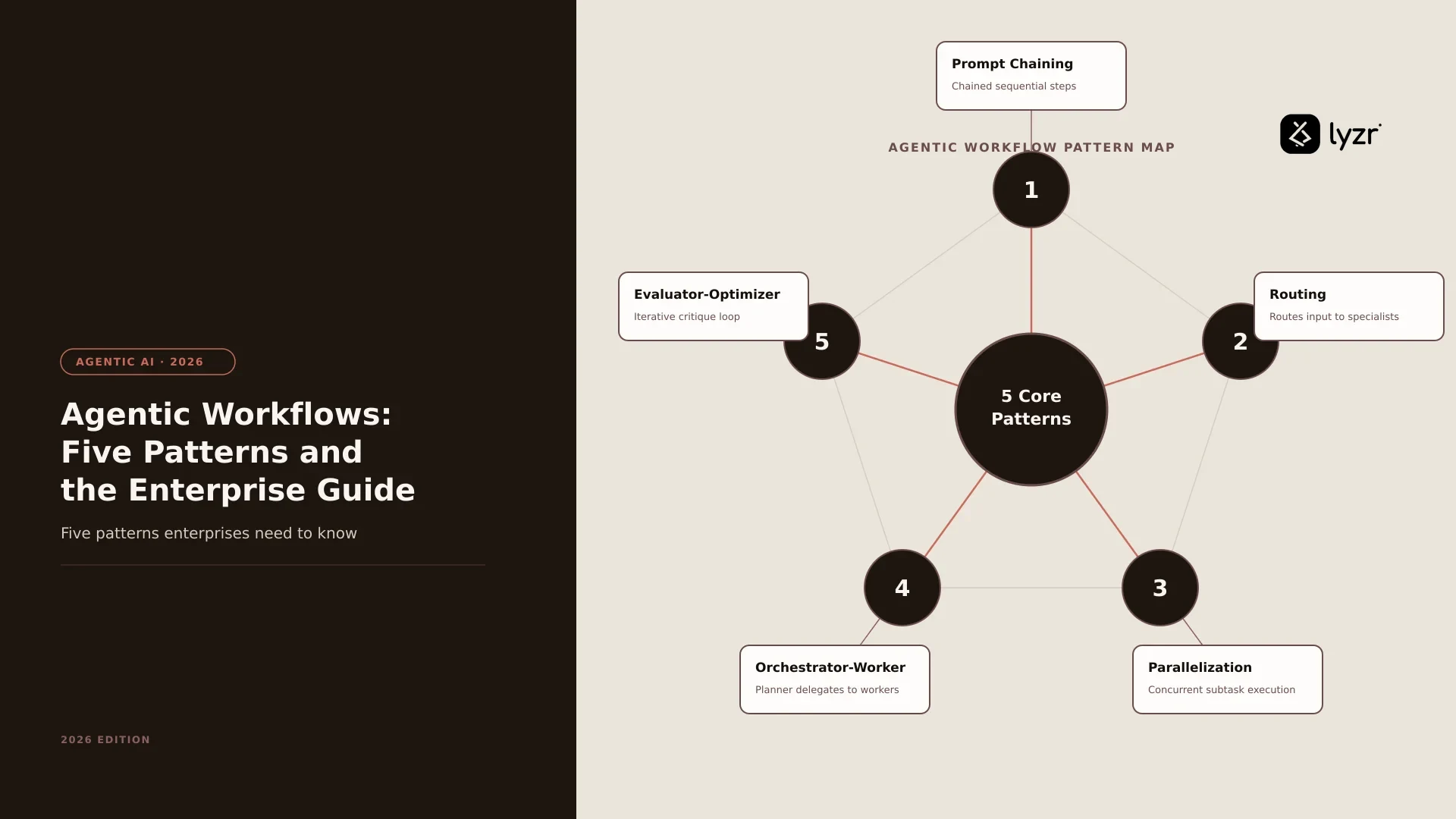
Anthropic’s “Building Effective Agents” (December 2024) named five composable patterns that cover most of what developers actually build in production agent architecture. These are the patterns every serious technical reference on this topic now cites, and they are worth learning by name.
Prompt chaining
Prompt chaining decomposes a task into a sequence of LLM calls, where the output of one call becomes the input to the next. It works best for tasks that decompose cleanly into stages: outline a document, draft each section, then edit for tone. Each step has fewer degrees of freedom, which reduces compounding error.
Routing
A routing workflow classifies an input and directs it to a specialized handler based on that classification. It fits when input types vary widely and each type needs different handling, such as a support system that separates billing tickets from technical ones before either reaches a resolution chain.
Parallelization
Parallelization runs multiple LLM calls at once and aggregates the results. Sectioning breaks a task into independent subtasks run in parallel, while voting runs the same task multiple times to get diverse outputs. Sectioning cuts latency on divisible work. Voting improves confidence through consensus.
Orchestrator-workers
A central LLM decomposes a task, delegates the pieces to worker LLMs, and combines their results into a final response. The key difference from parallelization is that subtasks aren’t predefined here, but determined by the orchestrator based on the specific input. Use it when the shape of the work can’t be known before the task starts.
Evaluator-optimizer
One LLM call generates a response while another provides evaluation and feedback in a loop. This is particularly effective when you have clear evaluation criteria and iterative refinement provides measurable value, such as code review or contract redlining.

See how these patterns map to real deployments in our Control Plane guide
How to choose a workflow pattern
Five questions decide which pattern fits your use case. Work through them in order rather than picking a pattern first and justifying it afterward.
Are the steps knowable in advance? A fixed, linear sequence points to prompt chaining. A handful of known branches points to routing. Steps that can’t be known until the task starts point to orchestrator-workers.
Do input types vary widely? Distinct categories that need different handling justify a router. Uniform inputs don’t need one, and adding routing logic here just adds latency without benefit.
Do you need lower latency or higher accuracy? Parallelization solves both, but through different variants. Sectioning cuts wall-clock time on divisible tasks. Voting raises confidence by running the same task multiple times and reconciling the outputs.
Do clear evaluation criteria exist? If quality can be scored against a standard, an evaluator-optimizer loop earns its cost. If the criteria are vague or subjective, the extra LLM call in the loop adds spend without adding quality.
What does failure cost? High-stakes workflows, the kind you’ll be asked to audit, favor constrained patterns like chaining and routing because their paths are traceable end to end. Orchestrator-workers gives you more reach at the cost of a wider blast radius when something goes wrong.
Enterprise use cases across functions
Different functions gravitate toward different patterns, based on how predictable their tasks are.
Marketing uses prompt chaining to outline, draft, and edit content before publishing, the kind of sequential process Skott, Lyzr’s Agentic OS for Marketing, runs end to end.
Sales applies routing to qualify inbound leads and orchestrator-workers for multi-touch outreach sequences, which is the architecture behind Jazon, the AI SDR built on Lyzr’s platform.
Customer support relies on routing for ticket triage and an evaluator-optimizer loop to keep response quality consistent.
HR chains prompts through onboarding sequences and parallelizes resume screening against a job description, the pattern Diane uses.
Banking and finance chain prompts for reconciliation and use orchestrator-workers for KYC checks that pull from multiple data sources.
Software development pairs evaluator-optimizer loops for code review with orchestrator-workers for feature implementation across multiple files.
Implementing agentic workflows: framework options
Seven frameworks implement these five patterns, and most enterprises end up running more than one at once.
LangChain offers LCEL (LangChain Expression Language) for chaining and a mature agents module, making it a strong default for prompt chaining and routing.
LangGraph models workflows as an explicit state machine, which makes it the stronger choice for the cyclic patterns: orchestrator-workers and evaluator-optimizer.
LlamaIndex centers on query engines and sub-question decomposition, which suits retrieval-heavy routing workflows.
CrewAI organizes work around role-based agents, a natural fit for orchestrator-workers.
Anthropic’s Claude Agent SDK provides native tool use and structured outputs, which supports evaluator-optimizer loops with built-in reflection.
OpenAI’s Agents SDK focuses on handoffs, guardrails, and tracing, useful for routing and orchestrator-workers.
Google’s Agent Development Kit (ADK) runs multi-model orchestration on Vertex AI, which scales parallelization workloads well.
Five patterns, seven implementation surfaces. Enterprises rarely standardize on one, which is why framework-agnostic platforms matter more than picking a single winning framework.
Production reality: what enterprise deployments need
A pattern that works in a notebook is not a production system. Only 21% of organizations report having a mature governance model for autonomous AI agents, per Deloitte’s State of AI in the Enterprise 2026 report, even as 73% cite data privacy and security as their top AI risk. That gap is where most agentic projects stall between pilot and production.
Governance
Every workflow needs role-based access control, a per-step audit trail, and policy enforcement on what tools it’s allowed to call. Lyzr’s Responsible AI as a Service layer applies this at the workflow level, not just the model level.
Hallucination detection
A single bad step in a chain propagates downstream. The Hallucination Manager catches this at runtime, at the infrastructure layer, before a hallucinated intermediate output becomes a hallucinated final result.
Observability
You need OpenTelemetry-compatible traces across the entire workflow, not isolated logs per LLM call. Lyzr’s monitoring layer and Cognis memory layer give you that continuity across steps and sessions.
A framework-agnostic control plane
Enterprises run LangChain, LangGraph, and CrewAI workflows side by side. The Control Plane sits above all of them, applying one governance layer regardless of which framework built the workflow underneath.
A global payments company runs agentic workflows across multiple frameworks that register centrally with this Control Plane, giving one audit trail across a stack no single vendor built.
Deployment mode
Regulated industries need workflows deployable as managed Sovereign AI, inside a private VPC, or fully on-premise. Read more on on-premise AI vs cloud AI for how these tradeoffs play out.
A tier-1 global bank runs auditable superagent workflows per employee with a full workflow audit trail, a requirement that a purely cloud-hosted stack can’t meet on its own.

Frequently asked questions
What are agentic workflows?
Agentic workflows are systems that use large language models to orchestrate multi-step tasks with tool use, retrieval, and verification. They’re distinct from AI agents, which direct themselves dynamically; workflows follow predefined code paths.
What is the difference between agentic workflows and AI agents?
Workflows use predefined code paths to orchestrate LLMs and tools. Agents dynamically direct their own processes and tool usage. Workflows are more predictable and easier to govern; agents are more flexible but harder to constrain.
What are the five patterns of agentic workflows?
The five patterns are prompt chaining, routing, parallelization, orchestrator-workers, and evaluator-optimizer. They come from Anthropic’s December 2024 “Building Effective Agents” post and form the industry-standard taxonomy.
What is prompt chaining?
Prompt chaining breaks a task into a fixed sequence of LLM calls, where each call processes the previous one’s output. It suits linear tasks with clear sub-steps, like document generation or data transformation.
What is the orchestrator-workers pattern?
A central LLM dynamically breaks a task into subtasks, delegates them to worker LLMs, and synthesizes the results. It fits tasks where the number and shape of subtasks aren’t knowable in advance.
What is the evaluator-optimizer pattern?
One LLM generates a response while a second evaluates it against criteria and feeds back improvements in a loop. It works best where evaluation criteria are clear, such as code review or translation refinement.
How do I build an agentic workflow?
Start with the decision framework: check whether steps are knowable, inputs vary, and evaluation criteria exist. Then implement the matching pattern in a framework like LangGraph, CrewAI, or the Anthropic Claude Agent SDK.
Which framework is best for building agentic workflows?
No single framework wins outright. LangGraph handles orchestrator-workers and evaluator-optimizer loops well. LangChain suits chaining and routing. LlamaIndex fits retrieval-heavy work. Anthropic and OpenAI SDKs offer strong native tool use.
What are examples of agentic workflows in enterprise?
Examples include content generation through prompt chaining, support ticket routing, KYC processing through orchestrator-workers, code review through evaluator-optimizer, and multi-source financial reconciliation.
How do I run agentic workflows in production?
Production deployment needs governance controls, runtime hallucination detection, a framework-agnostic control plane, full audit trails, and a deployment mode, cloud, VPC, or on-premise, that matches your data residency requirements. See Sovereign AI for regulated environments.
Where to go from here
Where you go next depends on where you are in the decision.
- Learning the patterns? Read the sibling piece on agentic RAG (linked above).
- Deciding on a framework? Read framework-agnostic platforms (linked above).
- Building the business case for your CIO or CISO? Read the agentic AI roadmap playbook.
- Planning production deployment? Read the production playbook (linked above).
- In a regulated industry? Explore Sovereign AI (linked above).
- Ready to build or evaluate? Book a demo of Lyzr’s Agentic OS, built on Lyzr Studio.
Agentic workflows aren’t a shortcut around good architecture. They’re a structured way to apply LLM reasoning to processes that used to require either rigid RPA or unbounded human judgment.
The five patterns tell you how to build one. Whether it survives contact with production depends on the governance layer underneath it.
Book A Demo: Click Here
Join our Slack: Click Here
Link to our GitHub: Click Here