TL;DR
- AI agents for finance plan, retrieve, execute, and verify finance work end to end. That’s different from RPA, workflow automation, and copilots.
- Five workflow categories tell you where to start: R2R, O2C, P2P, FP&A, and Treasury/Risk.
- Governance, audit trails, RBAC, hallucination detection, isn’t an add-on. It’s the gate.
- Willis Towers Watson, JPMorgan Chase, and a federal government agency already run these agents in production finance workflows.
AI agents for finance are autonomous software systems that plan a task, retrieve the data behind it, execute the steps across your systems, and verify the output before it reaches a ledger or a report, without waiting on a human for every intermediate step.
Jump to: Why finance is under pressure | Five workflow categories | Governance requirements | Real deployments in production
What are AI agents for finance?
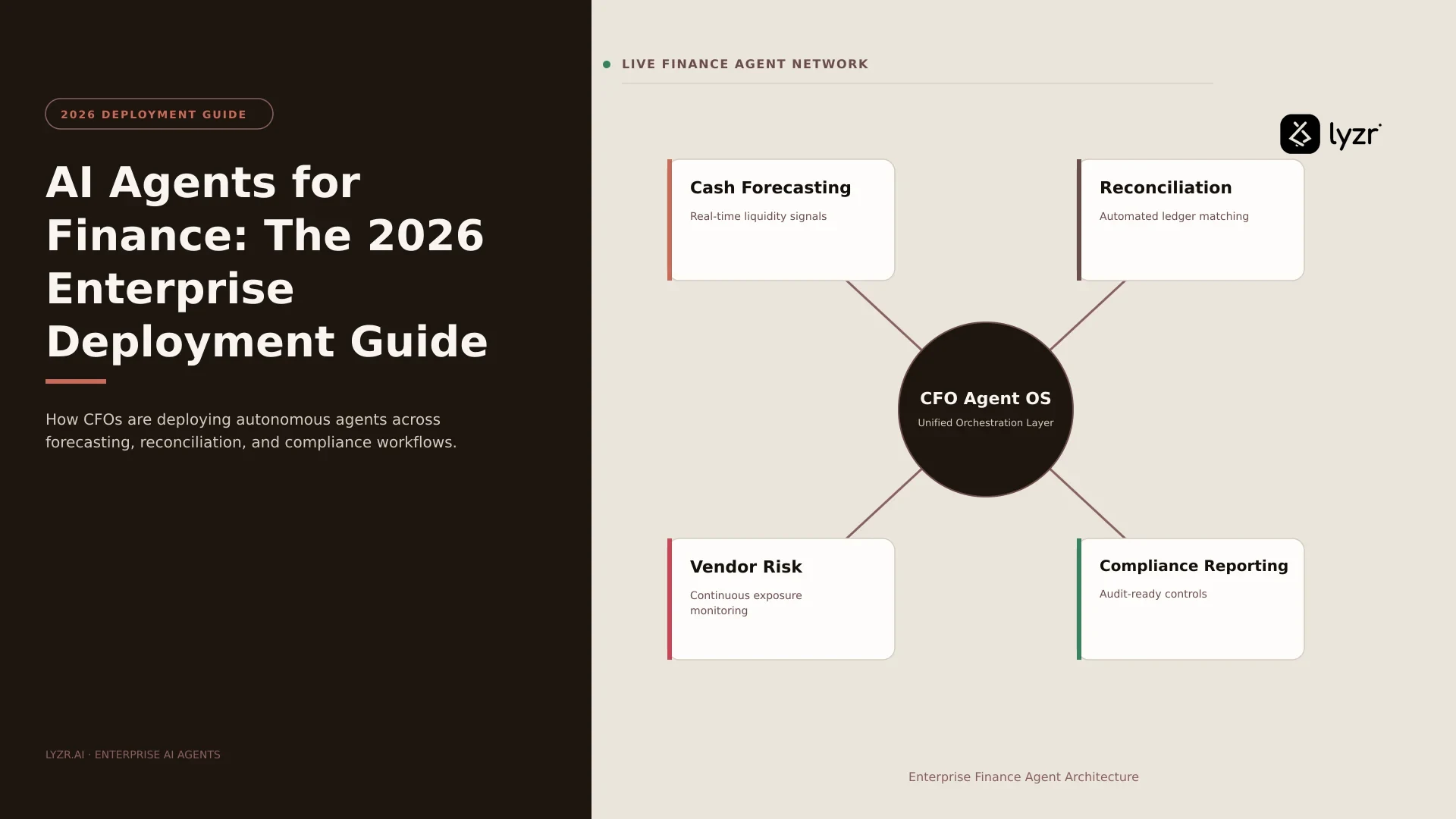
AI agents for finance plan a task, retrieve the data it needs, execute the steps across connected systems, and verify the output before it lands in a general ledger or a board report. That’s a different job description than the automation you already run.
Robotic process automation (RPA) follows a fixed script: click here, copy this field, paste it there. Workflow automation moves data along a deterministic path someone designed in advance. A financial copilot drafts a summary or answers a question, then waits for a person to act on it. An AI agent does the acting, inside guardrails you set.
This guide covers two contexts on purpose. AI agents for the finance function serve the CFO’s office: controllers, FP&A teams, treasury. AI agents in the financial services industry serve banking, insurance, and fintech. We lead with function, because that’s where most Fortune 2000 finance leaders start.
That distinction matters because adoption is real but uneven. According to McKinsey’s State of AI report, 62% of organizations say they are at least experimenting with AI agents, and 23% are actively scaling an agentic AI system in at least one business function, with another 39% still in early experimentation. Finance is one of the functions still deciding where it fits on that curve.
Why finance is under pressure in 2026
Regulation keeps expanding while headcount doesn’t. The EU’s Digital Operational Resilience Act (DORA) has applied to financial entities since January 2025. The EU AI Act added obligations for general-purpose AI models in August 2025, and the governance rules and obligations for GPAI models became applicable on August 2, 2025. SOX (Sarbanes-Oxley Act) controls haven’t gone anywhere either.
Close cycles are the visible symptom. According to APQC benchmarks, top-performing organizations complete the annual close in 10 days or less, compared with a median of 18 days and 35 days for slower performers. The gap isn’t budget or team size. It’s process design.
Layer on a persistent talent shortage in accounting and FP&A roles, plus data volume across Oracle NetSuite, SAP S/4HANA, and Workday Financials growing faster than your team can absorb it. Finance leaders aren’t asking for tools that hand off judgment. They’re asking for structured-work automation that keeps audit-grade controls intact. That’s the fit AI agents for finance have to earn before anything else.
Five finance workflow categories where AI agents deliver
Enterprise AI agents for finance earn trust one workflow at a time, not as a blanket rollout. Five categories cover most of what a Fortune 2000 finance function runs.

- Record-to-Report (R2R). This is the financial close: journal entries, intercompany reconciliation, consolidation, variance analysis. Agents that read the general ledger and flag exceptions before a controller sees them typically shorten close cycle time by 20-40%. According to APQC, 31% of organizations actively use AI in record-to-report processes, while another 39% are still in the early stages of adoption.
- Order-to-Cash (O2C). Credit scoring, invoice generation, collections prioritization, cash application, and dispute management live here. In banking, Lyzr’s Amadeo handles O2C-style workflows, loan servicing and payment reconciliation, under the same audit standard a corporate treasury desk expects.
- Procure-to-Pay (P2P). Invoice processing, three-way matching, supplier onboarding, and contract compliance. Usually the fastest first win, because the data is structured and an exception rarely carries real risk. The strategic procurement automation playbook breaks down where to start.
- Financial Planning & Analysis (FP&A). Forecasting, budget consolidation, scenario planning, variance commentary. This is where finance teams historically burn the most analyst hours, and where agentic workflows still route final output to a human for sign-off.
- Treasury, Risk, and Compliance. Cash forecasting, fraud detection, KYC (Know Your Customer) and AML (Anti-Money Laundering) monitoring, regulatory reporting. See how this plays out in AI for risk management and AI in risk and compliance.
Top AI agent use cases in finance (function view)
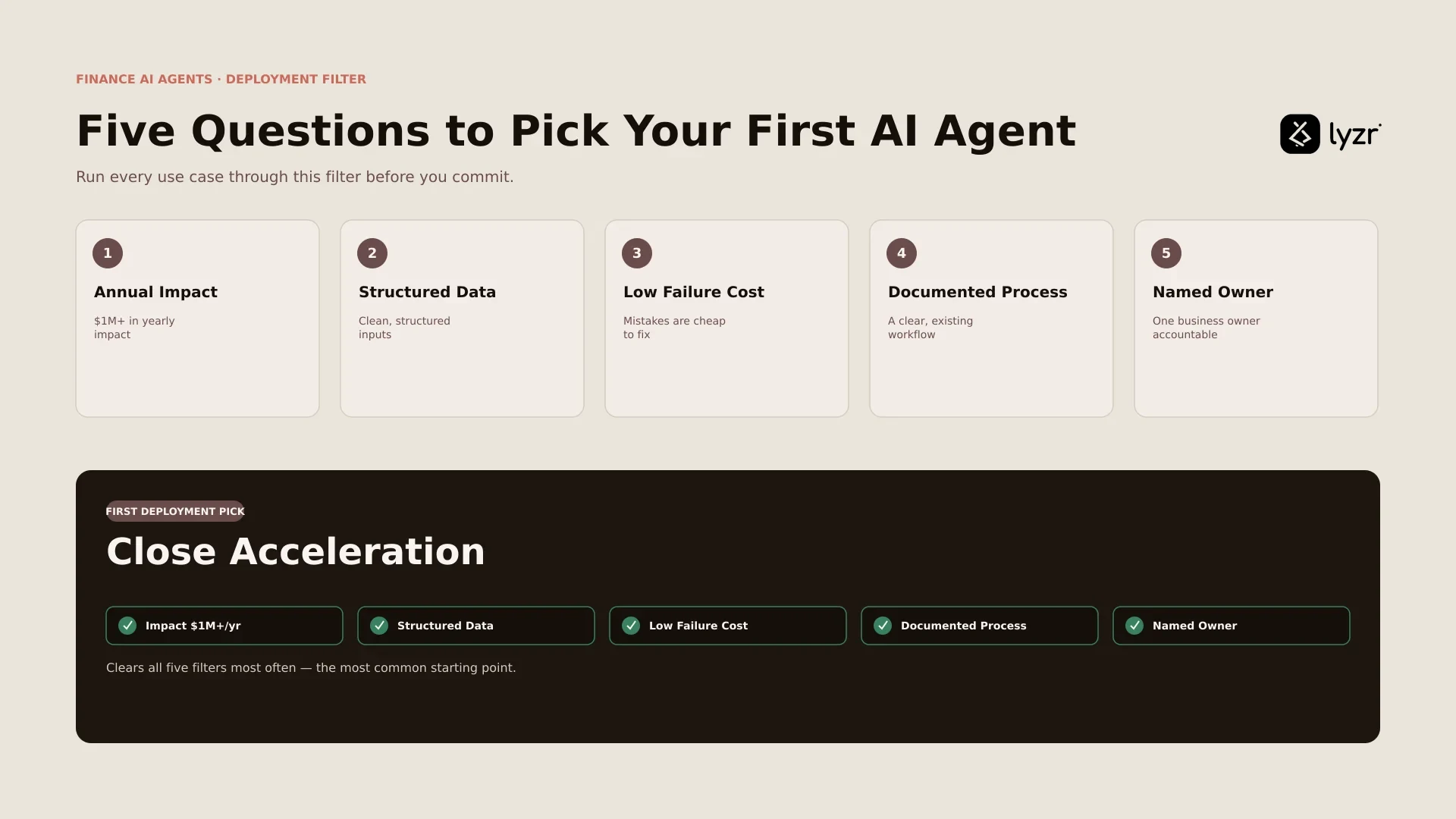
Every category above has a use case worth deploying first. Before you pick one, run it through a short filter: annual impact above $1 million, structured data, low failure cost, a documented process, and a named business owner. Close acceleration clears all five most often, which is why it’s the most common starting point.
Finance workflow categories and business outcomes
| Workflow category | Top 2 AI agent use cases | Typical business outcome |
|---|---|---|
| Record-to-Report (R2R) | Automated reconciliation, consolidation | 20-40% shorter close cycle |
| Order-to-Cash (O2C) | Collections prioritization, dispute management | Faster cash application, fewer aged disputes |
| Procure-to-Pay (P2P) | Invoice processing, three-way matching | Lower cost per invoice processed |
| Financial Planning & Analysis (FP&A) | Forecast automation, variance commentary | Less manual data aggregation |
| Treasury, Risk, and Compliance | Fraud detection, KYC/AML monitoring | Higher anomaly detection accuracy |
Four use cases carry most of the value in year one. Automated financial close runs reconciliations, drafts journal entries, and assembles the consolidation package, logging every action for the audit trail. Collections and dispute management prioritizes which accounts to chase, drafts the outreach, and predicts which invoices are likely to pay late.
Forecast automation pulls actuals straight from the ERP, applies your existing models, and drafts the variance commentary an analyst used to write by hand. Vendor risk and KYC/AML monitoring watches transactions continuously, flags anomalies against defined thresholds, and prepares the draft filing a compliance officer reviews before it goes out.
None of these remove the finance team from the decision. They remove the team from re-keying data and hunting for it. Purpose-built custom AI agents are how most of these use cases get built in practice.
Applications across financial services
Outside the CFO’s office, the same agent architecture runs entire industries.
Banking runs KYC processing, loan origination, regulatory monitoring, and fraud detection through agents like Amadeo, purpose-built for banking workflows with audit trails intact.
Insurance uses agents such as Benjie for claims processing, underwriting support, litigation clause extraction, and policy servicing.
Wealth and asset management applies agents to portfolio analysis, client onboarding, and retirement advisory automation, the exact workflow Willis Towers Watson rebuilt in production.
Fintech agents handle payments fraud detection, transaction monitoring, and the logic behind embedded finance products, covered in Lyzr’s fintech deployments.
Private equity and venture capital teams use agents for deal sourcing, due diligence automation, and first-draft investment memo generation, detailed in The Fundraising Agent.
Capital markets and payments firms apply agents to trading support, cross-border payment optimization, and transaction monitoring at volumes no manual team could review.
Governance requirements: what finance imposes on AI agents
Finance is a regulated function, and that changes what deploying an agent actually means. According to Deloitte’s State of AI report, only one in five companies currently has a mature model for governing autonomous agents. Finance can’t afford to sit in the other four out of five.
Six requirements aren’t optional:
- Audit trail per action. Every retrieval, calculation, and posting needs a traceable, immutable log, not a summary written after the fact.
- SOX-grade controls. Separation of duties, approval workflows, and logs no single actor can alter.
- RBAC and identity governance. Agents authenticate as distinct principals, not shared service accounts.
- Hallucination detection at runtime. Financial calculations can’t tolerate confabulation. A Hallucination Manager catches errors before they post, under a broader Responsible AI as a Service layer.
- Data residency. Many finance workflows require data to stay inside your perimeter. That’s why sovereign AI and on-premise deployment matter for regulated finance specifically.
- A framework-agnostic Control Plane. You’ll run agents on more than one framework over time. A unified Control Plane enforces governance across all of them, not just the ones built on your primary stack. Lyzr’s platform is framework-agnostic by design for exactly this reason.
GAAP (Generally Accepted Accounting Principles), IFRS (International Financial Reporting Standards), and GLBA (Gramm-Leach-Bliley Act) obligations apply to agent-generated output exactly as they apply to a human analyst’s. For Europe, the rules for high-risk use cases in certain sensitive areas have been extended to December 2, 2027 as a result of the political agreement on the AI Omnibus, but GPAI obligations already stand. Treat governance as the design constraint, not the compliance checklist you add afterward.
Real finance deployments in production
Three named deployments show what governed AI agents for finance look like once you’re past the pilot stage.
Willis Towers Watson rebuilt its retirement advisory platform on WTW’s own data and compliance framework. The rebuild brought customers back from using generic tools like ChatGPT for advisory questions, and it has run in production for over a year, now under an internal AI Steering Committee mandate.
JPMorgan Chase deployed an enterprise-grade, auditable superagent available to every employee, built on a per-user knowledge graph with a full audit trail for every action, and governance enforced at the platform substrate through a Git Agent.
A federal government agency runs a sovereign agent factory on AWS GovCloud, the highest-security deployment Lyzr has shipped. Financial and operational workflows run entirely inside the government’s perimeter, with no external data egress.

These aren’t aspirational vignettes. They’re production systems handling regulated financial work today. Review the full customer list and case studies for detail on scope and outcomes.
See how the Control Plane powers governed finance agents
Frequently asked questions
What are AI agents for finance?
AI agents for finance are autonomous software agents that plan, retrieve, execute, and verify finance work end to end. That’s different from RPA, which follows fixed rules, and copilots, which only assist a human decision.
What is the difference between AI agents and RPA in finance?
RPA follows fixed rules for structured, repetitive tasks and breaks when the input format changes. AI agents combine reasoning, tool use, and autonomous execution, handling exceptions and unstructured work RPA can’t touch.
What are the best AI agents for finance in 2026?
It depends on the workflow. Route close acceleration to R2R-focused agents, collections to O2C agents, and forecasting to FP&A agents, on a platform that unifies governance across all of them rather than one that only covers one.
What AI agents work for accounting?
Accounting-focused agents automate journal entries, reconciliation, invoice matching, and month-end close support. They typically integrate directly with Oracle NetSuite, SAP S/4HANA, and Workday Financials rather than working around those systems.
Which finance use case should I start with?
Apply a five-question filter: annual impact above $1 million, structured data, low failure cost, a documented process, and a named business owner. Close acceleration usually ranks first because it clears every filter.
Are AI agents secure enough for financial data?
Yes, when deployed with audit trails, RBAC, and hallucination controls in place. Regulated finance workflows often require sovereign AI or on-premise deployment to satisfy data residency requirements specifically.
Can AI agents help with FP&A and forecasting?
Yes. Agents pull actuals from the ERP, apply your existing forecasting models, and draft variance commentary and reporting, one of the highest-return finance use cases available today because the analyst work is so manual.
What AI agents work for banking?
Banking agents automate KYC processing, loan origination, regulatory monitoring, and fraud detection. Amadeo, Lyzr’s AI banking agent, is built for these workflows with audit trails and governance native to the platform.
How much does it cost to deploy AI agents in finance?
Cost depends on workflow scope and deployment mode more than per-agent licensing. Managed sovereign deployments typically reach production in under 90 days, with integration and governance work driving most of the total cost.
How do I run AI agents in production for regulated finance?
Production deployment requires audit trails, RBAC, hallucination detection, and a framework-agnostic Control Plane that fits your data residency requirements. The production playbook walks through the sequence.
Where to go from here
The right next step depends on where you actually are, not where a vendor wants you to be.
- Looking for more use case ideas? Download the 100 CFO use cases template.
- Building the internal business case? Read the agentic AI roadmap playbook.
- Deciding on governance and deployment mode? Read the Control Plane pillar.
- In a regulated industry? Explore banking, insurance, fintech, or financial services agents.
- Planning a production rollout? Read the production playbook.
- Ready to evaluate? Book a demo.
The finance function that wins the next two years won’t be the one that automates the most tasks. It’ll be the one that knew which five workflows to govern first, and built the audit trail before the agent ever touched a ledger.
Book A Demo: Click Here
Join our Slack: Click Here
Link to our GitHub: Click Here