TL;DR
- Voice agents use speech recognition, an LLM, and speech synthesis (or a single end-to-end audio model) to hold real-time spoken conversations, not scripted menus.
- Two architectures compete: modular pipeline (STT to LLM to TTS) and speech-to-speech.
- Production success depends on sub-800ms latency, telephony integration, and compliance with TCPA, HIPAA, and PCI DSS, not just conversation quality.
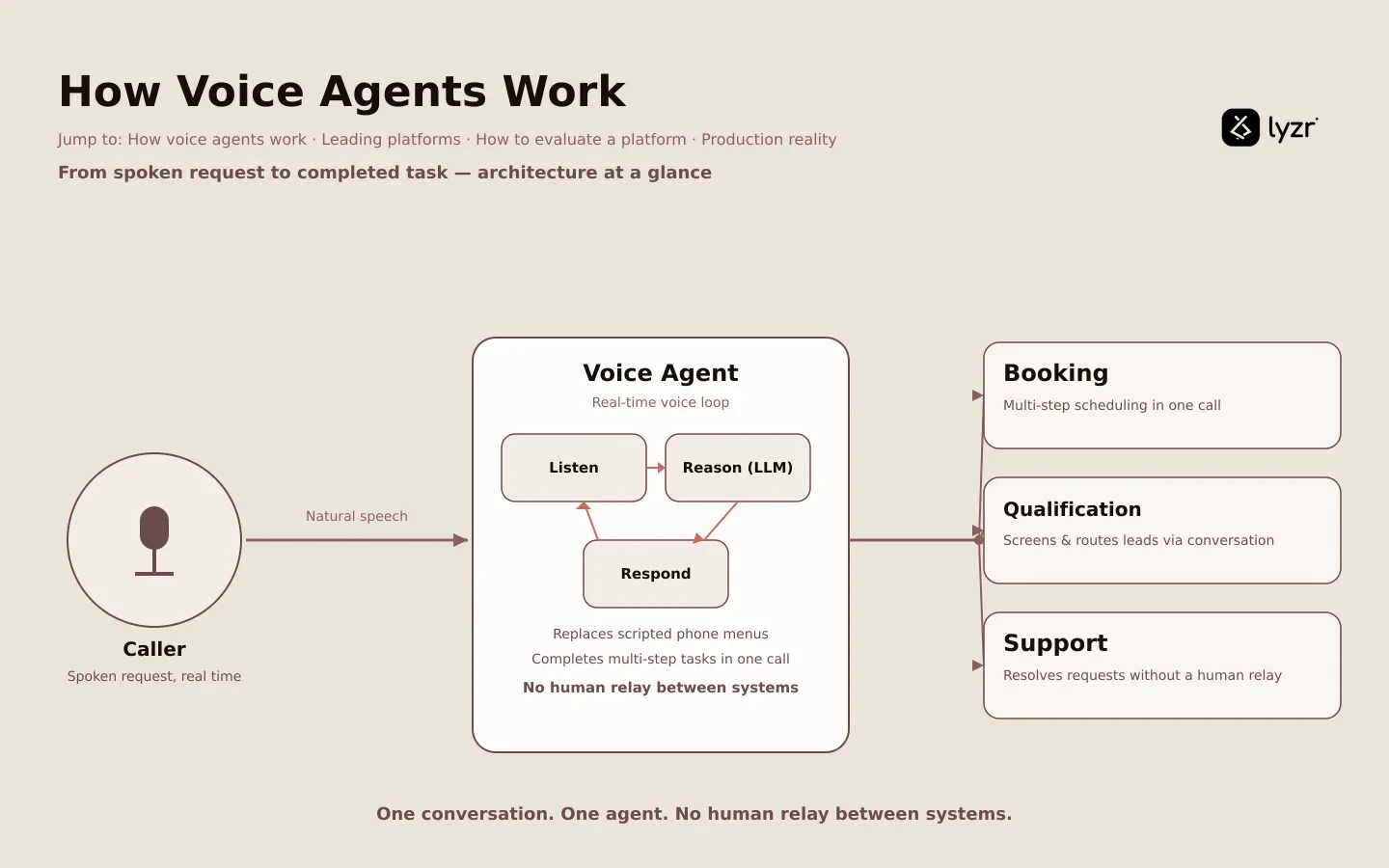
Voice agents are AI systems that listen to spoken language, reason about it with a large language model (LLM), and respond in natural speech in real time. They replace scripted phone menus and handle multi-step tasks like booking, qualification, and support from a single conversation, without a human relaying the request between systems.
Jump to: How voice agents work · Leading platforms · How to evaluate a platform · Production reality
What are voice agents?
Voice agents are AI systems that understand spoken language, reason with an LLM, and reply in natural speech in real time, without routing callers through a fixed menu tree. That distinction separates them from three things they get confused with. Interactive voice response (IVR) forces a caller through pre-recorded prompts and touch-tone choices. Traditional chatbots handle text, not speech, and break down the moment the interaction moves to a phone line. Voice bots sit in between: they play scripted responses but cannot reason about an open-ended request the way an LLM-backed voice agent can.
The category is moving fast. Sixty-two percent of survey respondents say their organizations are at least experimenting with AI agents, and 23% of organizations report scaling AI agents in at least one business function, while an additional 39% are actively experimenting with agentic deployments, according to McKinsey’s State of AI 2025 survey. Voice carries more risk than most agent categories, because it runs on two competing architectures and a compliance stack most platforms treat as an afterthought. Both are covered below, starting with what AI agents actually are before the phone rings.
How voice agents work: two architectures
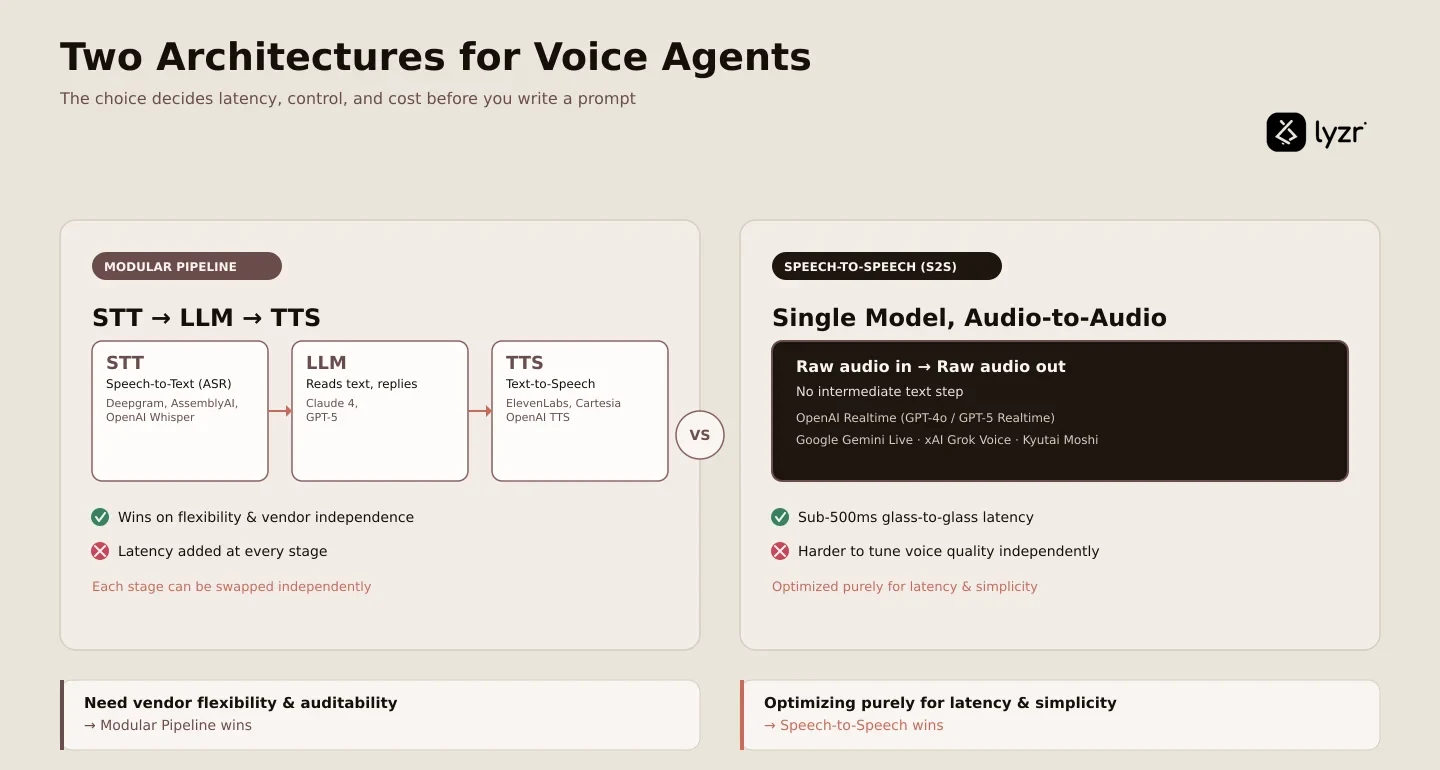
Every voice agent runs on one of two architectures, and the choice decides latency, control, and cost before you write a single prompt.
Modular pipeline (STT to LLM to TTS). Three chained steps do the work. Speech-to-text (STT), also called automatic speech recognition (ASR), transcribes the caller’s audio into text; Deepgram, AssemblyAI, and OpenAI Whisper lead this layer. An LLM, such as Claude 4 or GPT-5, reads the text and generates a response. Text-to-speech (TTS), from vendors like ElevenLabs, Cartesia Sonic, or OpenAI TTS, converts that response back into audio. Each hop can be swapped independently, which is why this architecture wins on flexibility and vendor independence, at the cost of latency added at every stage.
Speech-to-speech (S2S). A single model takes raw audio in and produces raw audio out, with no intermediate text step. The OpenAI Realtime API (GPT-4o Realtime, GPT-5 Realtime), Google Gemini Live, xAI Grok Voice, and Kyutai Moshi all work this way. Removing the hops cuts latency, often into sub-500ms glass-to-glass territory, at the cost of tuning individual voice or transcription quality.
If you need vendor flexibility and stage-by-stage auditability, build on a modular pipeline. If you are optimizing purely for latency and conversational simplicity, speech-to-speech wins.
The six core components of a voice agent
Regardless of architecture, six components decide whether a voice agent works once it leaves the demo environment.
The LLM is the reasoning engine, typically Claude 4 Sonnet, GPT-5, Gemini 2.5, or a self-hosted Llama 4 for on-premise needs. It functions as the agent brain behind every turn of conversation. Voice input is either a dedicated STT service or the input side of an S2S model. Voice output is a TTS service or the output side of an S2S model, and it defines the brand voice a caller hears. Tools and function calling connect the agent to calendars, CRMs, ticketing systems, and payment gateways, following the same agentic workflow patterns that power text agents. Memory carries context across turns and sessions; Lyzr’s Cognis layer, paired with retrieval-augmented generation, gives a voice agent recall a scripted bot never had. Telephony integration, through Twilio, Vonage, Telnyx, or SignalWire for the public switched telephone network (PSTN), or WebRTC for browser calls, is what makes any of this reachable from a phone number.

Where enterprises deploy voice agents in 2026
Voice agents cover far more ground than customer support, though that remains the highest-volume category.
Customer support deflection replaces legacy IVR with a conversational agent that resolves common issues and escalates the rest. Appointment booking, common in healthcare, dental, and field service, handles calendar checks, confirmations, and cancellations without a scheduler on the line. Outbound sales calling covers lead qualification, discovery, and meeting booking; Jazon, Lyzr’s AI SDR, runs this with voice as one of its channels, and the AI sales agents category covers the broader pattern. AI receptionist duties route inbound calls, cover after-hours volume, and capture messages that used to go to voicemail. Survey and feedback collection, including post-service NPS calls, tends to see higher completion rates by voice than by email. Order status and self-service, covering package tracking and refund requests, deflects volume that would otherwise sit in a support queue.
See the sales voice agent use cases template or the customer support use cases template for deployment patterns, and the sales playbook for rollout sequencing.
Leading voice agent platforms in 2026
The voice agents platforms market splits into four categories, and the right one depends on who is buying.
Voice-first platforms serve developer-centric teams. Vapi, ElevenLabs Conversational AI, Retell AI, LiveKit Voice Agents, Bland.ai, Synthflow, and Millis.ai are built voice-first, with SDKs tuned for low-latency streaming and interruption handling. Enterprise-suite voice AI serves buyers standardizing on an existing system of record. Salesforce Agentforce Voice, ServiceNow AI Agents, Microsoft Copilot Voice, Genesys AI, and Nice CXone Mpower add voice to a CRM or contact center suite already in place. Model provider APIs suit teams building direct: the OpenAI Realtime API, Google Gemini Live, and xAI Grok Voice hand you the frontier speech-to-speech models with no platform layer between you and the model. Open-source frameworks, including Pipecat, the open-source build of LiveKit Agents, and LangChain’s voice agent templates, offer the most control at the cost of engineering time. AI-native agentic platforms, including Lyzr, treat voice as one channel inside a framework-agnostic system, integrated with telephony, governance, and multi-agent orchestration rather than bolted onto a single product surface.
How to evaluate a voice agent platform
Seven questions separate a platform that survives a pilot from one that survives production.
1. What is the target end-to-end latency? Under 800ms glass-to-glass is the threshold for natural turn-taking; speech-to-speech architectures hit this by default, while modular pipelines need careful tuning across every hop.
2. What voice quality do you need? ElevenLabs and Cartesia Sonic lead on natural, brand-specific voices; model-provider voices are competitive out of the box with less customization.
3. What telephony integrations are supported? Twilio and Vonage cover most PSTN needs; buyers with an existing Genesys or Nice deployment need native integration, not a rebuild.
4. How deep is tool use and function calling? Native calendar, CRM, and payment integrations, ideally coordinated by something like a Manager Agent, separate a real deployment from a demo.
5. How does the platform handle compliance? TCPA opt-in, consent recording, and HIPAA or PCI DSS controls need to be built into the platform before launch, not added after an incident.
6. What LLM providers are supported? A framework-agnostic platform lets you route between Claude 4, GPT-5, Gemini 2.5, or Llama 4 without a rebuild when the best available model changes.
7. What deployment modes exist? Regulated buyers need on-premise or VPC options, not just multi-tenant cloud; the agent diagnostic assessment is a fast way to see where your requirements actually land.
Production reality: latency, compliance, and telephony
Three things break voice agent deployments that never show up in a demo: latency, compliance, and the phone network itself.
The latency stack adds up fast. A typical stitched voice AI pipeline spends 100 to 300ms on speech-to-text, 350 to 1,000ms on LLM inference, 90 to 200ms on text-to-speech, and another 50 to 200ms on network round trips between vendors. Staying under 800ms glass-to-glass end to end is the working target; anything above 800ms feels noticeably delayed, and above 1,500ms, callers report that the conversation feels broken. Speech-to-speech architectures compress this closer to 500ms because they skip the hand-offs between vendors.

The enterprise voice compliance stack is where most platforms fall short. Outbound calls in the US fall under the Telephone Consumer Protection Act (TCPA), with per-call penalties for unsolicited contact. Call recording needs consent, one-party in most states, two-party in California, Florida, and several others. Healthcare voice needs Health Insurance Portability and Accountability Act (HIPAA) controls. Payment voice needs Payment Card Industry Data Security Standard (PCI DSS) controls. EU callers need General Data Protection Regulation (GDPR) handling. Responsible AI as a Service and Lyzr’s Hallucination Manager build these checks into the deployment layer instead of leaving them to a compliance review after launch. Regulated industries evaluating sovereign AI should treat voice data residency the same way they treat any other regulated workload.
A global consumer brand runs voice agents on Lyzr’s Control Plane alongside text agents, governed from one place instead of two. Browse case studies for more on how enterprise voice deployments hold up in production.
See how the Control Plane governs voice agents
Frequently asked questions
What are voice agents?
Voice agents are AI systems that understand spoken language using an LLM and reply in natural speech in real time. They handle customer support, appointment booking, and lead qualification over the phone or web, without a fixed menu tree.
How do voice agents work?
They work through one of two architectures. Modular pipelines chain speech-to-text, an LLM, and text-to-speech. Speech-to-speech models process raw audio end to end. Both connect to tools like calendars and CRMs to take action.
What is the difference between IVR and voice agents?
IVR routes callers through fixed menus, such as press 1 for sales. Voice agents hold open-ended conversations powered by an LLM, handling exceptions, interruptions, and multi-step requests a scripted menu tree cannot process.
What are the best voice agent platforms in 2026?
It depends on the buyer. Developer teams lean toward Vapi, ElevenLabs, LiveKit, or Retell. Enterprise-suite buyers use Salesforce Agentforce Voice or ServiceNow AI Agents. Teams building direct use the OpenAI Realtime API or Gemini Live.
What is a speech-to-speech voice agent?
It uses a single end-to-end model that processes raw audio input and produces raw audio output, with no text step in between. The OpenAI Realtime API, Google Gemini Live, and xAI Grok Voice all work this way.
Can voice agents make outbound calls?
Yes, through a telephony provider like Twilio, Vonage, or Telnyx. Outbound calls require TCPA opt-in in the US, a Do Not Call registry check, and STIR/SHAKEN caller ID authentication so the call is not flagged as spam.
How much do voice agents cost?
Cost depends on architecture. Modular pipelines bill per minute of STT, LLM tokens, and TTS characters used. Speech-to-speech APIs bill per minute of audio. Enterprise deployments typically land between $0.10 and $1.00 per minute all-in.
Are voice agents open source?
Yes. Pipecat, the open-source build of LiveKit Agents, and LangChain’s voice agent templates are open source. Most enterprise buyers still choose a managed platform for built-in compliance, telephony, and monitoring.
How do voice agents handle compliance?
Enterprise voice platforms build compliance into the deployment layer: TCPA opt-in, consent recording banners, HIPAA controls for healthcare, PCI DSS for payment data, and GDPR handling for EU callers. Regulated buyers often pair this with sovereign AI deployment.
How do I deploy voice agents in production?
Production deployment needs sub-800ms latency architecture, telephony integration through a provider like Twilio, compliance controls for TCPA and consent recording, and governance from a Control Plane. The production playbook covers the full sequence.
Where to go from here
Where you go next depends on where you are in the decision.
- Learning the architectures: read agentic workflow patterns.
- Evaluating voice for sales outbound: explore Jazon.
- Deciding on architecture and platform: read framework-agnostic platforms.
- Running in a regulated industry: read Sovereign AI.
- Planning production deployment: work through how to take agents to production.
- Ready to build or evaluate: book a demo.
Voice agents are one channel inside the broader Agentic OS enterprises are standardizing on. Build one in Lyzr Studio or prompt one into existence with Lyzr Architect. The architecture question and the compliance question are, in practice, the same question: can you prove what your agent did on a call, and why.
Book A Demo: Click Here
Join our Slack: Click Here
Link to our GitHub: Click Here