TL;DR
- An agent gateway is the network and runtime access layer for agentic systems: routing, security, protocol handling, and observability for agent-to-model, agent-to-tool, and agent-to-agent traffic.
- It solves the M×N connectivity problem created by agent sprawl, but it doesn’t answer ownership, evaluation, or compliance questions.
- MCP and A2A are the two protocols reshaping what a gateway has to understand, alongside ordinary HTTP and gRPC traffic.
- AWS, Google, and the open-source agentgateway project (now under the Linux Foundation) are all building toward the same category, with different tradeoffs.
- A gateway handles connectivity. A control plane handles governance. Enterprises running fleets of agents need both.
Every agent your organization runs needs to reach a model, a tool, another agent, or all three. Multiply that by however many agents you have, and you get a connectivity problem with a name: M×N.
Ten agents and twenty tools isn’t thirty connections. It’s two hundred, each with its own credentials, its own logging, its own way of failing silently.
An agent gateway is the layer that collapses that back down to something a platform team can actually secure and explain.
What is an agent gateway?
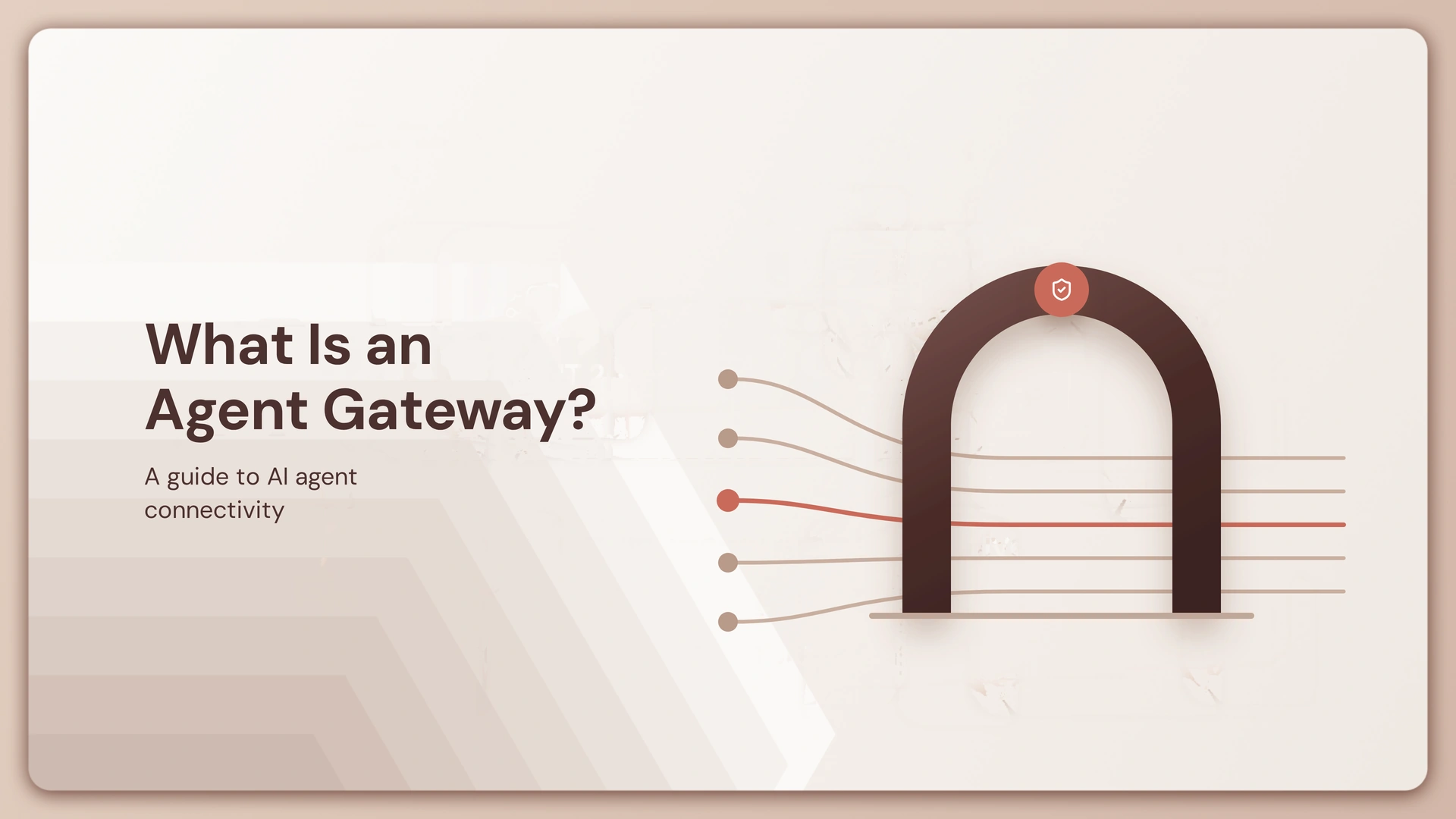
An agent gateway is a network and runtime access layer for agentic systems. It manages how agents connect to models, tools, APIs, data sources, and other agents, while handling the routing, security, protocol support, and observability needed to run those connections at scale.
That’s broader than “an API gateway with an AI label,” and deliberately so. A conventional API gateway was built for stateless, predictable request-response traffic between a client and a backend. Agentic traffic isn’t that. It’s long-running, it carries session state across multiple tool calls, and it increasingly speaks protocols an API gateway was never built to parse.
Traditional API gateways were built and optimized for RESTful microservices architectures where the gateway receives short-lived HTTP requests, decides on a backend, and forwards the request, while MCP is a stateful protocol based on JSON-RPC where clients and servers maintain long-lived sessions.
That’s the real dividing line, not branding.
Why do AI agents need a gateway?
Because without one, every agent connects directly to every model, tool, database, and other agent it needs, and that grows as M×N, not M+N.
Ten agents needing access to twenty tools isn’t thirty connections. It’s two hundred, each with its own credentials, its own retry logic, its own logging (or lack of it).
The fundamental problem agent gateways solve is the M×N integration pattern: when M agents need to connect to N tools, you face M×N potential integration points, and a company with 100 agents accessing 20 tools confronts 2,000 individual connections, each requiring separate authentication, monitoring, and governance.
Every one of those connections is also a place a credential can leak, a policy can be skipped, or an audit trail can go dark. A gateway collapses M×N into M+1: agents talk to the gateway, and the gateway manages the N downstream relationships centrally.
The blast radius of a bad call is larger than a normal API request, which is why you want a single enforcement point for which agent may call which tool, with which arguments.
How does an agent gateway work?
Practically, requests flow through a consistent path: application or user → agent gateway → agent runtime → model, tool, API, or another agent.
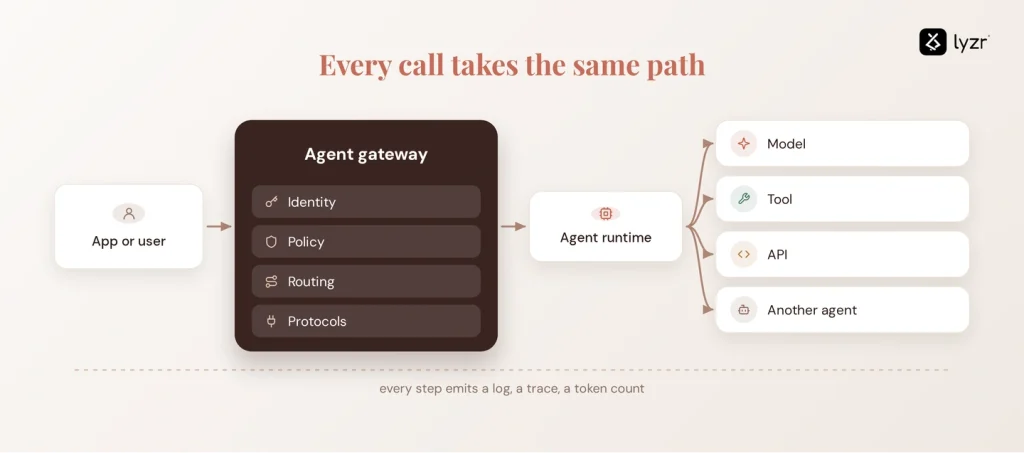
A request arrives and the gateway checks identity, usually via API key, OAuth, or mutual TLS. Policy determines what that identity is allowed to reach. The gateway routes the call, mediates whichever protocol applies (MCP for tool access, A2A for agent-to-agent, plain HTTP for everything else), and the downstream interaction happens. Every step generates a log line, a trace, a token count. Nothing about this is exotic. It’s the same discipline API gateways applied to microservices, extended to cover sessions and protocols microservices never had.
What does an agent gateway actually do?
Strip away the marketing and a mature agent gateway does a specific, bounded set of jobs:
- Protocol mediation – translating between HTTP/gRPC and agent-native protocols like MCP and A2A so agents don’t each implement protocol handling themselves.
- Authentication and authorization – verifying identity and brokering credentials so agents don’t hold their own API keys.
- Agent-to-agent routing – discovery and secure message passing between agents, often across different frameworks.
- Tool and API access – acting as a controlled proxy between agents and internal systems.
- LLM routing – directing calls across providers like OpenAI, Anthropic, Gemini, or Bedrock, with failover and cost controls.
An LLM gateway routes traffic to major LLM providers through a unified API with budget and spend controls, prompt enrichment, load balancing, and failover.
- Traffic management – rate limiting, retries, load balancing for stateful, session-based interactions.
- Observability – latency, token spend, tool-call traces, and error rates at the agent-interaction level, not just the request level.
- Security and policy – contextual, identity-aware access control, because agent traffic carries more risk per call than a typical API request.
Agent gateway vs API gateway vs LLM gateway
Capabilities increasingly overlap across all three categories. No single product sits cleanly in one column, and vendors in each category keep absorbing features from the other two, which is exactly why the confusion persists.
The cleanest way to tell them apart isn’t by feature list but by what they were originally built to route. An API gateway assumes short-lived, stateless requests between a client and a backend. An LLM gateway assumes every request eventually resolves to a model call, so it’s built around tokens, providers, and cost. An agent gateway assumes neither: it has to handle long-running sessions, tool calls, and traffic to other agents, none of which the other two were designed for.
Comparing capabilities across gateway types
| Capability | API gateway | LLM gateway | Agent gateway |
|---|---|---|---|
| Primary purpose | API traffic | Model traffic | Agentic traffic |
| API routing | Yes | Sometimes | Yes |
| LLM routing | Rarely | Yes | Often |
| MCP support | No / varies | Limited | Yes |
| A2A support | No | No | Yes |
| Tool access | Limited | Limited | Yes |
| Agent identity/policy | Request-level | Model-level | Agent-level |
| Observability | Request-level | Model/token-level | Agent and tool interaction-level |
In practice, most enterprises end up running more than one of these at the same time rather than picking a single winner. An API gateway keeps handling general service traffic, an LLM gateway (or the LLM-routing piece of an agent gateway) manages model calls, and the agent gateway is the layer that has to understand both plus whatever protocol traffic sits on top. The overlap in the table isn’t a sign that any one of them is redundant — it’s a sign that the category boundaries are still being drawn in real time.
Agent gateway protocols: MCP and A2A
MCP governs agent-to-tool communication. A2A governs agent-to-agent communication. A gateway matters because both now run across the same enterprise infrastructure at once.
Model Context Protocol standardizes how an agent discovers and calls a tool or data source, replacing one-off integrations per tool.
Agentgateway governs and secures communication across agent-to-agent, agent-to-tool, and agent-to-LLM interactions.
Agent2Agent handles discovery, messaging, and task handoff between agents, often built on different frameworks entirely. Running both protocols without a shared enforcement point means duplicating auth, logging, and policy logic inside every agent you ship.

Agent gateway on Kubernetes
For teams running agents on Kubernetes, a gateway that speaks the Gateway API is the path of least resistance, not an add-on.
That means native integration with service discovery, ingress and egress control, and the same RBAC and network policy model already governing the rest of the cluster.
For GKE deployments, an agentgateway on Kubernetes provides native Kubernetes Gateway API support, dynamic configuration, and MCP service discovery.
The open-source agentgateway project is a concrete example of this pattern, not a synonym for the whole category.
agentgateway, an open-source project (Apache-2.0) now hosted by the Linux Foundation’s Agentic AI Foundation, describes itself as “one high-performance gateway for service, LLM, and MCP traffic.”
Open-source agent gateways
The open-source layer here is moving fast, and it’s genuinely plural, not a single winning project.
agentgateway, created by Solo.io, is the most visible entrant.
The Linux Foundation welcomed the agentgateway project, an open source, AI-native proxy created by Solo.io to optimize connectivity, security, and observability in agentic AI environments.
It grew out of Solo’s Istio ambient mesh work rather than a fork of Envoy.
Solo also contributed kagent, a Kubernetes-native agent framework, to the CNCF as a Sandbox project, separately from agentgateway’s Linux Foundation home.
kagent is a “CNCF Sandbox project”
worth noting because “CNCF” and “Linux Foundation” get used interchangeably in casual coverage, and they’re not tracking the same governance body here.
Teams also extend existing open-source API gateways like Kong or Envoy-based proxies with custom agent-aware plugins, though that path means building MCP and A2A handling yourself rather than getting it natively.
Google, AWS, GCP, and other agent gateway approaches
Every major cloud provider is now shipping some version of this layer, with different scopes and different names.
AWS AgentCore Gateway
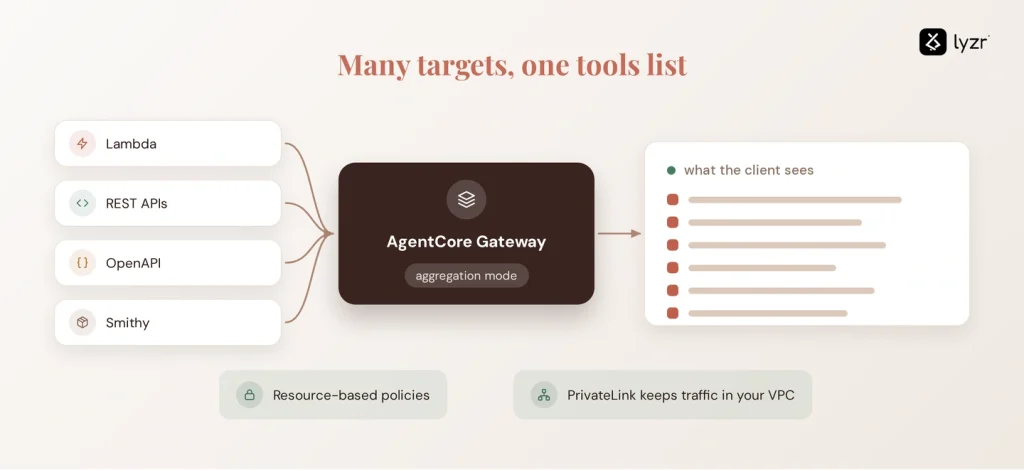
AgentCore Gateway sits inside Amazon Bedrock’s agent ecosystem.
MCP targets operate in aggregation mode, where the gateway acts as an MCP server whose capabilities combine those of all its attached MCP targets, and clients see a single consolidated tools list.
It supports targets including Lambda functions, REST APIs, OpenAPI schemas, and Smithy models.
Resource-based policies control who can invoke AgentCore Gateway, and it supports AWS PrivateLink for both control plane and data plane operations so traffic stays within your VPC boundaries.
Pricing and full documentation are best verified directly against current AWS docs, since both are still evolving.
Google Agent Gateway
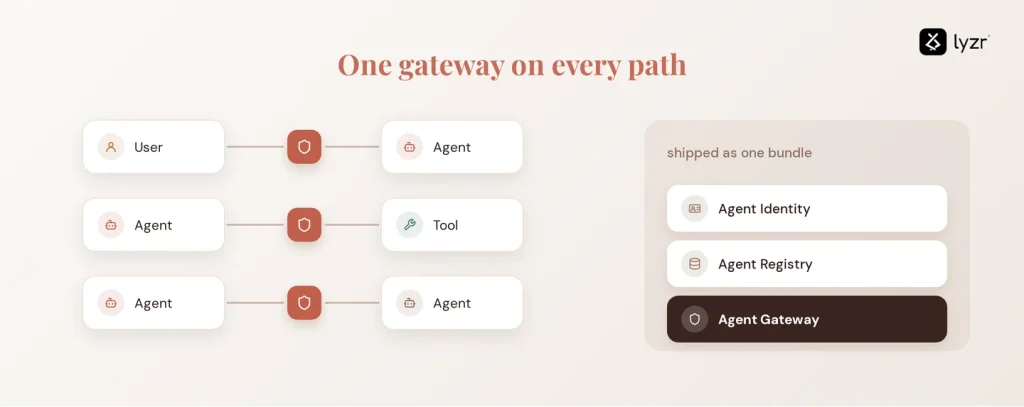
Google’s Agent Gateway is the networking component of its Gemini Enterprise Agent Platform (the 2026 successor to Vertex AI).
Agent Gateway is the networking component of the Gemini Enterprise Agent Platform ecosystem, securing and governing connectivity for interactions between users and agents, agents and tools, or among agents themselves.
The platform update bundled three governance features together: Agent Identity, Agent Registry, and Agent Gateway.
Solo.io Agent Gateway
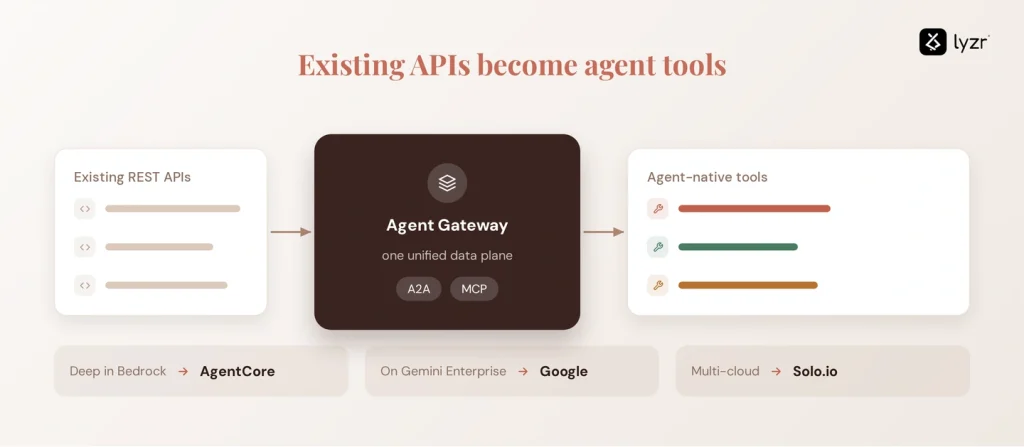
Solo’s open-source, cloud-native approach treats the gateway as a data plane first.
Agent Gateway provides a unified data plane for agent connectivity, supporting A2A and MCP, with the ability to automatically integrate an organization’s existing REST APIs as agent-native tools.
Which one should you use? If you’re already deep in Bedrock, AgentCore Gateway avoids extra integration work. Committed to Gemini Enterprise, Google’s Agent Gateway does the same. Running multi-cloud, multi-framework, or Kubernetes-first, the open-source route keeps you out of a single vendor’s runtime assumptions.
How to choose an agent gateway
Before committing, check a gateway against the questions your platform team will actually face in month six, not month one:
- Does it natively support MCP and A2A, or bolt them on?
- Does it run across clouds and frameworks, or lock you into one runtime?
- Does it integrate with Kubernetes Gateway API if that’s your deployment model?
- Can it broker credentials so agents never hold raw API keys?
- Does observability capture tool-call and agent-interaction traces, not just HTTP logs?
- Can it route across multiple LLM providers with failover?
- Does it enforce tenant and team boundaries for multi-team environments?
- Can it integrate with an existing or planned control plane, rather than becoming a second source of truth?
Where agent gateways fit in the enterprise AI stack
Picture the stack as a straight line, with governance running across it rather than inside it:
Applications → Agent Gateway (connectivity, routing, protocol handling) → Agents / Agent Runtimes → LLMs, Tools, APIs, Data
Spanning across every layer of that line: Identity | Policy | Registry | Evaluation | Deployment | Observability | Audit – the control plane’s job, not the gateway’s.

The gateway is an enforcement point for policies the control plane defines. It doesn’t set those policies itself.
Meet Lyzr: agent gateway as part of a governed agent stack
Lyzr treats the agent gateway as part of the production infrastructure for enterprise agents, not as the entire governance layer.
The distinction holds cleanly: the gateway handles connectivity and the execution path.
The Lyzr Control Plane is the deployment infrastructure layer that provides a fully automated, no-touch pipeline to take agent code from any framework and deploy it to any supported cloud runtime, with security scanning, evaluation, identity registration, and staged promotion built in.
It’s framework agnostic, working with agents built on LangGraph, CrewAI, Strands, or the Lyzr SDK, and cloud agnostic, deploying to AWS Bedrock AgentCore, GCP Vertex AI Agent Engine, or other supported runtimes.
That means an agent can run through any gateway, on any cloud, built on any framework, and still show up in one registry with one identity, one evaluation history, and one audit trail. For the technical detail on how that governance layer actually operates, see the deep-dive below.
Lyzr Agent Control Plane: the technical reference
Ready to move beyond connectivity and start governing your AI agents?
Schedule a walkthrough of the Lyzr Agent Control Plane
Frequently asked questions
A network and runtime access layer that manages how agents connect to models, tools, APIs, data sources, and other agents, handling routing, security, protocol support, and observability for that traffic.
An LLM gateway focuses on routing and managing calls to language models. An agent gateway covers that plus MCP tool access and A2A agent-to-agent communication, a broader scope than model traffic alone.
A registry is the catalog of what agents exist and who owns them. A gateway sits in the call path and enforces access to those agents in real time.
The registry tracks what exists; the gateway enforces what can run.
There’s no single universally accepted taxonomy.
One commonly cited grouping lists simple reflex agents, model-based reflex agents, goal-based agents, utility-based agents, learning agents, hierarchical agents, and multi-agent systems.
Different sources group and label these differently.
No. An API gateway handles stateless, predictable HTTP traffic. An agent gateway handles stateful, session-based traffic and understands protocols like MCP and A2A that API gateways don’t parse natively.
Another name for the same category, infrastructure purpose-built for the connectivity patterns AI agents create, as distinct from general web or API traffic.
A gateway (or gateway function) that manages Model Context Protocol traffic specifically, the connections between agents and the tools or data sources they call.
A gateway function that routes and secures Agent2Agent protocol traffic, handling discovery and message passing between agents built on different frameworks.
Several are.
agentgateway is an open source, AI-native proxy created by Solo.io
now under Linux Foundation stewardship, and teams also extend existing open-source API gateways with agent-specific plugins.
A managed gateway inside Amazon Bedrock’s AgentCore that aggregates MCP servers, Lambda functions, and REST APIs as callable targets, with VPC-based private connectivity options.
The networking component within Google’s Gemini Enterprise Agent Platform, governing connectivity between users, agents, tools, and other agents across the platform.
If you’re running more than a handful of agents on Kubernetes, yes. A gateway that integrates with the Gateway API centralizes routing, security, and observability instead of leaving each agent to handle them independently.
Book A Demo: Click Here
Join our Slack: Click Here
Link to our GitHub: Click Here