AI agent frameworks have become essential tools to develop and deploy intelligent systems that can reason, learn, and act autonomously and choosing the right one can be challenging. LangChain (via LangGraph) suits teams needing broad ecosystem flexibility, CrewAI suits fast, role-based multi-agent builds in Python, Microsoft Agent Framework suits teams standardized on Azure and .NET, LlamaIndex suits agents built over large private datasets, and Lyzr suits teams needing production governance and pre-built agents without building that infrastructure themselves.
You’ve already made the call to build with an agent framework. Now, you’re staring at five credible options, three of which changed names or merged in the last twelve months, and a Slack channel full of opinions that don’t agree with each other.
Key takeaways
- There’s no universal winner. The right framework depends on your language stack (Python vs. .NET), how much multi-agent complexity you need, and whether your team wants to own the production infrastructure or not.
- Microsoft has consolidated AutoGen and Semantic Kernel into a single product, Microsoft Agent Framework, which reached 1.0 general availability in April 2026. Treat the old names as legacy, not live alternatives.
- Open-source frameworks (LangChain, CrewAI, LlamaIndex) give you full control over code and hosting, but observability, governance, and scaling are separate problems you assemble yourself.
- Managed platforms like Lyzr trade some of that control for built-in governance, pre-built agents, and deployment options, which shortens the path from prototype to production.
- Production readiness (reliability under load, cost control, audit trails, human-in-the-loop escalation) is a bigger differentiator between these options than any single feature checklist.
Why the right framework choice matters
Your framework choice locks in architecture decisions early: how state persists between agent turns, what orchestration pattern coordinates multi-agent work, and how tools get called and versioned. Migrating off a framework after six months of production traffic is a rewrite, not a swap. Early open-source multi-agent projects, including Lyzr’s own Automata framework, established the orchestration patterns that today’s platforms still build on, which is worth knowing before you assume any of this is brand new.
Types of AI Agent Frameworks
Understanding the architecture of different frameworks is key to selecting the right tool for the job. Most frameworks fall into one of four primary categories, each suited for different levels of complexity and collaboration.

Single-Agent & Linear Workflow Frameworks are the foundational building blocks. They excel at executing a sequential series of tasks, where one action follows another in a predefined chain. These are ideal for straightforward automation, like summarizing a document and then emailing it.
Role-Based Multi-Agent Frameworks introduce the concept of collaboration. They allow you to define multiple agents with specialized roles and skills (e.g., a “Researcher,” a “Writer,” and a “Critic”) that work together to solve a more complex problem. This approach improves results through simulated teamwork and diverse perspectives.
Graph-Based / Production Orchestration Frameworks are designed for complex, non-linear, and stateful workflows. By representing tasks as nodes in a graph, they allow for conditional logic, loops, and dynamic path-finding. This is critical for building resilient, production-grade systems that can handle exceptions and adapt their process in real-time.
Retrieval & Data-Centric Frameworks are specialized for building agents that interact heavily with large, proprietary knowledge bases. Their primary function is to master Retrieval-Augmented Generation (RAG), enabling agents to query, understand, and synthesize information from your enterprise data to provide accurate, context-aware responses.
Key features of leading AI agent frameworks in 2026
Comparison table: LangChain, CrewAI, Microsoft Agent, Lyzr and more
| Framework / platform | Type | Memory | Tool calling | Observability | Best fit |
| LangChain / LangGraph | LangChain: single-agent/linear. LangGraph: graph-based | LangGraph has built-in checkpointing (short- and long-term persistence); LangChain has chain-level memory classes | Native tool calling, large third-party tool and integration ecosystem | LangSmith (tracing, evals, monitoring). Enterprise plan adds SAML SSO, SCIM, RBAC | Teams wanting fine-grained, custom orchestration control with a large integration ecosystem |
| CrewAI | Role-based multi-agent | Built-in short-term, long-term, and entity memory | Native tools, plus LangChain tool compatibility | Built-in tracing. CrewAI AMP (Enterprise) adds dashboards, execution logs, governance | Teams that think in specialized agent “roles” collaborating on a task — fast to prototype |
| Microsoft Agent Framework | Role-based multi-agent (also carries a graph-based workflow layer from Semantic Kernel’s Process Framework) | Built-in state and thread management | Native function/plugin calling, native MCP support | OpenTelemetry-based tracing, integrates with Azure AI Foundry | Enterprises on Azure/.NET wanting unified multi-agent and workflow orchestration in one framework |
| LlamaIndex | Retrieval & data-centric | Long-term memory blocks, vector-store backed | Native, plus deep integration with data loaders and connectors | LlamaTrace and third-party integrations (e.g. Arize) | Agents that reason over large private or enterprise datasets — RAG-heavy use cases |
| OpenAI Agents SDK | Single-agent & linear workflow | Sessions (SQLAlchemy, SQLite, Redis, MongoDB, encrypted variants) | Function tools with automatic schema generation; native Responses API for OpenAI models | Built-in tracing — visualize, debug, and evaluate agent flows | Teams building lightweight, OpenAI-model-native agents without adopting a heavier framework |
| Amazon Bedrock AgentCore | Managed platform (a runtime, not a code framework — hosts agents built in any of the four types) | Built-in managed memory service | Tool gateway — managed, authenticated access to APIs and tools | Built-in observability and evaluation tooling | AWS-native teams wanting a production runtime and governance layer without committing to one framework |
| Google Agent Development Kit (ADK) | Role-based multi-agent (ships graph-based workflow orchestration as a flagship ADK 2.0 feature) | Session and state schema, cross-version compatible | Native tool support, function tools | Built-in evaluation framework, event model for tracking interactions | Teams on Google Cloud/Gemini wanting multi-agent hierarchies with a managed deployment path |
| Lyzr | Managed platform (sits outside the four types — framework-agnostic) | Built into Lyzr Control Plane | Managed integrations (AWS, Weaviate, Pinecone, and others) | Lyzr Control Plane — continuous monitoring, audit trail, guardrails, Responsible AI | Teams wanting pre-built, ready-to-deploy agents and governance out of the box, rather than building from primitives |
Orchestration and multi-agent support
LangChain added LangGraph to model agent interactions as an explicit graph, which gives fine-grained control at the cost of defining your own state machine. CrewAI builds multi-agent coordination from the start through Crews (role-based teams) and Flows (event-driven sequencing), a deliberate multi-agent architecture choice rather than a bolt-on.
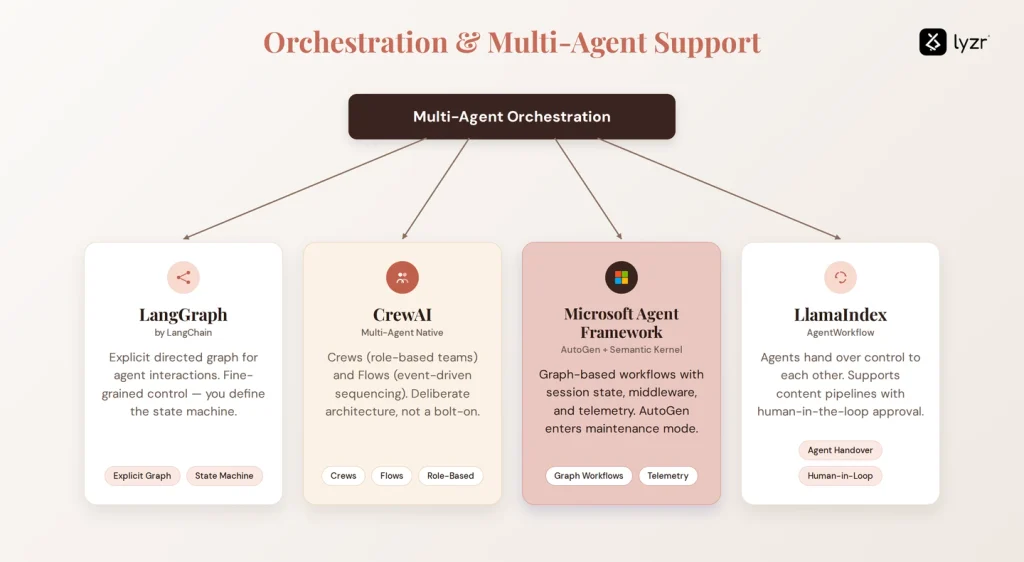
Microsoft Agent Framework combines AutoGen’s lightweight agent abstractions with Semantic Kernel’s session-based state, type safety, middleware, and telemetry, and it adds graph-based workflows for explicit multi-agent orchestration. Microsoft describes it as “the direct successor” to both projects, “created by the same teams”. It doesn’t replace AutoGen and Semantic Kernel outright, but it’s the path Microsoft is directing new agent development toward, with AutoGen now in maintenance mode (bug fixes and security patches rather than new features). LlamaIndex’s AgentWorkflow lets developers build agentic systems that coordinate across multiple agents by handing over control to each other when needed, including content generation pipelines with human-in-the-loop approval.
Memory and state management
LangChain and LlamaIndex hand you memory primitives (buffers, entity stores) and leave persistence and scaling as your problem. CrewAI’s memory is simpler and tied to its process model. Microsoft Agent Framework carries over Semantic Kernel’s session-based state handling, which is one of the reasons Microsoft frames it as production-ready rather than experimental. Lyzr manages state persistence at the platform layer, so context survives across sessions without custom infrastructure.
Tool calling and integrations
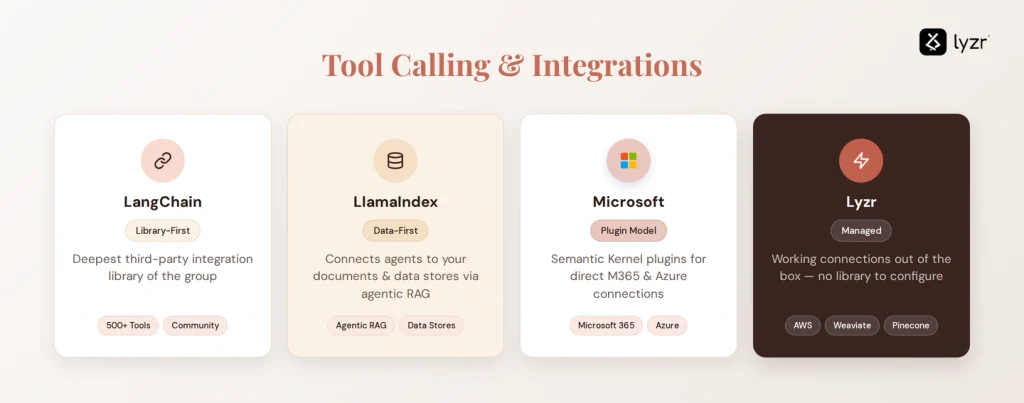
LangChain has the deepest third-party integration library of the group. LlamaIndex’s tool story is data-first: its strength is connecting agents to your own documents and data stores through agentic RAG patterns. Microsoft Agent Framework inherits Semantic Kernel’s plugin model, which makes Microsoft 365 and Azure service connections direct, though teams migrating existing Semantic Kernel plugins should expect to convert them (Microsoft’s migration guide covers the steps and offers a compatibility utility for Python), not drop them in unchanged. Lyzr’s managed integrations cover AWS, Weaviate, and Pinecone out of the box, aimed at teams that want a working connection rather than a library to configure.
Observability and governance
This is where the framework-versus-platform gap is widest. LangChain users typically pair the framework with LangSmith for tracing, or wire in Langfuse or Arize themselves. LangSmith’s Enterprise plan adds SAML-based SSO, SCIM provisioning, and role-based access control (RBAC), but that’s a separate product and contract. Microsoft Agent Framework merges Semantic Kernel’s telemetry hooks and AutoGen’s tracing capabilities into a single instrumentation layer, with OpenTelemetry support throughout. Lyzr’s Control Plane bundles continuous monitoring, audit trails, and Responsible AI guardrails as part of the deployment pipeline itself, rather than as an add-on you assemble.
Licensing and deployment model
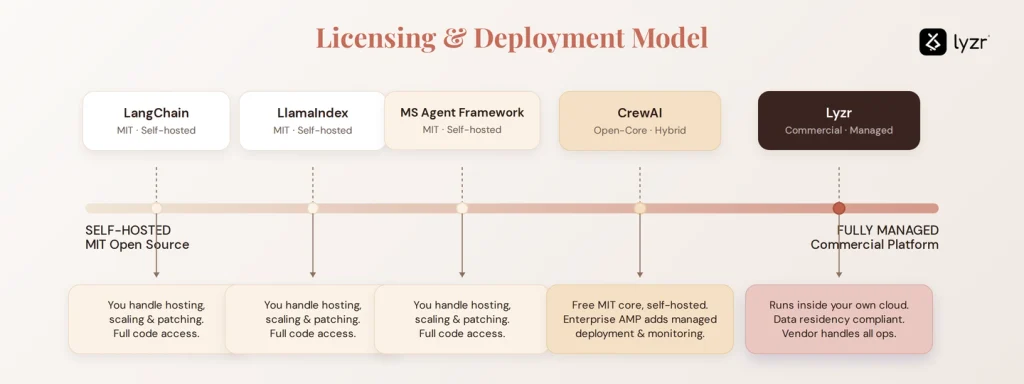
LangChain, CrewAI, Microsoft Agent Framework, and LlamaIndex ship under permissive open-source licenses (MIT), meaning you own hosting, scaling, and patching. CrewAI follows an open-core structure: the framework is free and MIT-licensed, while a separate commercial CrewAI Enterprise (AMP) product adds managed deployment, monitoring dashboards, execution logging, and governance. Lyzr operates as a commercial managed platform with deployment options that include running inside a company’s own cloud infrastructure, which matters for teams with data residency requirements they can’t hand off to a third-party cloud.
Comparing the best AI agent frameworks head-to-head
LangChain vs. CrewAI vs. Microsoft Agent Framework
LangChain launched in October 2022, is written in Python and JavaScript, and is distributed under the MIT license. Its strength is breadth: the largest integration ecosystem of any framework here, which makes it the default for teams that don’t yet know exactly what they’re building. That breadth is also the complaint: assembling a production agent out of LangChain’s abstractions takes more decisions than a narrower tool.
CrewAI’s stable release is 1.15.18, released in August 2026, written in Python and MIT-licensed, with an initial release in December 2023. It picks one lane, role-based multi-agent orchestration, and doesn’t try to be a general-purpose toolkit. That focus is the appeal for teams building research, content, or analysis crews quickly, and the limitation for teams that need a different orchestration pattern entirely. Because CrewAI ships new releases frequently, confirm the current version against its changelog before publishing anything version-specific.
Microsoft Agent Framework is the current, unified identity of both AutoGen and Semantic Kernel. Microsoft announced the public preview on October 1, 2025, and released Agent Framework 1.0 for both Python and .NET on April 3, 2026, describing it as production-ready with stable APIs and long-term support. Microsoft’s own framing is direct: it is “the direct successor” to both Semantic Kernel and AutoGen, “created by the same teams”, not a wrapper bolted over two old projects. For teams already on Azure, or with existing Semantic Kernel plugins, that continuity matters: though moving existing plugins over is a conversion using Microsoft’s migration guide, not a drop-in swap. Its main constraint is an ecosystem still smaller than LangChain’s outside the Microsoft stack.
LlamaIndex: the data-first agent framework
LlamaIndex earns its spot in this comparison for a specific reason: it treats retrieval as the core problem and agents as the layer on top. LlamaIndex Workflows 1.0 is a lightweight framework for building complex, multi-step agentic AI applications in Python and TypeScript, and it’s now a dedicated package rather than a module buried inside the main library, with the older llama_deploy repository now deprecated in favor of the llama-agents package family for serving, calling, and deploying workflows. If your project is primarily retrieval over large private document sets, with agentic reasoning as a secondary layer, LlamaIndex’s data tooling is more mature here than any general-purpose framework’s. If multi-agent orchestration is the primary problem, it’s a weaker fit than CrewAI or Microsoft Agent Framework.
Lyzr vs. Microsoft Agent Framework
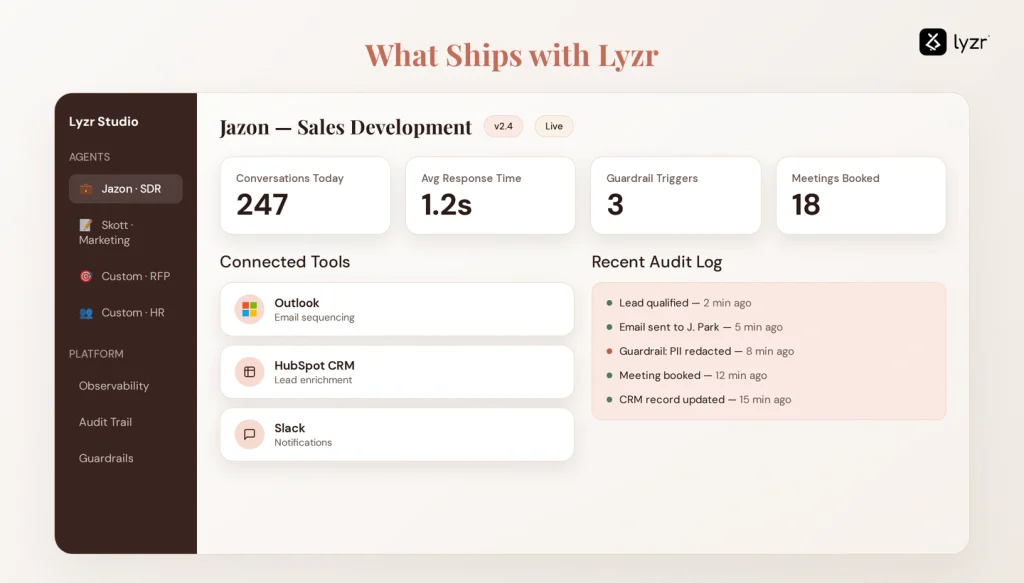
Microsoft Agent Framework gives a .NET or Python team a well-supported library for building and orchestrating agents. It doesn’t give them a deployment pipeline, an audit trail, or a governance dashboard; those get built on top, typically inside Azure AI Foundry. Lyzr’s approach is to ship that layer already built: the Lyzr Control Plane is framework-agnostic, accepting agents built with LangGraph, CrewAI, Strands, or Lyzr’s own agents, and connecting a code repository triggers a full pipeline automatically, including security and vulnerability scanning, a container build and scan, deployment to a supported cloud runtime, identity registration, and version-tagged rollbacks. The distinction isn’t which one builds a better agent. It’s whether your team spends the next quarter building the pipeline around the agent, or inherits one.
Lyzr vs. LangChain and CrewAI
The same distinction holds against LangChain and CrewAI, with one addition: Lyzr ships pre-built, named agents rather than starting every project from primitives. Jazon handles sales development, Skott handles marketing, and other named agents cover HR, support, competitive analysis, and RFP scouting, functioning as working starting points rather than finished, unconfigured products. A team can adapt one of those inside Lyzr Studio, or build from scratch using the Agent Builder primitives, but either path starts inside a platform that already has observability, audit trails, and guardrails attached. With LangChain or CrewAI, the equivalent starting point is empty code and a decision about which observability and governance tools to wire in yourself.
AI agent framework vs. agent platform: what’s the actual difference?
An AI agent framework vs platform distinction comes down to what’s included by default. A framework, LangChain, CrewAI, LlamaIndex, Microsoft Agent Framework, gives you code primitives for building an agent: model calls, memory, tool interfaces. You own everything around it: hosting, scaling, security, monitoring. A platform bundles a framework (or accepts agents built on multiple frameworks) with that surrounding production layer already built, trading some flexibility for a shorter path to a governed, running system.

Choosing a framework for production
Before committing, confirm the framework has an honest answer for each of these, not a feature that “supports” them in theory:
- Project Complexity: intricate projects often require advanced planning, multi-agent systems, and seamless integration.
- Data Privacy: it is paramount to ensure that your data remains private and secure.
- Observability – can you trace a failed multi-step run without adding a second product?
- Error handling – what happens when a tool call times out mid-task, and does the agent recover or silently fail?
- Cost control – can you cap or forecast LLM spend per agent, not just per API key?
- State management – does memory survive a restart, a redeploy, or a scale-out event?
- Versioning – can you roll back a bad agent update to a known-good version in minutes?
- Scalability: As your business grows, so do your AI needs. Your AI agents should be able to adapt to increased demands without compromising performance.
Our playbook on taking agents to production walks through each of these in more depth if you’re closer to a launch date than a proof of concept.
Open source vs. managed platforms vs. model APIs
Open-source frameworks (LangChain, CrewAI, LlamaIndex, Microsoft Agent Framework) give you full control over code and hosting, at the cost of building and maintaining the operational layer yourself.
Managed platforms like Lyzr trade some of that control for built-in governance, monitoring, and faster time to a running production system, which is the buy-versus-build calculation most platform teams are actually making in 2026.
Model provider APIs (assistant-style APIs from model vendors) work for single-agent use cases with light orchestration needs, but give you limited control over multi-agent coordination, tool governance, and the surrounding infrastructure once complexity grows.
If governance and deployment speed matter more than owning every layer of the stack, book a demo and walk through your specific production requirements with the Lyzr team.
How to evaluate AI agent frameworks
Score candidates against your actual requirements, not a generic feature list. A simple weighted rubric keeps the comparison honest:
Weighted evaluation checklist
| Criteria | Suggested weight | What to check |
|---|---|---|
| Ease of use / developer experience | High | Time to a working prototype using the framework’s documentation and tutorials |
| Documentation and community | Medium | GitHub issue response time, release cadence, and how active the developer community actually is |
| Production tooling | High | Built-in observability, error handling, and cost visibility versus bolt-on tools |
| Cost | Medium | Licensing cost, infrastructure cost, and engineering hours to reach production |
| Ecosystem fit | Medium | Compatibility with your existing cloud, data stores, and CI/CD pipeline |
Emerging trends in multi-agent systems
The direction of travel in 2026 is standardization, not just capability. Microsoft Agent Framework 1.0 has native MCP support, and its A2A (agent-to-agent) support shipped in preview in April 2026. That pattern, model-agnostic protocols for tool access and agent-to-agent communication, is showing up across the framework landscape, not just in one vendor’s roadmap. Expect less differentiation on “can it run multiple agents” and more on how well each framework handles failures, cost, and governance once those multi-agent systems are actually running in production.
Conclusion
Every framework in this comparison can build a working agent. The differences that matter show up six months later: who’s on call when a multi-agent workflow fails at 2 a.m., how much you can see about what an agent actually did, and how much of the production layer your own team had to build versus inherit. Match the framework to what your team is actually equipped to own, not to whichever one has the loudest community this quarter, and revisit that decision once the agent is handling something you can’t afford to get wrong.
Frequently asked questions
An AI agent framework is a code library that provides the building blocks for autonomous agents, including LLM orchestration, memory, tool calling, and multi-agent coordination, so developers don’t build each piece from scratch. It handles the mechanics of reasoning and action, not the production infrastructure around it. For a full breakdown, see our guide to the AI agent framework.
There’s no universal best AI agent framework; the right pick depends on your language stack, deployment target, and how much production infrastructure you want to own. LangChain suits broad flexibility, CrewAI suits fast role-based builds, Microsoft Agent Framework suits Azure and .NET shops, and Lyzr suits teams that want governance and pre-built agents included from day one.
AI agent frameworks generally fall into four types: single-agent and linear workflow frameworks for simple, sequential automation; role-based multi-agent frameworks that coordinate specialized agents like a team; graph-based and production orchestration frameworks for complex, stateful systems; and retrieval and data-centric frameworks built around enterprise knowledge and RAG.
Each targets a different build style: LangChain offers the broadest ecosystem for custom orchestration, and CrewAI simplifies role-based multi-agent crews. AutoGen’s capabilities now live inside Microsoft Agent Framework, which merged AutoGen and Semantic Kernel into one production SDK in 2026, so “AutoGen” as a standalone choice no longer applies. The better fit depends on your language stack and whether you’re standardized on Azure.
Yes, LangChain remains one of the most widely used agent frameworks in 2026, particularly through LangGraph for orchestration and LangSmith for observability. Its integration ecosystem and early head start in developer mindshare keep it a common default starting point, even as specialized frameworks like CrewAI compete directly for role-based, multi-agent use cases.
An agent framework is a code library for building agents; an agent platform bundles a framework with the production infrastructure around it, including deployment, monitoring, and governance. Frameworks require your team to assemble observability, security, and scaling yourself. Platforms like Lyzr ship those as built-in capabilities rather than separate projects.
The best framework for production is the one with the clearest path to observability, error handling, and cost control for your specific team, not the one with the longest feature list. Open-source frameworks reach production with added engineering work around them. Managed platforms are built for that path from the start, trading some flexibility for faster, governed deployment.
Related reading
A few adjacent resources worth a look if your evaluation extends beyond framework selection: teams scaling virtual assistants alongside agent deployments, notes on sentiment analysis tools that often sit downstream of agent output, and guidance on engineering and project management practices and PMP certification paths for teams formalizing agent rollout governance. For distributed or multilingual teams, English learning resources can support cross-region documentation review.
Book A Demo: Click Here
Join our Slack: Click Here
Link to our GitHub: Click Here
Got a use case in mind?
8 weeks from use case to agents running in production.
Platform, people and FDEs, all in. Bring your environment. We'll co-build and stay until it's live.
Talk to UsFree resource
101 AI Agents Use Cases
100+ production-ready AI agent use cases across Marketing, Sales, HR, Banking, Insurance, Operations and a lot more
Download now