TL;DR
- The real question behind “Claude alternative for enterprise” isn’t which model wins. It’s what governs the model once it’s deployed across a whole organization.
- Claude runs inside a customer’s own cloud through Amazon Bedrock, Google Cloud Vertex AI, and Microsoft Foundry, so data residency is solvable for Claude specifically.
- Anthropic offers HIPAA Business Associate Agreements on HIPAA-ready configurations of Claude Enterprise and the API, though not on every Claude surface.
- Claude Enterprise is seat-based; the Anthropic API is consumption-based. Both exist, and the right one depends on how evenly your organization actually uses AI.
- The unresolved gap is above the model: one governed workspace across Claude, GPT, Gemini, and open models, with shared memory, a shared knowledge base, and one audit trail.
- Lyzr isn’t a replacement for Claude. It’s a workspace layer that can run Claude alongside other models, which is a different comparison than picking a single chatbot.
Somewhere in the last year, “Claude alternative” stopped meaning one thing.
Type it into a search bar and you’ll get ten different answers depending on who’s asking. A developer wants a cheaper coding agent. A writer wants a different chat assistant. A CIO evaluating a claude alternative for enterprise deployment is asking neither of those questions. They’re asking what happens when a capable model gets handed to three thousand employees, none of whom read the same compliance memo.
Those are not the same search, even though they use the same three words. This piece is written for the second reader.
What People Actually Mean by “Claude Alternative”
Most people typing that phrase are not evaluating enterprise architecture. They’re looking for a different tool for a specific job, and it’s worth naming those jobs before narrowing to the one this article actually answers.
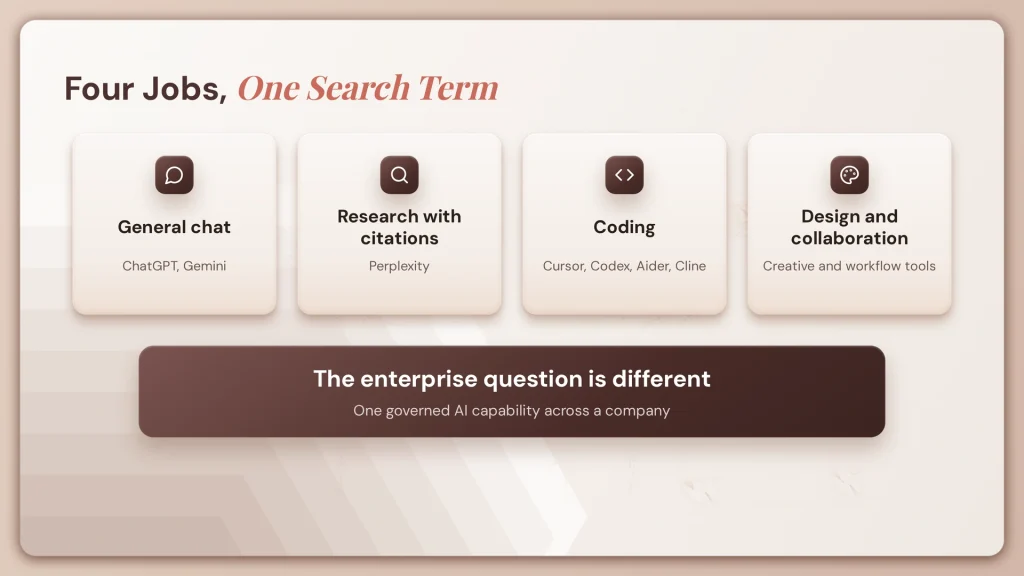
For general chat and reasoning, the direct substitutes are OpenAI’s ChatGPT and Google’s Gemini, both broad general-purpose assistants with large ecosystems around them. The best alternatives to Claude tend to come down to whether someone prioritizes raw reasoning, cost, or autonomy, with ChatGPT often favored for general reasoning and Gemini for multimodal tasks and large context windows. For research with citations attached, Perplexity is the tool most often named for search-backed answers with sources attached to every claim.
For coding, the conversation moves to a different set of tools entirely. Cursor is frequently named as the developer favorite, alongside OpenAI Codex, Aider, and Cline, each built around a different workflow: IDE-native editing, terminal-first agents, or lightweight extensions. Developers often prefer Cursor over Claude Code for its visual IDE, its “Composer” mode for multi-file editing, and its ability to switch between Claude and GPT models mid-project.
For design and collaborative work, queries like “Claude Design alternative” or “Claude Cowork alternative” point at yet another category of software, closer to creative and workflow tools than to chat.
None of that is the enterprise question. That question isn’t about finding a better individual tool. It’s about building one governed AI capability across a company, which is where the best AI agent platforms and AI agent frameworks enter a completely different conversation than the one a search engine’s autocomplete is having. If you want the underlying vocabulary, the LLM glossary is a reasonable place to start.
Why Enterprise Evaluation Is a Different Question
An AI tool that’s excellent for a ten-person team can become a governance liability for a three-thousand-person company. Individual productivity tools and enterprise AI workspaces are different product categories, and that’s true regardless of which model sits underneath either one.
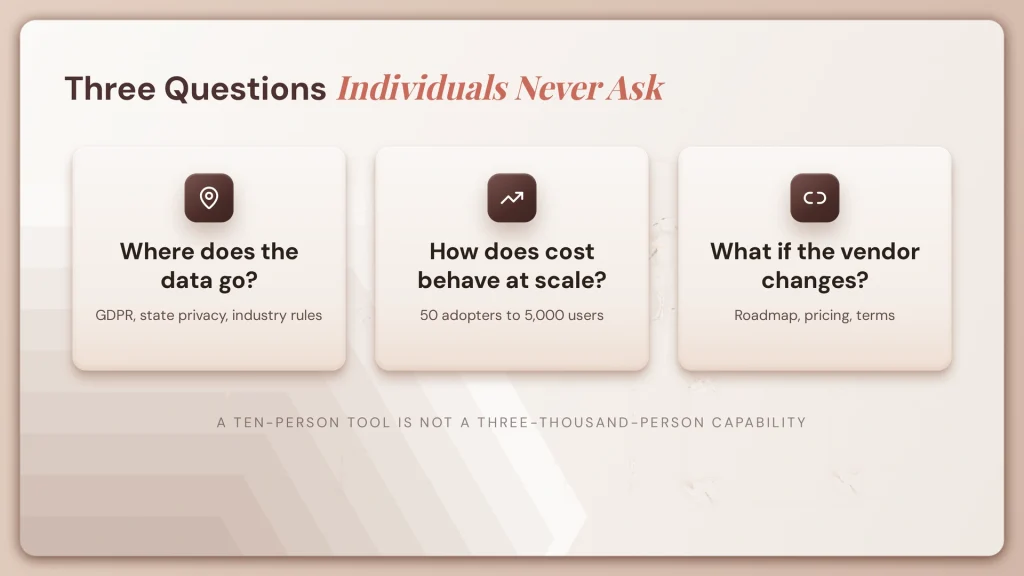
A head of AI evaluating options for the whole company has to ask questions an individual user never confronts.
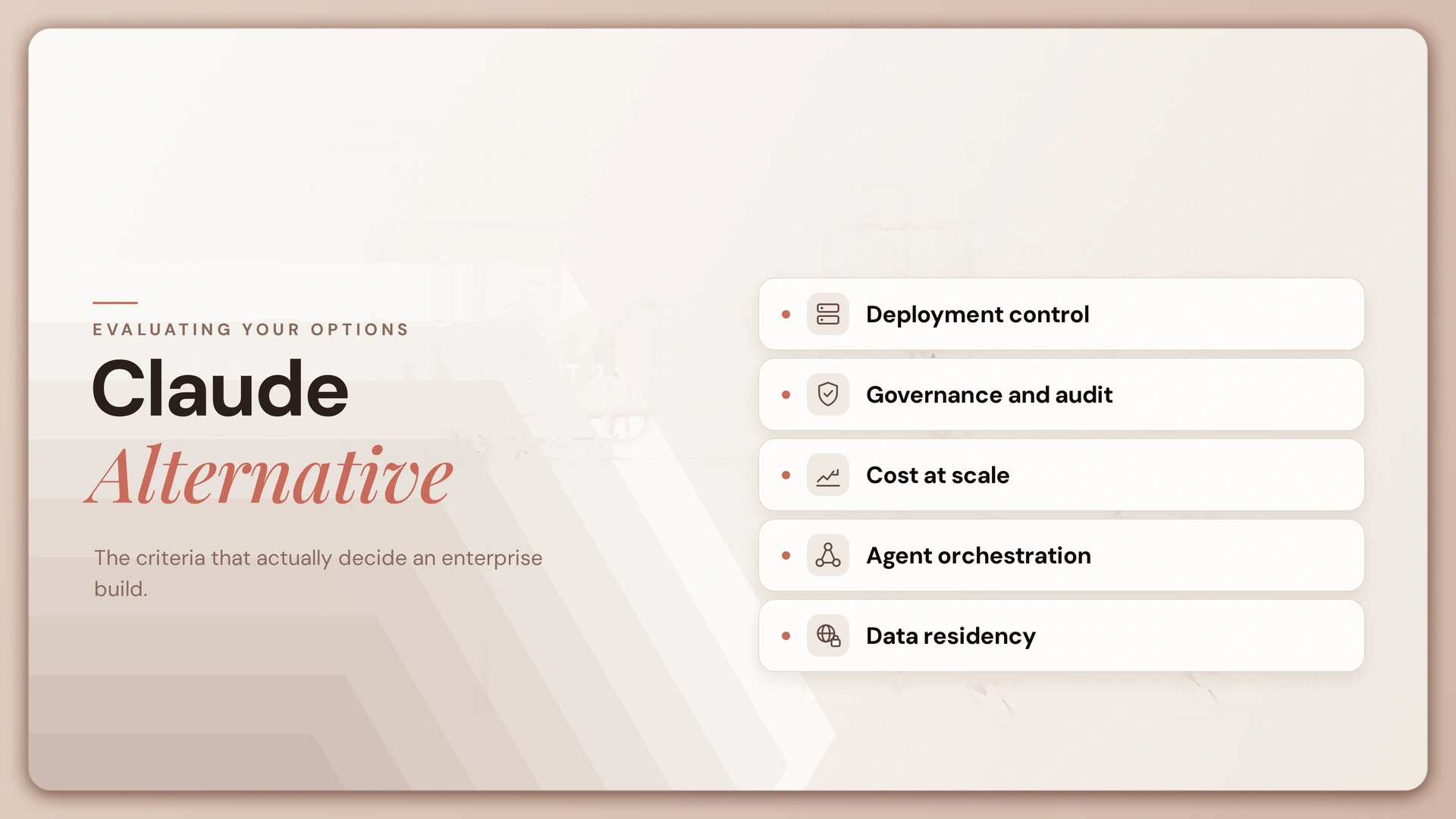
Where does the data actually go, and does that satisfy the regulatory regime the company operates under, whether that’s GDPR, a state privacy law, or an industry-specific rule?
How does the cost curve behave once usage goes from fifty enthusiastic early adopters to five thousand people who log in twice a month?
If the whole company builds workflows on top of one interface, what happens the day that vendor changes its roadmap, its pricing, or its terms?
Those three questions define what a real enterprise Claude alternative search is actually for. They also happen to be questions that apply to any single model, not just Claude, which is worth sitting with before reading the next section. Answering them well is part of what makes AI agents for enterprises succeed past the pilot stage instead of stalling there.
Data Residency and Deployment Control
Claude does not require your data to leave your environment. It can, but it doesn’t have to.
Claude is currently the only frontier model available to customers across all three major cloud platforms at once: AWS through Bedrock, Google Cloud through Vertex AI, and Microsoft Azure through Foundry. Enterprise teams can deploy through Anthropic’s own cloud, or through any of those three marketplaces, using VPC isolation and private endpoints for security. Running Claude this way lets a team use its existing cloud credits and keep data inside its own cloud environment, which simplifies procurement and satisfies most data residency requirements outright.
The HIPAA question deserves the same precision. Anthropic does offer coverage for healthcare workloads, but it isn’t automatic and it isn’t universal across every Claude surface. For Claude Enterprise features to fall under a Business Associate Agreement, the organization’s primary owner has to actively enable HIPAA compliance in settings and accept Anthropic’s BAA. Standard Claude Enterprise plans don’t include that coverage by default. The BAA, once accepted, only covers the organization that accepted it, and it excludes certain features such as Claude Console, Claude Cowork, and beta surfaces like Claude in Office and Claude Design. A hospital running HIPAA-ready Claude Enterprise or the HIPAA-ready API is on solid ground. A team quietly using Cowork or Console for the same task is not, regardless of what the parent org signed.

So residency for Claude, specifically, is a solved problem with the right configuration. Here’s where it stops being solved: the moment a company runs more than one model.
Picture a mid-size insurer running Claude through Bedrock for underwriting notes, GPT through Azure OpenAI for marketing copy, and a fine-tuned open-weight model on-premise for claims data too sensitive to send anywhere. Each of those is individually compliant. None of them talk to each other. There’s no shared memory across the three, no common knowledge base, no single access model, and no unified audit trail that a compliance officer can pull for one report. Three residency problems get solved and one platform problem gets created.
That fragmentation, not any single vendor’s architecture, is the actual risk of public LLMs at enterprise scale. A sovereign AI deployment run through a single control plane closes that gap by putting governance above the model layer instead of inside each individual model’s console. It’s also the reason regulated-industry examples like clinical systems matter here. A healthcare workflow that touches EMR systems or practice management software has to prove residency and audit continuity across every tool that touches patient data, not just the AI vendor.
Pricing Models at Scale
The honest pricing comparison isn’t Lyzr versus Claude. It’s per-seat versus consumption, and most vendors, Anthropic included, offer both.
Claude Enterprise is available through Claude.ai on a managed, seat-based model, through the Anthropic API for custom integrations priced on consumption, and through cloud marketplaces like AWS Bedrock and Google Vertex AI. The seat-based plan includes admin controls, SSO, and audit logging built in. The API, by contrast, is priced by usage. Both are legitimate paths. The question is which one fits how your organization actually adopts AI.
Per-Seat vs. Consumption Pricing by Adoption Pattern
| Adoption pattern | Per-seat cost behavior | Consumption cost behavior |
|---|---|---|
| Small group of daily power users | Efficient, usage justifies the fixed price | Comparable, tracks actual load |
| Mixed team, uneven daily use | Overpays for light users | Scales with what’s actually used |
| Company-wide rollout, long tail of occasional users | Expensive, most seats go underused | Aligns spend with real usage |
Per-seat pricing is efficient only when nearly every licensed person uses the tool heavily. Most enterprise rollouts don’t look like that. They look like a small core of daily users, a larger group of occasional users, and a long tail of people who open the tool twice a month and forget the password in between. A seat-based model charges full price for that entire tail. A consumption model, which is how Lyzr’s pricing works, charges for what actually gets used, which tends to matter more the larger and more uneven the rollout gets.
Model Flexibility and the Lock-In Question
Building an entire enterprise AI strategy on one vendor’s interface ties the roadmap to that vendor, whoever it is. That’s true of Anthropic. It’s equally true of OpenAI and Google.
No single model dominates every enterprise use case. Claude tends to lead on safety and nuance, GPT tends to lead on ecosystem breadth, and open-weight models are increasingly viable for enterprises with the infrastructure to self-host. That’s part of why the strongest enterprise AI strategies in 2026 tend to involve multiple models for different tasks rather than a single vendor commitment. The deeper a company builds on one interface, the more expensive it becomes to change course when a better model ships, a price changes, or a roadmap shifts direction.
This is where the framing needs to be exact, because it’s the point that resolves the tension at the heart of this whole comparison. Lyzr is not an alternative to Claude. Lyzr is a workspace layer that can run Claude, alongside GPT, Gemini, and open models, behind one governed interface, so switching models is a routing decision rather than a rebuild. That’s what makes it possible to design agentic workflows once and point them at whichever model fits the task, instead of re-engineering every workflow each time a new model takes the lead on a benchmark.
This argument is covered in more depth in two dedicated pieces worth reading alongside this one: model flexibility vs. vendor lock-in and multi-LLM platforms in enterprise AI.
What LyzrGPT Actually Is
LyzrGPT is a private, model-agnostic workspace, not a competing chatbot. It deploys inside a customer’s own cloud or on-premise environment, so enterprise automation work never has to leave the company’s infrastructure to happen.
Inside that workspace, a company can route tasks to Claude, GPT, Gemini, or an open model through one interface, priced on consumption rather than per seat. Memory persists across sessions through Cognis, so an agent handling a claims review in March still has context in June. Pre-built AI agents cover recurring department needs out of the box: an AI hiring assistant for resume screening, customer service agents for scheduling and triage, and agents built for employee satisfaction tracking instead of another annual survey nobody reads. The whole thing runs on the Agentic OS, with governance and audit handled through Responsible AI as a Service rather than bolted on department by department.
None of that requires giving up Claude. It requires deciding that the workspace layer and the model layer are two separate purchases, which is the argument this entire article has been building toward.
Three Ways to Deploy, Compared Honestly
| Deployment approach | Data location | Model choice | Pricing |
|---|---|---|---|
| Single-vendor SaaS workspace | Vendor’s cloud | Locked to one vendor | Usually per-seat |
| Model API in your own cloud | Your cloud, for one model | Locked to one vendor | Consumption |
| Multi-model governed workspace | Your cloud, across all models | Claude, GPT, Gemini, open models | Consumption |
| Deployment approach | Memory persistence | Audit trail | Switching cost |
|---|---|---|---|
| Single-vendor SaaS workspace | Siloed to that vendor | Vendor-provided logs only | High, retrain and rebuild |
| Model API in your own cloud | Requires custom build | Requires custom build | Medium, rebuild integrations |
| Multi-model governed workspace | Native, shared across models | Unified across every model | Low, reroute traffic |
Read this for what it is: not Claude losing to Lyzr, but three architectural choices with different tradeoffs. A company that only ever needs Claude, deployed correctly through Bedrock or Vertex AI, may not need the third row at all. A company running Claude for one team, GPT for another, and an on-prem model for a third almost certainly does.
An Evaluation Checklist Worth Actually Using
Data and compliance. Where is data processed and stored, and can the platform run entirely inside your cloud or on-premise? Does the vendor offer BAAs on the specific configuration you’ll actually use, not just somewhere in its product line? What happens to your data if you leave?
Cost. Is pricing per-seat or consumption-based, and which one fits how unevenly your organization actually adopts new tools? Are there hidden costs tied to specific premium models?
Strategic flexibility. Can you run models from more than one lab? Can the workspace run the model you already prefer, or does adopting it mean giving that model up? If you left the platform tomorrow, what would you actually keep, your prompts, your agent configurations, your data?
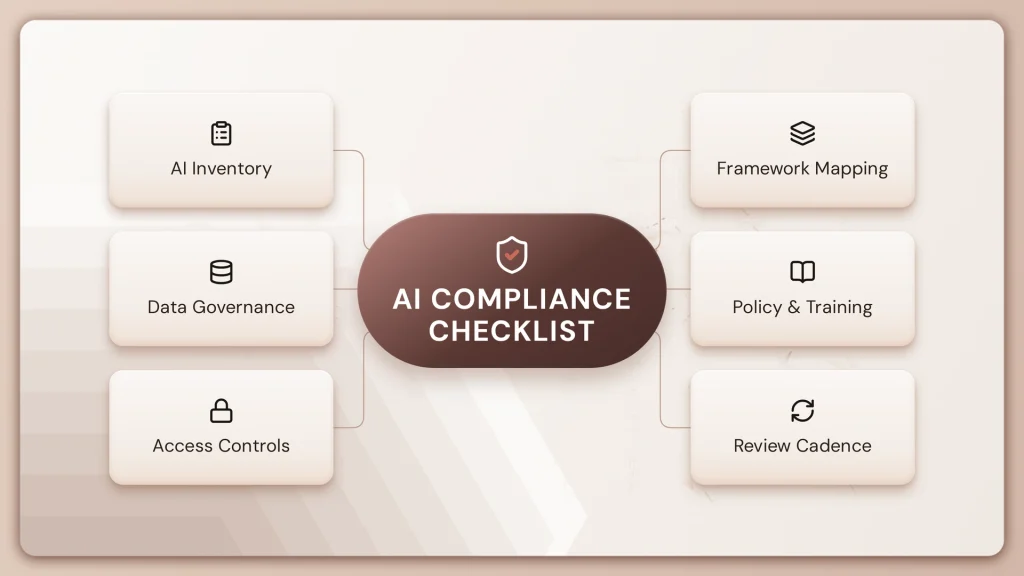
Governance. Is there a unified audit log across every model in use, or one per vendor? Does AI agent governance sit above the model layer, or inside each individual console? Does the approach hold up against AI governance for enterprises standards your compliance team already applies elsewhere?
Ownership. Who on your platform team would actually manage this day to day? Would your CIO or head of AI sign off on the audit trail if a regulator asked for it tomorrow?
Frequently Asked Questions
Which AI is better than Claude?
It depends on the task. ChatGPT and Gemini often lead on general reasoning and ecosystem breadth, while Cursor and Codex are strong for coding. Benchmarks shift with nearly every release, so “better” is a moving target rather than a fixed answer.
Is ChatGPT better than Claude?
They trade the lead depending on the benchmark and the release cycle.
A closer comparison of Claude and ChatGPT can help put those differences into context. Most enterprise teams find that model choice matters less than deployment architecture, governance, and how well either one integrates with existing systems.
Is there a cheaper version of Claude?
Anthropic offers smaller, lower-cost models alongside its frontier tier, and API access is priced on consumption rather than per seat. Actual cost depends more on usage pattern than on list price.
Is Claude the most powerful AI?
No single model leads across every task. Frontier models from Anthropic, OpenAI, and Google are broadly comparable, and the ranking shifts with each new release.
What are the top AI models right now?
Frontier models from Anthropic, OpenAI, and Google, alongside strong open-weight options from Meta and Mistral. Any ranking dates quickly given how often these models update.
Why do people switch between ChatGPT and Claude?
Usually writing style, coding performance on a specific stack, context window needs, or pricing structure. Preference tends to be task-specific rather than absolute.
Who owns Claude?
Anthropic, an AI safety and research company, develops and owns Claude.
Is there an open-source Claude alternative?
No open-weight model is a direct one-to-one equivalent, but Llama, Mistral, and Qwen models are widely used where self-hosting or access to model weights is a requirement.
What is the best Claude alternative for coding?
Cursor, OpenAI Codex, Aider, and Cline are the most-cited alternatives to Claude Code. The right one depends on whether the preference is an IDE, a terminal tool, or an editor extension.
Can we use Claude inside an enterprise AI platform?
Yes. Platforms including Lyzr run Claude alongside other models behind one governed interface, which is a different question from choosing a single chatbot to standardize on.
What happens to our data if we leave LyzrGPT?
Configurations, agent logic, and knowledge bases remain exportable, since the platform is built on the premise that the workspace layer shouldn’t create its own lock-in while arguing against everyone else’s.
Can we build custom agents beyond the pre-built library?
Yes. The pre-built agents cover common department workflows, but the platform is built for teams to design and deploy their own agents on top of the same governed infrastructure.
Where This Leaves the Decision
The question was never really “what replaces Claude.” It’s whether your organization has one governed place for AI to happen, or three separate compliant deployments that don’t share memory, access rules, or an audit trail.
Claude, deployed through Bedrock, Vertex AI, or Foundry, solves its own residency question well. It does not solve what happens the day a second model joins the stack, which for most companies past a certain size is a matter of when, not if.
If you’re weighing this for your own organization, a more useful exercise than picking a model is reading how enterprises are getting started with generative AI adoption the right way, then asking a harder question than “which chatbot”: if you added a second model tomorrow, could your current setup show you, in one place, everything either of them touched last month? For most single-vendor deployments, the honest answer is no.
Book a demo to see what changes when that answer becomes yes.
Book A Demo: Click Here
Join our Slack: Click Here
Link to our GitHub: Click Here