The conversation every boardroom needs to have next is “How do we build Agentic AI Architecture?” The real challenge for HR leaders, SaaS founders, and the entire C-suite now is rethinking how the business actually operates.
You deploy a powerful AI model that generates text, classifies data, drafts code and it does that one task incredibly well and then it waits for the next prompt.
The output is great…
but the workflow? Completely broken.
A human has to grab that output, move it somewhere else, feed it into the next step, and hope nothing gets lost in the handoff. This process loses time, context, quality every single time.
Most teams building on top of a large language model hit the same wall. The model answers well. It does not act, remember, or coordinate with other systems on its own.
Key takeaways
- Agentic AI architecture lets an AI plan and execute multi-step work on its own, not just answer a single prompt.
- Reactive AI stops at output; agentic AI checks its own result, escalates exceptions, and acts again without a new prompt.
- Architectures are single-agent for narrow tasks, or multi-agent, split into vertical (manager-delegates) and horizontal (peer-to-peer) patterns.
- Enterprises scale by proving one governed agent in production first, then expanding into multi-agent workflows.
- Governance, observability, audit trails, human-in-the-loop checkpoints, security and guardrails should be evaluated before any platform’s feature list.
What is agentic AI architecture?
Agentic AI architecture is the structural design that lets an AI system perceive its environment, reason toward a goal, take action through tools, and retain memory across steps, instead of just generating a single response to a single prompt. It defines how agents ingest data, reason over goals, call tools, retain context across steps, and stay auditable once deployed in production.

Getting from a good prompt to a production agent that can look up a record, call three APIs, and hand off to a human when it’s unsure requires an actual architecture, not a bigger prompt. This piece lays out that architecture layer by layer, compares it to the reactive systems most teams still run, and ends with a named reference design you can hand to your platform team.
For a broader library of implementation patterns, Lyzr’s blog covers deployment specifics across industries.
Agentic AI inverts the usual interaction pattern. Instead of a user supplying a step-by-step recipe, the user supplies an outcome, and the architecture is what decomposes that outcome into a plan, executes the plan, and checks the results. The architecture is the difference between a chatbot that drafts a compliance summary when asked and a system that monitors a queue of claims, drafts the summary, checks it against policy, and only escalates the ones that fail a rule.
Agentic AI vs. reactive AI
You might ask, why is Agentic AI even important? What can it achieve that a reactive AI cannot?
The difference between agentic and reactive AI is persistence and initiative: reactive AI answers one prompt and stops, while agentic AI plans a sequence of steps, acts on them, and adjusts based on what happens next. Generative AI is a strong example of the reactive pattern. It’s excellent at producing a single output, a drafted email, a summarized report, but it has no mechanism for checking whether that output actually solved the underlying problem.

Take a concrete case. A reactive system asked to “process this invoice” will extract fields and return structured text. An agentic system given the same instruction checks the invoice against a purchase order, flags a mismatch, routes the exception to an approver, and updates the ledger once approved, all without a new prompt for each step. The reactive system produced an answer. The agentic one closed a loop.
Before we dive deeper, try out this assessment to understand the readiness of your enterprise for autonomous AI agents.
Core components of an agentic AI architecture
An agentic AI architecture is built from four functional components: perception, reasoning, action, and memory, each handling a distinct part of the plan-act-observe loop. Strip any one of them out and the system stops being agentic and reverts to a single-turn tool.
Perception is the ingestion layer. It pulls in a user’s natural language request alongside structured signals, a CRM update, a document upload, a webhook from an upstream system, and normalizes all of it into a format the reasoning layer can use.
Reasoning (cognition) is the core intelligence. This is where large language models (LLMs) interpret the goal, break it into sub-tasks, and decide which tool or agent handles each step. This is also where agent orchestration lives when more than one agent is involved, deciding sequence, handoffs, and escalation rules.
Action (tool use) governs access to the outside world: calling an API, updating a database record, sending a notification, or triggering a downstream workflow. Model Context Protocol (MCP) has become the standard way to expose these tools to an agent in a consistent, auditable form.
Memory keeps the system coherent across steps and sessions. Short-term memory holds intermediate results within a single run; long-term memory, typically a vector store or knowledge graph, lets the agent recall prior interactions, past decisions, and organization-specific context without retraining the underlying model.
Governance wraps all four, enforcing policy, logging every decision, and holding a human checkpoint where the workflow calls for one.
Types and patterns of agentic AI architecture
There are two fundamental types of agentic AI architectures: single-agent and multi-agent, and multi-agent systems split further into vertical (hierarchical) and horizontal (peer-to-peer) patterns.
A single-agent architecture centers on one autonomous entity handling the full perceive-reason-act loop itself. It’s simpler to build, test, and debug, and it’s the right starting point for a well-scoped task like document classification or a single-channel support bot.
Multi-agent architectures come into play once a workload needs specialization. In a vertical (hierarchical) pattern, a manager agent decomposes a goal and delegates subtasks to subordinate agents, useful for sequential, auditable processes like loan underwriting.
In a horizontal (peer-to-peer) pattern, agents of similar standing collaborate directly, better suited to dynamic, exploratory work like collaborative research or content generation where no single agent should hold final authority. For a deeper walkthrough of these coordination patterns, Lyzr’s guide to multi-agent architecture breaks down orchestration models with real workflow examples, and this multi-agent blueprint offers additional pattern detail for enterprise-scale builds.
Single-agent vs. vertical vs. horizontal multi-agent patterns
| Pattern | Structure | Best fit | Failure mode to watch |
|---|---|---|---|
| Single-agent | One agent owns perceive-reason-act | Narrow, well-scoped tasks | Struggles once scope grows |
| Vertical (hierarchical) multi-agent | Manager delegates to subordinate agents | Sequential, auditable workflows (underwriting, claims) | Bottleneck at the manager agent |
| Horizontal (peer-to-peer) multi-agent | Agents collaborate as equals | Dynamic, creative, exploratory work | Coordination complexity, unclear ownership |

How enterprises deploy agentic AI at scale
When enterprises deploy agentic AI at scale, they start with a single well-bounded agent, proving it in production, then expanding into orchestrated multi-agent workflows once the first agent is stable. A common failure pattern here is trying to launch five agents simultaneously before any one of them has a track record.
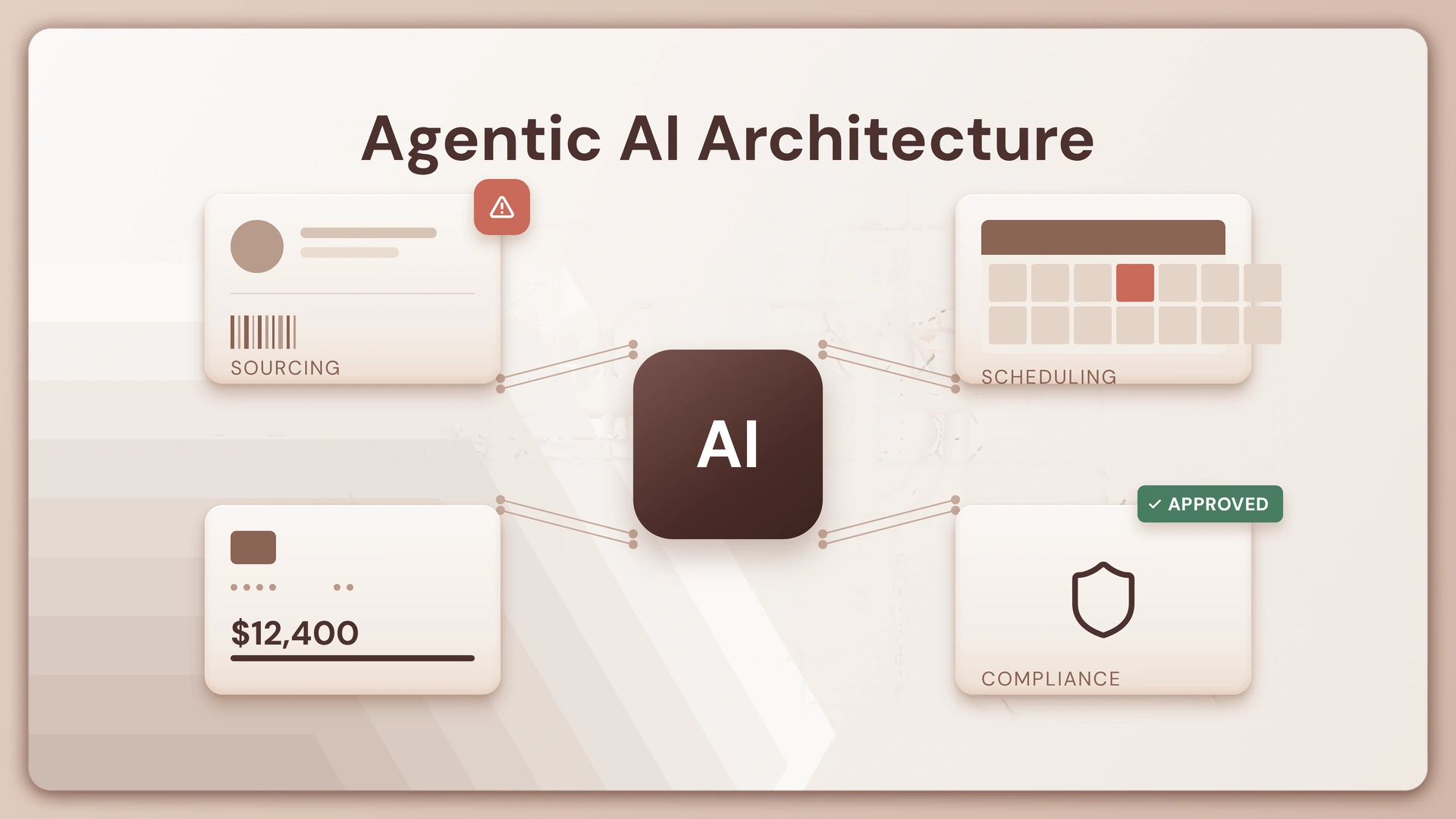
HR sourcing workflows are a practical entry point for deploying agentic AI architecture: a Talent Sourcing Agent scans internal databases and external platforms for candidates matching a role, an Interview Scheduling Agent resolves calendar conflicts across hiring managers, and a Compliance Agent audits the process against labor law in real time. Each agent owns a narrow scope, and the orchestration layer, not any single agent, owns the handoffs between them.
The same pattern extends to regulated industries. According to Accenture’s October 2025 announcement of its investment in Lyzr, the goal was to help banking, insurance, and financial services firms create secure, explainable, and compliant agents that automate decisions across workflows. That same investment framed the core challenge enterprises face as moving from experimentation to production and scaling, not simply proving a demo works.
This is directionally consistent with what teams evaluating AI agents for customer service also report, that scripted single-turn bots plateau quickly once volume and edge cases grow. For a look at how this applies to regulated sectors specifically, review examples of banking solutions built on multi-agent patterns, and teams communicating these workflows internally often reach for an AI PowerPoint generator to walk stakeholders through the handoffs before rollout.

Governance and guardrails for agentic AI architectures
Governance in an agentic AI architecture is the set of controls, observability, audit trails, human-in-the-loop checkpoints, and security boundaries that determine whether a multi-agent system is safe to run unattended. Treat these as evaluation criteria when assessing any platform, not as a checklist of nice-to-have features.
Observability means being able to see every agent decision, tool call, and failure as it happens, not reconstructing it after an incident. Audit trails turn that visibility into a permanent, chronological record usable for compliance review. Human-in-the-loop checkpoints define exactly where an agent must pause for approval, high-stakes financial commitments or irreversible actions, rather than leaving that judgment to the model. Security guardrails cover API rate limits, data access scoping, and action boundaries so an agent’s authority expands only as it demonstrates reliability.

Evaluate any agentic platform against these four criteria before evaluating its feature list. A platform with elegant orchestration but no audit trail is not enterprise-ready, regardless of how well its demo performs. Lyzr’s own AI agent governance framework treats these controls as dynamic rather than fixed, tightening automatically when an agent underperforms and expanding autonomy where it earns it.
How Lyzr enables agentic AI architecture
Lyzr implements the PRAMG reference architecture as production infrastructure rather than a diagram teams have to build themselves from open-source parts. Agents are assembled in Lyzr Studio, which handles the reasoning and action layers, model selection, tool integration, and multi-agent assembly, without requiring a rebuild for every new workflow. Orchestration, the coordination layer between agents, runs through Orchestration as a Service, supporting both static workflows and dynamic manager-agent decomposition, the same pattern described above.
Governance is not bolted on afterward. Lyzr is built to integrate Safe AI and Responsible AI modules directly into the core agent architecture, and the Control Plane extends that governance across agents built on other frameworks or clouds, giving a platform team one place to see policy enforcement, identity, and audit logs regardless of where an agent originally ran. This is the part most agentic AI architecture diagrams leave out: governance as a layer that spans the whole stack, not a feature attached to one agent.
Teams evaluating the technical details can review the Lyzr Agent Framework documentation directly, and platform teams presenting this architecture internally can use an AI presentation maker to walk stakeholders through the layered design before greenlighting a rollout.
If your current setup has agents that work individually but no governance layer connecting them, that gap is exactly what the reference architecture above is meant to close. Book a Lyzr Studio demo to see how the perception, reasoning, action, memory, and governance layers come together in a live environment.
Frequently asked questions
Agentic AI architecture is the layered system design, perception, reasoning, action, memory, and governance, that lets an AI system plan and execute multi-step tasks autonomously instead of just responding to a single prompt. It’s what turns a language model into a system capable of acting in and adapting to a live environment, not just generating text.
The four core components are perception (data ingestion), reasoning (the LLM-driven planning core), action (governed tool and API access), and memory (short-term session state plus long-term retrieval). Together they form a continuous loop where the system perceives a situation, plans a response, acts, and updates its memory based on the outcome.
The two fundamental types are single-agent and multi-agent architectures. Multi-agent systems split further into vertical (hierarchical), where a manager agent delegates to subordinates, and horizontal (peer-to-peer), where agents of equal standing collaborate directly on shared goals.
Reactive AI generates a single response to a single prompt and stops there, while agentic AI plans a sequence of steps, executes them through tools, and adjusts based on results. The practical difference shows up in workflows: a reactive system drafts an answer, while an agentic system checks that answer, escalates exceptions, and closes the loop.
A reference architecture for agentic AI is a named, reusable blueprint of the layers a production system needs: perception and data ingestion, reasoning and orchestration, action and tool use, memory, and governance. The PRAMG structure described above is one version of this, built so platform teams can reuse it across projects instead of redesigning each new agent from scratch.
Enterprises deploy agentic AI at scale by proving one narrowly scoped agent in production first, then expanding into orchestrated multi-agent workflows once that first agent is stable and governed. Regulated industries in particular tend to layer in audit trails and human-in-the-loop checkpoints before expanding an agent’s authority, per Accenture’s 2025 partnership announcement with Lyzr on banking and insurance deployments.
Book A Demo: Click Here
Join our Slack: Click Here
Link to our GitHub: Click Here