Agentic automation is enterprise automation built on autonomous AI agents that reason, plan, and act toward a goal, instead of following a fixed script. It differs from RPA by handling variation and exceptions on its own, and from agentic AI by being the applied, production layer where that reasoning runs enterprise workflows.
Key takeaways
- Agentic automation replaces fixed scripts with goal-directed reasoning, so processes keep running when inputs, systems, or rules change.
- It sits between two neighboring terms: agentic AI, the underlying technology, and agentic process automation, the end-to-end methodology built on top of it.
- A Levels 0-5 maturity model, not a single on/off switch, is the clearest way to plan a migration from RPA to agentic systems.
- Exception handling is the biggest practical difference from RPA. Agents diagnose, attempt self-correction, and escalate with context instead of simply failing.
- Governance shifts from scripting every action to defining guardrails, audit trails, and human checkpoints around autonomous decisions.
What is agentic automation?
Agentic automation is enterprise automation powered by AI agents that reason and act toward a goal rather than follow a script. Unlike RPA, it adapts to exceptions on its own; unlike agentic AI, it’s the applied layer that runs inside actual business workflows.

Most of what gets labeled agentic automation today is a genuine architectural shift, not a rebrand of older robotic process automation.
At the center of it is the AI agent. In one sentence, an AI agent is a software system that perceives its environment, reasons about a goal, and takes action through tools and APIs. You can get the full mechanics in our explainer on what an AI agent is.
Agentic automation applies that capability to a business process end to end, replacing the earlier generation of enterprise automation tools that could only execute steps a human had already mapped out in advance.
According to Gartner, by 2028, 33% of enterprise software applications will incorporate agentic AI capabilities, up from less than 1% in 2024, and agentic AI will make at least 15% of day-to-day work decisions autonomously.
Picture an agent tasked with processing a vendor invoice. It does not run a static script from step one to step ten.
It perceives the inbox and the attached PDF. It reasons about which fields matter and whether the format matches anything it has seen before. It plans a sequence: validate the vendor, check the purchase order, schedule payment. Then it acts, calling the ERP and accounting APIs directly.
When a source system has no clean feed, the same agent can reach for connected web scraping tools to pull structured data from a portal, echoing the broader shift researchers describe as AI systems that gather and synthesize data autonomously rather than relying on a person to collect it first.
What makes automation “agentic”?

Automation becomes agentic when it stops executing a script and starts pursuing a goal.
Three traits carry that shift: reasoning about what a situation requires, planning a multi-step path to the outcome, and self-correcting when the first attempt does not work. A traditional bot fails when a button moves on a page. An agentic system understands the goal is to submit the form, notices the button moved, and adapts. That is the practical line between agentic and non-agentic systems, and it is also what separates resilient workflow automation from the brittle kind.
Agentic automation vs. agentic process automation vs. agentic AI

These three terms describe different layers of the same stack, not three competing categories.
Agentic AI is the underlying technology field: research and model capability focused on building systems that can act on a goal rather than just answer a prompt. Read the full definition of what agentic AI is for the technical grounding, and see how it differs from a plain language model in our comparison of agentic AI vs. LLMs.
Agentic automation is the applied layer. It is agentic AI put to work inside a specific business process, department, or system of record.
Agentic process automation is the methodology layer, the practice of redesigning an entire end-to-end process, such as procure-to-pay or order-to-cash, around a coordinated set of agents rather than a single point tool.
You will also see the phrase what is agentic AI automation used as a catch-all for the same idea. It is not a fourth category. It is shorthand for agentic automation that makes explicit which technology is doing the reasoning.
Agentic automation vs. RPA

Gartner’s own December 2025 research frames this directly. Gartner predicts a new era of agentic automation where AI agents, orchestration and process intelligence reshape enterprise operations, describing it as an architectural transition rather than an upgrade to existing automation models.
That transition shows up most clearly in how each approach handles the messy parts of a real process. RPA still has a place for narrow, high-volume, low-variance tasks. But rigid scripts break the moment an input, a UI, or a rule changes, which is why teams running banking automation at scale have spent years patching bots after every minor system update.
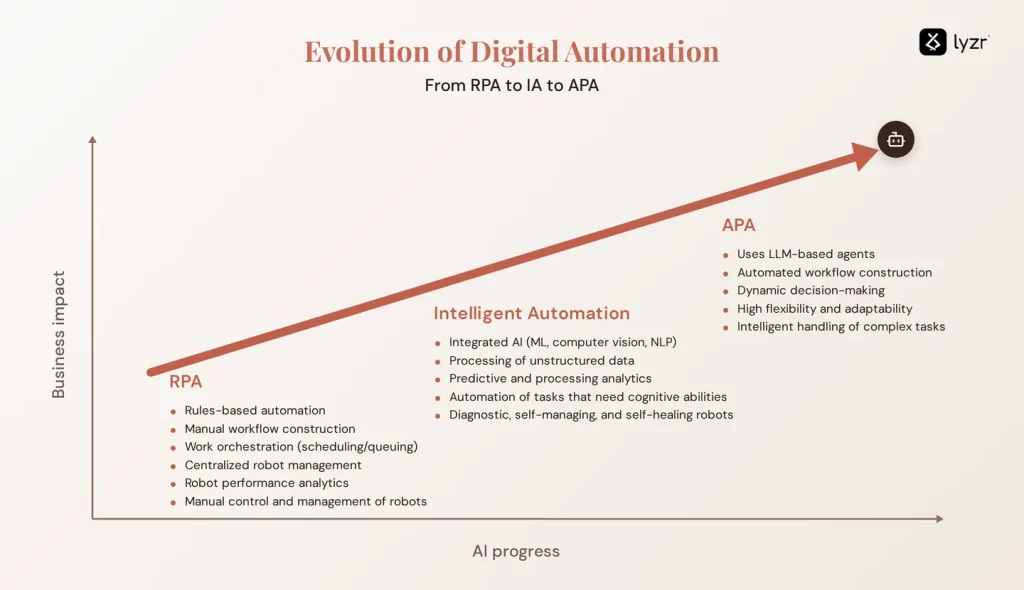
RPA vs. agentic automation at a glance
| Dimension | RPA | Agentic automation |
|---|---|---|
| Decision-making | Rule-based. Follows a predefined script step by step. | Goal-based. Reasons about the best path to an outcome. |
| Exception handling | Brittle. Stops and creates a ticket when input or UI deviates from the script. | Adaptive. Diagnoses the anomaly, attempts self-correction, and escalates with context if needed. |
| Change resilience | Low. Requires re-scripting when an application, form, or process changes. | Higher. Built for workflow continuity under changing configurations, since the agent reasons from the goal rather than a fixed path. |
| Cost model | Lower upfront build cost, higher ongoing maintenance as scripts break. | Comparable or higher setup investment, with maintenance load falling as autonomy increases. |
| Governance | Access and action control at the script level. | Guardrails, audit trails, and human checkpoints around autonomous decisions. |
The six levels of agentic automation

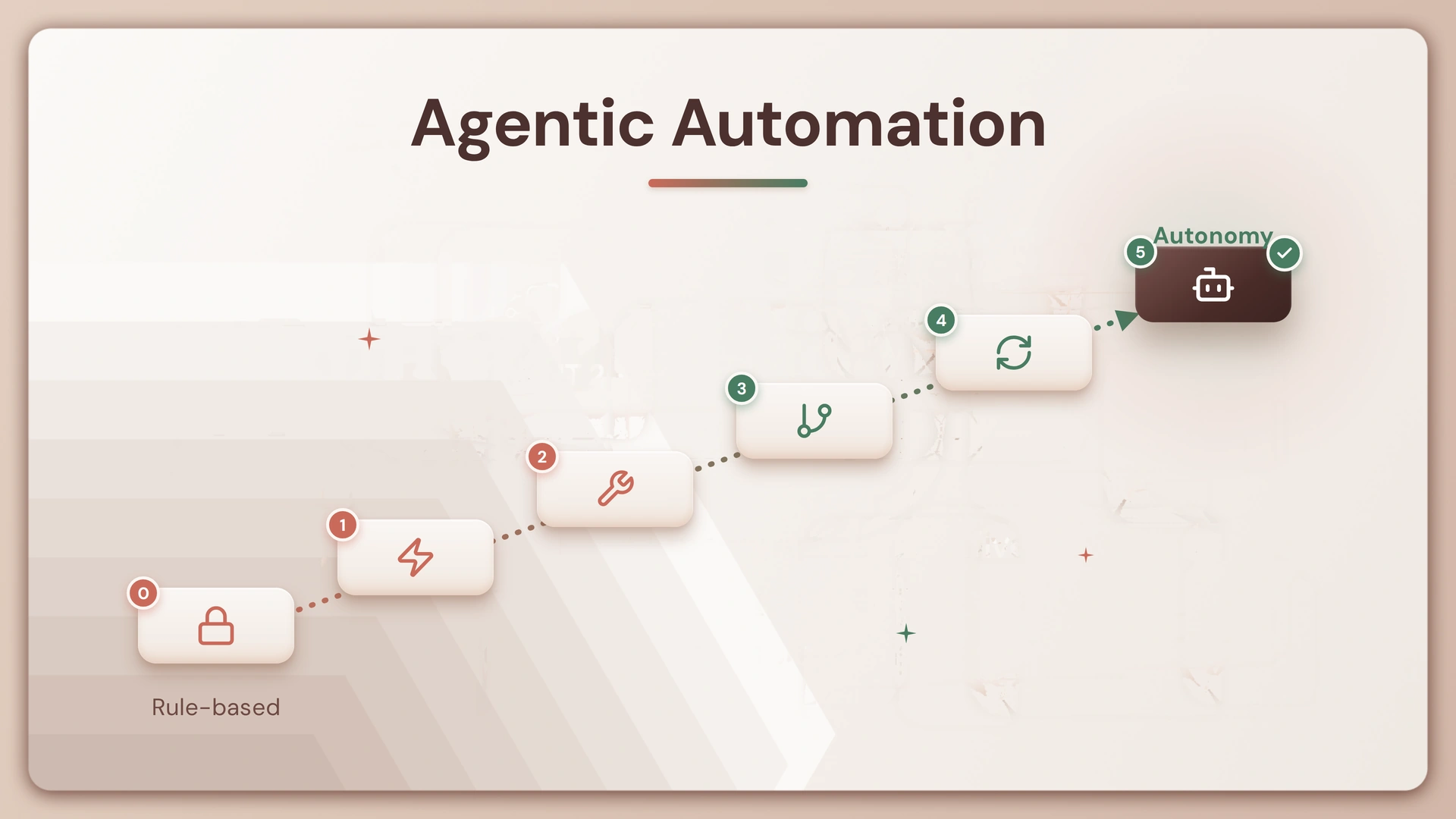
Not every deployment that calls itself agentic operates the same way. The framework below gives automation leaders a shared maturity model for benchmarking where a given process actually sits, rather than taking a vendor’s label at face value.
Levels 0-5 of agentic automation
| Level | Name | What it means | Enterprise example |
|---|---|---|---|
| 0 | Manual | All work is performed by a person. No automation exists. | A support agent manually copies data from an email into a CRM record. |
| 1 | Fixed automation | Single-task scripts execute a predefined sequence with no ability to deviate. | An RPA bot copies fields from one specific spreadsheet template into a CRM. |
| 2 | Assisted autonomy | The agent handles minor variation and proposes an action, but a human approves every execution. | An agent extracts invoice data from varied formats and presents it to an AP clerk for sign-off. |
| 3 | Conditional autonomy | The agent acts independently within defined conditions and handles known exceptions without escalation. | An agent auto-processes invoices under a set threshold from approved vendors, flagging only new vendors or larger amounts. |
| 4 | High autonomy | The agent runs an entire end-to-end process and resolves most novel exceptions. Human oversight shifts to review, not intervention. | An agent manages full vendor onboarding, from intake through system setup to confirmation. |
| 5 | Full autonomy | A network of agents runs a business function and adjusts its own approach over time. This is an aspirational, forward-looking state for most enterprises today. | A coordinated agent fleet manages supply chain inventory, supplier negotiation, and rerouting in real time. |
As a process moves up the ladder, the human role shifts from doing the work, to approving it, to reviewing it, to setting strategy for it.
Agentic automation examples in the enterprise

Agentic automation is already running in production across finance, insurance, and logistics, not just in pilots.
Accounts payable: Wesco, a $22 billion industrial distributor, now processes 40% of its 3 million annual invoices with zero human intervention using Genpact’s agentic AP suite, according to their September 2025 announcement. The pattern behind that number, extracting data, validating it, matching it to purchase orders, and escalating only genuine exceptions, is what separates agentic automation from a traditional RPA-scripted AP bot.
Insurance: AI-driven transformation is already showing up in insurers’ unit economics: McKinsey research published in July 2026 found customer onboarding costs falling 20 to 40% and insurance agent productivity rising 10 to 20% at carriers deploying AI across servicing and distribution. Those are the kind of enterprise-wide, cross-system gains that come from agents managing full workflows, not single-task scripts.
Supply chain: Gartner projects agentic AI adoption in supply chain software will jump from roughly 5% of enterprises in 2025 to 60% by 2030, with related software spend growing from under $2 billion to $53 billion over the same period. A separate Gartner survey of 509 leaders found 55% expect agentic AI to reduce entry-level hiring as agents absorb the exception-heavy coordination work scripted automation could never handle.
Lyzr automated the supply chain solution for a leading innovator in energy solutions, NPD Powered, for faster vendor processing and improved vendor satisfaction.
How agentic automation handles exceptions

Agentic automation handles exceptions by treating an anomaly as a problem to solve, not a reason to stop.
That is the single biggest operational gap RPA never closed. A bot that hits an input it does not recognize stops and files a ticket. Exception management under RPA is where most of the manual labor in a “fully automated” process actually hides.
An agentic exception flow runs differently:
- Detection. The agent notices an unexpected state, such as a required field missing from a form.
- Diagnosis. It reasons about the cause relative to the goal: the form needs a PO number, and the source document does not have one.
- Self-correction. It searches connected systems, such as historical invoices from the same vendor, for a plausible answer.
- Contextual escalation. If self-correction fails, it hands off to a person with a full summary of what it tried, not just a failure code.
This is the same pattern showing up in IT helpdesk triage and vendor onboarding: an agent handles the routine ninety percent, and hands the genuinely ambiguous ten percent to a human who now has full context instead of a blank ticket.
Benefits of agentic automation

The benefits compound because agentic automation removes the maintenance tax that RPA quietly imposes.
- Lower total cost of ownership over time. Setup investment may be comparable to a complex RPA build, but ongoing maintenance and re-scripting costs drop sharply as autonomy increases.
- Operational resilience. Processes keep running through software changes, policy updates, and demand spikes instead of breaking at the first deviation.
- Employee experience. Repetitive reconciliation, data entry, and status-chasing work moves to agents, freeing staff for judgment calls and exceptions.
- Faster speed to value. Gartner projects up to 40% of enterprise applications will include integrated task-specific agents by the end of 2026, up from less than 5% today, which is pulling agentic capability into existing software rather than requiring a separate build for every use case.
Put together, these gains are what analysts and operators increasingly describe as the agentic enterprise: an organization where autonomous agents run core operational work alongside human teams, rather than beneath them as background scripts. As one Gartner analyst put it, AI agents will evolve rapidly, progressing from task and application specific agents to agentic ecosystems. That shift is what makes enterprise workflow automation look fundamentally different in 2026 than it did even two years ago.
Risks, governance, and control in agentic automation

Autonomous agents introduce risk categories that RPA governance was never built to handle, so the control model has to change with the technology.
The stakes are real. Gartner predicts over 40% of agentic AI projects will be canceled by the end of 2027, due to escalating costs, unclear business value, or inadequate risk controls. At the same time, Gartner’s 2026 CIO and Technology Executive Survey found only 17% of organizations have deployed AI agents so far, while more than 60% expect to do so within two years, which means most of the governance work is still ahead of most enterprises, not behind them.
Evaluation criteria worth applying to any agentic deployment:
- Guardrails over scripts. Define operational boundaries, spend limits, and ethical constraints the agent must stay inside, rather than scripting every action.
- Auditability. Every decision and action needs a human-readable trail, so a failure can be traced to its cause, not just its symptom.
- Human-in-the-loop design. High-stakes steps need a deliberate checkpoint, not just an approval button bolted onto the end.
- Orchestration and oversight. One agent is simple to manage. A fleet of AI agents needs an agent orchestration layer acting as the coordination point, and a control plane to enforce policy across all of them consistently.
For a full framework on setting these controls up correctly, see our guide to AI agent governance.
FAQs
What is agentic automation?
Agentic automation uses autonomous AI agents that reason, plan, and act to complete business tasks and workflows, rather than following a fixed script. It differs from older automation by adapting to change and handling exceptions with far less human intervention.
What is agentic process automation?
Agentic process automation is the practice of redesigning an entire end-to-end business process, such as procure-to-pay, around a coordinated team of AI agents instead of a single scripted tool. It is the methodology layer built on top of agentic automation.
How is agentic automation different from RPA?
Agentic automation is goal-driven, while RPA is rule-driven. An RPA bot follows a fixed script and stops when it hits a deviation. An agentic system reasons toward an outcome, adapts its own plan, and handles many exceptions without stopping.
What are the levels of agentic automation?
The six levels run from Level 0 (manual) through Level 1 (fixed automation), Level 2 (assisted autonomy), Level 3 (conditional autonomy), Level 4 (high autonomy), to Level 5 (full autonomy). Each level reduces the amount of direct human intervention required.
What is an example of agentic automation?
Accounts payable is a common example. An agent monitors an inbox for invoices, extracts data across varied formats, checks the invoice against a purchase order in the ERP, and schedules payment, escalating with context only when it hits a genuine exception.
Is agentic automation the same as agentic AI?
No. Agentic AI is the underlying technology field focused on building autonomous, goal-directed systems. Agentic automation is the applied layer, the practical use of that technology to run specific business tasks and processes inside an enterprise.
What is agentic orchestration and why does it matter for scaling automation?
Agentic orchestration is the coordination layer that manages how multiple agents share tasks, priorities, and system access. It matters because a single agent is easy to govern, but a fleet of dozens or hundreds needs a central point to prevent conflicting actions and enforce policy consistently.
What are the main governance risks of agentic automation?
The main risks are unclear guardrails, weak audit trails, and missing human checkpoints on high-stakes decisions. Gartner has flagged that a large share of agentic AI projects stall or get canceled specifically due to unclear value or inadequate risk controls, not the underlying technology itself.
See the six-levels framework applied to your own workflows
Lyzr Studio gives automation and platform teams a single place to design, govern, and scale agentic workflows, from Level 2 pilots to Level 4 production processes, with the guardrails and audit trail built in from day one.
Ready to see it inside your own stack? Explore how Lyzr Studio supports teams migrating from RPA, or start from the platform overview at Lyzr.
Book A Demo: Click Here
Join our Slack: Click Here
Link to our GitHub: Click Here