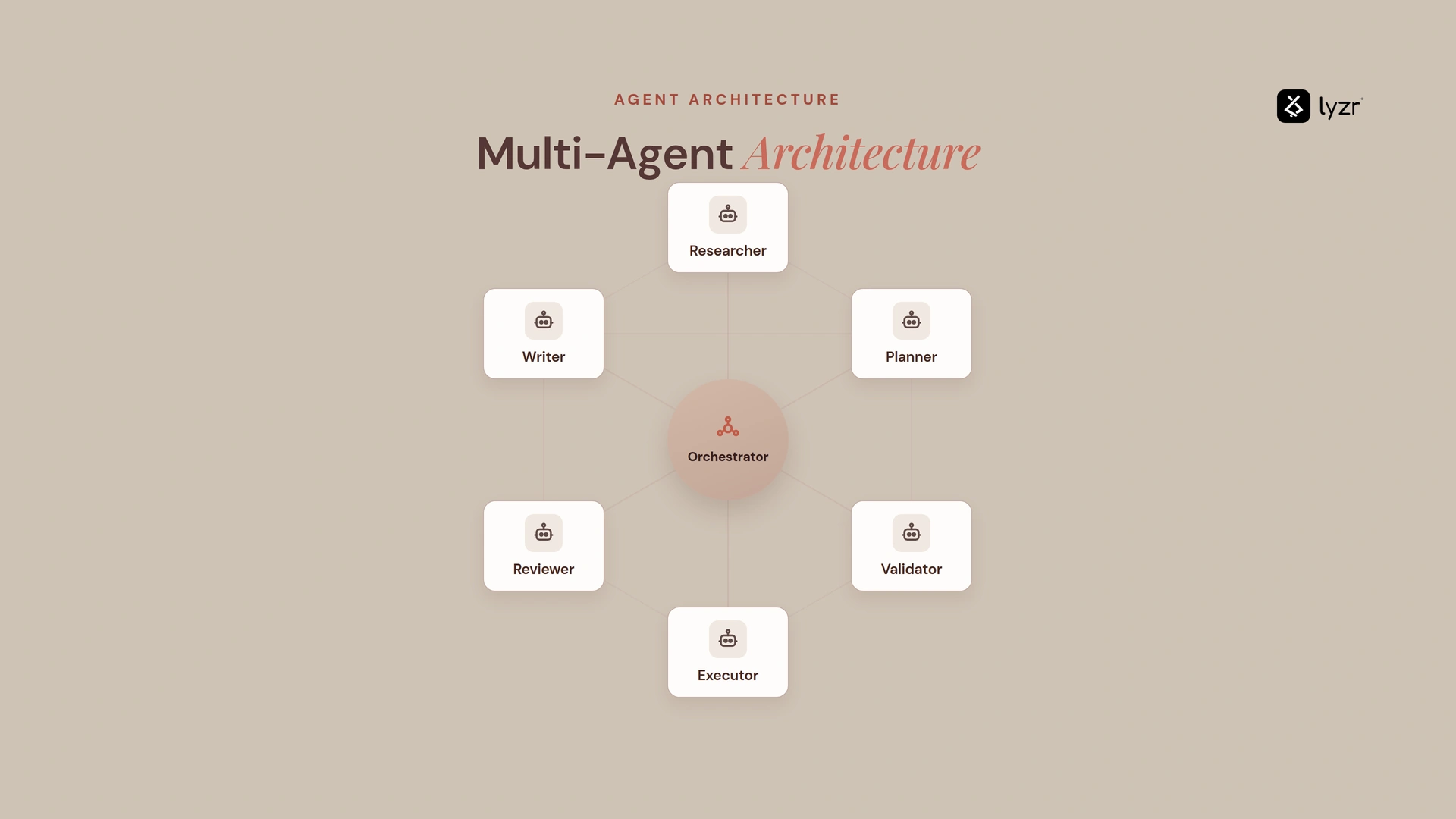
A multi-agent architecture coordinates specialized AI agents, each with a defined role, tool set, and scope, through an orchestration layer that routes tasks between them using patterns like sequential, hierarchical, or orchestrator-worker execution. It exists because no single model, however capable, holds enough context or focus to reliably plan, execute, and verify a complex workflow end to end.
That coordination layer is also where most builds quietly fail. A well-designed Orchestration as a Service layer is the difference between a system that demos cleanly and one that survives contact with real traffic, real errors, and real cost pressure. This guide covers the components, the orchestration patterns the 2026 ecosystem has converged on, and the production realities that decide whether any of it ships.
What is multi-agent architecture?
Multi-agent architecture is the structural pattern of dividing a complex task among multiple specialized agents that communicate through a coordination layer, rather than asking one model to hold the entire problem in its context window. The distinction matters more than it sounds, because three very different architectures get called “agentic” in vendor marketing.
A single AI agent operates independently, handling one class of task end to end. A common version is a Retrieval-Augmented Generation (RAG) system, where one LLM answers questions grounded in a connected knowledge base. This works well for narrow, well-scoped work.
A single agent with tools extends that model with function calling, letting it query a calculator, hit an API, or run a search. The reasoning still lives in one place, the agent just has more hands. Where this breaks is tool sprawl: past a certain number of available tools, one model reliably picks the wrong one or none at all.
A multi-agent system goes further, distributing not just tools but reasoning itself. One agent drafts, another verifies, a third formats, and an orchestrator decides what happens next.
According to Microsoft’s Azure Architecture Center, “these systems often exceed the abilities of a single agent that has access to many tools and knowledge sources, so multiagent orchestrations handle complex, collaborative tasks reliably instead.”
When do you need a multi-agent system (and when you don’t)
You need a multi-agent system when a single agent, even one loaded with tools, consistently fails on tool selection, context capacity, or multi-step reasoning. You don’t need one for most tasks, and starting there anyway is the single most common architecture mistake teams make in 2026.
Microsoft’s own guidance is blunt on this point: “use the lowest level of complexity that reliably meets your requirements.”
Before you adopt a multiagent orchestration pattern, you should evaluate whether your scenario requires one, since each level of complexity introduces coordination overhead, latency, and cost.
Three concrete signals justify the jump from a single agent to a multi-agent system:
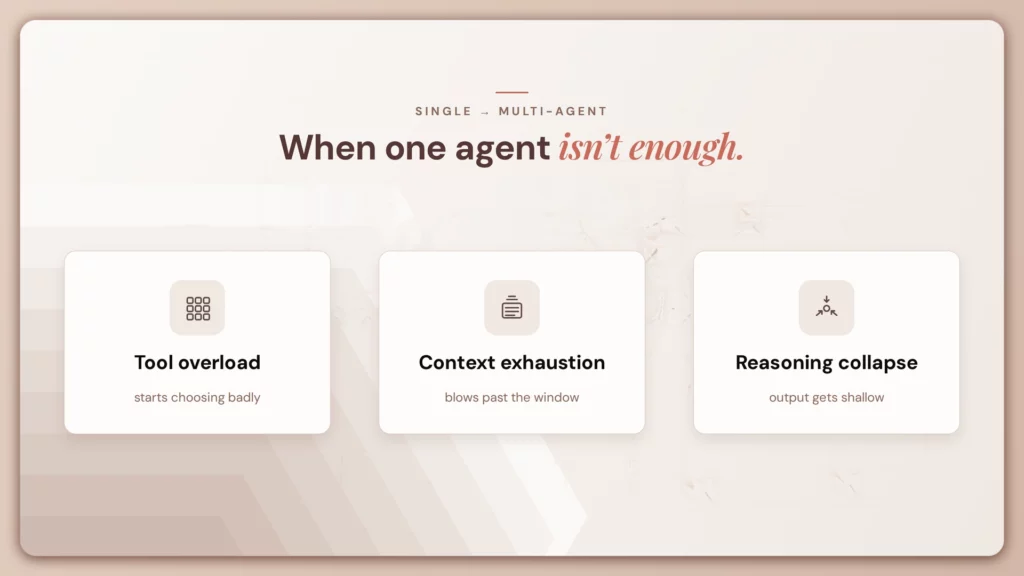
- Tool overload: an agent juggling dozens of tools starts choosing badly.
- Context exhaustion: a task that requires accumulating research, drafts, and citations will blow past a single context window before it finishes.
- Reasoning collapse: asking one model to plan, execute, and self-critique in the same pass produces shallower output than splitting those functions across agents.
If you’re not hitting one of these walls, the honest move is to stay single-agent longer than instinct suggests. For a deeper breakdown of the tradeoffs, see our single-agent vs. multi-agent comparison.
Some vendors frame this shift as inevitable rather than situational. Aura Ventures has described coordinated agent fleets as the next stage of AI evolution, where interconnected agents outperform isolated ones on efficiency and decision quality. That’s true for the right workload. It’s also exactly the framing that leads teams to add agents before they’ve exhausted a simpler design.
Core components of a multi-agent system
A production-grade multi-agent architecture has five components, and skipping any one of them is where “it worked on my laptop” systems come from. Picture them as a stack: agents at the top doing the reasoning, a coordination layer in the middle routing work, protocols connecting everything, memory holding state, and tools reaching out to the world.
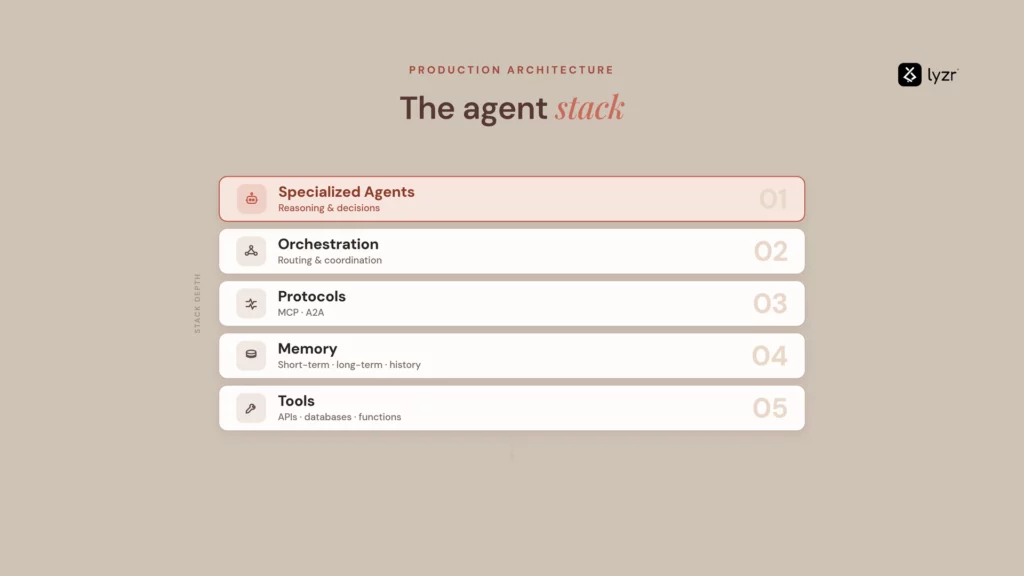
Specialized agents
Each agent is scoped to a narrow role, a research agent, a compliance checker, a writer, with its own prompt, tools, and success criteria. These are built on the same machine learning and natural language processing foundations as any LLM agent, but narrower scope is what makes them reliable rather than clever.
Orchestration and coordination
This layer decides execution order, aggregates results, and handles failure. It is the part most teams underbuild.
Multi-agent systems require workflows to implement orchestration patterns, because manual chaining of agents creates brittle connections that fail unpredictably.
Communication protocols
Two standards now dominate how agents talk to tools and to each other.
MCP (Model Context Protocol) is a vertical protocol that connects an AI model to external tools, data sources, and APIs, while A2A (Agent2Agent) is a horizontal protocol that lets one AI agent communicate with and delegate tasks to another.
Production multi-agent systems typically use MCP for data access and A2A for coordination, rather than choosing one over the other.
Memory and shared state
Agents need short-term working memory, long-term retrieval, and a record of what already happened. Confluent’s architecture guidance treats this as non-negotiable at scale.
To prevent inconsistent decisions, agents rely on a shared state and context layer rather than private memory, with all state updates flowing through events and reflected in that shared layer before downstream agents act, so no agent owns state privately.
Redis takes a similar position from the infrastructure side.
Streams and pub/sub messaging support real-time agent coordination without requiring separate message brokers, handling the shared memory and event-driven patterns essential for multi-agent workflows.
Tools
The actual APIs, databases, and functions agents call to act on the world. This is also where an agent framework choice, LangGraph, CrewAI, AutoGen, or a managed platform, determines how much glue code you write versus configure.
Orchestration patterns: the part that actually decides your architecture
Orchestration patterns are the rules governing how agents hand work to each other, and picking the wrong one for your workload is a more common failure point than picking the wrong model. Six patterns cover nearly every production system built in 2026.
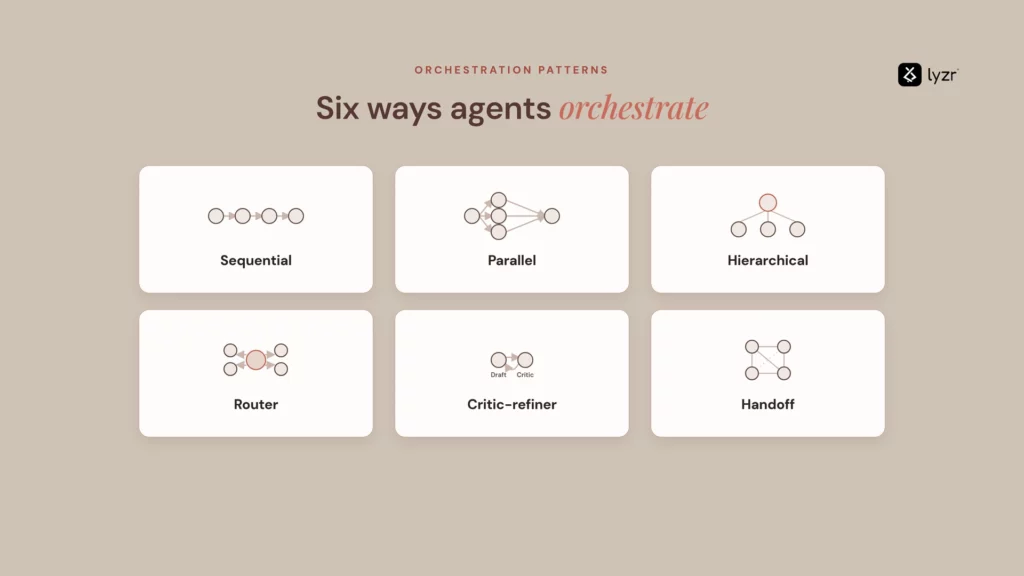
Sequential (pipeline)
Agents execute in a fixed, deterministic chain, each consuming the previous agent’s output.
Use it for multistage processes with clear linear dependencies and predictable workflow progression, especially data transformation pipelines where each stage adds value the next depends on.
The tradeoff: latency grows linearly with agent count, and error propagation is unidirectional, so upstream errors compound downstream.
Parallel (concurrent)
Independent agents work the same input simultaneously and results get merged.
Use it when stages are embarrassingly parallel and you can run them without compromising quality or creating shared state contention.
Avoid it when early-stage failures would silently corrupt downstream aggregation.
Hierarchical (orchestrator-worker)
A supervisor agent decomposes a goal into subtasks and dispatches them to worker agents, then aggregates.
This pattern features a central orchestrator agent responsible for delegating tasks to a pool of worker agents and overseeing their execution, introducing centralized control for task decomposition and coordination.
It’s the default choice for open-ended goals where the steps aren’t known in advance.
Router
A lightweight agent classifies the incoming request and forwards it to the one specialist equipped to handle it, without every agent seeing every request. Use it for high-volume, low-ambiguity intake, like support ticket triage.
Critic-refiner
One agent produces a draft, a second agent evaluates it against criteria, and the loop repeats until the output passes. This costs extra tokens per cycle but meaningfully raises accuracy on tasks where correctness matters more than speed, like compliance review.
Handoff and group chat
Agents converse with each other directly rather than through a strict hierarchy, passing control based on who’s best positioned to act next.
Microsoft names this alongside sequential and concurrent as one of the fundamental orchestration patterns for AI agent architectures.
It fits open-ended collaboration where the next best actor isn’t known upfront.
Real-world examples, mapped to pattern
Intelligent document processing runs on the sequential pattern
A benchmarking study on financial document processing describes it directly.
The sequential pipeline processes documents through a fixed chain of agents, where each agent receives the full context accumulated by prior agents, moving from parsing to extraction to validation to summarization.
In a fielded example, Xenoss reports that a multi-agent invoice reconciliation system built on this kind of pipeline shows a meaningful jump from the traditional OCR baseline, which the same source measured at only 64% accuracy across 200 annotated pages.
Automates over 80% of reconciliation tasks, reducing finance workload by 70% and improving processing speed by 60%.
Market and research intelligence runs on orchestrator-worker
Anthropic’s own multi-agent research system uses a lead agent that decomposes a query and dispatches subagents with separate context windows to investigate in parallel.
That architecture, with Claude Opus 4 as lead and Claude Sonnet 4 subagents, outperformed a single-agent baseline by 90.2% on internal research evaluations, because distributing work across agents with separate context windows enabled parallel reasoning a single agent couldn’t achieve.
The catch is cost. Anthropic’s own engineering team found something worth sitting with before you commit to this pattern.
Multi-agent systems work mainly by spending enough tokens to solve the problem, with token usage alone explaining 80% of performance variance.
The hard part: multi-agent in production
Production is where multi-agent systems stop being an engineering exercise and start being an operations problem. Five failure modes show up repeatedly, and none of them appear in a demo.
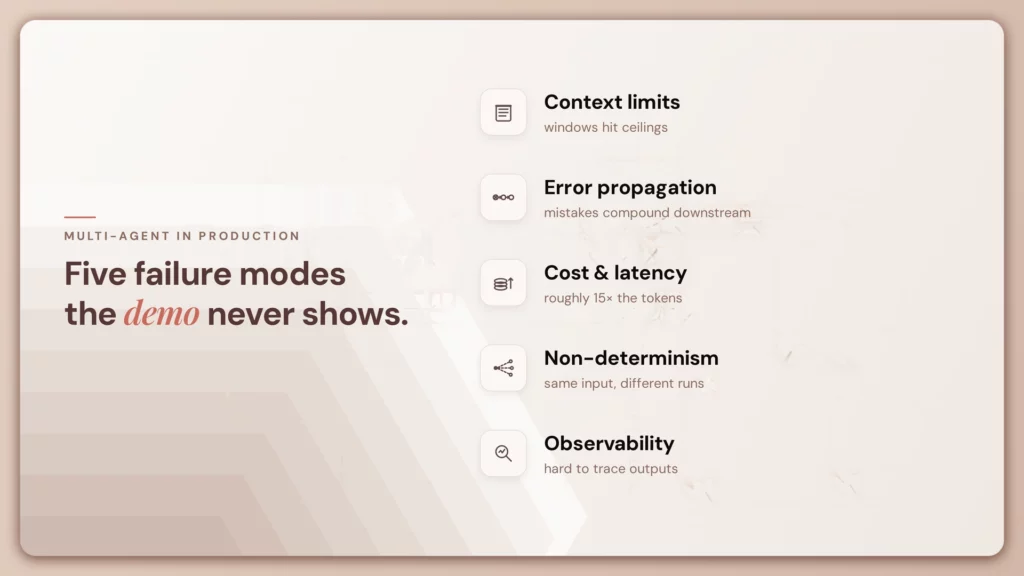
Context limits. Orchestrators accumulate context from every worker they manage, and that accumulation is bounded. A hierarchical system with four or more active workers routinely runs into window ceilings that a two-agent pipeline never touches.
Error propagation. In sequential and hierarchical designs, an early mistake doesn’t stay contained.
Error propagation is unidirectional: upstream errors compound downstream, so a single bad extraction can quietly corrupt every stage after it.
Cost and latency. Multi-agent systems multiply model calls, and the multiplication compounds fast at scale.
Multi-agent systems burned roughly 15x the tokens of a chat interaction.
Anthropic’s team was candid about the implication: “for economic viability, multi-agent systems require tasks where the value of the task is high enough to pay for the increased performance.” Not every workflow clears that bar.
Non-determinism. The same input can produce different agent decisions run to run, especially in handoff and group-chat patterns without strict state control.
Deterministic replay is the foundation for incident investigation, regulatory audit, model validation, and safe agent updates.
Observability and debugging. Once agents hand off work across a coordination layer, tracing why a specific output happened becomes genuinely hard without instrumentation built in from the start.
Moving beyond experimentation, this level of coordination often depends on scalable AI transformation expertise that aligns multi-agent intelligence with secure data systems and operational discipline, not just a working prototype.
From architecture to production with Lyzr
Lyzr’s answer to that production gap is built around governance and orchestration as first-class infrastructure, not an afterthought bolted onto a working demo. Orchestration as a Service handles both static, developer-defined workflows and dynamic manager agents that decompose a goal into subtasks at runtime, the same orchestrator-worker pattern described above, without requiring a rebuild every time a workflow changes.
The Control Plane is where multi-agent systems actually survive contact with production. It gives teams versioned deployments, rollback to an exact previous state, and “a unified layer for orchestration, monitoring, and governance built for enterprise-grade reliability.”
Agents built with LangGraph, CrewAI, Strands, Lyzr SDK, or custom code all follow the same deployment pipeline.
Which means adopting Lyzr’s governance layer doesn’t mean abandoning whatever an agent architect already built.
Manager agents in Lyzr Studio handle the orchestrator-worker pattern natively: a manager agent decomposes a broad goal, delegates subtasks to specialist agents, and reassembles the output, with Responsible AI checks and audit logging running underneath every handoff rather than layered on after the fact. That framework-agnostic governance is the actual answer to the pilot-to-production gap. The problem was rarely the agents. It was the absence of a control layer built to catch what happens when they fail.
Related reading
A few resources worth bookmarking if you’re weighing frameworks or evaluating where multi-agent fits your stack:
- Our broader breakdown of multi-agent systems and the frameworks that implement them
- A primer on what AI agents actually are, for teams still scoping the basics
- How banking teams are deploying agent workflows in regulated environments
- What it takes to build autonomous agents from scratch versus configuring them on a platform
- An overview of Lyzr’s platform, reviewed by builders on G2 and featured on There’s An AI For That
Frequently asked questions
What is multi-agent architecture?
Multi-agent architecture is a system design where multiple specialized AI agents, each with defined roles and tools, are coordinated by an orchestration layer using patterns like sequential, hierarchical, or router execution. It exists because complex workflows exceed what one agent can reliably plan and execute in a single context window.
What are the core components of a multi-agent system?
The five core components are specialized agents, an orchestration and coordination layer, communication protocols like MCP and A2A, shared memory and state, and the external tools agents call. Each layer solves a distinct failure mode, from tool overload to inconsistent state across agents.
What are the main types of orchestration patterns?
The main patterns are sequential (pipeline), parallel (concurrent), hierarchical or orchestrator-worker, router, critic-refiner, and handoff or group chat. Each fits a different task shape, linear pipelines suit document processing, while orchestrator-worker suits open-ended research and planning goals.
Should I use a single agent or a multi-agent system?
Start with a single agent, optionally with tools, and only move to multi-agent when you hit tool selection failures, context window limits, or reasoning breakdowns on multi-step tasks. Most workloads never need multiple agents, and adding them early increases cost and failure surfaces without a clear return.
What is the orchestrator-worker pattern?
The orchestrator-worker pattern uses a central orchestrator agent to decompose a goal into subtasks, delegate them to specialized worker agents, and aggregate their results into a final output. It’s the standard choice for hierarchical multi-agent systems handling open-ended or research-style goals.
When do you actually need a multi-agent system?
You need one when a single agent consistently fails on tool overload, context exhaustion, or degraded reasoning across multi-step tasks, not simply because a task feels complex. If a single agent with tools still succeeds reliably, adding agents only adds coordination overhead.
How do you run a multi-agent system in production?
Running multi-agent systems in production requires observability into every handoff, deterministic state management, cost controls on token usage, and a governance layer that works across agent frameworks. Without that layer, teams hit the same wall that stalls most pilots: agents that work individually but can’t be trusted, audited, or debugged together.
Where this leaves you
Multi-agent architecture is not a shortcut around hard problems, it’s a way of structuring them so specialization, coordination, and failure handling are explicit instead of accidental. If your team is past the point where a single agent can hold the whole problem, book a demo and see what an orchestration layer built for production actually looks like.
Book A Demo: Click Here
Join our Slack: Click Here
Link to our GitHub: Click Here