Banking automation is the use of software and AI, from rule-based bots to autonomous agents, to run banking processes across the front, middle, and back office. It spans robotic process automation, intelligent document processing, intelligent automation, and agentic systems that reason, decide, and orchestrate entire workflows without constant human input.
Most banks already run some version of this stack. Few run all four levels well, and fewer still have moved past rule-based bots into the territory where the real efficiency gains sit: autonomous banking agents that handle exceptions instead of choking on them.
This guide walks through what banking automation means in 2026, why the pressure to adopt it keeps rising, and how to think about the jump from brittle scripts to agents that actually own a process.
Quick summary
- Banking automation sits on a spectrum: RPA, intelligent document processing (IDP), intelligent automation, and agentic automation, each layer adding a capability the last one lacked.
- Compliance cost, fraud losses, and customer expectations are forcing banks past pilot-stage automation in 2026.
- Rule-based bots break on exceptions, unstructured documents, and legacy UI changes. Agentic automation is built to survive exactly those conditions.
- Lyzr Studio and prebuilt banking blueprints let banks deploy KYC, loan origination, and regulatory monitoring agents without a multi-year build.
What is banking automation?
Banking automation is the application of technology, ranging from simple scripted bots to reasoning AI agents, to execute banking tasks that once required a person at a keyboard. The definition matters because the term gets used loosely to describe everything from a single macro to a fully autonomous loan desk, and those two things behave nothing alike.
The honest way to think about it is as a spectrum, not a category. On one end sit rule-based bots that follow a fixed script and fail the moment reality deviates from it. On the other end sit autonomous agents that can read an unfamiliar document, decide what it means, and route the exception without waiting for a developer to patch the code. Robotic process automation, intelligent document processing, and intelligent automation occupy the middle, each adding a layer of judgment the previous one lacked. Enterprise automation in banking has always meant something different depending on where on that spectrum a bank actually operates.
Why banks are automating now
Banks are automating now because manual processes have become too expensive, too slow, and too easy to get wrong at a time when regulators, fraudsters, and customers are all moving faster. The math no longer favors adding headcount to keep pace with volume.
Compliance is the sharpest edge of this. 42% of banks, credit unions and other lenders still “often” rely on manual processes for regulatory compliance, according to Wolters Kluwer’s latest Regulatory and Risk Management Indicator survey, with another 31% doing so “sometimes”, a combined majority still running compliance by hand. That gap is not free: shifting to systems-based risk and compliance processes could generate $25 to $50 billion in annual savings from risk and compliance operating expenditures, according to a joint Nasdaq and Boston Consulting Group study.
Front-office pressure compounds it. Retail banks could unlock more than $370 billion annually in additional profits by 2030 through large-scale deployment of artificial intelligence, according to BCG’s November 2025 analysis, and autonomous systems already running compliance, customer service, and risk workflows have improved collections performance while reducing costs by 30% to 40%. That means the banks that wait are competing against peers whose cost-to-serve is already dropping. Add legacy core systems that were never built to talk to each other, and manual workflow automation starts to look less like a productivity project and more like a survival requirement.
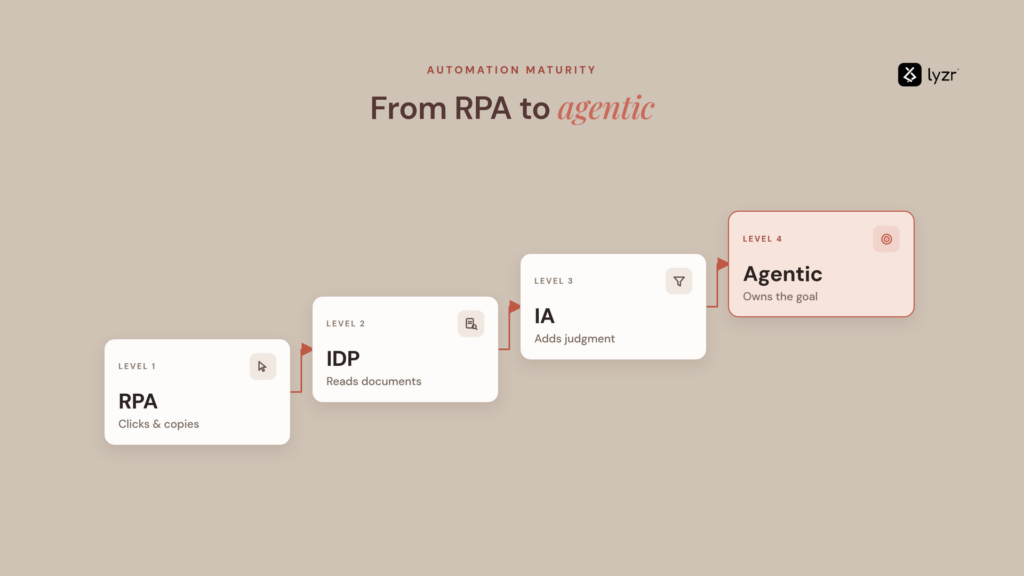
The four levels of banking automation
Banking automation matures in four distinct stages, and each one solves a problem the previous stage couldn’t touch. Skipping a stage usually means inheriting its blind spots.
Level 1: Robotic process automation (RPA)
RPA bots mimic a person clicking through a screen: log in, copy a field, paste it elsewhere, log out. They’re fast to deploy and cheap to run for high-volume, unchanging tasks like moving transaction data into a reconciliation sheet. The catch is fragility. Change the UI of the source system and the bot breaks until someone rewrites it.
Level 2: Intelligent document processing (IDP)
IDP adds the ability to read. Using optical character recognition and natural language processing, it extracts structured data from IDs, statements, and PDFs, feeding it to downstream bots or systems. It’s a step up, but most IDP tools are template-based and stumble on documents that don’t match the pattern they were trained on.
Level 3: Intelligent automation (IA)
IA layers machine learning (ML, systems that improve at a task from data rather than fixed rules) on top of RPA and IDP, letting the process make small decisions: routing an exception, flagging an anomaly, prioritizing a queue. It’s automation with a bit of judgment, but that judgment is usually confined to a single step, not the whole workflow.
Level 4: Agentic automation
This is where the process stops being a chain of scripted steps and becomes a goal an AI agent is responsible for achieving. Give it an objective, “onboard this customer in line with Reg CC,” and it plans the sequence, calls the right systems, handles what it encounters, and escalates only what genuinely needs a human. Each level built the pieces; agentic automation is the first one that can assemble them on its own.
Banking automation use cases, function by function
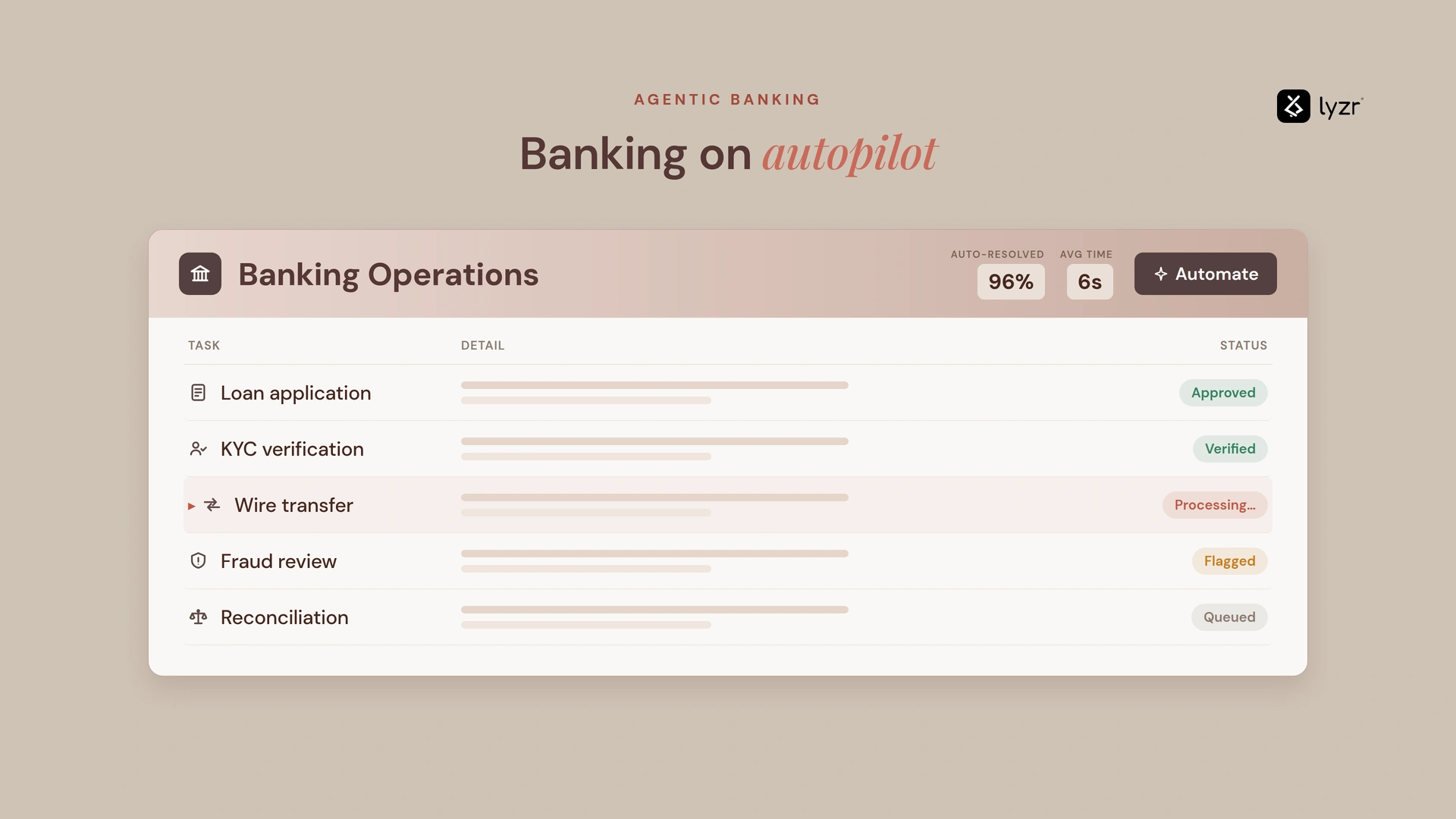
Customer service and onboarding. An agent verifies an ID against a scanned document, cross-checks it against a sanctions list, and opens the account, cutting onboarding from days to minutes. Voice channels increasingly route through an AI answering service that authenticates a caller before a human joins, while a text messaging service pushes real-time fraud alerts and payment reminders. Lyzr’s Banking Customer Service Agent and Teller Assistant Agent handle exactly this mix of live interaction and back-end verification.
KYC and AML. An agent collects identity documents, screens against watchlists, scores risk, and builds an audit-ready file, only surfacing the case to a compliance analyst when the risk score crosses a threshold. Ongoing monitoring runs continuously instead of at scheduled review intervals.
Loan origination and servicing. An agent extracts income data from financial statements, pulls a credit report, runs it through a risk model, and produces a package for underwriter sign-off. This applies across the credit spectrum, including scenarios where applicants are comparing bad credit loan options in Australia and need a same-day answer. Faster loan approval directly affects conversion, since delay is often the reason an applicant walks. On the servicing side, debt collection software manages payment follow-ups while agents handle payoff requests and escrow analysis.
Reconciliation. Instead of an accounting team manually matching ledger entries against nostro accounts and statements, an agent ingests every source continuously, applies matching rules, and flags true exceptions. Most reconciliation programs still lean on a reliable accounting automation platform to keep transaction records and balances consistent before an agent layer sits on top.
Regulatory reporting. An agent aggregates data across systems, validates it against reporting schemas, and prepares submissions for requirements like Basel III/IV, maintaining a clear lineage from source data to final filing. A data integration solution usually sits underneath this, since the hardest part of reporting is rarely the math, it’s getting clean data out of five different systems. Lyzr’s Regulatory Monitoring Agent is built specifically for this kind of continuous compliance tracking.
Fraud detection. Machine learning models analyze transaction streams in real time, catching patterns that a fixed rule set would miss entirely. A strong underlying security.ai posture matters here too, since the systems doing the detecting are themselves a target.
What banking automation actually delivers
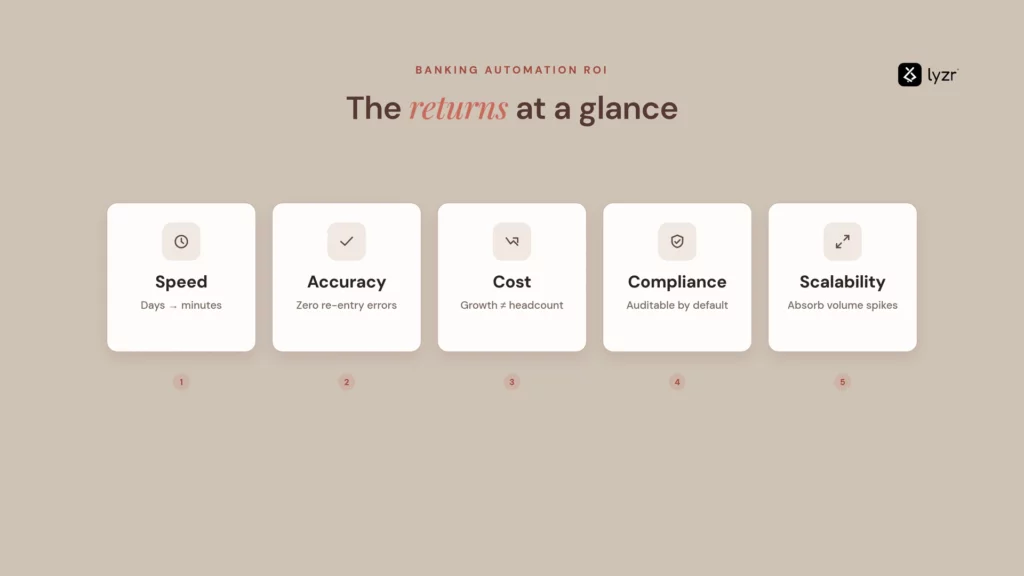
The return on banking automation shows up as speed, accuracy, cost, compliance, and headroom to grow, in that rough order of visibility to leadership.
- Speed: processes that took days, like onboarding or loan pre-approval, drop to minutes.
- Accuracy: removing manual re-entry removes the copy-paste errors that come with it.
- Cost: high-volume, repetitive work no longer scales linearly with headcount.
- Compliance: every automated action leaves a consistent, auditable trail, which regulators increasingly expect to see by default.
- Scalability: volume spikes get absorbed without a hiring cycle, and the same infrastructure that runs operations can support digital banking experiences from providers like Meniga or personalized marketing without a parallel build.
Where rule-based automation breaks down
Rule-based automation breaks wherever reality stops matching the script it was given. That single sentence explains most failed RPA programs.
- Exceptions: a bot with no instructions for an unfamiliar case simply stops, dumping the work back onto a human queue.
- Unstructured inputs: a bot can’t interpret a free-text email or a non-standard contract clause, only fields it was explicitly trained to find.
- Brittle integrations: bots that screen-scrape a legacy UI break the moment that interface is updated, and banks running hundreds of bots absorb this as a constant maintenance tax.
- Maintenance overhead: an “army of bots” needs a standing team just to keep it from breaking, which quietly erodes the ROI the program was built on.
- Compliance as an afterthought: when a rule changes, every bot touching that rule needs manual reprogramming, so compliance gets patched in after the fact instead of built in from the start.
These aren’t edge cases. They’re the default behavior of any system built on fixed scripts, which is exactly the gap agentic automation was built to close.
Agentic automation: the next stage
Agentic automation replaces the instruction “follow these exact steps” with the instruction “achieve this outcome,” and that shift is what lets it survive the conditions that break RPA. Where a bot halts on an exception, an agent reasons about it, tries an alternative path, or escalates with a clear explanation instead of a silent failure.
That reasoning is visible, not a black box. Every decision produces a trace explaining why the agent acted, which matters enormously in a regulated environment where “the model said so” is not an acceptable answer to an examiner. Deployed inside a VPC with data residency controls, that trace becomes the audit record compliance teams already need, generated automatically instead of reconstructed after the fact.
Agents also adapt in a way scripts can’t. They interact through APIs rather than screen scraping, so a UI change doesn’t take them down, and they can be built to track regulatory updates and adjust behavior instead of waiting for a developer to patch every affected process. Combined with human-in-the-loop checkpoints on the decisions that warrant one, this is what lets a single agent orchestrate an entire agentic workflow, like full KYC review, instead of stitching together a dozen fragile bots to approximate it. For a deeper look at what this shift looks like in production, see AI agents in banking 2026: from chatbot theater to autonomous operations and how agentic automation differs from the RPA model it’s replacing.
How Lyzr helps banks move up the spectrum
Lyzr builds the platform banks use to move from brittle bots to governed, autonomous agents without starting from a blank canvas. Lyzr Studio lets operations and compliance teams design, test, and deploy agents using prebuilt banking blueprints, including KYC, loan origination, loan servicing, regulatory monitoring, and onboarding, so a bank is configuring a proven workflow rather than building one from scratch.
Responsible AI is built into the platform, not bolted on: hallucination control, human-in-the-loop checkpoints, and complete audit trails come standard, which matters when every agent decision needs to hold up to an examiner. Agents connect to existing core banking systems through APIs, so deployment doesn’t require ripping out infrastructure that already works.
Above the individual agents sits Amadeo, Lyzr’s agentic OS for banking, which coordinates agents across functions so KYC, lending, and reporting operate as one governed system instead of isolated pilots. Have a workflow that doesn’t fit the standard blueprints? Come speak to us.
Frequently asked questions
What is banking automation?
Banking automation is the use of technology, from rule-based bots to autonomous AI agents, to run tasks and processes across a bank’s front, middle, and back office. It covers everything from simple data entry bots to agents that manage an entire regulated workflow, with the goal of cutting manual work while improving speed, accuracy, and compliance.
What is an example of automation in banking?
A clear example is automating know-your-customer (KYC) onboarding. An agent receives a new customer’s documents, extracts and verifies the data, screens it against sanctions and watchlists, scores the risk, and produces a complete audit file, only involving a human analyst when the case genuinely requires judgment.
What is RPA in banking?
Robotic process automation (RPA) in banking uses software bots that mimic a person’s clicks and keystrokes to perform repetitive, rule-based tasks, such as copying data from a report into a spreadsheet. It works well for stable, high-volume, structured work but breaks when the task deviates from its script.
What is the difference between RPA and intelligent automation?
RPA follows a fixed set of rules and cannot deviate from them. Intelligent automation combines RPA with AI and machine learning, allowing the system to process unstructured data, make small contextual decisions, and adapt within a process, rather than just executing an identical sequence of steps every time.
How is AI used in banking automation?
AI extends banking automation past simple rule-following. It powers document understanding for reading unstructured files, machine learning models for fraud detection, and reasoning engines behind autonomous agents that can plan and execute an entire workflow, like loan origination, rather than completing a single scripted step.
What are the benefits of automation in banking?
The core benefits are speed, accuracy, and lower operating cost, since automated processes run in minutes instead of days and remove manual re-entry errors. Automation also strengthens compliance through consistent, auditable execution and gives banks the scalability to absorb volume growth without a proportional rise in headcount.
What is the future of banking automation?
The future is agentic automation, replacing large fleets of brittle bots with smaller teams of autonomous agents that own entire business functions. Banks are redesigning entire value chains, onboarding to servicing, underwriting to collections, AML to reporting, using agentic automation that can reason, orchestrate, and act across systems, rather than assist at the margins.
The spectrum keeps moving. Where does your bank sit?
Banking automation isn’t a single tool decision anymore, it’s a position on a spectrum that runs from scripted bots to autonomous agents, and every quarter spent at the bottom is a quarter of avoidable cost and exception backlog. Book a demo to see where Lyzr’s banking agents can move your institution next.
Book A Demo: Click Here
Join our Slack: Click Here
Link to our GitHub: Click Here