TL;DR
- Enterprise AI governance is the policies, roles, processes, and technical controls that manage AI across its full lifecycle, from inventory through runtime monitoring of autonomous agents.
- Governance is distinct from security, ethics, and responsible AI. Each is necessary; none alone is sufficient.
- Six pillars anchor a working framework: policy, risk classification, oversight, data governance, lifecycle monitoring, and security.
- Model-centric governance evaluates a system once before launch. Agentic AI acts continuously, which means governance now has to run in real time, not just at deployment.
- A phased 60 to 90 day roadmap gets most enterprises from zero to an operational framework, mapped to standards like the EU AI Act, NIST AI RMF, and ISO/IEC 42001.
Every enterprise running AI in production has already had the conversation. Someone in legal asks who approved a customer-facing chatbot.
Someone in risk asks what data a procurement agent can touch. Someone on the board asks what happens if one of these systems makes a decision nobody can explain.
Enterprise AI governance is the answer to all three questions at once. It’s the system of policies, roles, processes, and technical controls that manage AI across its full lifecycle: inventory, risk classification, cross-functional ownership, monitoring, and, increasingly, runtime control of autonomous agents.
Get it wrong, and every one of those questions turns into a legal exposure. Get it right, and it becomes the reason your AI programs clear audit instead of stalling in it.
This guide builds that framework from the ground up, then goes somewhere most governance content stops short: the runtime control layer that autonomous agents actually require. Governance built for a static model that gets reviewed once doesn’t hold up against an agent making thousands of decisions an hour. That gap is where this guide, and Lyzr’s approach to responsible AI, starts to differ from the rest of the field.
What is enterprise AI governance?
Enterprise AI governance is the structured system of policies, roles, and technical controls an organization uses to manage how AI is built, approved, deployed, monitored, and retired. It’s the operating model that turns “we use AI” into “we can prove exactly how, where, and under what rules.”
That definition sounds close to three other terms leaders use interchangeably. They aren’t the same thing, and conflating them is where most programs get stuck.
Governance vs. security. AI security protects models and data from being attacked, stolen, or manipulated, think adversarial inputs, model theft, prompt injection. Governance is the larger structure that security sits inside. Security answers “can someone break this system.” Governance answers “should this system exist, who owns it, and what happens when it fails.”
Governance vs. ethics. AI ethics are the principles, fairness, transparency, non-maleficence, that guide what “good” AI looks like. Ethics gives you the values. Governance gives you the enforcement mechanism: the committee that reviews a biased model, the policy that blocks a prohibited use case, the audit trail that proves a decision was fair.
Governance vs. responsible AI. Responsible AI is the outcome an organization is trying to achieve, AI that’s safe, explainable, and trustworthy at scale. Governance is the machinery that gets you there and lets you prove it. You cannot credibly claim responsible AI without a governance structure standing behind it.
Why it matters now
Governance matters now because the gap between AI adoption and AI oversight has become the primary source of enterprise AI risk. Enterprises are deploying AI faster than they’re building the structures to control it, and that gap is where financial, legal, and reputational exposure accumulates.
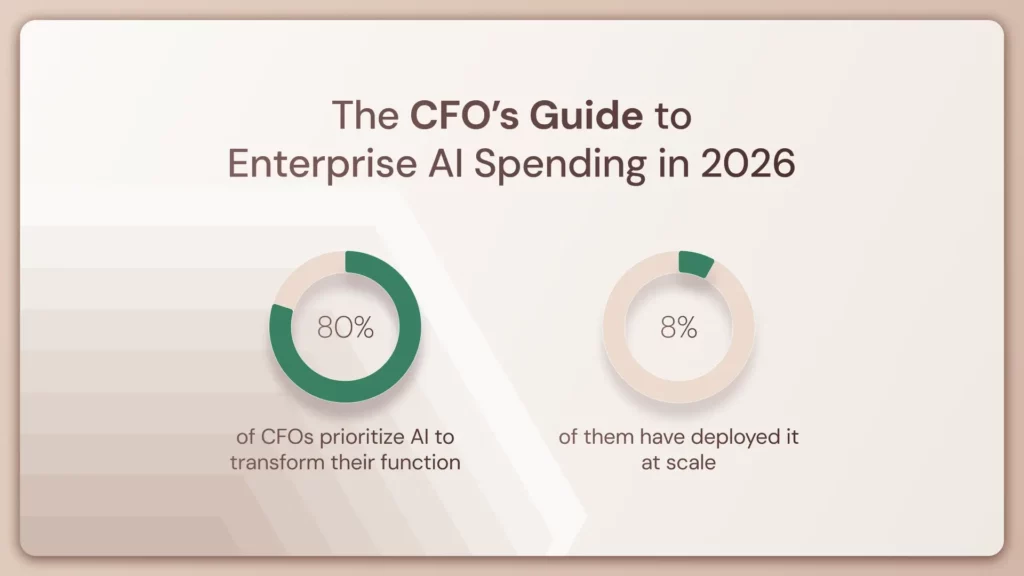
The adoption curve backs this up.
Scale is no longer the bottleneck. Oversight is. McKinsey’s 2026 AI trust research found that organizations with explicitly assigned AI governance roles average a maturity score of 2.6, compared to just 1.8 for organizations without clear ownership. That gap between 2.6 and 1.8 isn’t abstract, it shows up as fewer failed deployments and faster time from pilot to production.
The legal system has already made the stakes concrete. In 2024, a Canadian tribunal ruled on a case that every enterprise deploying customer-facing AI should know by name. Air Canada’s website chatbot told a grieving customer he could apply for a bereavement fare retroactively. He booked full-price tickets based on that answer.
The airline’s actual policy prohibited retroactive claims, and Air Canada refused to honor the fare, arguing the chatbot was “one of its ‘agents, servants or representatives'” and therefore not something the company could be held liable for.
The tribunal rejected that argument outright, finding “Air Canada did not take reasonable care to ensure its chatbot was accurate.” The adjudicator went further, noting the airline never explained “why the webpage titled ‘Bereavement travel’ was inherently more trustworthy than its chatbot.”
The dollar amount was small. The precedent wasn’t: an organization owns every output its AI produces, whether a human reviewed it or not. That’s the exact liability governance exists to close.
None of this makes governance a brake on AI deployment. It’s the opposite. A documented, auditable framework is what lets a legal team say yes to a new use case in weeks instead of quarters, because the risk questions are already answered before the request lands on their desk.
Ungoverned AI doesn’t move faster, it just moves until it hits an audit, a regulator, or a tribunal, and then it stops entirely.
The core pillars of an AI governance framework
A working framework rests on six pillars that operate together, not as a checklist to complete once but as a system that runs continuously across the AI lifecycle. The diagram below, our Enterprise AI Governance Framework, maps how these pillars connect from policy at the top down to the technical controls that enforce it in production.
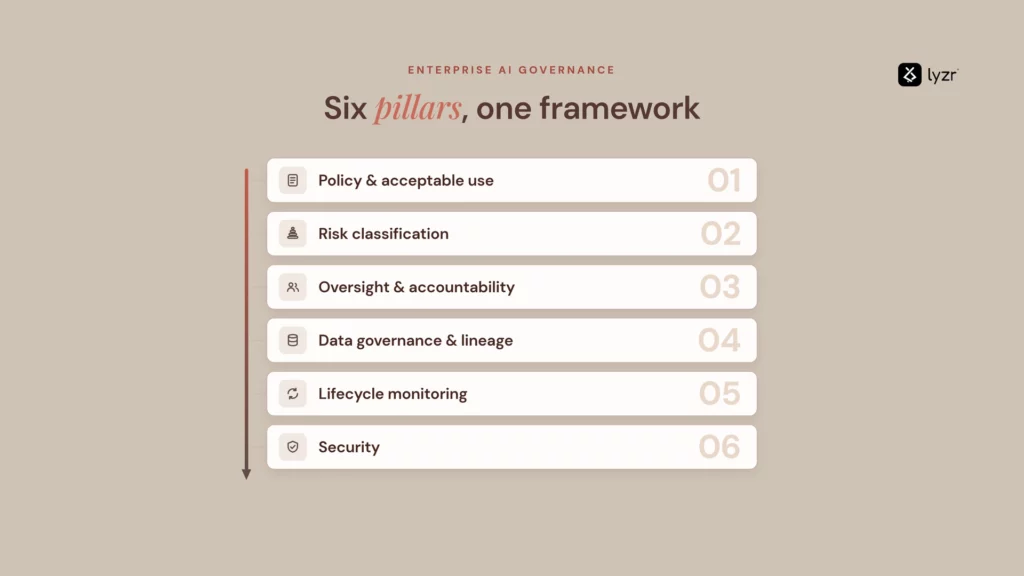
1. Policy and acceptable use. This is the written constitution for AI in your organization. It defines what’s permitted, what requires approval, and what’s banned outright, covering everything from which LLMs employees can use to whether AI can make final decisions in hiring or credit. Without this document, every team invents its own rules, and shadow AI fills the vacuum.
2. Risk classification and triage. Not every AI use case carries the same weight, so treating them identically wastes review cycles on low-risk tools and under-scrutinizes the dangerous ones. A four-tier model works well in practice:
- Unacceptable risk: banned outright, such as social scoring or covert manipulation.
- High risk: systems influencing hiring, credit, healthcare, or legal outcomes, requiring committee review before launch.
- Medium risk: internal automation and analytics with moderate business impact.
- Low risk: tools like internal search or spam filtering, reviewed on a lighter cadence.
3. Oversight and accountability. Someone has to own each AI system by name, not by department. This pillar establishes a cross-functional governance committee, typically legal, risk, compliance, IT, and the business unit deploying the tool, with clear decision rights over what gets approved, paused, or shut down. A RACI matrix (Responsible, Accountable, Consulted, Informed) turns that structure from a slide into an operating habit.
4. Data governance and lineage. AI is only as trustworthy as the data feeding it. This pillar extends beyond training data quality into full lineage tracking: where the data came from, how it was transformed, and whether its use complies with privacy law. When an auditor asks why a model produced a specific output, lineage is what lets you answer.
5. Lifecycle monitoring and change management. A model approved in January can drift by June. This pillar mandates continuous monitoring for performance degradation, bias creep, and data drift in production, plus a formal change process before any retrain or update ships. This is also where usage visibility earns its keep. Without it, teams lose track of who’s running what, which is exactly the blind spot that turns into a compliance gap months later.
6. Security. AI-specific threats, prompt injection, model inversion, data poisoning, sit outside traditional cybersecurity’s usual playbook. This pillar layers access controls, encryption, and AI-aware threat detection onto the infrastructure running your models and agents.
How to build an AI governance framework
Building a governance framework doesn’t require a year-long initiative before you see results. A crawl-walk-run rollout gets most enterprises to an operational framework in 60 to 90 days, with maturity compounding from there.
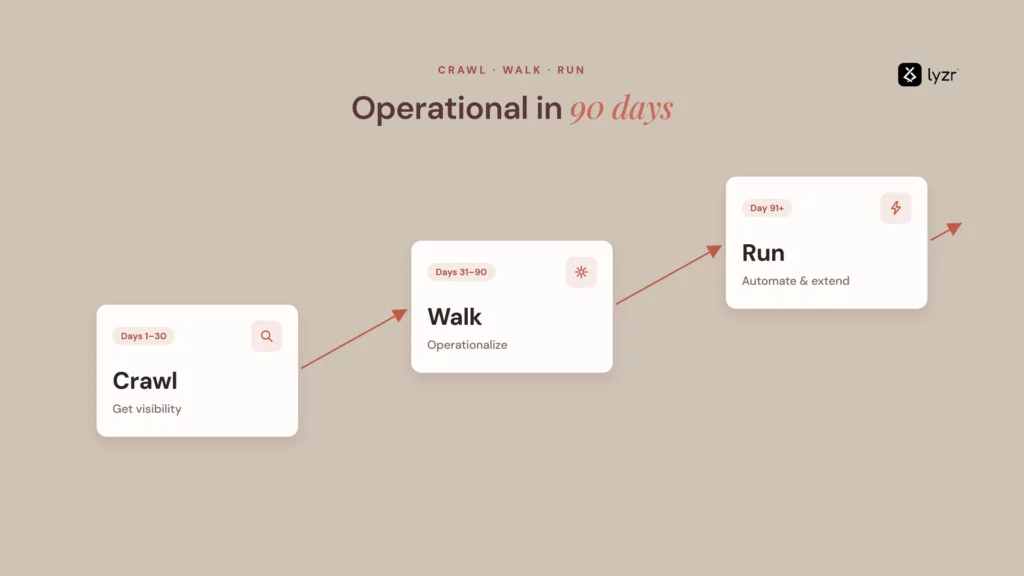
Crawl (days 1 to 30): get visibility and form the committee. Stand up a cross-functional governance group with executive sponsorship. Run a full inventory of every AI system in use, including the SaaS tools and shadow deployments nobody officially approved. Draft a one-page acceptable use policy that at minimum bans unacceptable-risk applications.
Walk (days 31 to 90): operationalize the rules. Build the RACI matrix and assign named owners to every system in the inventory. Require risk classification on all new AI projects before they get budget or engineering time. Turn on monitoring for at least your highest-risk production system, even if it’s manual at first.
Run (day 91 onward): automate and extend. Wire governance checkpoints directly into your development and deployment pipelines so they trigger automatically rather than depending on someone remembering to file a form. Connect the framework to your broader GRC (Governance, Risk, and Compliance) tooling. And, critically, extend the framework to cover autonomous agents, which is where most existing programs run out of road.
That last step is worth pausing on, because it’s the one incumbents in this space consistently skip.
Agentic AI governance: the layer model-centric frameworks miss
Agentic AI governance is the discipline of controlling autonomous agents in real time, not just reviewing them before deployment. Traditional AI governance was designed around a model you validate once, then monitor periodically. That assumption breaks the moment the “model” becomes an agent that reasons, acts, and executes decisions on its own, thousands of times an hour, without a human reviewing each one.
An agent processing insurance claims doesn’t produce one output to evaluate. It makes a sequence of decisions: which claims to flag, which data sources to query, which actions to execute against a policy system.
Gartner forecasts that more than 40% of agentic AI projects will be canceled by 2027 due to escalating costs, unclear ROI, and weak risk controls, and weak risk controls sit at the center of that failure pattern more often than the technology itself.
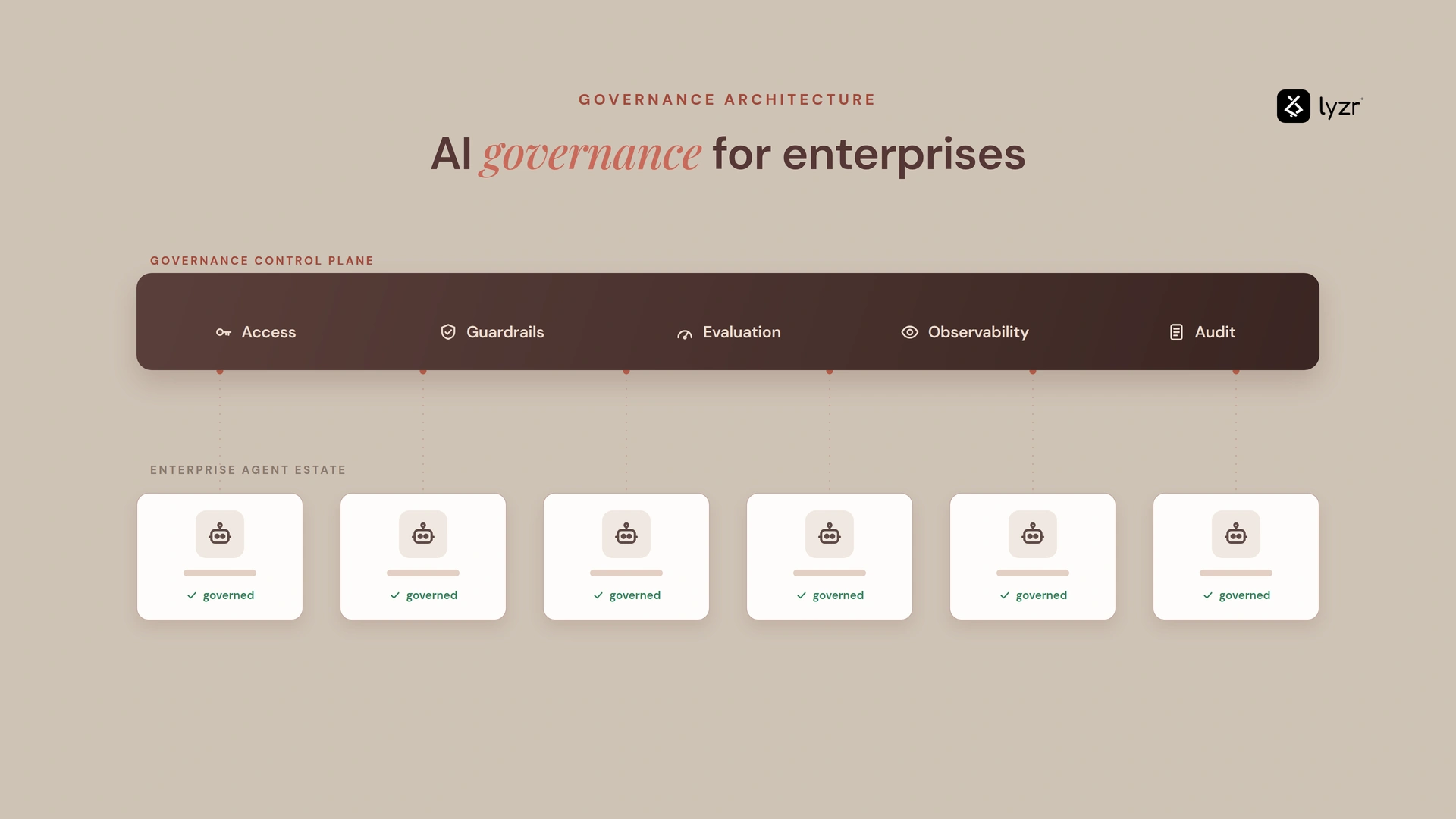
Runtime control is what closes that gap. It means governance moves from a pre-deployment checkpoint to a continuous, live layer sitting alongside the agent as it works. The core components:
- Runtime guardrails: policies enforced live, blocking an agent from accessing restricted data or exceeding a spending threshold the moment it attempts the action, not after the fact.
- Action approval workflows: routing specific high-stakes actions, a large payment, a contract commitment, to a human for sign-off before execution.
- Escalation logic: automatically routing anomalous agent behavior to the right person, rather than letting it run until someone notices downstream.
- Per-decision audit trails: an immutable log of every action an agent took and every input it used to take it, built for the moment a regulator or auditor asks “why did this happen.”
- Role-based access control (RBAC): least-privilege permissions applied to agents the same way they’re applied to employees, so an agent only ever touches what its role requires.
- A single control plane: one place to see, pause, and audit every agent running across the enterprise, instead of a different dashboard per team or framework.
This is agentic AI governance, and it’s additive to everything already covered here, not a replacement. The six pillars still apply. What changes is that pillar three, oversight, and pillar five, lifecycle monitoring, now need to operate at machine speed instead of quarterly review speed.
One Lyzr team built an outreach agent that illustrates the pattern well: the agent needed freedom to personalize messaging, but hard boundaries on what commitments it could make and what data it could touch, enforced automatically rather than through a human reviewing every message.
Regulations and standards to map your framework to
A governance framework holds up under scrutiny when it maps directly to the standards regulators and auditors actually check against. Four frameworks matter most right now.
EU AI Act. A risk-tiered regulation that bans unacceptable-risk AI outright and imposes strict documentation, oversight, and transparency requirements on high-risk systems.
NIST AI Risk Management Framework (AI RMF 1.0). A voluntary U.S. framework organized around four functions: Map, Measure, Manage, and Govern, giving organizations a structured process for identifying and reducing AI risk.
ISO/IEC 42001. The international standard for an AI Management System (AIMS), specifying how to establish, operate, and continually improve AI governance within an organization, similar in structure to ISO 27001 for information security.
OECD AI Principles. Intergovernmental principles promoting AI that’s innovative, trustworthy, and respects human rights, forming the values foundation many national regulations build on.
Pillar-to-standard mapping
| Governance pillar | EU AI Act | NIST AI RMF 1.0 | ISO/IEC 42001 |
|---|---|---|---|
| Policy and acceptable use | Prohibited practices | Govern | AI policy and objectives |
| Risk classification | Risk-tiered approach | Map, Measure | Risk assessment process |
| Oversight and accountability | Human oversight requirement | Govern | Roles and responsibilities |
| Data governance | Data governance obligations | Map, Manage | Resources and data controls |
| Lifecycle monitoring | Post-market monitoring | Manage | AI system lifecycle |
| Security | Robustness and accuracy | Manage | Security controls |
AI governance tools: what to look for
The right governance tool consolidates inventory, risk assessment, monitoring, and runtime control into one system instead of forcing teams to stitch together spreadsheets and point solutions. Fragmented tooling is exactly how shadow AI and blind spots creep back in after a framework launches.
When evaluating platforms, prioritize systems that give you usage visibility across every deployed agent, not just the ones a team remembers to register. Look for native RBAC, automated PII handling, and audit logs generated by default rather than bolted on after a compliance request. A platform that treats governance as a downstream integration will always lag behind what your teams are actually shipping.
Lyzr Studio is built with governance embedded at the point of creation, not added afterward. That includes a Responsible AI module enforcing fairness and transparency by default, a Hallucination Manager that catches fabricated outputs before they reach a user, granular RBAC for both humans and agents, automatic PII redaction across prompts and outputs, and immutable audit logs covering every agent decision.
The difference between baked-in and bolted-on governance shows up exactly when it matters most: during an audit, an incident review, or a regulator’s request for evidence.
Best Fiddler AI Alternative in 2026: Why Lyzr Control Plane Is the Smarter Choice for AI Agents
Frequently asked questions
What is enterprise AI governance?
Enterprise AI governance is the system of policies, roles, processes, and technical controls that manage AI across its full lifecycle, from inventory and risk classification through deployment, monitoring, and runtime control of agents. It’s what turns AI from an ungoverned experiment into an auditable enterprise capability.
What are the pillars of AI governance?
The core pillars are policy and acceptable use, risk classification and triage, oversight and accountability, data governance and lineage, lifecycle monitoring and change management, and security. Together they cover an AI system from the moment it’s proposed through the moment it’s retired.
What’s the difference between AI governance and responsible AI?
Responsible AI is the outcome, AI that’s fair, transparent, and trustworthy. Governance is the operational structure, policies, committees, and controls, that gets an organization to that outcome and lets it prove the outcome was achieved. One is the goal, the other is the machinery.
Who is responsible for AI governance?
Responsibility sits with a cross-functional committee spanning legal, risk, compliance, IT, and the business units deploying AI, typically with executive sponsorship. Day-to-day accountability then falls to named owners for each individual AI system or agent, assigned through a RACI structure.
What is agentic AI governance?
Agentic AI governance is the discipline of controlling autonomous agents in real time as they act, rather than reviewing a model once before deployment. It relies on runtime guardrails, action approval workflows, per-decision audit trails, and RBAC to keep agents inside defined boundaries while they operate.
How do you build an AI governance framework?
Start with a 60 to 90 day crawl-walk-run rollout: form a governance committee and inventory existing AI in the first 30 days, operationalize risk assessment and ownership in the next 60, then automate controls and extend the framework to cover agents. Maturity compounds from there rather than arriving all at once.
What tools are needed for AI governance?
You need tools covering AI inventory, risk assessment workflows, continuous monitoring, and runtime control, ideally unified in a single platform rather than scattered across point solutions. Lyzr Studio builds these in natively, including a Responsible AI module, Hallucination Manager, RBAC, PII redaction, and full audit logs.
Where this leaves you
Ungoverned AI doesn’t fail quietly, it fails in an audit, a tribunal, or a headline, and by then the fix costs far more than the framework would have. Enterprise AI governance, built to cover both the models you evaluate once and the agents acting thousands of times an hour, is what lets you deploy with confidence instead of hoping nothing goes wrong.
Book a demo to see how Lyzr’s governance layer works across your existing AI stack.
Book A Demo: Click Here
Join our Slack: Click Here
Link to our GitHub: Click Here