The sales team launches a campaign. Marketing doesn’t know. Meanwhile, the tech team is busy fixing a bug no one told them about.
So each team is doing their job, but in isolation. No updates, no shared context, just chaos in slow motion.
Now shift that to AI Agents. You’ve got smart agents doing their own tasks, but without talking to each other, they miss the bigger picture.
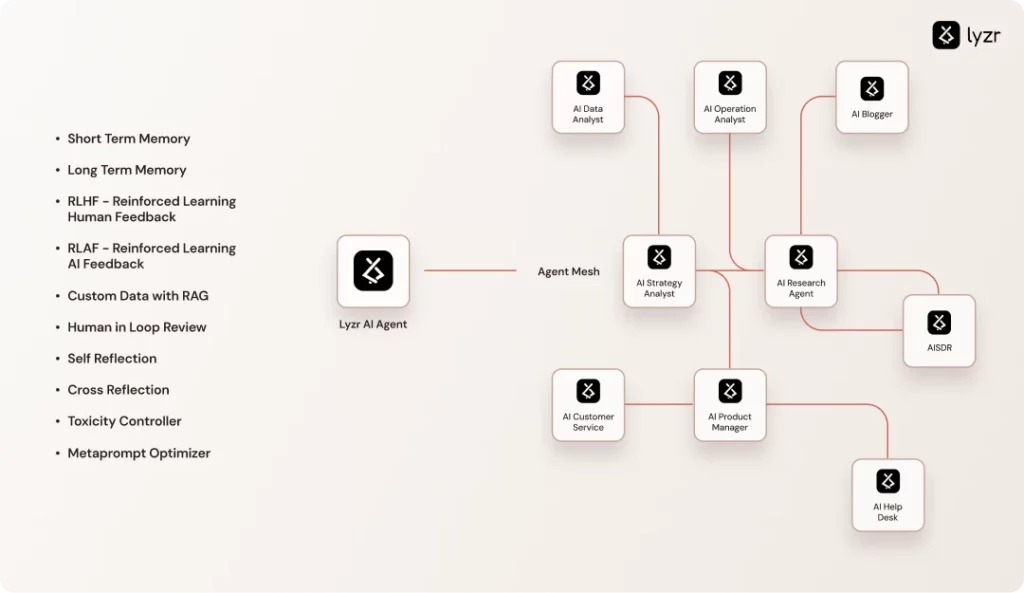
That’s where agent mesh comes in. It’s how AI agents stay connected, sharing, syncing, and solving problems together like a real team.
Let’s understand agent mesh better.
Key takeaways
- An agent mesh is a decentralized ecosystem where AI agents register, discover each other, and coordinate autonomously.
- Agents communicate through direct messaging, shared memory, and standardized languages, not ad hoc exchanges.
- Unlike centralized orchestration, a mesh is peer-to-peer and adapts in real time, with no single controller.
- A “mesh-ready” agent needs six traits: purpose, ownership, trustworthiness, autonomy, discoverability, and intelligence.
- CIOs, COOs, CAIOs, and functional teams each get distinct value, from IT integration to governance.
What is an agent mesh?
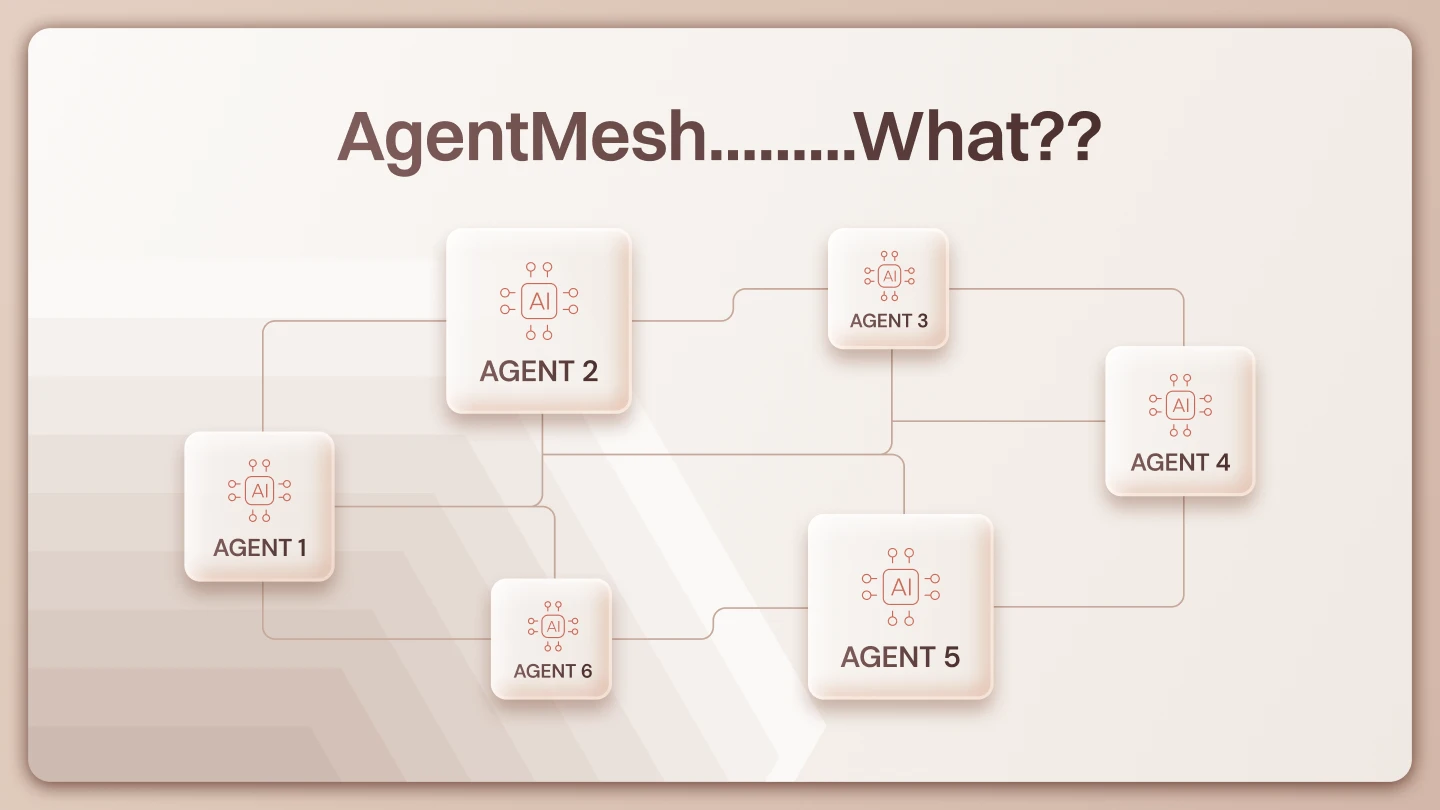
An agent mesh is an interconnected ecosystem where Autonomous Agents can register themselves, showcase their capabilities, and coordinate with other Agents or humans to get tasks done.
The agent mesh leverages an event-driven architecture to enable dynamic collaboration and real-time data exchange among agents.
Many Agents, One Ecosystem
Big tech is all in on AI Agents. Microsoft, Amazon, Salesforce, and others are pouring billions into building and deploying them across industries.
And it’s not just a handful of Agents, we’re looking at a future where hundreds, maybe thousands, work around the clock, each with its own specialized role.
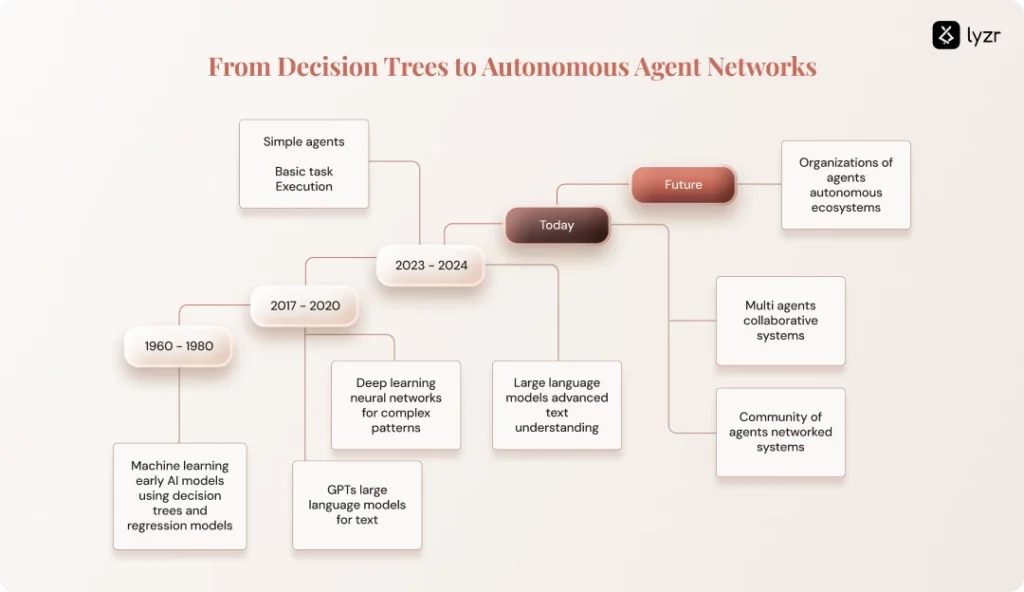
It’s no longer just about building AI Agents, it’s about making autonomous AI agents work together.
Take a supply chain, for example. One Agent tracks raw materials. Another handles shipping. A third ensures compliance with regulations. Individually, they’re smart. But without a structured way to find, connect, and collaborate, they’re just isolated systems.
What they need is a mesh, a unifying environment where Agents can discover each other, assess capabilities, and exchange data in a structured, trusted way. Otherwise, it’s like having a team where no one knows who does what, leading to confusion, inefficiencies, and missed opportunities.
An agent mesh is built to solve exactly this problem, where the goal is to create an environment where Agents are discoverable, trustworthy, and easy to interact with, whether by human users or other AI systems.
But wait! Before things get complicated for you, let’s understand agent mesh with a very simple example, as shown in the image below:
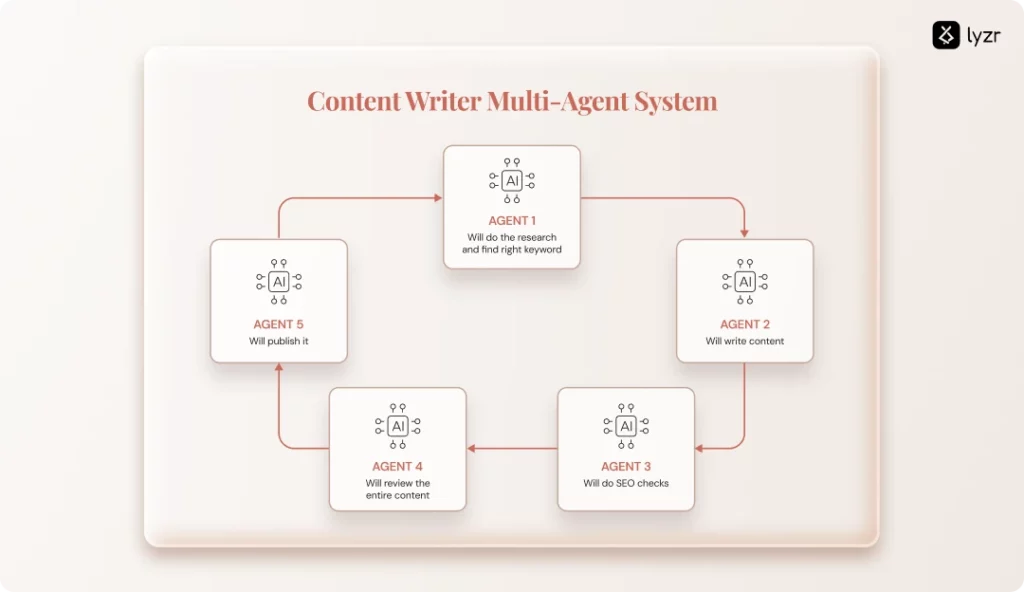
Now let’s get into the technical side of it
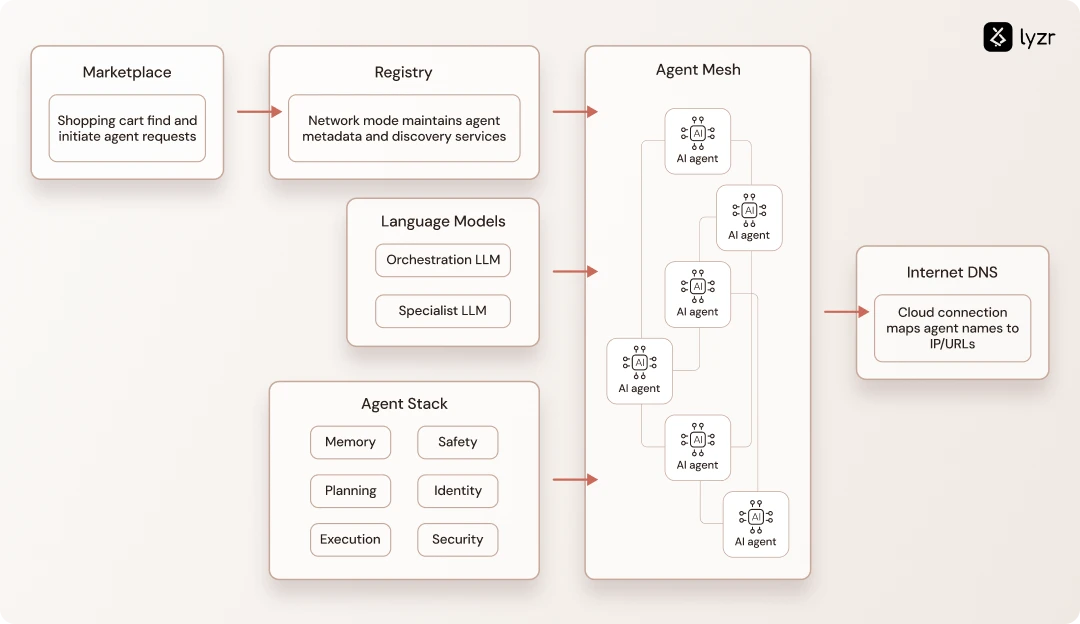
A key part of this ecosystem is the Marketplace, where users can explore available Agents, just like browsing apps in an app store. Here, users can see what each Agent does, initiate tasks, track progress, give feedback, and even check billing details.
Another essential component is the Registry, a structured repository that holds critical metadata about each Agent, its purpose, capabilities, policies, and ownership. This metadata helps the mesh match tasks with the right Agents and ensures they operate within defined parameters, building trust in their reliability.
At its core, the agent mesh is designed to answer fundamental questions:
- How do I find the right Agent for the job?
- How do I interact and transact with it?
- How can I trust that it will act securely, ethically, and reliably?
How do AI agents communicate with each other
Effective collaboration hinges on clear communication, and AI agents are no different. They don’t simply “talk” to each other; they exchange structured data through well-defined protocols to coordinate actions, share findings, and delegate tasks. This communication is the lifeblood of any multi-agent system.
The primary mechanisms for agent interaction include:
- Direct Messaging: One agent sends a formatted message, often in JSON or XML, directly to another. This is efficient for simple, one-to-one task handoffs, like a “Data Retrieval Agent” sending a dataset to an “Analysis Agent.”
- Shared Memory (Blackboard Systems): Agents communicate asynchronously by reading from and writing to a common, persistent data space. This “blackboard” holds the current state of the problem, allowing agents to contribute their expertise as needed.
- Standardized Languages: To ensure interoperability between diverse agents, they often use an Agent Communication Language (ACL). These languages define the syntax and semantics of messages, allowing an agent to understand the intent behind a message (e.g., request, inform, propose) regardless of which agent sent it.
This combination of methods allows a fluid and dynamic exchange of information, enabling a team of agents to function as a cohesive unit.
Who is agent mesh designed For?
The agent mesh framework serves different stakeholders, each with unique priorities:
1. For Chief Information Officers (CIOs)
| Priority | How Agent Mesh Helps |
|---|---|
| Integration | Integrates with existing IT systems without disrupting current workflows. |
| Scalability | Supports growth by adapting to evolving business needs and expanding operations. |
| Adaptability | Offers flexible architecture to ensure long-term viability as technology and requirements change. |
2. For Chief Operating Officers (COOs)
| Priority | How Agent Mesh Helps |
|---|---|
| Workflow Automation | Streamlines and automates workflows, reducing manual interventions. |
| Operational Efficiency | Improves business operations by enabling adaptive and responsive processes. |
| Productivity at Scale | Helps scale productivity across teams without increasing operational overhead. |
3. For Chief AI Officers (CAIOs)
| Priority | How Agent Mesh Helps |
|---|---|
| Governance | Provides built-in tools for managing and ensuring compliance in AI ecosystems. |
| Security | Safeguards AI operations with robust security features and access controls. |
| Monitoring | Enables real-time monitoring of agent performance and effectiveness, ensuring transparency and accountability. |
4. For Functional Teams
| Priority | How Agent Mesh Helps |
|---|---|
| Task Automation | Frees teams from repetitive and time-consuming tasks, allowing focus on higher-value activities. |
| Increased Productivity | Enhances efficiency by providing intelligent, autonomous assistants that support decision-making and execution. |
| Collaboration | Improves team collaboration by offloading routine tasks, leading to smoother teamwork and task management. |
Agent mesh vs agent orchestration
As enterprises begin to build multi-agent systems, they face a critical architectural choice: orchestration or a mesh. While they sound similar, they represent fundamentally different philosophies of control and collaboration.
Agent Orchestration is a centralized, top-down approach. A master “conductor” agent dictates the entire workflow, assigning specific tasks to subordinate agents in a predefined sequence. This model is rigid and predictable, making it suitable for linear, repeatable business processes where the steps are known in advance. However, its rigidity is also its weakness; it struggles to adapt to unexpected events and has a single point of failure in the orchestrator. It’s like a traditional assembly line.
An agent mesh, in contrast, is a decentralized, peer-to-peer network. There is no central conductor. Agents possess greater autonomy and communicate directly with one another to negotiate tasks, share information, and collaboratively solve problems. The workflow is emergent, not predefined. This bottom-up approach provides immense flexibility and resilience, making it ideal for complex, dynamic environments where adaptability is key. It’s less like an assembly line and more like a responsive special operations team.

When is an agent mesh ready? The six criteria
For an Agent to be considered “mesh-ready,” it must have a set of key aspects that enable it to operate effectively within the ecosystem. These key aspects ensure that Agents are not only functional but also accountable, discoverable, and intelligent enough to handle complex tasks.
Key attributes of a mesh-ready Agent are:
1. Key Aspects of Purpose
Every Agent needs a well-defined mission that outlines its role and scope. This clarity ensures the Agent remains focused on specific objectives and helps others determine if it’s the right fit for their needs.
Example: A procurement Agent should explicitly state that it handles vendor negotiations and purchase approvals rather than general accounting tasks.
A well-defined mission helps the agent focus on specific objectives, which is crucial for automating complex workflows within an organization.
2. Ownership
Every Agent must have a designated owner, whether an individual, a department, or an organization—who is accountable for its actions. Ownership is essential for governance, policy enforcement, and troubleshooting.
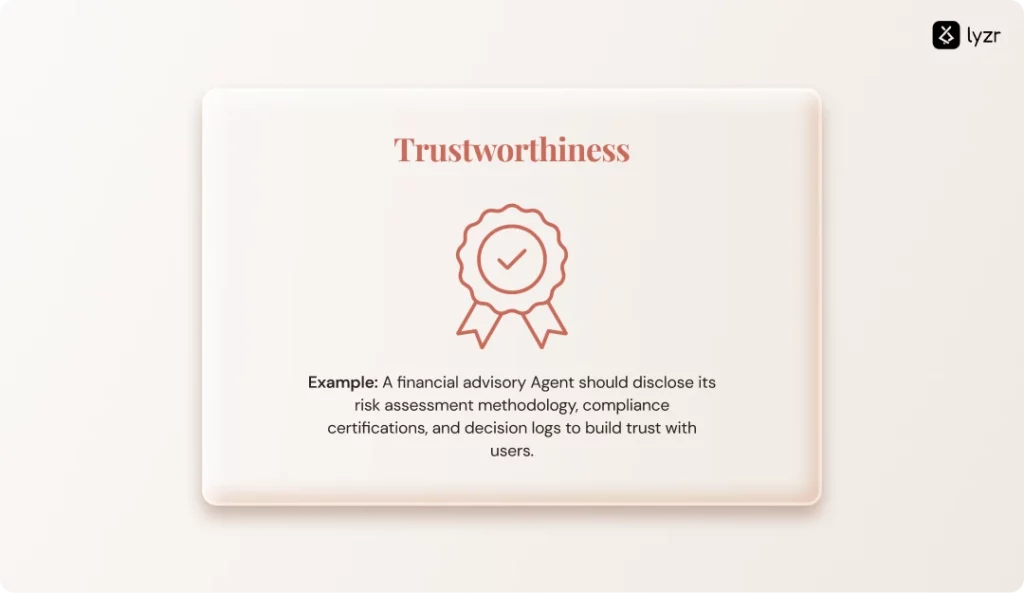
3. Trustworthiness
Agents should operate transparently, with clear policies, certifications, and operational logs available to users and other Agents. This transparency ensures compliance with ethical, security, and legal standards.
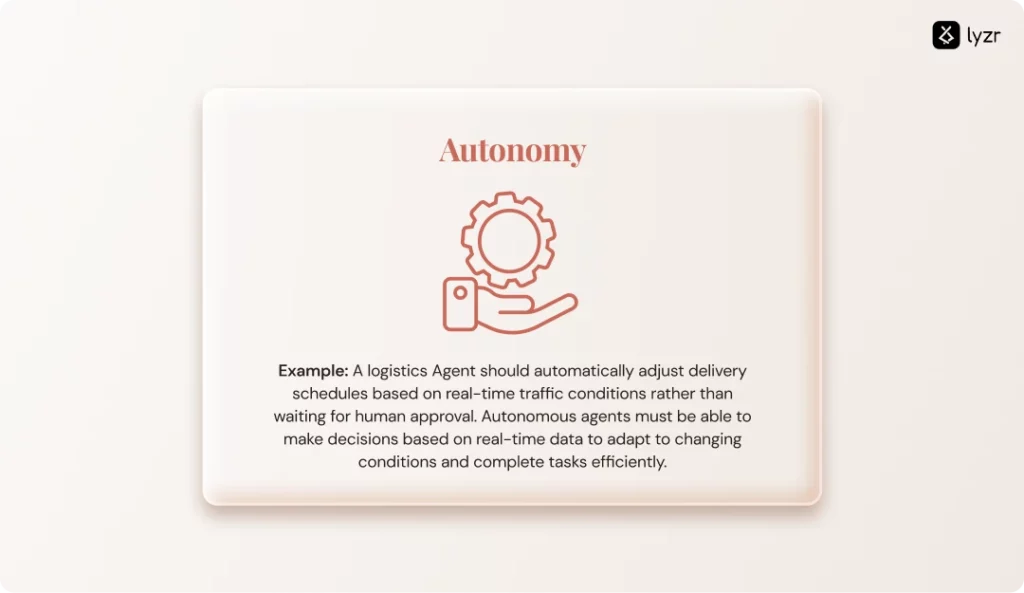
4. Autonomy
A mesh-ready Agent must function independently without requiring constant human intervention. It should be able to decide how to complete tasks within predefined policies and scope. This sets it apart from traditional scripts or bots that follow rigid, rule-based instructions.
5. Discoverability
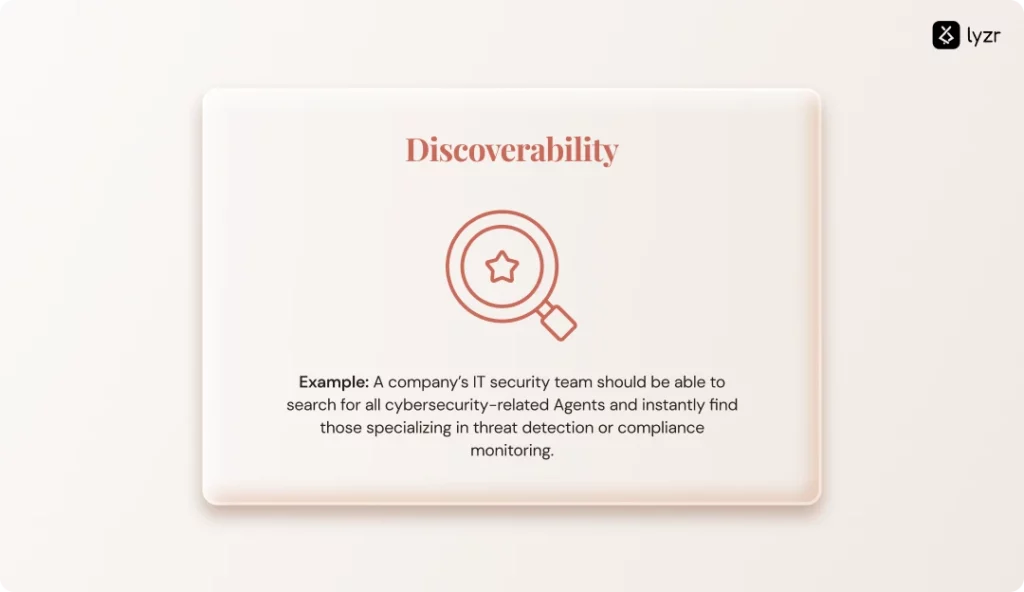
Agents must be easy to find within the mesh, whether by their purpose, ownership, or capabilities. This is similar to how websites are located using domain names via DNS, where .com premium domains are often chosen because they’re easy to remember and trusted.
6. Intelligence
Agents leverage large language models (LLMs), often multiple specialized models, to interpret complex requests, plan solutions, and adapt to changing conditions. Leveraging generative AI can further enhance the capabilities of agents, enabling them to generate creative solutions and interact in more human-like ways.
By meeting these criteria, agents become mesh-ready, capable of easily integrating into an interconnected ecosystem where they can be trusted, easily found, and operate efficiently.
How an agent mesh works: registration, discovery and execution
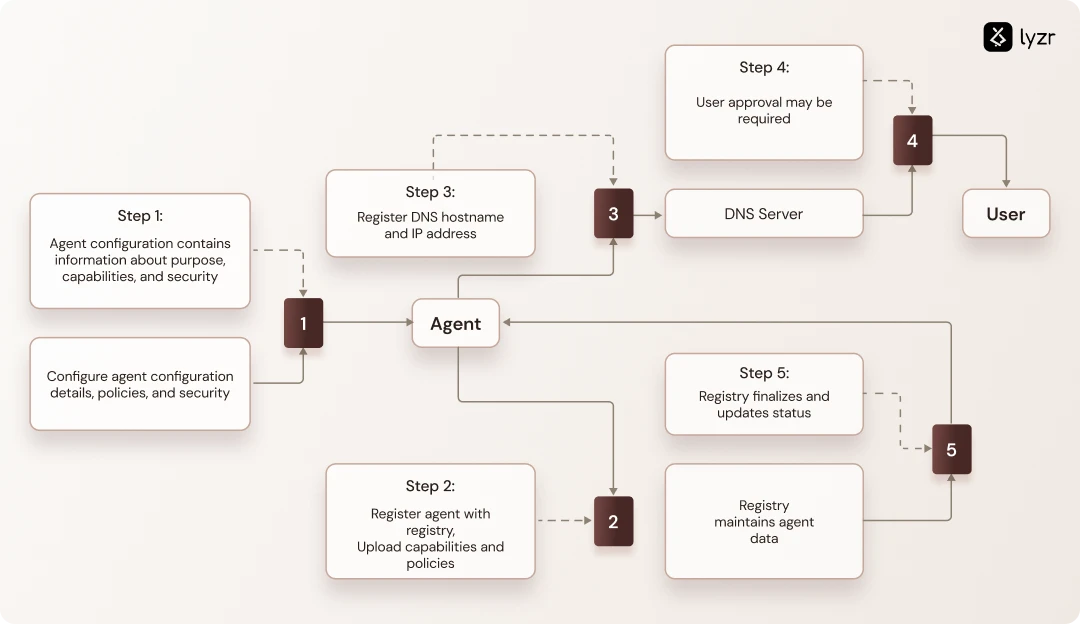
1. Registration: Getting an Agent into the Mesh
Before an Agent can start working, it needs to introduce itself to the mesh. This involves setting up its profile with key details:
- Purpose – What the Agent does
- Ownership – Who is responsible for it
- Security Policies – Rules it follows
Once set up, the Agent submits this information to the mesh’s Registry, much like registering a website. Just as a domain name links to an IP address, the Agent gets a unique identifier, making it easy to find and access.
Before going live, the registration might go through a quick review process, either automated or manual, to ensure compliance. Once approved, the Agent becomes discoverable and ready to interact.
2. Discovery: Finding the Right Agent for the Job
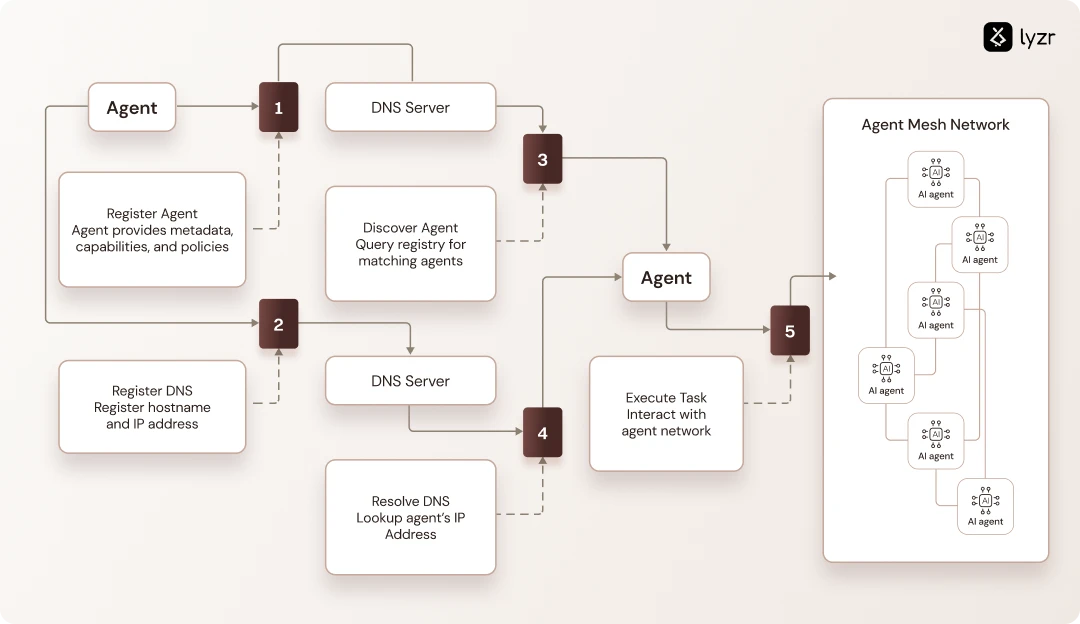
Once an Agent is registered, it must be easy to find. Users or other Agents can search the Registry based on specific needs, such as customer support agents, fraud detection agents, logistics management agents and more.
When a search is performed, the Registry returns a list of matching Agents with key details:
✅ Name ✅ Capabilities ✅ Relevant metadata
From there, users or other Agents can connect and assign tasks.
These foundational processes ensure that Agents aren’t just floating around in isolation; they are structured, searchable, and ready to contribute where needed.
Each mesh agent is equipped with a self-test script to ensure its functionalities are consistent and reliable within the ecosystem.
3. Task Execution: Getting Things Done
Once the right Agent is found, it’s time to put it to work. A user can browse the Marketplace, check an Agent’s capabilities or ratings, and send instructions.
From there, the Agent:
- Analyzes the request and creates a step-by-step plan
- Collaborates with other Agents if specialized tasks are needed
- Provides updates or asks for clarifications when necessary
- Stops execution if it detects issues or inconsistencies
By collaborating with other agents, they can solve complex problems that require diverse skills and real-time data analysis.
Applications of Agent Mesh
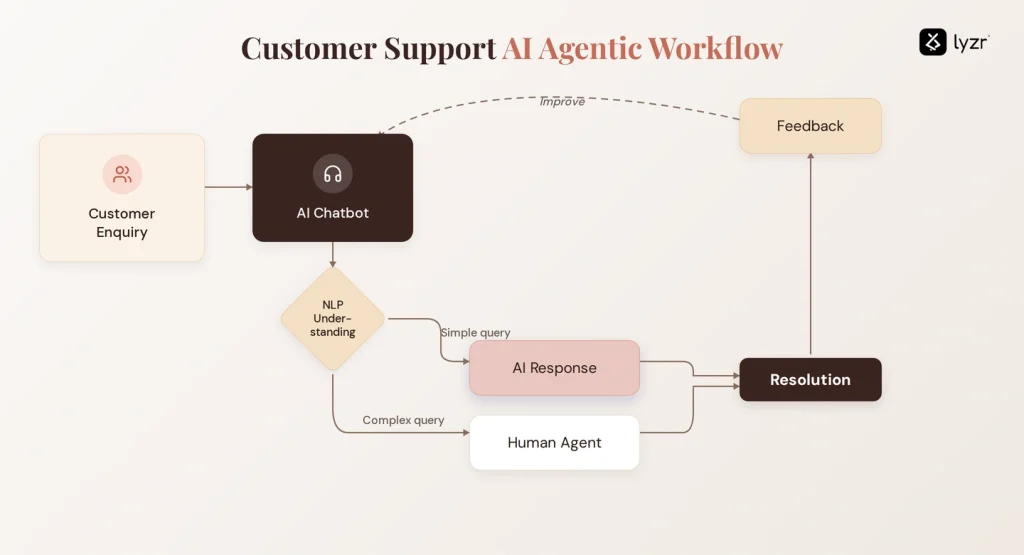
1. Customer Service Automation
Agents can handle inquiries, fetch relevant information, and generate accurate responses, reducing wait times and improving customer experience. Businesses can automate routine support tasks while allowing human agents to focus on complex issues. For example, integrating a reliable print and mail api enables automated sending of physical communications like invoices, notices, and customer letters without manual intervention, further streamlining customer operations.
2. Workflow Optimization for Operational Efficiency
Agents can monitor workflows, detect inefficiencies, and make real-time adjustments. Whether it’s automating approvals, reallocating resources, or optimizing task distribution, this leads to smoother operations and increased productivity.
Agents can also collaborate to automate financial analysis, optimizing resource allocation and enhancing decision-making processes.
3. Data Analysis & Decision Support for Complex Problems
With multiple agents working together, vast amounts of data can be processed, trends identified, and insights generated faster. Businesses can make data-driven decisions with real-time analysis, predictive modeling, and automated reporting.
Lyzr vs the best multi-AI agent builders
Here’s a high-level comparison of agent mesh with well-known AI solutions.
Agent mesh is designed to work alongside these offerings, helping enterprises avoid vendor lock-in while maintaining control and consistency.
It provides governance, interoperability, and scalability, making it easier to integrate multiple tools without creating unnecessary complexity. By integrating multiple tools and avoiding vendor lock-in, agent mesh significantly enhances operational efficiency and scalability.
| Feature | Lyzr.ai | Salesforce Agentforce | CrewAI Framework | Microsoft Copilot |
|---|---|---|---|---|
| Scope | ✓ | ✗ | ✓ | ✗ |
| Governance | ✓ | ✓ | ✗ | ✓ |
| Integration | ✓ | ✗ | ✓ | ✓ |
| Economic Model | ✓ | ✗ | ✓ | ✗ |
Wrapping Up
Agent mesh is the backbone of a world where intelligent Agents work together seamlessly while maintaining transparency, reliability, and trust.
For business leaders, developers, and governance experts, this isn’t just a trend; it’s the next phase of AI evolution.
At lyzr.ai, we’re building the infrastructure to make this shift accessible. With a no-code agent builder and an open marketplace, Lyzr is equipping teams to create, deploy, and scale autonomous Agents effortlessly.
The future of AI isn’t just about building Agents—it’s about giving them a network to thrive in.
Ready to be part of it? Get in touch with us
Evaluated by enterprise teams for security and control. Explore verified Lyzr reviews on marketplaces
Frequently Asked Questions
An agent mesh is a decentralized network where multiple specialized AI agents collaborate to solve complex problems. These autonomous agents communicate and coordinate with each other, dynamically forming teams to tackle tasks that are beyond the scope of a single agent.
Agent mesh architecture is the blueprint for building a collaborative AI system, defining key components like an agent registry for discovery, a communication bus for message passing, and standardized protocols. It provides the framework for agents to register their skills and interact dynamically.
AI agents communicate using standardized Agent-to-Agent (A2A) protocols and message-passing systems. They exchange structured data, requests, and results, often through a central communication bus or via direct peer-to-peer connections, ensuring all agents understand each other’s messages and capabilities.
Agent mesh involves decentralized, peer-to-peer collaboration where agents dynamically decide how to work together. Agent orchestration is a centralized, top-down approach where a single controller dictates tasks to agents in a predefined sequence, offering less flexibility and resilience.
A2A (Agent-to-Agent) protocol is a standardized set of rules and formats for communication between AI agents. It ensures that different agents, potentially built by different teams, can reliably exchange information, make requests, and understand each other’s responses within a mesh.
An agent is registered in a mesh by publishing its identity, capabilities, and communication endpoint to a central agent registry. This process makes the agent “discoverable,” allowing other agents or dispatchers to find it and request its specialized services for a given task.
Book A Demo: Click Here
Join our Slack: Click Here
Link to our GitHub: Click Here