Context engineering is not about fitting more into a context window. It is about designing what enters an agent’s context, keeping that information accurate as work gets handed from one agent to another, and being able to prove it stayed governed the whole way through.
That progression, from what context is, to how it behaves inside a running agent, to what breaks when agents hand work to each other, to how you prove any of it was under control, is the spine of this piece. If you want the wider view of how this fits into agent strategy generally, our Lyzr blog covers the adjacent ground. If you came here from a prompt-engineering search, you are one layer too shallow: read what prompt engineering actually covers first, then come back.
Here is the four-part shape the rest of this article follows: context engineering as a discipline, agentic context as it behaves inside one running agent, context across multi-agent handoffs where most production systems actually break, and governed context, the layer almost nobody selling you a framework talks about.
What context engineering actually means
Context engineering is the discipline of deciding what an LLM sees before it acts, not just what you tell it to do. The term was popularized in June 2025 when Shopify CEO Tobi Lütke posted that he preferred it to “prompt engineering”:
“I really like the term “context engineering” over prompt engineering. It describes the core skill better: the art of providing all the context for the task to be plausibly solvable by the LLM.”
Andrej Karpathy amplified it days later, arguing:
“+1 for “context engineering” over “prompt engineering”. People associate prompts with short task descriptions you’d give an LLM in your day-to-day use. When in every industrial-strength LLM app, context engineering is the delicate art and science of filling the context window with just the right information for the next step.”
Neither of them coined the underlying idea from nothing. Cognition, the team behind the coding agent Devin, had already written that “context engineering” is the next level of this. It is about doing this automatically in a dynamic system. It takes more nuance and is effectively the number one job of engineers building AI agents. Anthropic later formalized the term for its own engineering org, framing the shift plainly: context is a critical but finite resource for AI agents, and after a few years of prompt engineering being the focus of attention in applied AI, a new term has come to prominence, context engineering.
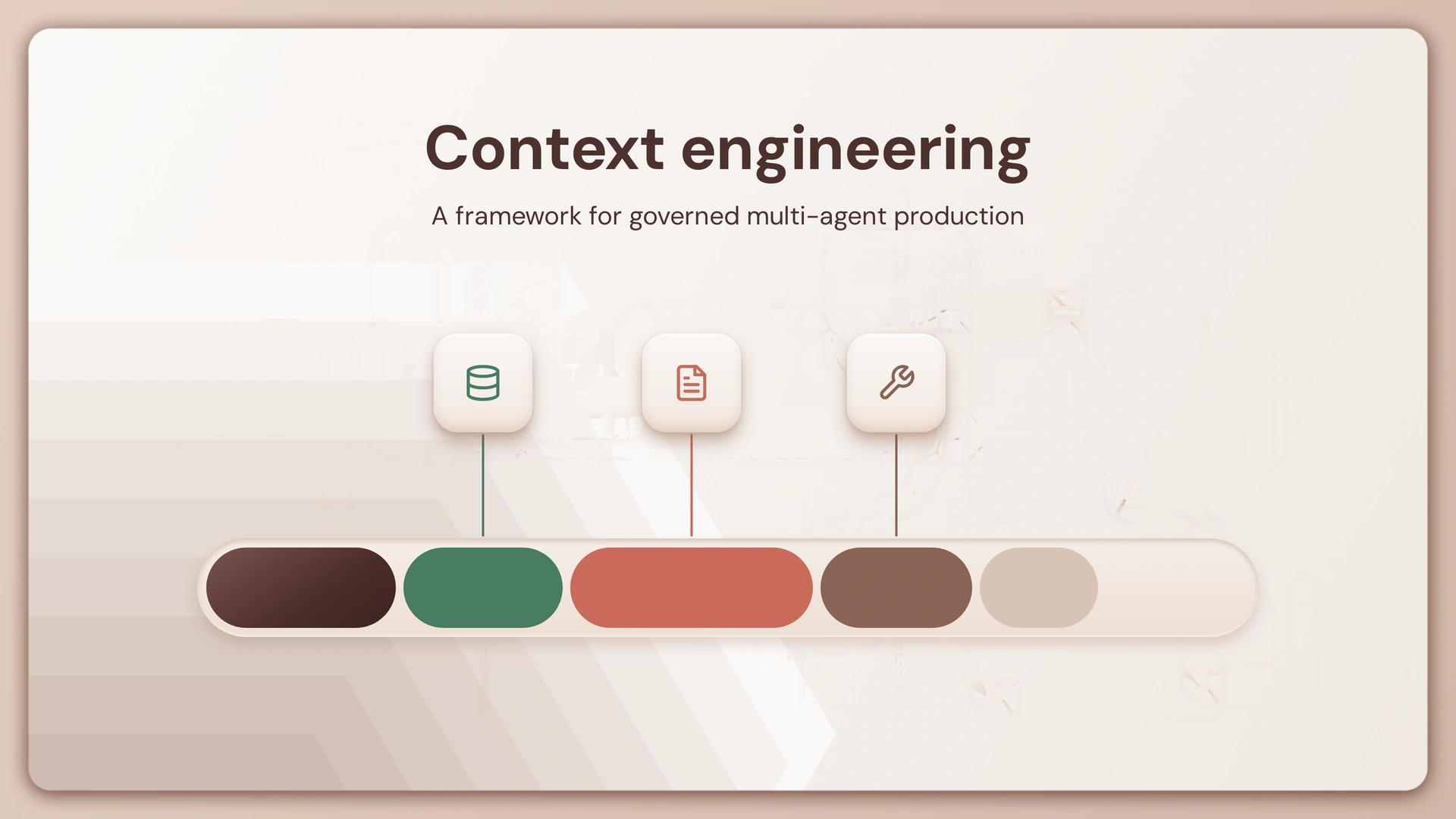
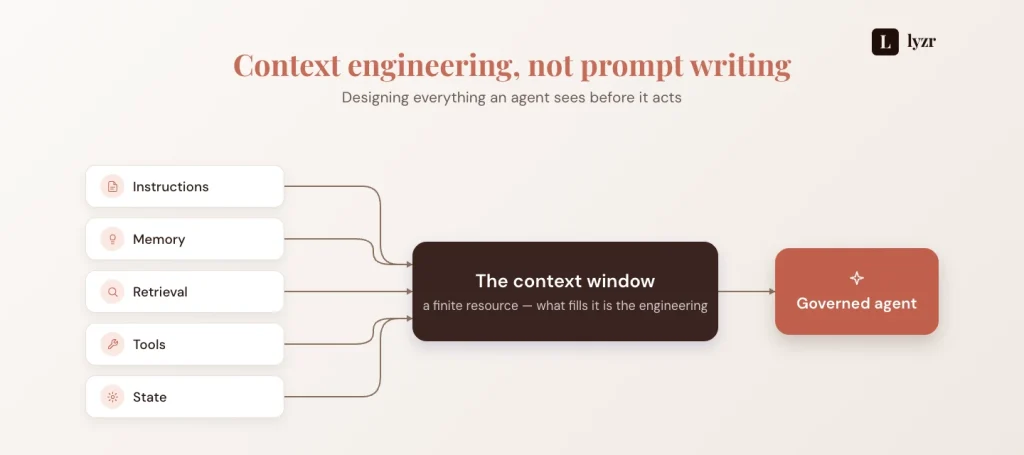
Loose bullet points do not hold up once you are architecting an actual system, so treat context as five components with distinct jobs:
- Instructions: the system prompt, role definition, and task-specific guidance. What used to be the whole job.
- Memory: short-term working state and long-term recall across sessions. See how memory architectures typically split short-term and long-term storage.
- Retrieval: documents, records, and facts pulled in on demand, usually through RAG.
- Tools: the APIs, functions, and other agents the model can call, and the outputs those calls return.
- State: where the agent is in a multi-step task right now, distinct from what it remembers about the past.
Every one of those five lives inside a finite context window. Managing what fills it, in what order, at what granularity, is the actual engineering problem.

Context engineering vs prompt engineering, RAG, and fine-tuning
| Dimension | Prompt engineering | Context engineering | RAG | Fine-tuning |
|---|---|---|---|---|
| What it controls | Phrasing and structure of a single instruction | The full assembly: instructions, memory, retrieval, tools, state | The retrieval step that feeds context with external documents | The model’s weights themselves |
| When to reach for it | A single-call task where wording changes the output | Any multi-step, multi-tool, or long-running agent workflow | The agent needs current or proprietary facts outside training data | Behavior or format needs to change in ways context can’t fix |
| What it cannot do | Fix a system where the failure lives outside the prompt | Change what the model fundamentally knows | Guarantee the model uses retrieved data correctly, or prevent it from being distracted by irrelevant chunks | Keep knowledge current without retraining |
Agentic context: the same discipline in motion
Static context is a document you hand the model once. Agentic context is a workspace that changes at every step, and the discipline of maintaining it is what practitioners increasingly call agentic context engineering.
Take a claims-intake agent processing an insurance submission. Step one, instructions and a retrieved policy document enter context. Step two, the agent calls a document-extraction tool and the output, a structured JSON of claim details, gets appended. Step three, state shifts from “extracting” to “validating,” and the agent pulls policy limits from memory of the customer’s account. Step four, it calls a fraud-check tool, and that result now sits alongside everything upstream.
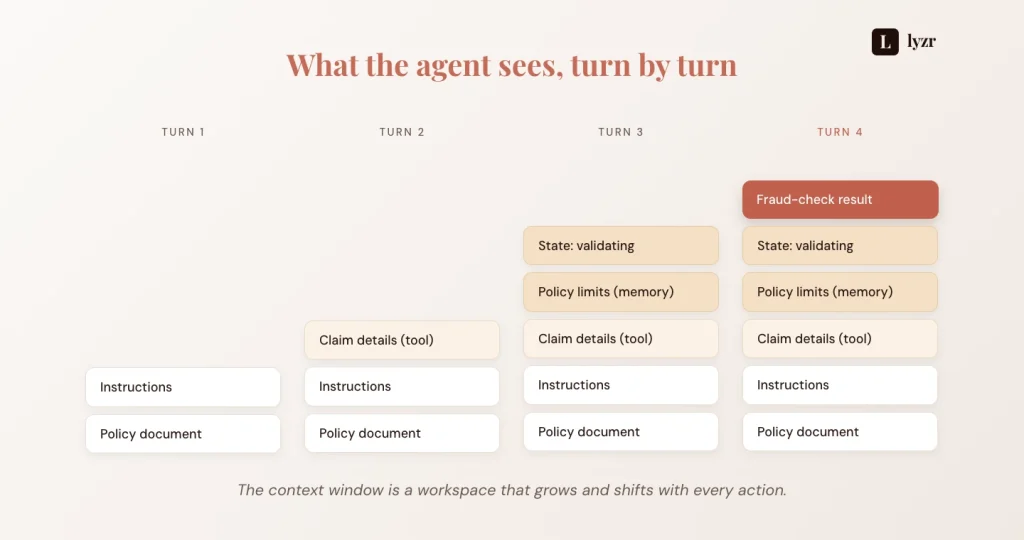
Nothing in that chain is a single prompt. It is five components being reassembled at every turn, and this is exactly where a well-engineered context layered with tool orchestration starts to matter more than any individual instruction.
Where context breaks: multi-agent handoffs
Hand that same claim off to a second agent, one that drafts the settlement letter, and the failure surface changes entirely. Four patterns, first named in detail by independent researcher Drew Breunig, explain most of what goes wrong.
Context poisoning. “When a hallucination or other error makes it into the context, where it is repeatedly referenced.” If the extraction agent misreads a policy limit and that number gets passed downstream, every subsequent agent treats it as fact.
Context distraction. “When a context grows so long that the model over-focuses on the context, neglecting what it learned during training.” A settlement agent handed forty turns of intake history may fixate on an early, since-corrected note rather than the final verified figure. This is precisely where a model’s limited attention span gets stretched past what it can reliably weigh.
Context clash. “When you accrue new information and tools in your context that conflicts with other information in the prompt.” The fraud-check tool flags “review required” while the policy memory says “auto-approve under $500,” and the agent has no clean way to resolve two contradictory directives.
Context rot, the term the applied research team at Chroma introduced for the broader pattern of accuracy decay as input length grows, describes what happens when none of the above gets caught. A cached policy price from an hour ago, a stale account status, an outdated tool schema, all quietly wrong, all still trusted.

Cognition’s own framing of reliability puts it directly: “when agents have to actually be reliable while running for long periods of time and maintain coherent conversations, there are certain things you must do to contain the potential for compounding errors.” Multi-agent handoffs are where that compounding happens fastest, because each agent trusts the last one’s output by default.
A decision framework: RAG, memory, tools, or isolation
| If your agent needs to… | Reach for | Why the others fall short here |
|---|---|---|
| Answer from private, static documents | RAG | Memory doesn’t scale to a full knowledge base; tools add latency for simple lookups |
| Recall a user’s preferences or past sessions | Memory | RAG re-retrieves the same static facts every time instead of persisting them |
| Act on the outside world (book, trade, update a record) | Tools | Neither RAG nor memory can execute a side effect |
| Run a task where sub-steps have conflicting assumptions | Multi-agent isolation with a shared, governed context layer | A single agent’s context will accumulate poisoning and clash faster than isolated sub-contexts with defined handoff contracts |
Governed context: proving what happened in production
None of the above is solved once a demo runs cleanly on a laptop. It is solved when you can show, after the fact, exactly what entered an agent’s context before it took a consequential action. A compliance reviewer asking why the agent approved a claim needs a trace, not a shrug, which is the same reason agent observability has become its own discipline rather than a feature bullet.
Directionally, across the workflows teams build on Lyzr Studio, context distraction shows up most often during early development, when builders solve problems by stuffing more data into the prompt rather than structuring retrieval. In production, it is context rot and poisoning that cause the costlier failures, because they surface quietly, days after a handoff, not immediately after a bad response.
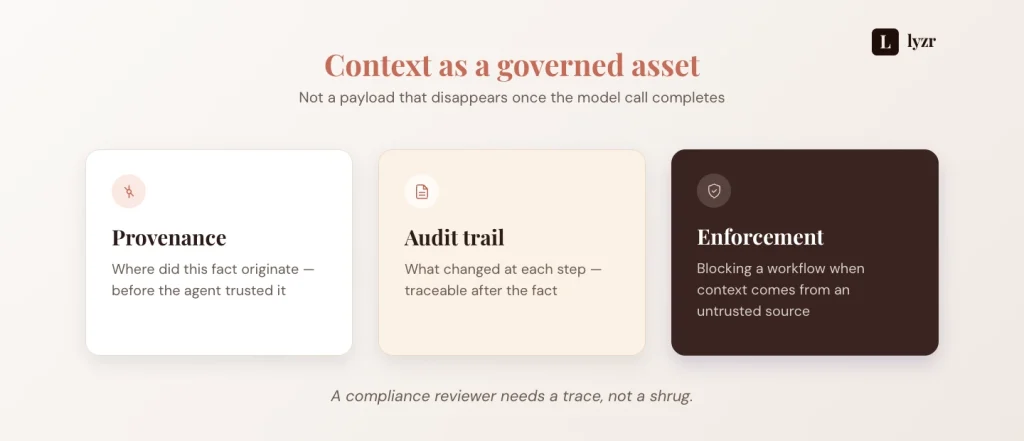
That gap between “it worked in testing” and “it’s provably safe in production” is what Control Plane is built to close. It treats context as a governed asset with provenance (where did this fact originate), an audit trail (what changed at each step), and enforcement (blocking a workflow when context comes from an untrusted source), rather than a payload that disappears once the model call completes. Lyzr Studio builds and orchestrates the agents; Control Plane is where you prove they stayed inside the lines. Platform teams evaluating this layer for the first time can see how it maps to their own stack on the page for Lyzr for platform teams.
This is not a finished checklist. Context that was governed for one workflow can drift the moment you add a new tool, a new upstream agent, or a new data source. Contextual engineering, done seriously, is an ongoing discipline, not a box you check once at launch.
Frequently asked questions
What is a context engineer?
A context engineer designs and governs the information flow into and between AI agents, focused on reliability and auditability rather than the wording of any single prompt.
What is an example of context engineering?
A financial research agent that combines real-time market data (tools), a client’s risk profile (memory), historical filings (retrieval), and a clear approval chain (instructions and state) before it can recommend a trade is a working context engineering example, not a prompting exercise.
Is there a free course in context engineering?
No single canonical free course exists yet. The most reliable path is reading the primary sources directly, Anthropic’s engineering blog, Cognition’s posts on multi-agent reliability, and Drew Breunig’s work on context failure modes, then building something that forces you to hit those failure modes yourself.
How can I learn context engineering?
Start with a working RAG pipeline, then add memory, then add tool calls, then add a second agent. The context engineering skill you’re actually building is debugging: noticing where a chain breaks and tracing it back to which of the five components failed.
Is context engineering better than prompt engineering?
It’s not a replacement, it’s a superset. Prompt engineering shapes the instructions component; context engineering governs everything else the model sees alongside those instructions. You still need both.
Is AI engineer a hard job?
It’s demanding in a specific way: you’re building deterministic guarantees on top of a non-deterministic system, which means most of the hard work is in evaluation, tracing, and failure analysis rather than in getting a first version to work.
Where this leaves you
The SERP has moved past “define context engineering.” The real question now is whether your agents can survive a handoff without quietly poisoning the next agent’s decision, and whether you can show a regulator, a customer, or your own CISO exactly what your agent knew before it acted.
If you’re past the definitional stage and need to see what governed context provenance and audit trails look like on a live multi-agent workflow, book a demo and bring your worst handoff failure. It’s usually the fastest way to see whether Control Plane and Lyzr Studio actually solve the problem you have, not the one a blog post assumed you had.
Book A Demo: Click Here
Join our Slack: Click Here
Link to our GitHub: Click Here