TL;DR
- AI in credit risk assessment uses machine learning and autonomous agents to evaluate borrower creditworthiness continuously, not just at application.
- Speed is now table stakes. The 2026 mandate is decisioning that is also explainable, auditable, and provably compliant.
- The EU AI Act classified creditworthiness assessment as high-risk under Annex III for Annex III systems; the Digital Omnibus, approved in June 2026, moves the standalone high-risk compliance deadline to December 2, 2027.
- CFPB Circular 2026-03 (May 5, 2026) confirms lenders using complex algorithms remain fully responsible under ECOA and Regulation B for providing specific, accurate reasons for adverse action.
- Explainability techniques like SHAP and LIME are not optional extras – they are the mechanism by which compliance gets satisfied.
- Lyzr’s Amadeo, the Agentic OS for Banking, delivers prebuilt credit agents with audit trails, RBAC, and human-in-the-loop review from day one.
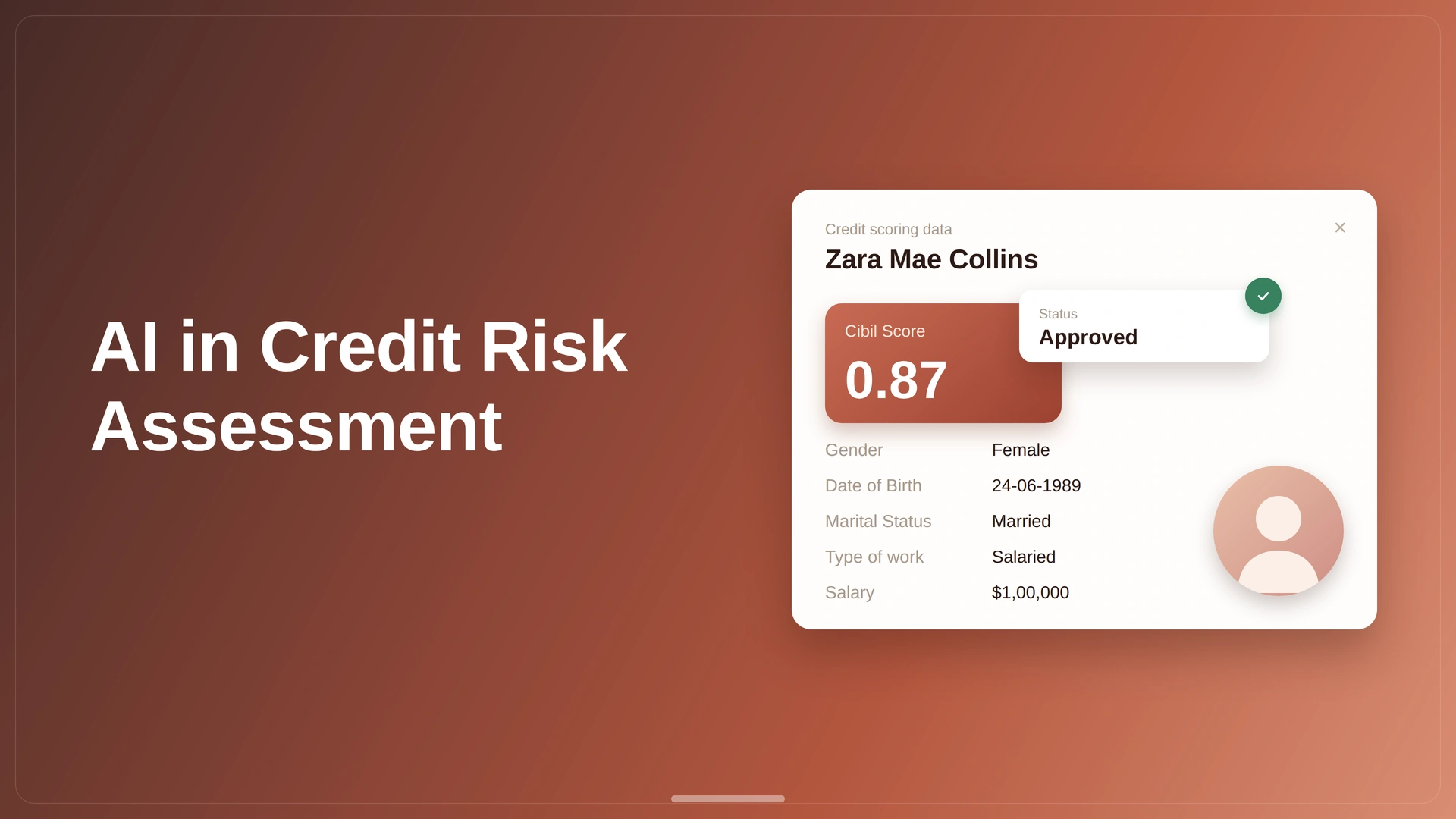
AI in credit risk assessment is the use of machine learning models and autonomous agents to evaluate a borrower’s creditworthiness across structured, unstructured, and alternative data – producing a dynamic, explainable risk profile that supports faster, more defensible lending decisions. AI agents now perform document verification, orchestrate API calls (e.g., CIBIL, Experian), compute eligibility, detect anomalies, and dynamically retrain models for ongoing credit portfolio health. It is not a point-in-time score. It is a continuous process that updates as new information arrives and generates a traceable rationale for every outcome.
For years, the pitch was simple: AI makes lending faster. That pitch is dead. Every vendor makes it, every competitor claims it, and every CRO has heard it. The real question risk officers and heads of lending are asking in 2026 is harder: can your AI decisioning survive a regulatory examination? Can it explain itself to a borrower who was denied? Can it hold up when a regulator asks for the audit trail? Speed without those answers is just a faster way to accumulate compliance exposure. This is the guide to building lending that is fast and defensible, and to understanding why those two things are now inseparable in modern banking operations.
What is AI in credit risk assessment?
AI in credit risk assessment is a technology-driven process that automates and enhances how lenders evaluate risk across the full borrower lifecycle – from application through portfolio monitoring. It moves well beyond traditional credit scoring, which is just one layer inside a broader assessment. Where a score produces a single static number, AI credit decisioning involves a dynamic, multi-source evaluation that updates as new data arrives and supports a complete decision workflow, not just a prediction.
Machine learning credit risk models simultaneously analyze three categories of data that legacy systems cannot combine at scale. Structured data covers the familiar ground: credit bureau reports, financial statements, application fields. Unstructured data includes bank statement narratives, legal documents, and income certificates that require natural language processing to interpret. Alternative and behavioral data – utility payment history, cash flow patterns, device signals, and transaction velocity – gives lenders a view of borrowers who have thin credit files but real financial lives. That last category is where AI credit risk models earn their differentiation: not just faster processing of the same inputs, but access to inputs that traditional underwriting simply cannot reach.
Distinguishing AI credit risk assessment from credit scoring matters because the audience for this guide – risk officers, CROs, and heads of lending – are accountable for the entire credit lifecycle, not just the scorecard. Assessment encompasses data governance, model explainability, continuous monitoring, regulatory reporting, and human-in-the-loop escalation. Scoring is one tool inside that system.
Why traditional credit risk assessment falls short
The legacy credit stack was built for a world where lending decisions took days, data came from two or three sources, and regulators asked few questions about how a model reached its conclusion. That world is gone. Static, rules-based systems assess an applicant once at the point of application and then go silent. The borrower’s financial situation changes – employment shifts, liquidity tightens, credit utilization climbs – and the lender has no visibility until the next scheduled review, which might be twelve months away.
Data silos compound the problem. Origination, servicing, and treasury systems rarely share a unified view of portfolio risk, which means early stress signals go undetected until a loan is already delinquent. According to Accenture, underwriters are spending 40% of their time on non-core activities, representing an efficiency loss of $85-$160 billion over the next five years. That is not a technology problem in isolation. It is a structural one: adding more rules to a rules engine does not free underwriters to do higher-value risk work.
The third and most consequential failure is opacity. A model that produces a denial without a traceable, human-readable rationale is not a defensible model – it is a liability. As financial institutions look to modernize, they recognize the need for a more dynamic and transparent approach to financial risk management – one where the audit trail exists before the examination request arrives, not after.
How agentic AI credit risk assessment works
Here is the distinction that matters most: a legacy system assesses once. An agentic AI credit risk assessment system monitors continuously, re-scores as new data becomes available, and flags portfolio-level risk changes without waiting for a human to ask the question. The move from event-based to state-based credit assessment is not an incremental improvement – it is an architectural shift.
“The use of multiagentic AI can create between a 40 and 80 percent productivity uplift per use case, greater consistency of outputs, and increased automation of control coverage.” – McKinsey, December 2025
McKinsey illustrates this with the case of a retail bank that reimagined credit-risk memo creation: relationship managers had been spending weeks manually drafting memos using data from ten sources. In the agentic model, AI agents now extract data, draft sections, generate confidence scores, and propose follow-up questions – shifting the relationship manager’s role to strategic oversight. The result was a potential 20-60% boost in productivity, including a 30% faster credit turnaround.
[IMAGE: The Lyzr Agentic Credit Decisioning Pipeline – a five-stage horizontal workflow diagram showing Data Ingestion Agent feeding into Verification Agents, Check and Monitoring Agents, Risk Modeling Agent, and Adjudication Agent, with a human-in-the-loop escalation branch and an immutable audit log running beneath all stages – AI in credit risk assessment pipeline visualization]
The Lyzr Agentic Credit Decisioning Pipeline structures this workflow across five specialized agents running in sequence – and the sequence is what makes it auditable and regulatorily defensible:
- Data Ingestion Agent. Securely ingests application data from digital forms, document uploads, bureau APIs, and connected data sources. Normalizes and validates inputs before passing downstream.
- Verification Agents. Cross-reference income, employment, and identity claims against primary data sources. Flag inconsistencies for escalation rather than silently absorbing them.
- Check and Monitoring Agents. Execute bureau and credit checks, run fraud and synthetic-identity detection models, and perform KYC and AML screenings. Every check is logged with a timestamp and result code.
- Risk Modeling Agent. Feeds verified, comprehensive data into AI credit risk models to generate a probability of default, a recommended credit limit, and a full set of SHAP-based explainability metrics – feature-level attribution that can be translated directly into adverse-action language.
- Adjudication Agent. Synthesizes all outputs. Approves, declines, or escalates to human review with a complete logged rationale. The human-in-the-loop path is a configured workflow step, not a fallback.
The whole pipeline runs in Lyzr Studio, where every agent action is written to an immutable audit log. This is the architecture that satisfies the EU AI Act’s human oversight requirement and the CFPB’s adverse-action obligation in practice, not in theory.
AI vs traditional credit risk assessment
A side-by-side comparison across six dimensions
| Feature | Traditional Assessment | Agentic AI Assessment |
|---|---|---|
| Data sources | Credit bureau, application form | Structured + unstructured + alternative and behavioral |
| Speed | Days to weeks; batch processing | Seconds to minutes; real-time |
| Adaptability | Static rules, manually updated | Models learn and adapt continuously |
| Explainability | Opaque score, limited rationale | SHAP and LIME attribution per decision |
| Monitoring | One-time at application | Continuous portfolio re-scoring |
| Compliance readiness | Manual documentation, audit-heavy | Automated audit trails, built-in controls |
The table above is a snapshot. The more important comparison is architectural. Traditional assessment is an event. Agentic assessment is a state – one that persists, updates, and generates evidence as it runs. That difference is precisely what regulators are now examining when they review AI-driven lending programs.
Explainability, bias and fairness: the part most vendors skip
“The model decided” is not a defense. It has never been a legal defense, and after CFPB Circular 2026-03 and the EU AI Act’s high-risk classification, it is not even a plausible one. Explainable AI credit risk is not a feature tier. It is the mechanism by which compliance gets satisfied and the tool by which bias gets detected before it becomes a fair-lending examination finding.
Research across 15 empirical studies shows that bias in AI credit scoring models is not primarily a technical failure – it originates from historically generated training data, is amplified through correlated proxy variables, and persists in part because institutional incentive structures do not penalise discriminatory outcomes absent regulatory compulsion. SHAP (SHapley Additive exPlanations) assigns a contribution value to each feature for each individual decision, enabling both systemic model audits and per-applicant explanations. LIME (Local Interpretable Model-agnostic Explanations) approximates model behavior locally, useful for generating the plain-language reason codes that adverse-action notices require.
Protected attributes are typically correlated with proxy features – ZIP code and race, income and gender – causing SHAP to distribute attribution credit between them in ways that are both technically correct under the model’s learned correlations and socially misleading about the true source of discrimination. This is why SHAP dependence plots must be reviewed for proxy effects as a standard pre-deployment step, not an optional audit. A model that appears to ignore race while incorporating ZIP code and neighborhood economic status may be making race-correlated decisions through the back door.
The second risk is thin-file exclusion handled carelessly. Alternative data can improve financial inclusion for borrowers who lack a traditional credit history – but only if the model’s use of that data is audited before deployment. Beyond compliance, teams that can explain their models debug them faster, catch biased features earlier, and build stakeholder trust more effectively. Building systems that are trustworthy by design requires embedding responsible AI principles and hallucination management at the architecture level, not the audit level.
The regulatory landscape lenders must design for
Regulators are no longer watching AI in lending from a distance. They are naming it, classifying it, and issuing guidance with enforcement teeth. Saying “we use AI” now invites scrutiny. Saying “our AI is explainable, auditable, and governed” is the only adequate response. Three regulatory frameworks define the minimum viable architecture for AI-driven credit decisioning in 2026.
EU AI Act – Annex III, point 5(b). The EU AI Act classifies AI systems used to evaluate the creditworthiness of natural persons as high-risk, with the exception of AI systems used for the purpose of detecting financial fraud. High-risk classification triggers obligations covering data governance, technical documentation, human oversight, accuracy requirements, and conformity assessment. On June 29, 2026, the Council gave final approval to the Digital Omnibus on AI; high-risk obligations are deferred to stand-alone Annex III systems from December 2, 2027, and AI embedded in Annex I regulated products to August 2, 2028. The temptation with a sixteen-month delay is to ease off on inventory and classification – but that would be a mistake. The work itself does not get easier with time. The window is an opportunity to build correctly, not a reason to defer.
CFPB Circular 2026-03 (U.S.). On May 5, 2026, the CFPB issued Circular 2026-03, advising that lenders using complex algorithms such as machine-learning underwriting models remain fully responsible under ECOA and Regulation B for providing specific, accurate reasons for adverse action. This places a clear responsibility on lenders to understand how these algorithms work so that any adverse lending decision can be translated into specific, accurate reasons for denial. Lenders cannot simply claim that the black box “told us to do it.” The Circular also makes clear that proprietary or “uninterpretable” models do not excuse compliance. A model you cannot explain does not excuse that duty under ECOA section 701(d) and Regulation B at 12 CFR 1002.9.
Freddie Mac Bulletin 2025-16 (U.S. mortgage). In December 2025, Freddie Mac issued Bulletin 2025-16, introducing a new governance framework requirement for the use of AI and ML by mortgage sellers and servicers. The new requirements, effective March 3, 2026, are designed to ensure the ethical, transparent, and safe deployment of AI in the mortgage industry. The update signals a clear shift away from high-level policy acknowledgment and toward a structured, risk-based approach to AI governance that operates continuously, not episodically.
GDPR Article 22. The CJEU ruled in Case C-634/21 (Schufa, December 2023) that a credit reference agency engages in automated individual decision-making under GDPR Article 22 when it creates credit repayment probability scores through automated processing and when lenders rely heavily on those scores to establish, implement, or terminate contracts. This means the obligation to comply with Article 22 of the GDPR falls on the credit reference agency rather than just on the lender. GDPR Article 22 and the EU AI Act layer obligations that are distinct and additive – meeting one regime does not satisfy the other.
The takeaway is not that compliance is hard. It is that compliance is now a design constraint, not a post-deployment checklist. The 2026 State of AI Agents in Enterprise report confirms that governance infrastructure is the primary differentiator between AI programs that reach production and those that stall in pilot.
Real-world use cases across financial services
SME and NBFC lending. Traditional underwriting for small and medium enterprises is slow and data-poor. AI agents can ingest GST filings, bank transaction histories, and cash flow statements to build a complete risk picture and reach a preliminary decision in minutes rather than weeks. This matters for the large share of SMEs that are underserved by conventional credit assessment because their financial data lives in non-standard formats across multiple platforms – a structural barrier that alternative data and NLP-based document parsing remove.
Retail loan origination. For personal and auto loans, speed is a competitive differentiator. Digital-native lenders have demonstrated that borrowers who receive an offer in a single session convert at dramatically higher rates than those who wait for a callback. Platforms like SoFi, which built their student lending business on real-time decisioning, illustrate how instant, data-rich underwriting can redefine customer acquisition economics in highly competitive lending categories.
Continuous portfolio monitoring and early warning. McKinsey’s survey of senior credit risk executives found that portfolio monitoring is the leading area of generative AI activity among financial institutions surveyed: nearly 60 percent are pursuing these use cases. Gen AI tools can support portfolio managers by automating the creation of routine performance and risk reports, and can optimize an existing early-warning system by consuming real-time unstructured information – such as news or market reports – to identify borrowers with elevated risk or borrower segments that may require attention. An AI agent monitoring a portfolio of 50,000 accounts can surface stress signals weeks before a traditional review cycle would catch them.
Build vs buy vs hybrid: how enterprises deploy AI credit risk
Once a firm commits to modernizing its credit risk function, the question is not whether to use AI – it is how to structure the deployment so it reaches production, survives compliance review, and can be extended without rebuilding from scratch. Three approaches define the field.
Deployment model comparison for AI credit risk
| Approach | Pros | Cons | Best for |
|---|---|---|---|
| Build | Full control; custom-fit; owns IP | Slow time-to-market; high cost; requires rare ML talent | Large banks such as JPMorgan Chase, with mature AI R&D teams |
| Buy | Fast deployment; managed service | Vendor lock-in; limited customization; potential black box | Point-solution needs with limited governance requirements |
| Hybrid (Lyzr) | Speed of Buy + Control of Build | Requires internal governance and product ownership | Enterprises wanting to own their AI strategy without building the full stack |
The hybrid model has become the default for most institutions because it solves the problem that kills most credit AI pilots: the gap between a working proof-of-concept and a production system that satisfies compliance, integrates with core banking infrastructure, and can be audited by a regulator. Lyzr Studio provides the orchestration layer, the audit trail infrastructure, and the prebuilt agent components – so teams spend their time on credit logic and risk policy, not on building logging pipelines. The governance infrastructure is already there. You configure it; you do not construct it.
See the Lyzr Blueprints library for production-ready credit and lending agent blueprints that enterprises deploy directly, including loan origination, income verification, and early-warning workflows.
How Lyzr accelerates compliant credit risk deployment
Lyzr does not offer a black-box model that makes lending decisions. It provides the agentic platform for financial institutions to build, deploy, and govern their own compliant AI-powered credit systems – with the infrastructure that makes those systems defensible to regulators, examiners, and denied applicants alike.
For credit specifically, prebuilt agents cover loan origination, credit-limit review, income verification, fraud detection, and KYC – each configurable to institution-specific risk policy and data sources. Every agent action within Lyzr Studio writes to an immutable audit trail. Role-based access controls (RBAC) and PII redaction are configured at the platform level. Human-in-the-loop review points are workflow steps, not exceptions. This is the architecture that satisfies the EU AI Act’s human oversight requirement under Article 14 and the CFPB’s adverse-action obligation in practice.
The banking-wide layer is Amadeo, the Agentic OS for Banking by Lyzr – a platform that connects credit risk agents to KYC, AML, regulatory monitoring, and customer service agents within a single governed environment. Institutions that deploy Amadeo are not building a credit tool. They are building an AI-native operating model for regulated banking – one where every decision is explainable, every action is logged, and every escalation path is documented before the regulator asks.
Book a demo to see how Lyzr deploys compliant credit risk agents in your environment.
Frequently asked questions
What is AI in credit risk assessment?
AI in credit risk assessment is the use of machine learning models and autonomous agents to evaluate a borrower’s creditworthiness across structured, unstructured, and alternative data – producing a dynamic, explainable risk profile. Unlike a static credit score, it is a continuous process that updates as new data arrives and generates a traceable rationale for every decision.
How does AI assess credit risk in real time?
AI systems ingest application data, verify income and identity, run fraud and bureau checks, and execute risk models in seconds. CROs and senior leaders can use agentic AI to transform financial institutions into true digital organizations led by AI agents but involving a human in the loop at the most critical risk and control points. Agentic platforms continuously re-score accounts as new financial data becomes available, moving from a one-time application review to perpetual portfolio monitoring that surfaces stress signals weeks before a traditional review cycle.
How is AI credit risk assessment different from traditional credit scoring?
Traditional credit scoring produces a single static number from a limited set of historical inputs. AI credit risk assessment is a continuous, multi-source evaluation that incorporates alternative and behavioral data, adapts to new information in real time, and generates feature-level explainability for every decision. Scoring is one layer inside assessment – not a substitute for it.
Is AI credit scoring regulated?
For more than a year, August 2, 2026, stood as the EU AI Act’s enforcement deadline for the high-risk regime covering creditworthiness assessment; in June, the European Parliament and Council approved the Digital Omnibus, which moves that deadline to December 2, 2027. In the U.S., the CFPB issued Circular 2026-03 on May 5, 2026, advising that lenders using complex algorithms remain fully responsible under ECOA and Regulation B for providing specific, accurate reasons for adverse action. A model you cannot explain does not excuse that duty.
What are the benefits and the risks of AI in credit risk management?
The benefits are real: faster decisions, broader data coverage, improved accuracy, financial inclusion for thin-file borrowers, and earlier detection of portfolio stress. The risks are equally real if the system is poorly designed: bias that originates from historically generated training data, is amplified through correlated proxy variables, and persists because institutional incentive structures do not penalise discriminatory outcomes absent regulatory compulsion. The benefits materialize when explainability and governance are built in from the start.
How do banks and NBFCs deploy AI credit risk agents quickly?
The fastest path is the hybrid approach: prebuilt, configurable agents from a platform like Lyzr Studio that include audit trails, RBAC, PII redaction, and human-in-the-loop review out of the box. This avoids an 18-month build cycle without accepting a vendor black box. Institutions configure credit logic, connect data sources, and set escalation thresholds – the governance infrastructure is already there. Book a demo to see the deployment timeline for your use case.
The standard has moved
The lenders who will define this decade are not the ones who automated fastest. They are the ones who automated in a way that holds up – to a regulator, to a denied borrower, to a board audit committee asking how a decision was reached. AI in credit risk assessment, done right, is not a faster version of the old process. It is a structurally different one: continuous, explainable, and governed at every step. The static batch model had a good run. Its successor is already in production at institutions that decided “fast and defensible” was not a tradeoff but a requirement.
Book your Lyzr demo and see what compliant, agentic credit risk decisioning looks like in your environment.
State of AI Agents in Enterprise: 2026 – Lyzr Research
Book A Demo: Click Here
Join our Slack: Click Here
Link to our GitHub: Click Here