TL;DR
- A vector database stores and searches high-dimensional embeddings using distance metrics like cosine similarity, not exact-match queries.
- Three types exist: vector-native (Pinecone, Milvus, Qdrant), database-extended (pgvector, MongoDB Atlas), and embedded (Chroma local, LanceDB).
- Vector search is one piece of a retrieval stack that also includes embedding models, chunking, hybrid search, and rerankers.
- Platform choice depends on scale, latency, deployment mode, and whether your data already lives in an existing database.
A vector database is a system built to store, index, and query high-dimensional vector embeddings. It uses distance metrics such as cosine similarity, dot product, and Euclidean distance to retrieve results based on meaning rather than exact text. If you are building retrieval-augmented generation (RAG), semantic search, or an AI agent that needs a knowledge base, this is the infrastructure layer underneath it.
Jump to: What is a vector database | Types of vector databases | Leading platforms in 2026 | How to evaluate a vector database
What is a vector database?
A vector database is a specialized system designed to store, manage, and query high-dimensional vector embeddings.
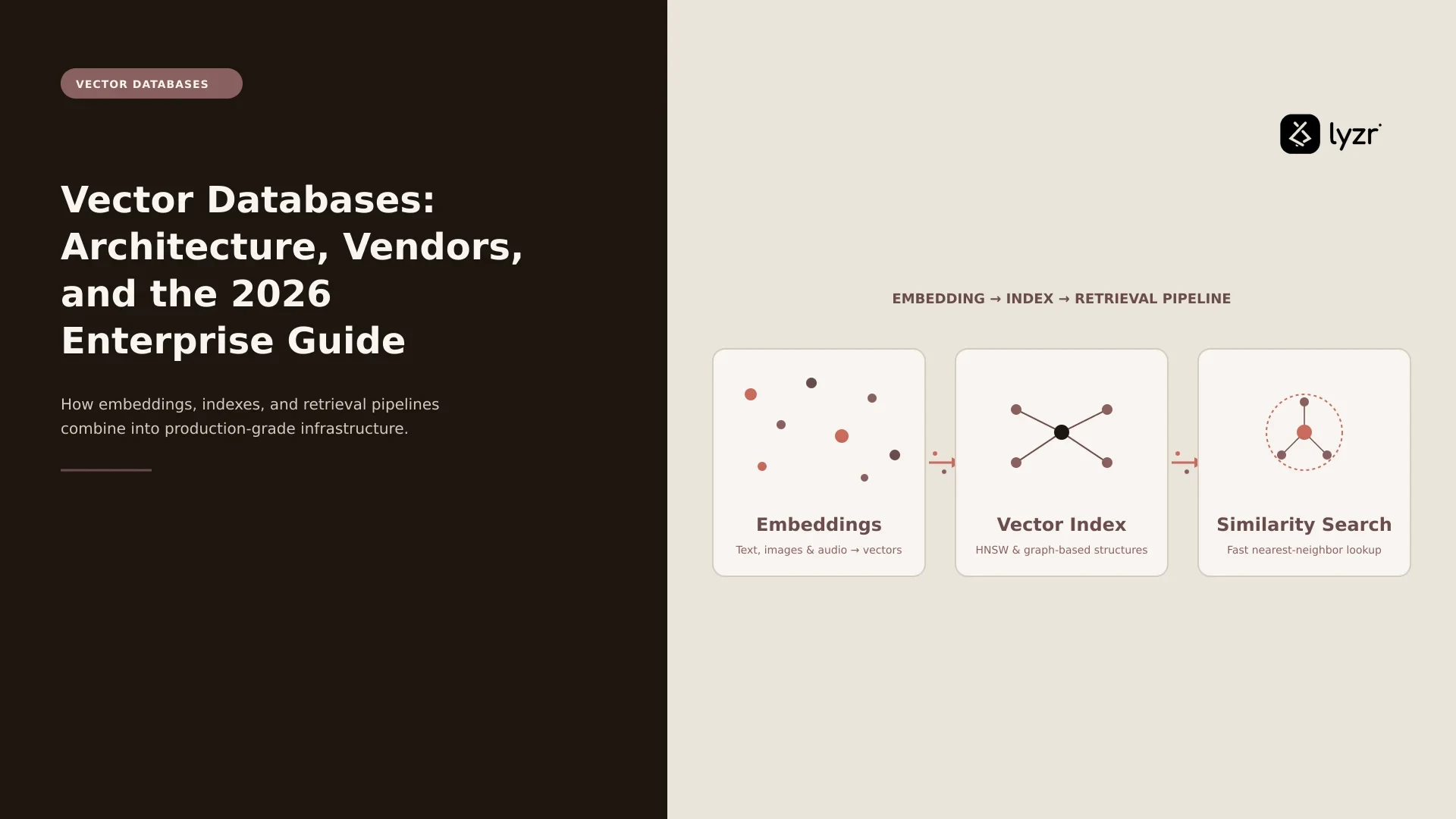
It is any database that allows you to store, index, and query vector embeddings, or numerical representations of unstructured data, such as text, images, or audio.
It finds matches using distance, not equality.
That is the core difference from what you already run.
Traditional databases store data in rows and columns, and to access this data you query rows that exactly match your query, while in a vector database, queries are based on a similarity metric.
Full-text search engines sit in between: they tokenize keywords into an inverted index, which catches lexical overlap but misses conceptual matches.
Vector databases fall into three types: vector-native, database-extended, and embedded. Each is a different implementation surface for the same underlying capability.
Enterprise pressure to build this correctly is real. Twenty-three percent of respondents report their organizations are scaling an agentic AI system somewhere in their enterprises, and an additional 39% are actively experimenting with agentic deployments, according to McKinsey’s State of AI 2025 report. Every one of those agents needs a place to store what it knows.
How vector databases work: embeddings, ANN, and similarity metrics
Three components determine retrieval quality: the embedding model, the search algorithm, and the distance metric.
Embeddings
An embedding model translates raw data, text, images, or audio, into an array of numbers that represents its meaning. Similar inputs land close together in that numerical space. Current models worth knowing: OpenAI’s text-embedding-3-small and text-embedding-3-large, Cohere’s embed-v4, Voyage AI’s voyage-3 and voyage-3-large, Google’s Gemini embedding (gemini-embedding-001), Nomic Embed, and BGE.
Multimodal embedding models place text and images in one vector space, so a text query can retrieve a relevant chart without an OCR preprocessing step. Model choice affects retrieval quality more than any other decision in the stack.
ANN algorithms
Scanning every vector for an exact nearest-neighbor match does not scale past a few million records. Approximate Nearest Neighbor (ANN) algorithms trade a small accuracy loss for large speed gains.
For millions of vectors, you use an ANN index like HNSW (Hierarchical Navigable Small World) or IVF (Inverted File), which Faiss also supports. LSH (Locality-Sensitive Hashing), Microsoft’s DiskANN, and Google’s ScaNN round out the field. HNSW is the default in most modern platforms.
Similarity metrics
Cosine similarity compares vector direction and ignores magnitude. Dot product weighs magnitude in. Euclidean distance (L2) measures straight-line distance between two points, and Manhattan distance (L1) sums absolute differences across dimensions. Your embedding model’s training method usually dictates which metric to use.

Vector database use cases
Retrieval-Augmented Generation (RAG) grounds an LLM with your private knowledge base at query time. It is the highest-volume enterprise use case for vector databases today. For the pattern where agents actively decide what and when to retrieve, read agentic RAG and the RAG glossary entry.
Semantic search returns conceptual matches, not keyword overlap. It powers enterprise search, documentation portals, and support ticket routing.
Recommendation engines surface similar products, media, or content by comparing behavior and attribute vectors.
Anomaly detection flags transactions, logs, or behavior that sit far from established vector clusters.
Multi-modal search lets you query across text, image, and audio in one embedding space.
Deduplication identifies near-duplicate records or documents through vector similarity instead of exact hashing.
Most of these use cases eventually route through a managed retrieval layer. See Knowledge Base as a Service for how that gets built, or how it connects to broader agentic workflows.
Read the agentic RAG pattern guide
Types of vector databases
Vector databases split into three categories. Each is a different implementation surface for the same underlying capability, and most enterprise stacks end up running more than one.

Vector-native databases are purpose-built for similarity search. Pinecone, Weaviate, Milvus, Qdrant, Chroma, LanceDB, and Vespa fall here. They give you the highest performance at scale and the most mature filtering and hybrid search features. This is the right starting point for greenfield builds.
Database-extended systems add vector search to a database you already run. pgvector for PostgreSQL, MongoDB Atlas Vector Search, Redis with RediSearch, Elasticsearch and OpenSearch with dense_vector, Cassandra, and Neo4j vector search all fit here. If your data already lives in one of these, unified operational and vector queries usually beat standing up a new system.
Embedded or in-process vector databases run inside your application, with no network hop. Chroma in local mode, LanceDB, DuckDB VSS, and sqlite-vec belong in this group. Use this category for prototyping, edge deployments, and low-scale applications. Retrieval that touches graph relationships instead of flat similarity, such as knowledge graphs, is a related but distinct pattern worth knowing about here.
The modern retrieval stack
A vector database is one component in a larger stack, and it is rarely the piece that fails first.

The embedding model converts raw content to vectors and is the single largest lever on retrieval quality. Chunking strategy, fixed-size, semantic, or hierarchical, determines what gets embedded in the first place; Lyzr’s model provider options are covered in model providers. The vector database stores those embeddings and runs the similarity search. Hybrid search layers BM25 keyword matching on top of vector search, recovering exact-match queries that pure vector search misses. A reranker, Cohere Rerank v3.5, Voyage rerank-2, or a BGE reranker, takes the top results and reorders them for precision. The LLM, whether Claude 4, GPT-5, Gemini 2.5, or Llama 4, consumes the reranked context and generates the answer. Persistent memory across sessions is a separate concern handled by a layer like Cognis, and orchestration runs through frameworks like LangChain, LlamaIndex, or Haystack, with MCP (Model Context Protocol) emerging as an integration standard. For more on how the LLM layer fits into agent design, see LLM agents and the LLM glossary.
Leading vector database platforms in 2026
Managed vector-native. Pinecone, Zilliz Cloud (managed Milvus), Qdrant Cloud, and Weaviate Cloud Services handle operations for you. MongoDB Atlas Vector Search also sits in this tier despite being database-extended, because it is common in managed deployments.
Self-hosted vector-native. Milvus, Qdrant, Weaviate, Vespa, and Marqo run on your own Kubernetes infrastructure. This tier suits teams with in-house platform expertise and sovereign data requirements.
Database-extended. pgvector, MongoDB Atlas Vector Search, Redis with vector support, Elasticsearch, OpenSearch, Neo4j vector search, and DataStax Astra DB avoid duplicating data into a separate store.
Embedded/in-process. Chroma in local mode, LanceDB, DuckDB VSS, and sqlite-vec fit prototyping, edge, and low-scale deployments.
Cloud provider integrated. AWS OpenSearch Serverless, Azure AI Search, Google Cloud Vertex AI Vector Search, Google AlloyDB with pgvector, and Amazon Bedrock Knowledge Bases work well if you are already committed to one cloud.
Vector libraries, not databases. Faiss (Meta), ScaNN (Google), hnswlib, and USearch are code libraries you embed directly, not standalone servers with persistence and APIs. Do not confuse the two categories when scoping a build.
If you want the specific setup flow for connecting a vector store inside Lyzr Studio, see setting up a knowledge base with Lyzr Studio.
How to evaluate a vector database
1. What is your target scale? Below 10 million vectors, most platforms perform similarly. Above 1 billion, Milvus, Vespa, and Pinecone are the proven options.
2. Do you need multi-modal search? Weaviate, Vespa, and Vertex AI Vector Search handle text and images natively. Others need an external multi-modal pipeline bolted on.
3. Managed or self-hosted? Managed buys speed. Self-hosted buys cost control at scale and data sovereignty. This decision maps directly to on-premise versus cloud AI.
4. Does your data already live in PostgreSQL or MongoDB? If so, pgvector or Atlas Vector Search often wins operationally over adding a dedicated vector store.
5. What are your latency and throughput requirements? Sub-100ms p99 at high queries per second narrows the field to vector-native platforms with HNSW indexes.
6. What deployment modes are supported? Regulated industries need VPC, on-premise, or sovereign deployment. Confirm this before you commit.
7. How does it integrate with your agent stack? Framework-agnostic platforms let you swap components without a rebuild. This is the core argument for framework-agnostic platforms.
Production reality: cost, sovereignty, and agent-specific requirements
Cost scales with dimensions and vector count, not just row count.
A 3,072-dimension vector takes twice the storage and search compute of a 1,536-dimension one, which compounds across millions of documents. Quantization techniques help here: Product Quantization compresses vectors aggressively, while scalar quantization and binary quantization shrink each number to a smaller size, are easier to use than Product Quantization, and are popular in production when you want to save memory with less effort.
Multi-tenancy matters once you move past a single agent. Enterprise deployments need per-agent or per-tenant knowledge isolation, through Pinecone namespaces, Weaviate multi-tenancy, or Qdrant collections. A tier-1 global bank runs auditable superagent knowledge across the enterprise with per-employee knowledge isolation, a pattern documented in Lyzr’s customer and case study work.
Incremental updates matter too. Vector databases often support real-time data updates, allowing for dynamic changes to the data to keep results fresh, whereas standalone vector indexes may require a full re-indexing process to incorporate new data.
For regulated industries, deployment mode is not optional; VPC, on-premise, or sovereign AI is the baseline. Retrieval accuracy also feeds directly into governance: a Responsible AI as a Service layer and a Hallucination Manager both depend on what the vector database returns. A framework-agnostic Control Plane is what governs vector databases consistently across cloud, on-premise, and embedded deployments at once.
See how the Control Plane governs vector databases across deployments
Frequently asked questions
What is a vector database?
A vector database is a specialized system designed to store, manage, and query high-dimensional vector embeddings. It uses mathematical distance metrics like cosine similarity to find unstructured data based on semantic meaning rather than exact keyword matching.
How do vector databases work?
They combine three components. Embedding models translate raw data into vectors. ANN algorithms like HNSW rapidly scan large datasets for close matches. Similarity metrics like cosine similarity or dot product measure how close two vectors actually are.
What is the difference between a vector database and a traditional database?
Traditional databases store structured data and match on exact values in rows and columns. Vector databases store high-dimensional embeddings and match on semantic similarity, which enables search over unstructured data like text, images, and audio.
What are examples of vector databases?
Vector-native platforms include Pinecone, Weaviate, Milvus, Qdrant, and Chroma. Database-extended options include pgvector, MongoDB Atlas Vector Search, and Redis. Embedded options include LanceDB and DuckDB VSS.
What are the best vector databases in 2026?
It depends on requirements. Managed vector-native: Pinecone, Zilliz Cloud. Self-hosted: Milvus, Qdrant, Weaviate. Database-extended: pgvector, MongoDB Atlas. Embedded: Chroma, LanceDB. Cloud providers offer their own integrated options too.
What are open-source vector databases?
Milvus, Qdrant, Weaviate, Chroma, LanceDB, Vespa, Marqo, and pgvector are all open source. Faiss and ScaNN are open-source libraries, not full databases. Self-hosted options give you data control and cost control at scale.
Is PostgreSQL a vector database?
PostgreSQL with the pgvector extension supports vector similarity search. It is not a dedicated vector database, but it works well when your existing data already lives in PostgreSQL and you want unified operational and vector queries.
How do vector databases work with RAG?
Documents are chunked and embedded, then stored in the vector database. At query time, the user’s question is embedded and used to retrieve top-k similar chunks, which are passed to the LLM as context for the response.
What is the difference between a vector database and a vector library?
Vector libraries like Faiss and hnswlib are code libraries you embed directly in an application. Vector databases like Pinecone and Milvus add persistence, replication, multi-tenancy, and API access as standalone production infrastructure.
How do I deploy vector databases in production?
Production deployment requires planning for scale, latency, cost, multi-tenancy, and sovereign requirements, then governing all of it through a framework-agnostic Control Plane and a tested production playbook.
Where to go from here
Your next step depends on where you sit today.
If you are still learning the retrieval pattern, read the agentic RAG guide. If you are building an enterprise knowledge base, explore Knowledge Base as a Service. If you are deciding on architecture and platform, read framework-agnostic platforms. If you work in a regulated industry, read Sovereign AI. If you are planning a production rollout, read the production playbook or the agentic AI roadmap. For a broader inventory of what to build first, the 101 AI use cases template and the agent diagnostic assessment are both useful starting points.
If you are ready to build, get started in Lyzr Studio or prototype architecture in Lyzr Architect. This full picture, vector databases, retrieval, governance, and orchestration, is what Lyzr’s Agentic OS is built to run. For a direct conversation about your specific requirements, book a demo.
Book A Demo: Click Here
Join our Slack: Click Here
Link to our GitHub: Click Here