TL;DR
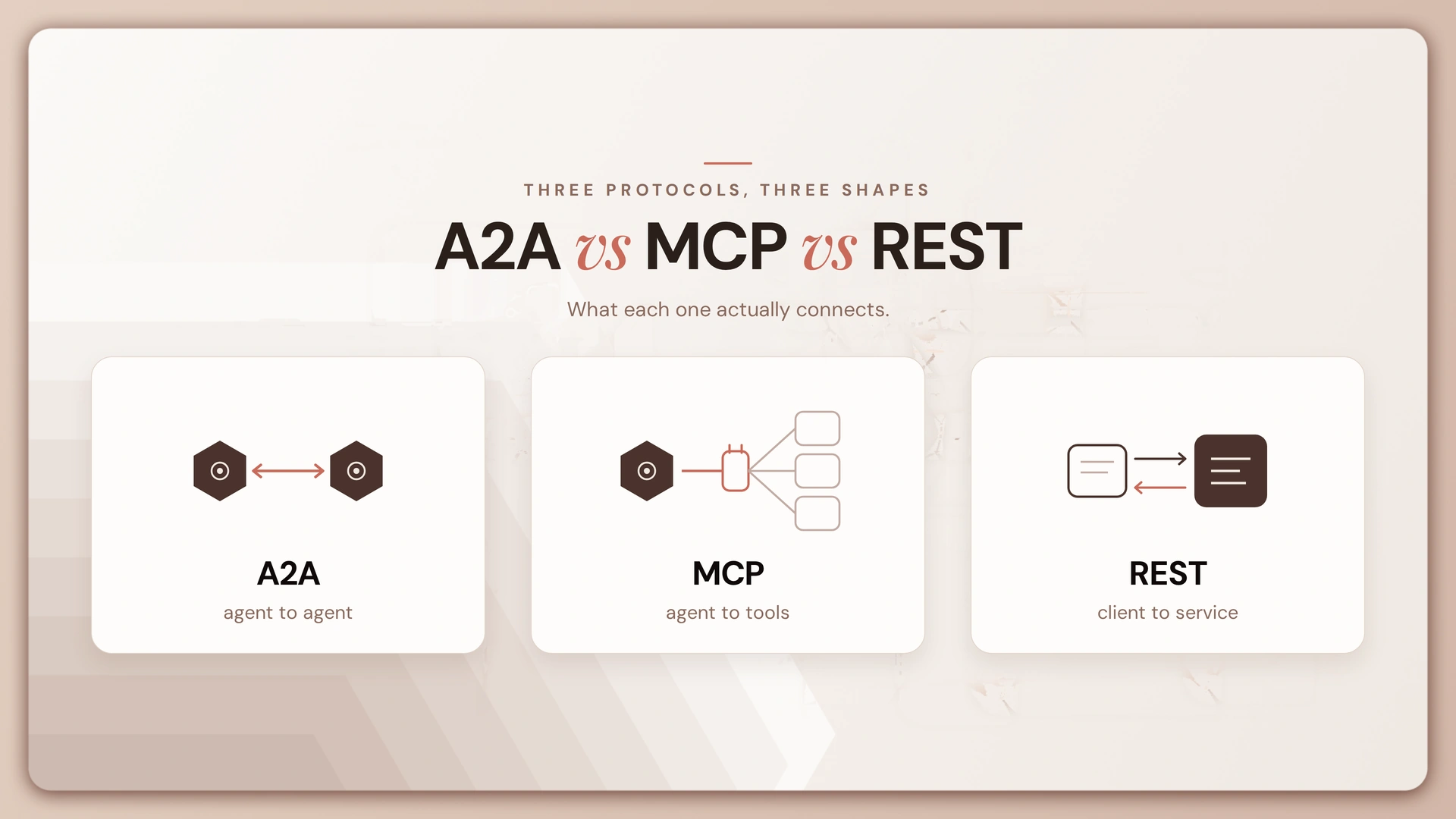
- REST connects services with a fixed, known contract. Use it for deterministic, consequential operations.
- MCP (Model Context Protocol) connects one agent to its tools and data, with capabilities discovered at runtime instead of hard-coded.
- A2A (Agent2Agent) connects independent agents to each other so they can delegate tasks across teams, frameworks, and vendors.
- ACP (IBM/BeeAI’s Agent Communication Protocol) existed as a fourth option in 2025. It merged into A2A in August 2025 and its repository is now archived. Don’t build new systems on it.
- These are layers, not competitors. Most production agent stacks run all three at once.
- The unaddressed risk: an MCP server is a supply-chain dependency, and A2A crosses trust boundaries by design.
- Facts checked against primary sources in September 2026: MCP specification 2026-07-28, A2A specification v1.0 (April 2026, Linux Foundation), ACP archived August 27, 2025.
Somebody on your team is going to ask which protocol the new agent should speak, and the honest answer is going to disappoint whoever wants a single word back.
Not because the question is unanswerable. Because it’s the wrong shape of question.
REST, MCP, and A2A don’t compete for the same job. They sit at different layers of the same system, and a production agent architecture built in 2026 tends to use every one of them somewhere. The interesting engineering decision isn’t which protocol wins. It’s where the boundary between them sits, and what happens to your security posture when you get that boundary wrong.
This is a comparison for the person drawing that boundary: what each protocol actually guarantees, where each one still has rough edges, what a fourth protocol (ACP) tells you about how fast this space is consolidating, and the same task implemented three different ways in Python so you can see the trade-off instead of taking someone’s word for it.
The Short Answer
If you came here for the decision and not the argument, here it is: use REST when the contract is fixed and known ahead of time, use MCP when an agent needs to discover and call tools at runtime, and use A2A when independent agents need to delegate work across a boundary you don’t fully control. Most systems need all three.
REST vs MCP vs A2A: The Core Trade-Offs
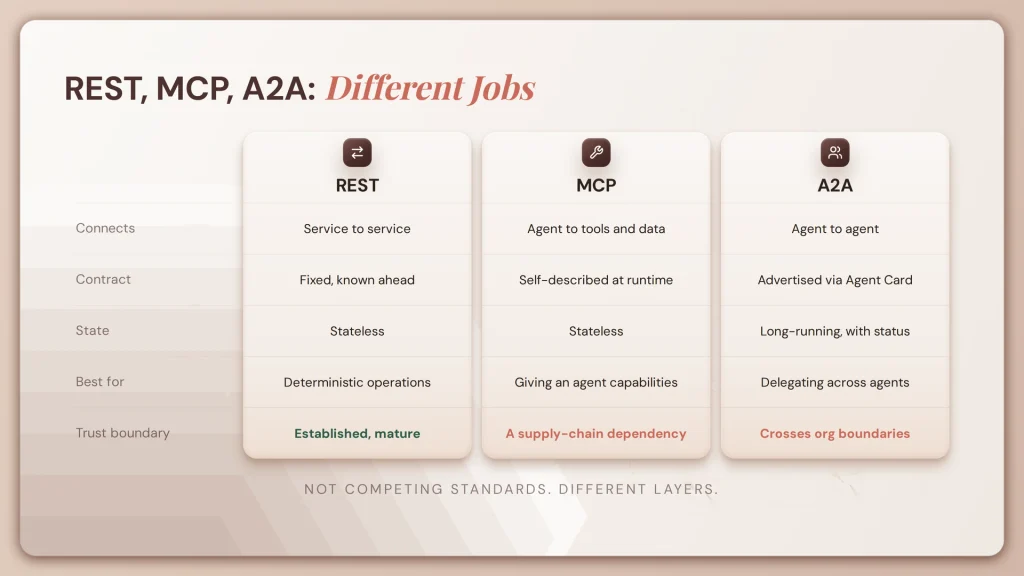
| REST | MCP | A2A | |
|---|---|---|---|
| Connects | Service to service | Agent to tools and data | Agent to agent |
| Shape | Synchronous request/response | Typed JSON-RPC, runtime discovery | Task-oriented, asynchronous |
| Contract | Fixed, known ahead of time | Self-described at runtime | Advertised via Agent Card |
| State | Stateless | Stateless as of the current spec | Long-running tasks with status |
| Discovery | Out of band (docs, OpenAPI) | Built in | Built in |
| Best for | Deterministic operations | Giving one AI agent its capabilities | Delegating across agents |
| Trust boundary | Established, mature | New; the server is a supply-chain dependency | Crosses org boundaries by design |
A payment call, a database write, an idempotent state change: that’s REST territory, because you don’t want a model improvising the contract. A model that needs to read a ticketing system, query a warehouse, or search internal docs without you writing a bespoke wrapper for each one: that’s what MCP standardizes. A manager agent handing a sub-task to a specialist agent built by a different team, on a different framework, possibly at a different company: that’s the problem A2A exists to solve.
REST, and Why It Didn’t Go Away
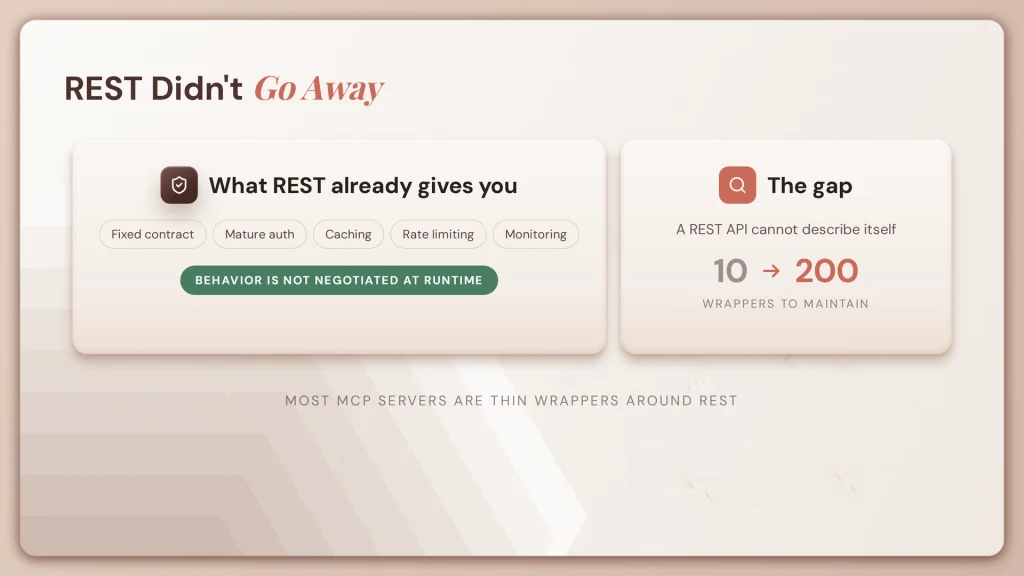
REST didn’t get replaced because its core property, a fixed contract that doesn’t change at runtime, is exactly what an agent architecture needs for anything consequential. You call an endpoint, you get a response, and the endpoint’s behavior tomorrow matches its behavior today because nothing inside the request negotiates that behavior on the fly.
That guarantee comes from decades of tooling most teams already trust: mature auth patterns, caching, rate limiting, and monitoring that agent-native protocols are still building toward. The gap is discovery. A REST API doesn’t tell an agent what it can do. Somebody has to describe it, whether that’s a hand-written function definition, an OpenAPI spec loaded into context, or a wrapper maintained alongside the endpoint. That works for ten tools. It becomes a maintenance job for two hundred, which is the actual agent API problem MCP was built to solve.
None of this makes REST the legacy option. It makes REST the right choice whenever you don’t want the model deciding what “get customer record” means at the moment it’s called. Worth noting: a large share of MCP servers in production today are thin wrappers around existing REST APIs. This isn’t REST versus MCP so much as MCP giving a model a way to discover a REST endpoint it would otherwise need hard-coded.
MCP: Giving One Agent Its Capabilities
MCP solves the integration math that breaks every agent project past a certain size: without a shared standard, N agents times M tools means N×M custom integrations.
MCP launched November 25, 2024, designed at Anthropic, and it standardizes the interface so a tool built once works with any MCP-compliant client.
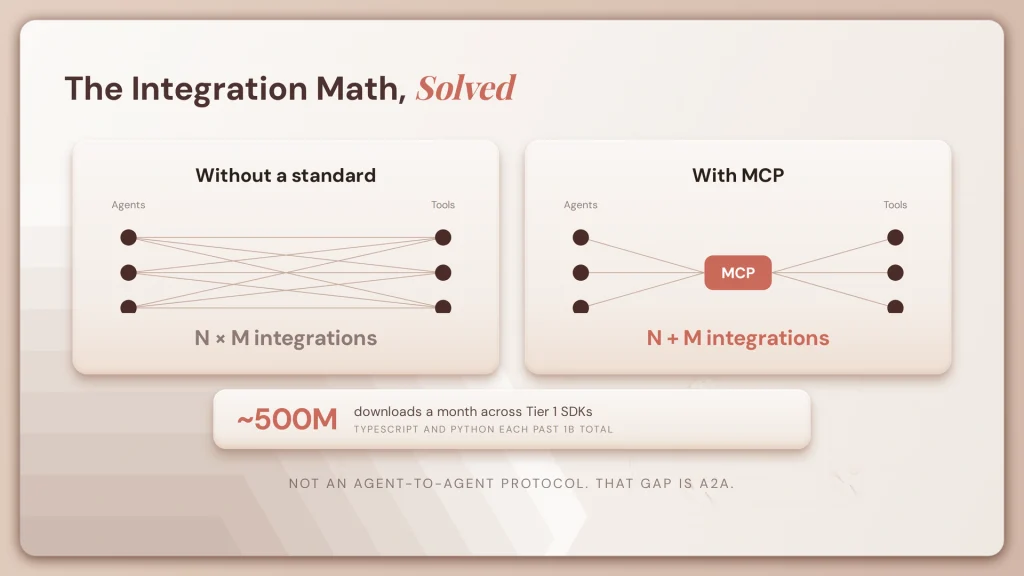
Here’s the mechanism. A client connects to an MCP server, asks what it can do, and the server describes its tools, resources, and prompts as structured schemas that land in the model’s context. The model reasons over those descriptions and asks the client to execute the ones it needs.
The 2026-07-28 Model Context Protocol specification brought a stateless protocol core, Multi Round-Trip Requests, header-based routing, cacheable list results, authorization hardening, a formal extensions framework, and updated Tier 1 SDKs.
That’s a substantial rewrite: earlier versions tracked session state with an Mcp-Session-Id header; the current spec removes that so any server replica can answer any request behind a plain load balancer, which is the difference between running MCP as a side project and running it as production infrastructure.
Transports, as of this spec: stdio for local processes only, and stateless Streamable HTTP for anything remote, which replaced the older session-based streaming model. Authorization has been hardening in the same direction, with MCP servers now expected to behave as OAuth Resource Servers, adding protected resource metadata to discover the corresponding authorization server, and the 2026-07-28 release adding further changes that align more closely with OAuth and OpenID Connect deployments.
Adoption is the strongest signal in this whole comparison.
Across Tier 1 SDKs, MCP is seeing close to half-a-billion downloads a month, with both the TypeScript and Python SDKs crossing the 1 billion total downloads threshold.
That’s not a niche standard.
What MCP is not: an agent-to-agent protocol, or a workflow engine. It connects one client to a set of tools. It has nothing to say about two independent agents coordinating, and that gap is exactly what A2A fills.
A2A: Agents Delegating to Agents
A2A exists because independent agents, often built by different teams on different frameworks, need to hand work to each other without one being embedded inside the other’s codebase.
A2A was announced by Google in April 2025 as an open protocol for secure agent-to-agent communication and collaboration, and the Linux Foundation launched the project in June 2025.
The mechanics: an agent publishes an Agent Card describing its capabilities, another agent discovers that card and submits work as a Task, and the task moves through a defined lifecycle while the requesting agent polls or subscribes to status.
Layer 1 of the specification defines core objects including AgentCard, AgentSkill, Task, Message, Part, Artifact, and Extension. Layer 2 defines abstract operations including SendMessage, SendStreamingMessage, GetTask, ListTasks, CancelTask, SubscribeToTask, push-notification configuration, and Agent Card retrieval. Layer 3 defines protocol bindings: JSON-RPC 2.0 over HTTPS as the primary binding, gRPC with Protocol Buffers, and HTTP/JSON/REST.
Failures aren’t silent: if an operation fails, the server returns a specific error code, either synchronously or asynchronously by transitioning the task to a failed or rejected state.
As of April 2026, A2A reached v1.0 under Linux Foundation governance, and the release matters beyond the version bump.
V1.0 introduced multi-protocol support, enterprise-grade multi-tenancy, modernized security flows including Signed Agent Cards, and a defined migration path for early adopters.
Signed Agent Cards are the direct answer to a question that dogged earlier A2A deployments: how does a receiving agent trust that the Agent Card it just fetched actually belongs to the organization it claims to represent. Adoption backs this up.
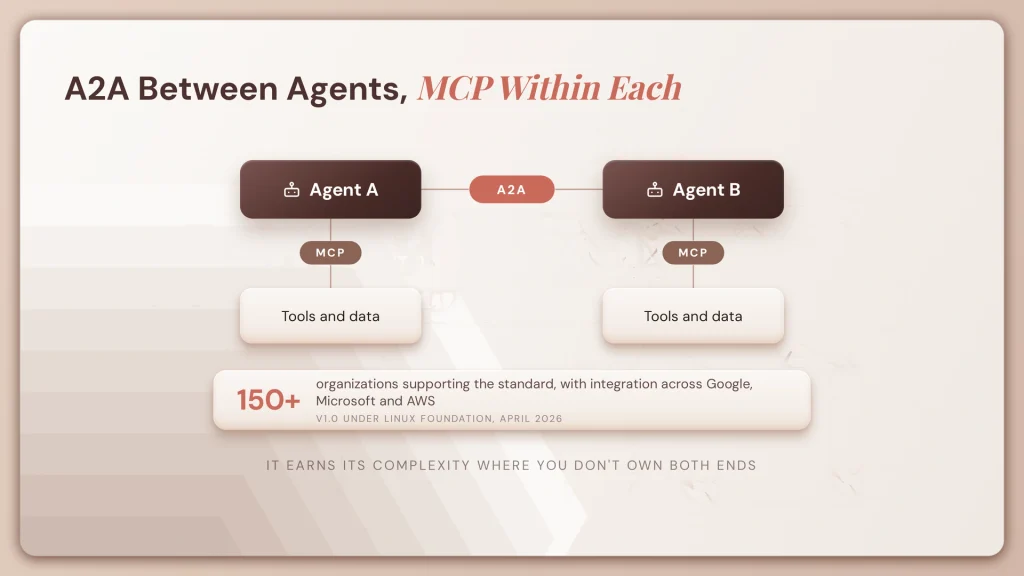
More than 150 organizations support the standard, with deep integration across Google, Microsoft, and AWS platforms, and active production deployments across multiple industries.
Say the maturity gap plainly: A2A is a year newer than MCP and its ecosystem is thinner, even at v1.0. And here’s the caveat most comparison pages skip. A2A’s own documentation frames the relationship directly:
“An agentic application might primarily use A2A to communicate with other agents. Each individual agent internally uses MCP to interact with its specific tools and resources.”
Much of what A2A standardizes, task queues, status polling, structured handoffs, you can build today with REST and a job queue if you own both ends. The protocol earns its complexity specifically at the boundary where you don’t own both ends, which is why multi-agent architectures that cross organizational lines reach for it and single-team agent orchestration usually doesn’t need to.
ACP and the Wider Protocol Landscape
ACP is worth covering honestly rather than skipping, because it’s the clearest lesson this space has produced about betting on a young standard.
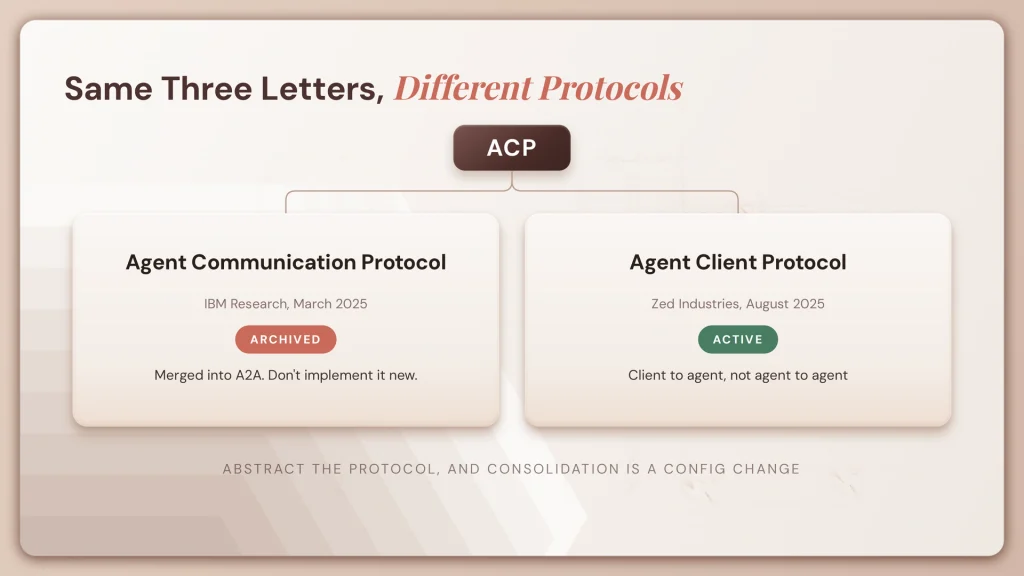
IBM Research launched the Agent Communication Protocol in March 2025 to power its BeeAI platform, then donated it to the Linux Foundation. It was a REST protocol with an OpenAPI specification: GET /agents to discover, POST /runs to execute, and Message/MessagePart structures carrying multimodal content.
It solved the same problem as A2A, built by a different vendor, five months earlier.
As of August 2025, that competition ended.
The two teams announced ACP was joining A2A under the Linux Foundation. The ACP repository was archived on August 27, 2025, and is read-only, with a migration guide in its README. BeeAI, which ACP was built for, now runs on A2A.
If you’re evaluating protocols today, ACP is historical context, not a live option. Don’t implement it new.
One disambiguation worth having, because the acronym got reused: a separate “Agent Client Protocol,” built by Zed Industries and launched in August 2025, survives and solves a different problem: not agent-to-agent, but client-to-agent, connecting editors and CLI tools to coding assistants. Same three letters, unrelated protocol, unrelated purpose. Check which one a source means before you cite it.
The pattern underneath both stories matters more than either protocol. Agent frameworks and communication standards have been converging fast, and IBM’s own migration validates the approach A2A took rather than the one ACP took. If your team wraps protocol-specific calls behind an internal interface, a consolidation like this costs you a config change. If protocol-specific code is scattered through the application, it costs you a rewrite. The open-source agentic framework layer above the protocol is exactly where that abstraction should live.
The Security Dimension Nobody Covers
Every comparison on this topic explains what these protocols do. Almost none explain what they expose, and the exposure is where the real decision-making should happen.
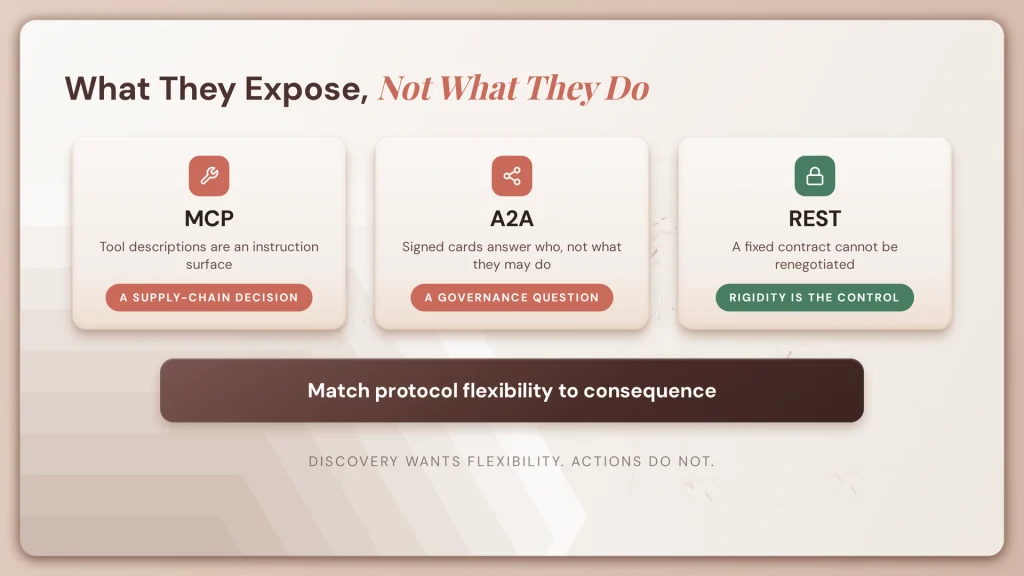
An MCP server is untrusted content entering your context window. The core mechanism that makes MCP useful, tools describing their own schemas to the model at runtime, is also a text-based instruction surface.
Security teams no longer just need to think about users interacting with models; they also need to think about agents acting autonomously, interacting with services via MCP, and exploring the internet on their own.
A tool description a model reads and acts on is structurally the same shape as a prompt injection vector. Installing a third-party MCP server is a supply-chain decision, not a configuration change: it grants that server a position inside the trust boundary of every agent that connects to it. Treat it like any other dependency. Know its provenance, pin its version, review its updates, and scope what it can reach to the minimum the task requires.
A2A crosses organizational trust boundaries by design. Its entire purpose is letting agents you don’t control accept work from agents you do, or the reverse. Signed Agent Cards answer the authentication half of that question. They don’t fully answer what a delegated task authorizes downstream, how far a compromise propagates through a multi-hop delegation chain, or who’s accountable for an action taken three agents removed from the human who started the request. Those are governance questions as much as protocol questions, and they belong in the same conversation as your broader AI agent governance posture, not treated as solved because the wire format is standardized.
REST’s rigidity is a control, not a limitation. A fixed contract can’t be renegotiated at runtime by anything the model reads. For a payment, a data-destructive write, or anything else with real consequence, that’s the property you want. A reasonable architecture uses MCP for discovery and read access, and keeps REST, behind an approval gate, for the operations that actually move money or delete data.
The general principle: match protocol flexibility to consequence. Discovery and reasoning benefit from flexibility. Actions with consequences don’t. Most incidents in production agent systems, the ones that end up as shadow AI agent postmortems, trace back to a flexible protocol being handed access to an operation that needed a rigid one.
The Same Task, Three Ways
Line count isn’t the interesting difference between these three implementations. Where the contract lives is.
Here’s one task, retrieve a customer record and produce a summary, implemented three ways. Library versions checked in September 2026: requests 2.x, the official mcp Python SDK targeting spec 2026-07-28, and a2a-sdk 1.x against A2A spec v1.0.
REST
The contract is fixed and known before the agent is ever built:
import requests

def get_customer_summary(customer_id: str, token: str) -> str:
    resp = requests.get(
        f"https://crm.internal/api/v1/customers/{customer_id}",
        headers={"Authorization": f"Bearer {token}"},
        timeout=5,
    )
    resp.raise_for_status()
    return summarize(resp.json())

# The model only knows this exists because someone wrote this
# function definition and shipped it to the model's context:
tool_spec = {
    "name": "get_customer_summary",
    "description": "Fetch a customer record by ID and return a one-paragraph summary.",
    "parameters": {
        "type": "object",
        "properties": {"customer_id": {"type": "string"}},
        "required": ["customer_id"],
    },
}
MCP
The same capability, but discoverable at runtime instead of hard-coded into the prompt:
from mcp.server.fastmcp import FastMCP

mcp = FastMCP("customer-tools")

@mcp.tool()
def get_customer_summary(customer_id: str) -> str:
 """Fetch a customer record and return a one-paragraph summary."""
 record = crm_client.get(f"/customers/{customer_id}")
 return summarize(record.json())

if __name__ == "__main__":
 mcp.run(transport="streamable-http")

# Client side, discovering the tool instead of hard-coding it:
from mcp import ClientSession
from mcp.client.streamable_http import streamablehttp_client

async def call_tool():
 async with streamablehttp_client("https://tools.internal/mcp") as (r, w, _):
 async with ClientSession(r, w) as session:
 await session.initialize()
 await session.list_tools()
 result = await session.call_tool(
 "get_customer_summary", {"customer_id": "C-4471"}
 )
 return result.content[0].text
A2A
The task is delegated to a specialist agent you don’t own, and you track it as work rather than a function call:
from a2a.client import A2AClient
from a2a.types import MessageSendParams, Part, TextPart

async def delegate_summary():
    client = await A2AClient.get_client_from_agent_card_url(
        "https://specialists.internal/customer-agent/.well-known/agent-card.json"
    )
    task = await client.send_message(
        MessageSendParams(
            message={
                "role": "user",
                "parts": [Part(root=TextPart(text="Summarize customer C-4471"))],
            }
        )
    )
    while task.status.state not in ("completed", "failed"):
        task = await client.get_task(task.id)
    return task.artifacts[0].parts[0].root.text
The REST version assumes you already know the endpoint exists. The MCP version lets the model discover it, at the cost of running a server. The A2A version doesn’t call a function at all, it submits work to something with its own reasoning loop and waits for a result, which is the right model when the other side is genuinely a separate agent and the wrong model when it’s really just a service you’re overcomplicating.
How to Choose
Do you control both ends? If yes, REST plus a job queue is usually the lowest-risk answer. Protocol complexity earns its keep at boundaries you don’t control, not inside a system you already own end to end.
Does the model need to discover the capability, or do you know it at build time? Runtime discovery is MCP’s entire reason to exist. A fixed, small tool set doesn’t need it.
Are the participants agents or services? A2A assumes an autonomous peer with its own reasoning loop on the other end. If the other side is a stateless function, it’s a service, and A2A is overhead, not capability.
What’s the consequence of the operation? Higher consequence argues for a fixed contract and an approval gate, regardless of what protocol surrounds it. This is where the agent types running in production start to diverge from the demo version of the same idea.
How much protocol-specific code ends up scattered through your application? That number is your switching cost, and in a space that consolidated one competing protocol in its first eighteen months, switching cost is not a hypothetical concern. Teams that hit this wall usually recognize it as one entry in a longer list of enterprise AI agent challenges, not an isolated protocol decision.
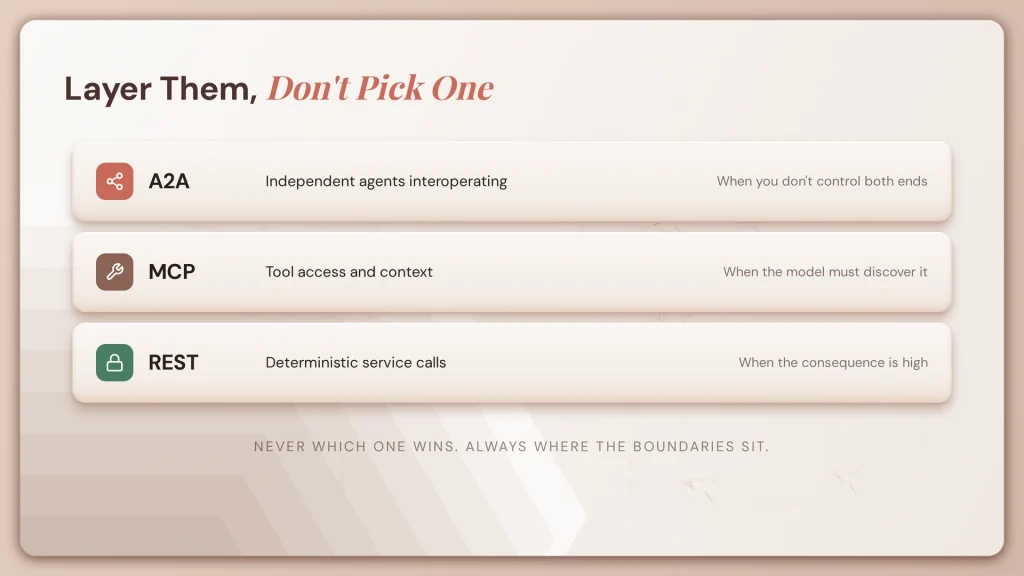
Layer them: REST for deterministic service calls, MCP for tool access and context, A2A where independent agents genuinely need to interoperate. The architecture question was never which one wins. It’s where the boundaries between them sit in your system.
Where an Agent Platform Fits
None of the three protocols above give you a permission model, an evaluation pipeline, a decision trace, or a registry of which agent is allowed to call which tool. Those sit above the protocol layer, and every team running agents in production builds or buys them regardless of which wire format their agents happen to speak.
This is where Lyzr’s role is additive, not competitive. An agent platform that already speaks MCP and A2A turns your protocol choice into a configuration decision instead of an application rewrite, which is the practical version of the abstraction argument from the ACP section above. Lyzr’s Agent Studio supports both natively, so a manager agent can call MCP-exposed tools and delegate to external A2A agents inside the same workflow without custom glue code for either.
Governance is the harder half. Permission scoping, approval gates, and decision traces need to apply consistently whether a capability arrived over REST, MCP, or A2A, which is exactly the job of Lyzr’s Control Plane. That consistency is what turns the security section above from a list of open questions into an enforceable policy, and it’s the piece platform teams and CTOs end up owning once agents cross from pilot into production, whether that’s run as Orchestration as a Service, Agents as a Service, or wired into an existing Responsible AI program.
To be direct about what this isn’t: Lyzr isn’t a protocol, and it isn’t a replacement for one. It’s the layer that makes the protocol choice a detail instead of a rewrite.
Frequently Asked Questions
What is the difference between MCP and A2A?
MCP connects one agent to tools and data. A2A connects independent agents to each other. They sit at different layers of the stack and are commonly used together in the same system.
What is the difference between REST and MCP?
REST has a fixed contract known ahead of time. MCP lets tools describe themselves to a model at runtime, so an agent can discover new capabilities without a hard-coded integration for each one.
Is MCP like an API but for AI?
Close, but the distinction matters. MCP is a standard way to expose existing APIs and data to a model, with discovery built into the protocol. It usually sits in front of a REST API rather than replacing it.
When should I use MCP instead of REST?
When the agent needs to discover a capability at runtime, or when you’d otherwise be hand-writing a wrapper per tool. Keep REST for deterministic, consequential operations behind an approval gate.
What is ACP?
IBM’s Agent Communication Protocol, built for the BeeAI platform in March 2025. It merged into A2A in August 2025 and its repository is archived. Don’t build new systems on it.
Do I need both MCP and A2A?
Often, yes. MCP gives an agent its tools. A2A lets agents delegate to each other. They solve different problems, and most multi-agent systems in production use both.
When should I use MCP vs a CLI?
A CLI works fine for a fixed workflow you invoke yourself. MCP matters once a model needs to discover and call the capability without you scripting each invocation by hand.
Is A2A production ready?
A2A reached v1.0 in April 2026 under Linux Foundation governance, with more than 150 supporting organizations and active production deployments. Its ecosystem is still thinner than MCP’s, so check current SDK support before committing.
Are MCP servers safe to install?
Treat every one as a dependency, not a plugin. Tool descriptions are text the model reads and acts on, which puts the server inside your agent’s trust boundary. Use known provenance and least-privilege scoping.
Will these protocols consolidate further?
Likely. ACP’s merger into A2A in 2025 wasn’t an isolated event; several overlapping standards emerged in the same window. Keeping protocol-specific code behind an internal interface is the practical hedge.
The Question Worth Sitting With
The versus framing in the title of every article on this topic, including the search results that brought you here, is doing a disservice to the actual decision in front of you. REST, MCP, and A2A aren’t three answers to one question. They’re answers to three different questions, and the system you’re building probably needs all three answered at once.
The harder question is the one this article spent its middle third on: which of your agent’s connections are flexible because they need to be, and which are flexible because nobody stopped to ask. Go open docs.lyzr.ai and try wiring one MCP-discovered tool and one A2A delegation into the same agent. The place where that exercise gets uncomfortable is usually where your real architecture decision is hiding.
Book A Demo: Click Here
Join our Slack: Click Here
Link to our GitHub: Click Here