Live in production · North America

300 hours of billing work.
Every day. Automated.

One of the world's largest insurance brokerages runs Lyzr AI agents inside its live North American billing operation. What billers spent 18 minutes doing by hand now takes seconds to process.

0+
Invoices per day,
deployed scope
0%
Reduction in manual data
entry per activity
5 → 1
Systems collapsed into
one review interface

Slotted alongside the stack already in place

At a glance
RegionNorth America
FunctionBilling Operations
Team~40 billing analysts
Volume~1,000 invoices / day in scope
SystemsEPIC, RMS, IRD, CABR, Industry Mapper
Insurance Brokerage Finance Ops Agentic AI Human-in-the-Loop
The Client

Global scale.
A workflow still running on people.

A leading global insurance brokerage and advisory firm. North America. B2C billing operations processing a continuous stream of activities — every day, without pause.

Financial and risk services — one of the largest in the world
North America billing team processing 1 million+ invoices annually
Mature enterprise stack: EPIC, SharePoint, Azure AD already in place
Gap: AI remained assistive, not operational — every workflow hit a ceiling within 12 months
The Challenge

Four problems.
One number that explains all of them.

01

Five systems. One biller.

EPIC, RMS, Industry Mapper, IRD, CABR
Every activity = five separate logins
Constant context switching — no single view
02

19 fields. All typed by hand.

Policy numbers, premiums, dates, commissions
Re-keyed from unstructured PDFs and emails
Every activity. Every time.
03

Every biller, slightly different.

No standardized process between operators
Errors surface weeks later — in compliance
Expensive to trace. Costly to fix.
04

No audit trail that holds up.

No field-level record of who changed what
Compliance questions had no clean answer
The answer lived in the biller's memory
~1,000
invoices / day
×
18
minutes / invoice
=
300 hrs
of analyst time. Every working day.
The Solution

9 agents. 22 steps.
One review screen.

An orchestrated pipeline of AI agents handles gathering, reading, extracting, and validating. The biller reviews a single confidence-scored dashboard and approves. Nothing posts without their sign-off.

AGENTagent/activity-parser
Activity Parser
Pulls open activities from EPIC every 5 minutes, no manual queue.
AGENTagent/rms-retrieval
RMS Agent
Retrieves binders, invoices, and quotes from SharePoint. Encrypted, logged.
AGENTagent/ocr
OCR Agent
Converts PDFs and emails to structured, machine-readable text.
AGENTagent/kv-extraction
Key Value Extraction
All 19 billing fields extracted, each with a confidence score.
parallel
AGENTagent/epic-validate
Validation Agent
Cross-checks extracted data against EPIC policy records.
AGENTagent/industry-mapper
Industry Mapper
Classifies by department, profit centre, and line of business.
parallel
AGENTagent/ird-validate
IRD Validation
Checks for special invoice routing instructions.
AGENTagent/cabr-validate
CABR Validation
Confirms premium payable entity and banking reference.
AGENTagent/dashboard-summary
Dashboard Summary
Assembles outcomes and recommended actions for the biller.
HUMAN GATEhuman/biller
Biller Approval
Reviews, corrects, or raises an RFI. Nothing posts without sign-off.
edit any field → partial rerun, only downstream steps approved corrections retrain future runs 9 agents · 22 steps · 1 human gate
scroll to run
How it works — click any step to expand

The pipeline above compresses into six phases a biller actually experiences — most of which they never have to think about.

01
Activity Intake
System auto-fetches open billing activities from EPIC every 5 minutes. No manual pulling.
Filters by North America owner codes automatically
Search by Activity ID, client code, policy number, or entity
Auto-run scheduler clears backlog — no human trigger needed overnight
02
Document Retrieval
RMS Agent reads activity notes and retrieves binders, invoices, quotes from SharePoint. Encrypted and logged.
Follows direct paths when available; recursive search otherwise
Every document linked back to original for side-by-side comparison
Transfer integrity-checked on every download
03
OCR + 19-Field Extraction
PDFs become structured data. 19 billing fields extracted, each with a confidence score. Large documents split and parallelized.
Policy numbers, premiums, dates, commissions, payable entities — all automatic
Conflicting documents: most recent wins, reasoning recorded
Score 90%+ = auto-process. Below 85% = biller reviews.
04
Multi-Layer Validation
Five check groups run automatically: EPIC, Industry Mapper, IRD routing, CABR banking, billing consistency.
Fuzzy client name matching (85% threshold), exact policy matching, semantic LOB classification
Commission cross-checks: commission = rate × premium within tolerance
Every mismatch surfaces with expected vs. actual — not just a red flag
05
Human Review and Approval
One dashboard. All checks. Document alongside extracted values. Biller corrects, approves. Nothing posts without sign-off.
Edit any field — partial rerun executes only what's downstream. Upstream compute reused.
Every edit: field-level diff with user, timestamp, and biller notes
Raise RFI when data is missing — no guessing
06
Self-Learning Loop
Biller corrections feed back into the agents. The system improves with every use. Auto-rate rises. Manual corrections fall.
Approved corrections become better prompts — injected into future runs
Billing expertise encodes into the pipeline — not locked in senior billers' heads
Cost per invoice decreases as accuracy increases
9 agents in the pipeline
Activity Parser
Reads notes, extracts policy IDs and document links
RMS Agent
Locates and downloads billing documents from SharePoint
OCR Agent
Converts PDFs and emails to machine-readable text
Key Value Extraction
Pulls all 19 billing fields with confidence scores
Validation Agent
Cross-checks extracted data against EPIC policy records
Industry Mapper
Classifies policy by department, profit centre, GLOB type
IRD Validation
Checks for special invoice routing instructions
CABR Validation
Confirms premium payable entity and banking reference
Dashboard Summary
Produces outcomes and recommended actions for the biller
Inside the product
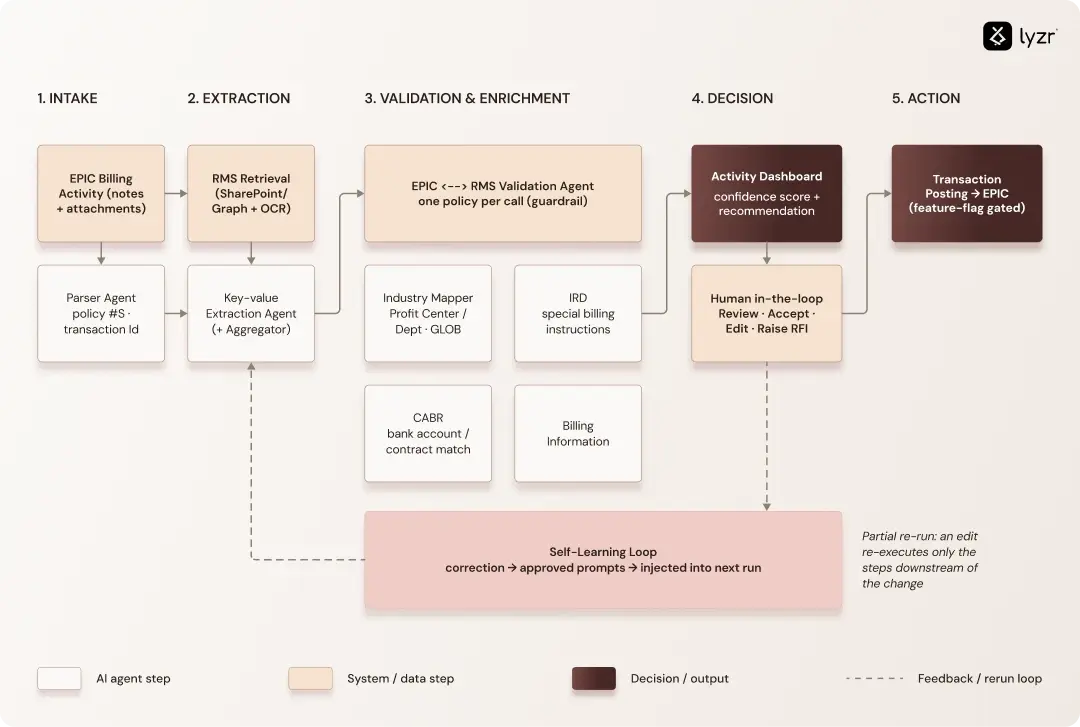
B2C Billing Automation — Agentic Data Flow diagram
Activity work queue dashboard
Activity detail with attachments and policy list
Activity detail with validation checks
The Outcome

What changed.
By the numbers.

Design targets, built into the architecture from day one and instrumented per activity. Baseline vs. actual captured on every run.

~0%
Straight-through automation. Activities auto-processed without manual data entry.
~0% faster
Billing turnaround time. From activity open to biller-approved, ready to post.
~0%
Manual validation steps eliminated. Five check groups run automatically — exceptions surfaced.
~0% fewer
Billing errors and corrections. Per-policy validation and pipeline consistency remove operator variance.
What Actually Changed

The shift that took longest to explain — and mattered most.

Ownership model

From a tech-owned project to a co-owned workflow.

The architecture was never just about speed. Business teams now design and evolve the billing workflow directly — IT became the enabler, not the bottleneck for every change.

Not every change needs a sprint anymore. — the shift leadership felt first.
Before
×AI projects owned and driven by technology teams
×Business teams consulted at the requirements stage, then handed off
×Every change required a developer; iteration was slow
×AI as a capability: assistive, advisory, not operational
After
Tech and business teams co-own the workflow — actively
Business teams design and evolve workflows, not just approve them
IT as architect and enabler — not every change needs a sprint
AI as infrastructure: live in the bill-to-cash operation, daily
Controls and Governance

Every result is reviewable.
Every edit is recorded.

Built for a finance operations team that could not afford an opaque system — where compliance, auditors, and senior leadership all need a clear answer to "why was this billed this way?"

Two HITL checkpoints: Activity Parser stage and Key Value Extraction stage
Edit any extracted field — partial rerun executes only downstream steps
Raise an RFI when data is missing — the activity is flagged, never guessed
Nothing posts to EPIC without explicit biller approval
Feature-flag gating — write-back can enable gradually as trust builds
Same judgment, far less transcription — billers keep the call, lose the typing
Field-level edit history on every correction: run ID, timestamp, step, policy, field, old value, new value
Who made the change, with biller status and notes attached
Full report exportable to CSV / Excel for compliance teams
Analytics dashboard: where runs fail, how often HITL triggers, throughput
Every document transfer logged, encrypted in transit, integrity-checked
Full prompts are not logged in production — compliance-aware by design
Azure Active Directory authentication — users explicitly assigned
Role-based feature sets: Admin and Biller roles with separate permissions
JWT auth, strict CORS allow-list, rate limiting, request-size limits
Managed-identity database access — no hardcoded credentials
Resilience: retries with backoff, startup reconciliation of interrupted runs
Slotted into existing Azure infrastructure — no new auth layer required
Owner reassignment — billing activities can be transferred between team members
No architectural change required to the existing EPIC or SharePoint environment
Read It From Your Seat

This story reads differently
depending on where you sit.

Pick your role. We'll surface what matters to you.

01

Cost recovery is built in

300 analyst-hours recaptured daily — the floor, before accuracy gains compound and the auto-rate rises with use.

02

Errors caught at creation

~60% fewer billing errors, caught before they ever reach compliance. Corrections that used to cost weeks now surface in seconds.

03

Audit questions have answers

Every field, every change, every reason — logged and exportable. Compliance stops chasing billers for explanations.

04

Cheaper the more it runs

Biller corrections improve future runs. Cost per invoice decreases as the pipeline learns from every approval.

01

No architectural change

Slotted alongside EPIC, SharePoint, and Azure AD — evaluation to production without a platform migration or new auth layer.

02

Security-first by design

JWT auth, Azure AD, CORS allow-list, managed-identity database access, rate limiting. Compliance-aware logging in production.

03

Built for operational resilience

22 dependency-ordered steps, parallel OCR with bounded concurrency, retries with backoff, startup reconciliation of interrupted runs.

04

Partial rerun architecture

Edit one field, re-execute only downstream steps. Feature flags control the rollout of write-back to EPIC.

01

Billers gained clarity, not less control

One dashboard, confidence scores, source document beside extracted values. Same judgment, far less transcription work.

02

Operations visibility that didn't exist

An analytics dashboard shows where runs fail, how often human review triggers, and throughput across the team, in real time.

03

The backlog clears without a trigger

An auto-run scheduler picks up open activities and emails a batch report automatically. Night shifts stop being a bottleneck.

04

One pattern, repeatable across teams

The same agentic pipeline and governance model already scales across billing teams and geographies — the blueprint exists.

Keep Reading

Other Lyzr deployments worth a look.

Got a use case in mind?

8 weeks from idea to
agents in production.

Platform, engineers, governance all in. Bring your use case and your environment. We'll show you the path from here.