“Who Approved This Agent?”
That’s becoming a very important question inside European enterprises right now.
Not: “What model are we using?”
Not: “How autonomous is the workflow?”
But: “Who approved this agent, what data can it access, and how do we control it?”
Because AI agents are no longer isolated experiments running inside innovation teams.
They’re starting to interact with:
- internal systems
- employee workflows
- customer operations
- financial processes
- enterprise data
And for CISOs, that changes the conversation completely.
The concern is no longer just AI capability.
It’s operational control.
The Biggest Concern Isn’t the Model
This is one of the biggest mindset shifts happening among CISOs.
Most security leaders are no longer asking:
“Which model are we using?”
They’re asking:
- Where does the data go?
- How are prompts managed?
- Who can modify workflows?
- Can agent behavior be audited?
- What happens after deployment?
- How do we prevent uncontrolled autonomy?
Because in practice, the operational layer around AI usually creates more risk than the model itself.
What CISOs Are Actually Evaluating in 2026
When European CISOs evaluate AI agent platforms today, the checklist looks very different from what it did a year ago.
| Earlier AI Conversations | Current CISO Conversations |
| “Can the model reason well?” | “Can the workflow be governed?” |
| “How autonomous is the agent?” | “How controlled is the agent?” |
| “How fast can we deploy?” | “How safely can we deploy?” |
| “How many workflows can it automate?” | “How do we audit those workflows?” |
| “Can teams build agents easily?” | “Can teams build agents securely?” |
This is the operational maturity phase of enterprise AI.
And Europe is moving toward it faster than most regions.
Why European Enterprises Are More Sensitive to AI Governance?
European organizations already operate inside stricter regulatory environments.
That includes:
- GDPR
- DORA
- NIS2
- AI governance frameworks
- financial compliance standards
- sector-specific data regulations
As AI agents become operational systems, CISOs now need visibility into:
- how agents access data
- where workflows execute
- how memory is retained
- who changes prompts
- how deployments are approved
- how audit trails are maintained
Without these layers, AI systems quickly become difficult to govern safely.
What European CISOs Actually Need From an AI Agent Platform
The conversation is increasingly shifting away from “AI features” and toward operational controls.
Here’s what security leaders are prioritizing.
1. Clear Governance and Auditability
This is becoming non-negotiable.
CISOs need:
- change tracking
- deployment history
- approval workflows
- rollback visibility
- operational audit trails
Because AI agents evolve constantly.
Prompts change.
Memory changes.
Workflows evolve.
Permissions expand.
Without visibility into those changes, operational risk increases quickly.
| Governance Requirement | Why CISOs Care |
| Audit trails | Track operational changes |
| Approval workflows | Prevent uncontrolled deployments |
| Version history | Understand behavior changes |
| Rollback support | Recover from risky updates |
| Access controls | Limit unnecessary permissions |
For security teams, governance is no longer optional infrastructure.
It’s foundational infrastructure.
2. Strong Data Control
European enterprises are especially sensitive to data movement.
CISOs increasingly want clarity around:
- where data is processed
- where memory is stored
- how prompts are retained
- which systems agents can access
- how permissions are enforced
The challenge is that many AI platforms still behave like black boxes operationally.
That creates security discomfort very quickly.
Especially for regulated industries.
3. Deployment Discipline
This is another area becoming increasingly important.
Many AI systems still rely heavily on:
- manual updates
- runtime configuration
- hidden workflow changes
- fragmented deployment handling
For security teams, that creates operational unpredictability.
CISOs increasingly prefer AI systems that behave more like modern infrastructure:
- structured deployment workflows
- staging environments
- rollback support
- version-controlled updates
- approval-based releases
Because operational discipline reduces security risk significantly.
4. Reduced Framework Lock-In
This is becoming a strategic concern as well.
Many enterprises worry about locking critical AI operations into one ecosystem too early.
CISOs want flexibility because:
- AI infrastructure is evolving rapidly
- vendors change quickly
- governance standards are still developing
- deployment requirements vary across regions
Platforms that support portability and interoperability are becoming much more attractive operationally.
Why Git-Native AI Operations Are Getting Attention
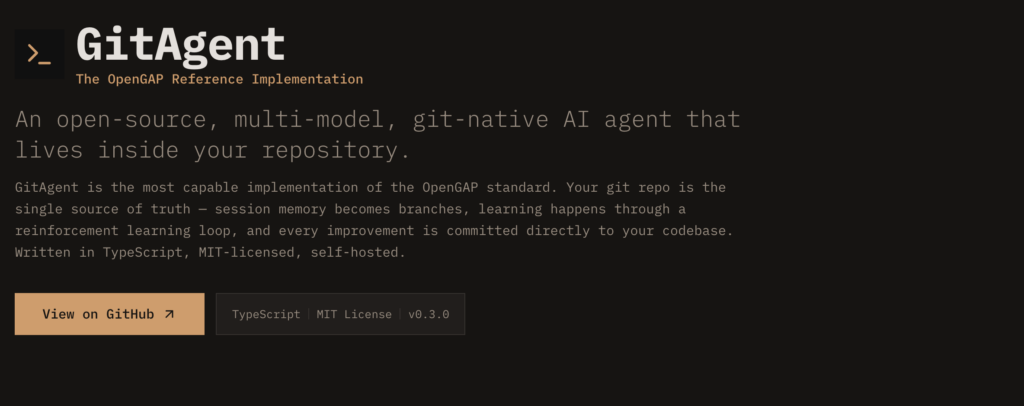
This is where Git-native AI infrastructure is starting to resonate strongly with enterprise security teams.
Because engineering organizations already trust Git-based workflows for operational control.
That includes:
- pull requests
- approvals
- rollback
- audit history
- deployment governance
- collaboration workflows
The natural question becomes:
“Why shouldn’t AI agents follow the same operational discipline?”
How GitAgent Aligns With Enterprise Security Requirements
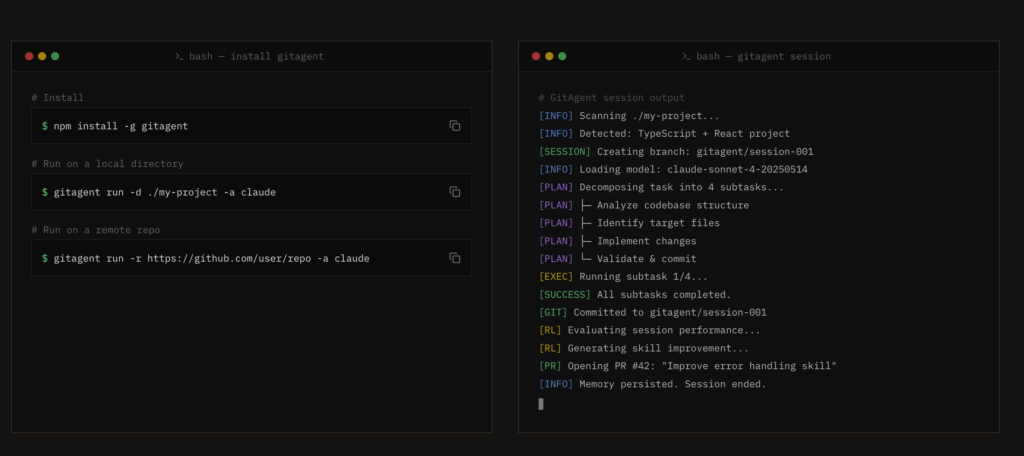
GitAgent approaches AI agents differently from many orchestration-first platforms.
Instead of treating agents like isolated runtime workflows, GitAgent treats them like version-controlled infrastructure.
Everything lives inside Git:
- prompts
- workflows
- memory
- hooks
- policies
- deployment configuration
That creates much stronger operational visibility.
GitAgent vs Traditional AI Agent Operations
| Traditional AI Agent Systems | GitAgent |
| Hidden runtime changes | Version-controlled workflows |
| Manual deployment handling | Branch-based deployment workflows |
| Limited rollback visibility | Full Git rollback |
| Fragmented governance | Built-in auditability |
| Weak operational transparency | Clear version history |
| Difficult collaboration tracking | Pull request workflows |
| Framework-specific lock-in | Multi-framework portability |
For CISOs, these operational controls matter far more than flashy AI demos.
Because production AI systems need to be governable first.
Why This Matters More in Europe
European enterprises are moving toward stricter operational expectations around AI.
The conversation is no longer:
“Can AI improve productivity?”
Most organizations already believe it can.
The real conversation now is:
- Can AI systems be governed safely?
- Can deployments be controlled?
- Can workflows be audited?
- Can risk exposure be reduced?
- Can operational accountability be maintained?
These are security and operational questions.
Not just AI questions.
Final Thoughts
The next phase of enterprise AI adoption will likely be shaped less by model capability and more by operational trust.
For CISOs, that means evaluating:
- governance
- deployment discipline
- auditability
- access control
- operational visibility
- portability
The platforms that succeed in European enterprises will likely be the ones that align best with those operational requirements.
GitAgent brings Git-native operational discipline into AI agent management, helping enterprises manage:
- version control
- approvals
- deployment workflows
- governance
- auditability
- collaboration
As AI agents become deeper operational systems inside enterprises, those controls become much harder to ignore.
Book A Demo: Click Here
Join our Slack: Click Here
Link to our GitHub: Click Here