Manual workshop execution
Facilitators had to manually create scenarios, manage evolving situations, coordinate participant roles, and run debrief sessions. Execution varied significantly between sessions and teams.
This video can't be played inline here.
Watch it directly ↗
A global strategy and workshop organization delivering crisis-management and strategic decision-making simulations for enterprise clients partnered with Lyzr to replace manual workshop execution with an AI-powered simulation platform. The goal was to standardize workshop delivery, reduce operational overhead, and create a scalable system capable of supporting multiple clients and simulation formats.
Facilitators had to manually create scenarios, manage evolving situations, coordinate participant roles, and run debrief sessions. Execution varied significantly between sessions and teams.
Scenarios, stakeholder configurations, and simulation parameters had to be recreated repeatedly, increasing setup time and reducing consistency.
Running multi-participant sessions required facilitators to constantly manage changing scenarios, participant actions, and live events manually.
Workshop intelligence, decision patterns, and historical outcomes were distributed across documents and facilitator experience instead of being stored in a reusable system.
Lyzr implemented an agent-driven inbound SDR system that combined structured knowledge, automated decisioning, and human-in-the-loop controls to manage inbound engagement at scale.
Lyzr delivered a full-stack simulation platform where facilitators can configure clients, create scenarios, launch sessions, and manage live workshops through a centralized interface.
The platform supports reusable client configurations, editable scenario libraries, stakeholder definitions, and simulation templates. AI-assisted onboarding automatically helps create new client environments.
Lyzr built a multi-agent framework where specialized agents manage simulations, stakeholder interactions, onboarding, and client intelligence within a shared workflow.
Participants join a shared simulation through QR or session codes, while facilitators manage live events, roles, and decisions in real time.
The platform integrates retrieval-based knowledge systems with public and private information repositories. Simulation outcomes, events, and responses are generated using organization-specific context instead of generic outputs.
The same technical foundation supports multiple clients with different scenarios, metrics, knowledge bases, and workshop configurations without requiring application changes.
Reusable templates and AI-assisted setup reduced repeated manual configuration work.
Sessions followed a structured workflow regardless of facilitator or client setup.
Live orchestration features shifted facilitator effort from coordination tasks toward participant engagement and decision guidance.
Events, decisions, outcomes, and debrief reports are stored and available for future review.
A single platform can support different organizations, scenarios, and workshop formats while maintaining consistency across deployments.
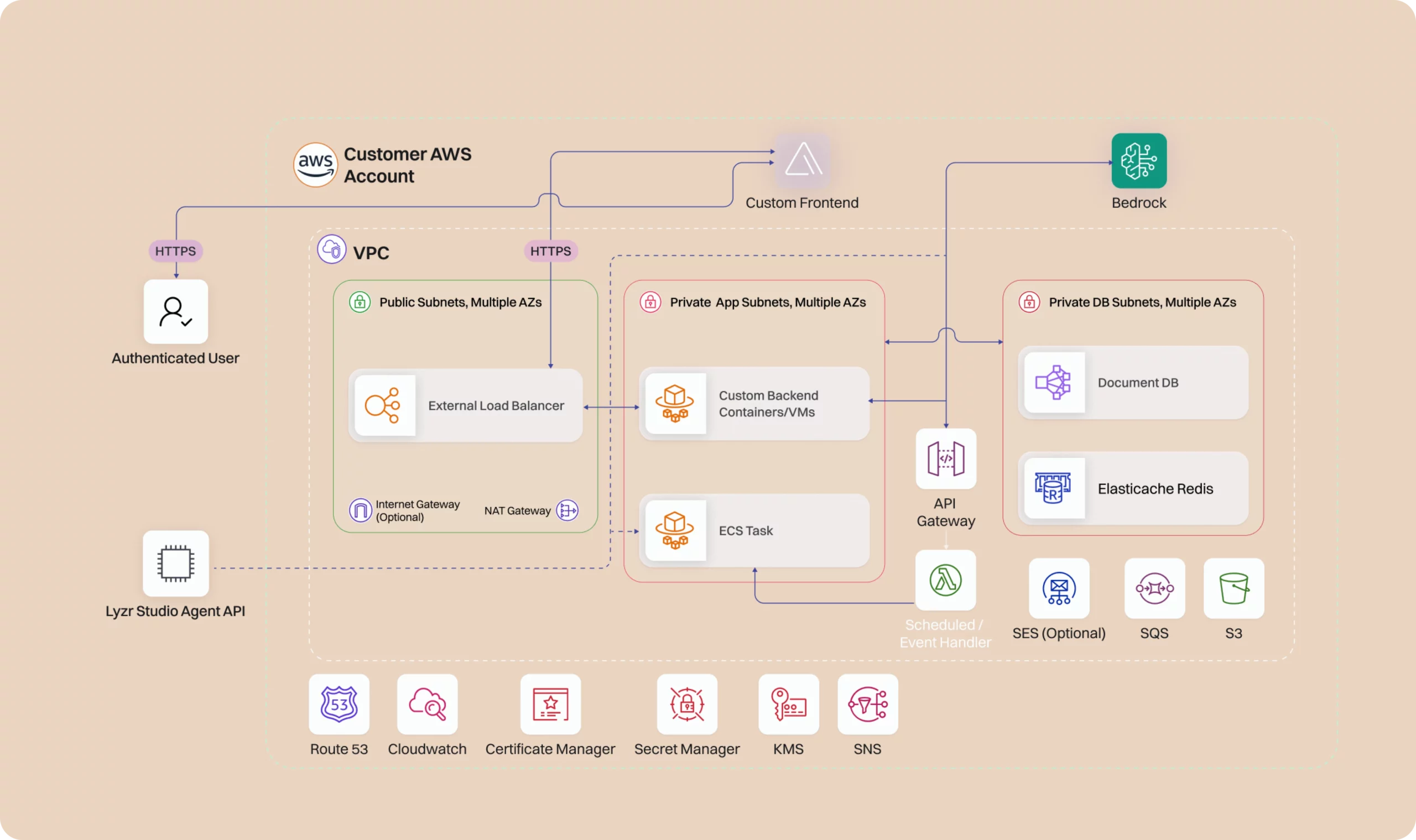
Administrative access is protected through Microsoft Entra SSO with authenticated access controls and JWT validation.
Sensitive information remains protected through isolated infrastructure, private database networking, and controlled access policies.
Simulation events, decisions, and agent interactions are logged and persisted, providing visibility into every action generated throughout the workflow. Built by Lyzr in partnership with a global strategy and workshop organization.