Your AI governance policy is a PDF. The agent that just approved the payment never opened it, and the dashboard that flagged the problem did so eleven minutes after the money left.
This guide compares 10 AI agent governance platforms across 7 dimensions so you can build a shortlist. We show you how to tell the tools that document agent behaviour apart from the tools that stop it.
Best for: CIOs, CISOs, Heads of AI, model risk leads, and compliance officers who have AI agents in production and now have to prove who is accountable for each one.
Not for you if: You are running a single chatbot with no tool access. An AI model evaluation tool will serve you better until your agents start taking actions that have consequences.
Get the short answer
- MintMCP: Best for governing tool-call traffic specifically at the gateway layer, before it can be executed.
- Lyzr Opencontroller: Best overall for enterprises that need to enforce policy in the request path. It provides a governed front door in front of every agent and every model call, deployed in your own cloud account, with budgets and guardrails that refuse a call rather than just alerting on it. It works with any agent framework: LangGraph, CrewAI, AutoGen, and custom-built agents.
- Arthur AI: Best for discovering and mapping all the agents running across a multi-cloud, multi-framework estate.
- Kore.ai AMP: Best for pre-production evaluation of agents built on many different frameworks at once.
- Fiddler AI: Best for model risk functions that need to produce audit-grade observability evidence for regulators.
- Microsoft Agent 365: Best if your identity, security, and compliance stack is already built on Microsoft Entra, Defender, and Purview.
- IBM watsonx.governance: Best for large enterprises that have standardized their AI and data architecture on the IBM ecosystem.
- Credo AI: Best for policy-led governance programs where agentic risk is one component of a wider AI risk framework.
- OneTrust AI Governance: Best for building a comprehensive AI inventory as the system of record for a compliance or privacy program.
- Zenity: Best when the security operations team, not the ML or platform team, owns the runtime intervention layer.
What Is AI Agent Governance?
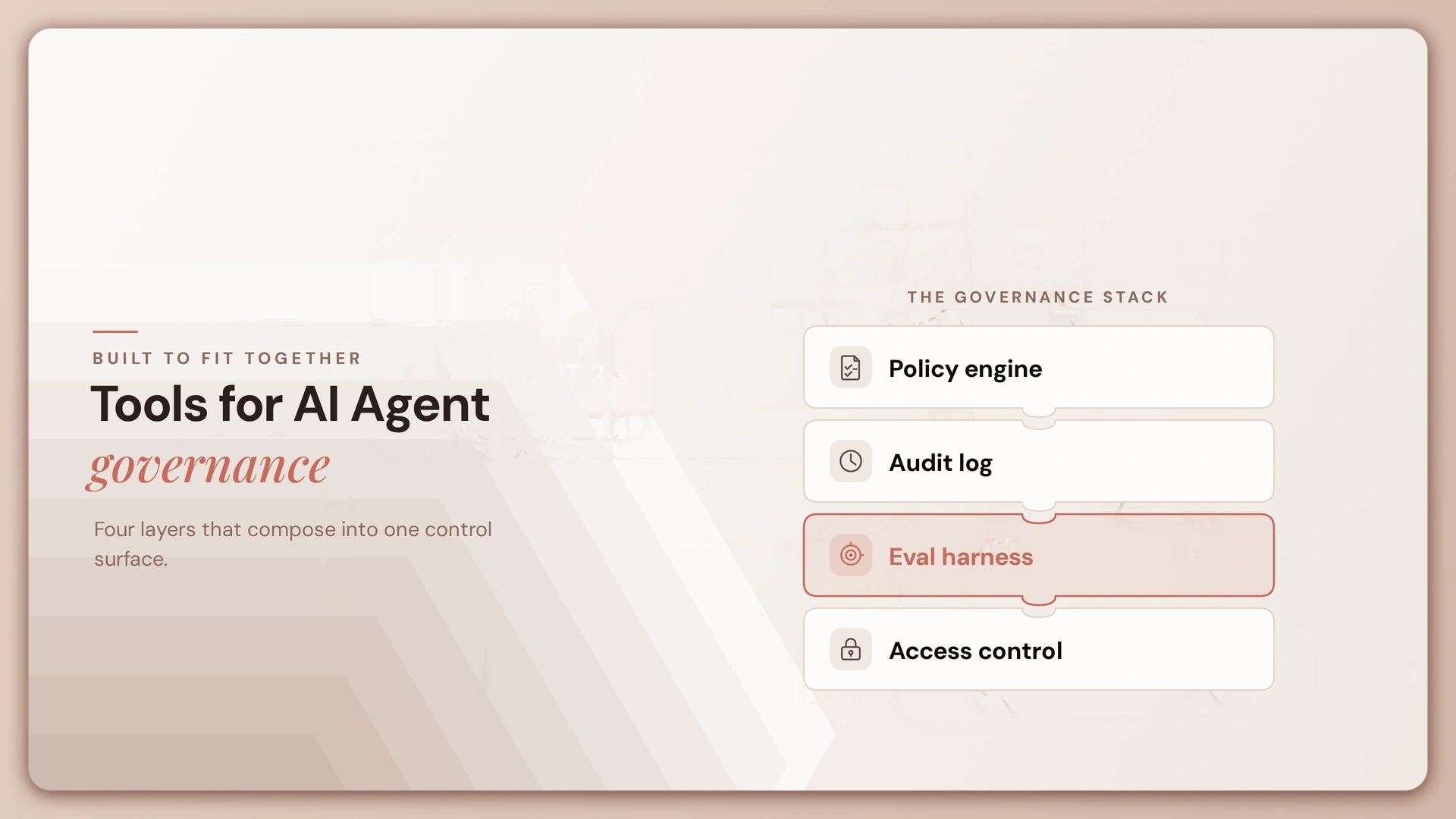
AI agent governance is the software layer enterprises use to manage the risk, compliance, and performance of autonomous AI agents across their lifecycle. It typically covers five capabilities:
- Discovery – knowing which agents exist across your environment, including ones built by other teams or embedded in third-party tools (see: agent registry)
- Runtime guardrails – screening and blocking risky agent behavior (prompt injection, unauthorized tool calls, PII exposure) as it happens, not after the fact
- Continuous evaluation – ongoing quality and safety scoring of agent outputs and actions, not a one-time model evaluation
- Observability – tracing what an agent did, at the application, session, agent, and individual-step level, for root-cause analysis (see: AI model monitoring)
- Compliance evidence – documentation and audit trails mapped to frameworks like the EU AI Act or SR 11-7 for regulated industries
Traditional AI governance tools were largely built to document and monitor static models. Agent governance is a distinct, newer category because agents act, not just predict, and that action needs to be authorized, constrained, and audited in real time.
Tell an alert and a refusal apart
This is the single axis the category divides on, and it is the one most comparison tables skip. An alert after a data leak or a bad payment does not undo the damage. A refusal prevents it.
| Observability | Governance that alerts | Governance that refuses | |
|---|---|---|---|
| What it produces | A trace | A policy violation record | A blocked call |
| When it acts | After the run | After the action completes | Before the action executes |
| Budget overrun | Shows in a cost chart | Sends a notification at 90% | Rejects the call at the ceiling |
| Prompt injection | Visible in the trace afterwards | Flagged for manual review | Response blocked before it returns |
| Misbehaving agent | Appears in a dashboard | Raises a support ticket | Quarantined, calls refused in seconds |
| Primary buyer | AI Platform Engineering | Risk and Compliance | Platform, Security, and Risk |
| Example tools | Pure tracing and eval platforms | OneTrust, IBM, Credo AI | Lyzr Opencontroller, Zenity, MintMCP |
The test that separates them is simple. Ask a vendor to demonstrate their platform stopping a call, live, rather than just reporting on one. A dashboard is monitoring. A ceiling that rejects the call is governance.
See how we scored every tool
We scored 10 tools on the same 7 dimensions.
- Sources: Our analysis is based on vendor documentation, public product announcements, and analyst coverage. We do not use third-party review sites.
- Bias: Lyzr is on this list. Opencontroller is our product. We score it on the same dimensions as every other tool and are clear about the scenarios where a competitor is a better choice.
- Freshness: This assessment is current as of September 2026. Capabilities change quickly, so verify every claim against current vendor documentation before you buy.
| Dimension | What we checked | Why it matters |
|---|---|---|
| In-path enforcement | Can the platform refuse a call before it executes, or only alert after? | An alert after a wire transfer does not reverse it. Prevention is the only meaningful control for high-risk actions. |
| Agent discovery | Does it find unregistered agents across clouds, clusters, SaaS platforms, and employee devices? | You cannot govern an agent you do not know exists. Shadow AI is a primary source of unmanaged risk. |
| Runtime guardrails | Does it screen for prompt injection, PII/PHI, secret egress, toxicity, and groundedness, on both request and response? | The blast radius of a compromised or misbehaving agent is categorically wider than that of a simple chatbot. |
| Compliance evidence | Does it produce structured, exportable evidence mapped to frameworks like the EU AI Act, SR 11-7, and ISO 27001? | Auditors accept evidence, not screenshots of a dashboard. Governance must be provable. |
| Framework neutrality | Does it cover agents built on LangGraph, CrewAI, AutoGen, vendor SDKs, and custom code? | Large companies never run just one agent framework. Governance cannot be tied to a single vendor’s stack. |
| Deployment control | Does it run as vendor SaaS, in your cloud account, on-prem, or air-gapped? | Prompts, completions, and tool-call data routinely contain regulated or sensitive information that cannot leave your environment. |
| Cost predictability | How does the pricing model behave as agent call volume grows? | Per-call or per-trace pricing punishes you for succeeding and can create runaway costs that kill projects. |
1. Lyzr Opencontroller: Govern every agent in the request path
Opencontroller is a governance, delivery, and improvement layer that sits in front of every AI agent and every model call an organization runs. It deploys inside your own cloud account rather than as external SaaS, putting enforceable policy in the request path.
Know the brand and the product
| Lyzr, the company | Opencontroller, the product |
|---|---|
| Enterprise AI agent platform: build agents in Agent Studio and Architect, govern them with Opencontroller | Governance layer for your entire agent estate, not just one framework |
| Headquartered in Jersey City, with a global engineering hub in Bengaluru and teams across the US and India | Runs inside your cloud account (AWS, GCP, Azure) or on-prem, air-gapped if needed |
| Serves banking, financial services, insurance, healthcare, and the public sector | Governs the agents you already have, with no rewrite and no proprietary SDK required |
| Technology partners include AWS, Google Cloud, Microsoft Azure, and NVIDIA | Flat annual fee with a $0 maintenance fee, providing predictable costs |
| Backed by Accenture Ventures | Learn more about Opencontroller by Lyzr |
See why “in the path” is the difference
Most platforms in this category sit beside the request path. They receive a copy of the trace, score it, and raise an alert if something looks wrong. This is documentation, not control.
Opencontroller sits in the path. It checks identity, permission, budget, and policy before the call reaches the model or the tool. It refuses the call when policy says no.
- A dashboard cannot stop an agent. An alert and a policy document have one thing in common: neither can stop a compromised agent from making a tool call. Control must happen where the call is made.
- Prevention, not documentation. Governance that alerts after an incident is just a reporting tool. In-path governance prevents the incident from happening in the first place.
- Real-time enforcement. When a budget is spent, the next call is refused. When an agent is quarantined, it is immediately blocked. Enforcement in the path is measured in milliseconds, not in the time it takes a human to respond to a ticket.
Follow the four-stage lifecycle

- Discover: Shadow discovery finds unregistered agents running across your Kubernetes clusters, AWS, Azure, and GCP agent services. It also identifies unsanctioned AI tools being used on employee devices, giving you a complete AI agent registry
- Gate: A gated release pipeline, with a mandatory evaluation gate and second-person approval, ensures no agent reaches production without oversight. This maps to the change-management controls your auditors already test.
- Enforce: Two distinct gateways, one for agent invocations and one for model calls, authenticate, authorize, meter, and trace every single call. This is where policy becomes reality.
- Improve: A closed-loop engine grades production traces, clusters failures, proposes prompt rewrites as a reviewable diff, and grows a permanent regression suite. This feeds a continuous, multi-turn evaluation process.
Check the core capabilities
| Capability | What it does | Why it matters to an enterprise |
|---|---|---|
| Shadow agent discovery | Finds unregistered agents across clusters, three major clouds, and employee devices. | Ends shadow AI. You can finally ask “show me every agent reading production data” and get a complete, reliable answer. |
| Attributable identity | Gives every agent a unique identity, an owner, and role-based permissions tied to your directory. | Answers the auditor’s first question: “Who is accountable for this agent’s actions?” Solves a key challenge for CIOs managing AI |
| In-path policy enforcement | Checks each call against policy and refuses it in the request path if it violates a rule. | Prevents the incident instead of just documenting it after the fact. This is the core of effective AI agent governance. |
| Budget ceilings | Rejects calls once a defined scope (per user, per agent, per project) is spent, rather than alerting after the fact. | Stops a runaway agent loop from becoming a multi-million dollar invoice. |
| Inline guardrails | Scores for prompt injection, PII/PHI, secret egress, toxicity, and groundedness on both the request and the response. | Screens the two directions an agent can leak sensitive data: in from the user prompt or out from the model’s response. |
| Quarantine | Refuses every call to or from a misbehaving agent within seconds, while preserving the complete forensic history. | Turns a live incident into a contained one without destroying the evidence needed for root cause analysis. |
| Two gateways | One gateway per agent invocation, one per model call, with roughly 11 ms of measured added latency. | Provides governance that does not become the performance bottleneck that developers complain about. |
| Framework neutrality | Access over OpenAI-compatible URLs, MCP, and A2A protocols rather than a proprietary SDK. | Governs agents built on LangGraph, CrewAI, Google ADK, Claude Agent SDK, OpenAI Agents SDK, Temporal, and hand-written code alike. |
| Sovereign by default | Runs in your own cloud account with private connectivity to model providers. | Clears data-residency and security reviews because sensitive data never leaves your environment. |
Pick it if you are:
- A CIO or CISO in a regulated industry who needs every agent action to be attributable, authorized, and enforceable.
- An AI platform lead responsible for governing agents across several frameworks, clouds, and vendor platforms.
- A risk or compliance lead who has to prove who approved what, to an auditor, with an exportable, immutable record.
- A Head of AI scaling past the first handful of agents, where ownership starts to blur and manual oversight is no longer feasible.
Skip it if you are:
- Running a single chatbot with no tool access. Start with an evaluation tool and come back when your agents start taking actions.
- Looking primarily for deep explainability reports on classical ML models. Fiddler AI‘s model-risk heritage serves that specific use case better.
- Buying governance as a module of an AI inventory and privacy program you already run in OneTrust.
- Expecting the platform to build and host your container images. Opencontroller governs agents; your team keeps ownership of the code and the images.
Cross-framework agent governance
2. Arthur AI: Discover and govern agents across frameworks

Arthur is positioned as the industry’s first Agent Discovery & Governance platform, purpose-built for the agentic era rather than retrofitted from classical ML monitoring. It combines automated discovery, native runtime guardrails, continuous evaluation, and end-to-end observability in one platform.
- Best for: Multi-cloud, multi-framework enterprises that do not know how many agents they have.
- Not ideal if: You need deep, framework-native debugging of one specific stack.
- Enforcement: Runtime guardrails are applied without requiring code changes to the agent.
- Automated agent discovery across cloud and framework boundaries.
- Guardrails apply without requiring the agent team to change code.
- Built for agents from the start rather than extended from model monitoring.
- Breadth across frameworks can mean less depth in any single framework’s failure modes.
- Less compliance-evidence tooling than the GRC-heritage platforms.
Arthur is the right call when discovery is the urgent problem. Pair it with, or compare it against, Opencontroller when the requirement moves from finding agents to refusing their calls in your own cloud account.
3. Kore.ai Agent Management Platform: Evaluate across stacks before production

Kore.ai launched a dedicated Agent Management Platform (AMP) in March 2026 with explicit cross-framework support. It supports LangGraph, CrewAI, AutoGen, and major vendor frameworks, featuring a pre-production evaluation studio and unified observability.
- Best for: Enterprises running agents on many frameworks that want one evaluation layer across all of them.
- Not ideal if: You need a long production track record from your governance vendor.
- Enforcement: Continuous governance and pre-production gating rather than in-path refusal.
- Explicit A2A and MCP protocol support, a technical marker of genuine cross-framework governance.
- Pre-production evaluation studio helps catch failures before they reach customers.
- Continuous governance model rather than a point-in-time audit.
- Launched in March 2026, so its production track record is shorter than observability-first competitors.
- Governance is framed around evaluation and AI agent observability more than runtime refusal.
Kore.ai AMP is a strong pre-production gate that answers “is this agent good enough to ship?”. It does not answer the runtime question: “should this specific call be allowed right now?”.
Observability and model-risk heritage
4. Fiddler AI: Produce audit-grade evidence for model risk

Fiddler AI’s heritage is in ML model monitoring, and in January 2026 it repositioned as an “AI Control Plane for Enterprise Agents”. It provides hierarchical tracing from application to session to agent to individual span, runs root-cause analysis, and applies over 100 quality metrics.
- Best for: Model risk management functions in regulated industries.
- Not ideal if: You need per-agent identity and in-path refusal more than you need explainability.
- Enforcement: Guardrails that score 11 safety dimensions; PII detection across 35+ entity types.
- Observability depth genuinely supports audit and regulatory needs, not just engineering debugging.
- Guardrails include prompt injection and faithfulness for hallucination detection.
- GRC offering produces model-risk evidence for SR 11-7 and the EU AI Act.
- Heritage in ML monitoring means agent-specific runtime concepts are newer additions rather than foundational.
- Agent discovery is not the product’s primary strength.
Fiddler is the deepest evidence engine on this list and the better pick when the auditor is the primary customer. It is the weaker pick when the requirement is stopping an agent mid-action rather than just tracing its behavior.
Platform-native governance
5. Microsoft Agent 365 and Purview: Govern agents with the controls you already run

Agent 365 provides a centralized governance surface for agents built on Microsoft platforms and for agents developed or acquired elsewhere. It integrates deeply with Microsoft 365 administration, Entra for identity, Defender for security, Intune for endpoints, and Purview for data governance.
- Best for: Organizations whose identity, security, and compliance stack is already Microsoft.
- Not ideal if: You are not standardized on Microsoft 365 and Entra.
- Enforcement: Access control and policy application through existing Microsoft controls.
- Agents become managed identities inside the same controls that already surround your workforce.
- No parallel governance system to staff and maintain.
- Covers third-party agents, not only Microsoft-built ones.
- Value proposition narrows sharply for organizations outside the Microsoft estate.
- Governs agents well within Microsoft’s own gravity but is less neutral across AWS, GCP, and independent frameworks.
If you are a Microsoft shop, start here. If your agent estate spans AWS, GCP, and independent frameworks, you will need a neutral layer like Opencontroller alongside it.
6. IBM watsonx.governance: Extend enterprise architecture to agents

IBM watsonx.governance covers lifecycle management, transparency, policy enforcement, and hybrid deployment for enterprise AI. It uses IBM’s deep integration capabilities to embed governance into the broader enterprise architecture.
- Best for: Large enterprises standardizing governance through the IBM ecosystem.
- Not ideal if: You need transparent pricing or a fast, small-footprint deployment.
- Enforcement: Lifecycle policy enforcement and explainability controls.
- Deep integration with existing IBM enterprise architecture products.
- Genuine hybrid cloud and on-prem deployment support.
- Explainability controls are well-suited to responsible AI programs.
- Priced by virtual processor cores or per-resource-unit, which adds procurement overhead.
- Built around models and workloads first; agent-specific runtime control is less central.
This is the lower-friction choice for an existing IBM estate. Budget for the procurement cycle, as unpublished, core-based pricing is a timeline factor, not a footnote.
Policy, inventory, and compliance programs
7. Credo AI: Run agentic risk inside a wider policy framework

Credo AI approaches governance from the policy and oversight direction. It translates regulatory requirements and internal standards into governance workflows, with its GAIA capability covering agentic oversight as one component of a broader AI risk program.
- Best for: Governance and risk teams building an AI oversight program where agents are one risk class among several.
- Not ideal if: Runtime interception and blocking is the primary requirement.
- Enforcement: Policy workflow and oversight rather than gateway-level intervention.
- Policy-first design maps cleanly to how risk functions already work.
- Integrates agentic oversight into a wider AI risk-management program.
- Strong visibility in search for the agentic oversight query space.
- Less emphasis on runtime guardrails than security-first tools like Zenity or MintMCP.
- Discovery of unregistered agents is not the product’s center of gravity.
Credo AI governs the program. Something else has to govern the call. Plan for both lines in the budget.
8. OneTrust AI Governance: Inventory every AI asset in one system of record

OneTrust AI Governance provides AI inventory management, risk assessment, and compliance automation. It was named a Visionary in the 2026 Gartner Magic Quadrant for AI Governance Platforms, the first edition of that report—a category Gartner sizes at $492 million in 2026, rising past $1 billion by 2030.
- Best for: Compliance and privacy teams that already run OneTrust for data governance.
- Not ideal if: You need deep runtime intervention on agent behavior.
- Enforcement: Assessment and workflow automation; documentation-led rather than in-path.
- Extending an existing OneTrust deployment into AI keeps one system of record.
- Strong AI inventory and automated compliance workflows.
- Analyst-recognized in the category’s first Magic Quadrant.
- Oriented toward compliance documentation and inventory rather than stopping an agent action.
- Agent-specific runtime concepts are newer than the core privacy and GRC product.
OneTrust provides the strongest inventory and assessment layer here. It will tell an auditor what you have, but it will not tell an agent “no”.
Security-led and gateway-level control
9. Zenity: Put the security team in charge of the intervention layer

Zenity takes a security-led approach to agent governance. It is built for organizations where the security operations team, not ML or platform engineering, owns runtime intervention over agent behavior.
- Best for: Organizations where SecOps owns the decision to allow or block an agent action.
- Not ideal if: Your requirement is model-risk evidence for a regulator.
- Enforcement: Runtime control over agent actions, mapped to security operations workflows.
- Security-first framing genuinely changes the design; policies map to SecOps workflows.
- Provides runtime intervention rather than after-the-fact reporting.
- Offers visibility into agent behavior from a security operations perspective.
- Less oriented toward the model-risk and regulatory-evidence needs of a compliance function.
- This ownership model only fits if your security team actually wants this responsibility.
Zenity fits a specific organizational chart. Confirm who owns agent blocking in your company before you shortlist it.
10. MintMCP: Screen tool calls at the gateway before they execute

MintMCP governs at the gateway layer, screening and controlling tool calls before they execute. It uses three layers: managed detection for prompt injection and PII, declarative rules on tool names and arguments, and gateway middleware for custom policy.
- Best for: Teams whose primary exposure is from MCP (Model-as-a-Service Control Plane) tool calls and gateway traffic.
- Not ideal if: You need discovery, lifecycle governance, and compliance documentation too.
- Enforcement: Real-time blocking of risky tool calls before execution.
- Intervening at the gateway before a tool call executes is a genuinely preventive checkpoint.
- Provides usage and cost tracking by model, user, agent, and session.
- SIEM export via OTLP or Splunk HEC lands data where your security team already works.
- Covers tool-call risk specifically; narrower than platforms that also cover discovery and compliance.
- Governs the MCP surface, not the full agent lifecycle.
MintMCP is the right narrow tool for a narrow problem. If MCP traffic is your whole exposure, this is enough. If agents also run outside that path, it is just one layer of several you will need.
Compare all 10 tools side by side
Legend: ● Strong / ◐ Partial / ○ Limited or not a focus. Editorial assessment as of September 2026. Verify every cell against current vendor documentation before you buy.
| Tool | Best for | Refuses a call in the path | Finds unregistered agents | Runtime guardrails | Compliance evidence | Framework neutral | Runs in your cloud | Pricing model |
|---|---|---|---|---|---|---|---|---|
| Lyzr OpenController | Enterprise enforcement | ● In the request path | ● Shadow discovery | ● Request & response | ● EU AI Act mapping | ● Any framework | ● Your cloud, on-prem | Flat annual fee |
| Arthur AI | Multi-framework discovery | ◐ Runtime guardrails | ● Automated discovery | ● No code changes | ◐ Observability-led | ● Strong | ◐ Enterprise | Enterprise contract |
| Kore.ai AMP | Pre-production evaluation | ○ Gating, not refusal | ◐ Limited | ◐ Pre-production | ○ Limited | ● A2A and MCP | ◐ Enterprise | Enterprise contract |
| Fiddler AI | Model risk evidence | ◐ Guardrails, not refusal | ○ Not a focus | ● 11 safety dimensions | ● GRC, SR 11-7 | ◐ | ● Air-gapped option | Enterprise, free tier |
| Microsoft Agent 365 | Microsoft stacks | ◐ Via Entra & Purview | ◐ Within the estate | ◐ Purview DLP | ● Purview | ○ Microsoft-centric | ○ Microsoft cloud | Microsoft licensing |
| IBM watsonx.governance | IBM-standardized enterprises | ○ Policy enforcement | ○ Not a focus | ◐ Explainability | ● Lifecycle transparency | ◐ | ● Hybrid, on-prem | Virtual processor cores |
| Credo AI | Policy-led AI risk | ○ Policy workflow | ○ Not a focus | ○ Limited | ● Policy workflow | ◐ | ◐ Enterprise | Enterprise contract |
| OneTrust AI Governance | Compliance & privacy | ○ Assessment workflow | ◐ AI inventory | ○ Limited | ● Automated workflows | ◐ | ◐ Enterprise | Enterprise contract |
| Zenity | Security-owned intervention | ● Runtime control | ◐ Limited | ● SecOps policy | ○ Limited | ◐ | ◐ Enterprise | Enterprise contract |
| MintMCP | MCP tool-call traffic | ● At the gateway | ○ Not a focus | ● Injection, secrets, PII | ○ SIEM export only |
Match your scenario to a tool
| If your situation is… | Pick | Why |
|---|---|---|
| “My agents move money, change records, or touch regulated customer data.” | Lyzr Opencontroller | It refuses non-compliant calls before they execute, preventing the incident. |
| “Nobody in this company can tell me how many agents we are actually running.” | Lyzr Opencontroller or Arthur AI | Both provide shadow discovery to find and map agents across clouds and clusters. |
| “Data residency rules block us from routing agent traffic through a third-party vendor.” | Lyzr Opencontroller | It deploys inside your own cloud account with private connectivity to model providers. |
| “Finance wants a fixed, predictable governance cost as our agent volume grows.” | Lyzr Opencontroller | It uses a flat annual fee instead of per-call or per-trace metering that punishes scale. |
| “An auditor has asked for model-risk evidence under SR 11-7.” | Fiddler AI | Its GRC offering is built for exactly that output, with deep observability. |
| “Our entire workforce identity and security stack is Microsoft.” | Microsoft Agent 365 | It governs agents using the controls you already have in place in Entra and Purview. |
| “We already run OneTrust for our privacy and data governance programs.” | OneTrust AI Governance | It extends your existing program to AI, creating one system of record, not a parallel inventory. |
| “Our security team, not the ML team, owns the decision to block a risky action.” | Zenity | Its policies and workflows are designed for how a SecOps team operates. |
| “Our primary risk exposure is from tool calls made through an MCP gateway.” | MintMCP | It provides focused gateway interception to block malicious or non-compliant tool calls. |
| “We need to evaluate agents built on seven different frameworks before we launch them.” | Kore.ai AMP | Its pre-production evaluation studio is explicitly designed for cross-framework testing. |
Get answers to common questions
What’s the difference between AI observability and AI agent governance?
Observability tells you what an agent did after the fact, through tracing and monitoring. Governance controls what an agent is allowed to do before it acts, through runtime guardrails and policy enforcement. Most enterprise deployments need both, and several platforms on this list, including Lyzr Opencontroller, Fiddler, and Arthur, combine them.
Do I need a separate AI agent governance platform if I already have observability tools?
Often, yes. You need a separate platform if your observability tool only reports on agent behavior rather than intervening in it. Runtime guardrails, budget ceilings, and tool-call approval gates are core AI agent governance functions that most pure observability platforms do not include.
Can one platform govern agents built on LangGraph, CrewAI, and AutoGen?
Yes, the stronger platforms here are explicitly framework-neutral. Arthur, Kore.ai’s AMP, and Lyzr Opencontroller are all built to govern agents regardless of the underlying framework. They use standard protocols like A2A, MCP, and OpenTelemetry rather than a proprietary SDK, so you can switch or add frameworks without re-integrating governance.
What compliance frameworks do AI agent governance platforms typically support?
The EU AI Act and SR 11-7 (the US model risk management guidance for banking) are the two most commonly supported. Platforms from Fiddler AI, OneTrust, IBM, and Lyzr all produce structured evidence mapped to these frameworks. Always check the full list of supported frameworks with the vendor before shortlisting.
How much do AI agent governance platforms cost?
Pricing varies widely, and many vendors do not publish rates. IBM watsonx.governance bills by virtual processor cores. Lyzr Opencontroller charges a flat annual fee. MintMCP is usage-based. Others use enterprise contract pricing that requires direct engagement. Treat an unpublished price as a procurement timeline factor, not a minor detail.
Why are agentic AI projects being cancelled at a high rate?
In a prediction published in June 2025, Gartner attributed a projected cancellation rate of over 40% by the end of 2027 to escalating costs, unclear business value, and inadequate risk controls. That third cause—inadequate risk control—is the gap that dedicated agent governance tooling is built to close, and it is the one that kills projects that were otherwise technically working.
How much do AI agent governance platforms cost?
Pricing varies widely and several vendors in this category don’t publish public rates. IBM watsonx.governance bills by virtual processor cores or a per-resource-unit SaaS rate; others use enterprise contract pricing that requires direct engagement to quote. Treat an unpublished price as a procurement timeline factor, not a minor detail.
Does an AI agent governance platform need to be framework-specific, or can it cover agents built on different stacks?
The stronger platforms in this category are explicitly framework-neutral. Arthur, Kore.ai’s AMP, and OpenController are all built to govern agents regardless of which framework built them, using standard protocols (A2A, MCP, OpenTelemetry) rather than a proprietary SDK, so switching frameworks or adding a new one doesn’t require re-integrating governance.
What should I look for when evaluating an AI agent governance platform?
Beyond regulatory documentation, look for whether controls actually refuse risky behavior in real time or only report on it afterward, activity logs and audit trails, transparency into how the platform reaches its safety scores, and where the platform itself is deployed, since a governance layer that runs inside your own cloud account (as OpenController does) closes a different set of data-sovereignty objections than one that routes your agent traffic through an external vendor’s infrastructure.
Choose the tool that fits your stage
- Still piloting? If your agents are in a lab with no tool access, an evaluation platform will serve you better than a full governance purchase.
- In production? The moment your agents take real actions, moving money, changing records, sending emails, you have an enforcement problem, not just a documentation problem.
- Ready for enforcement? That production stage is what Lyzr Opencontroller was built for. It runs alongside the inventory, evidence, and tracing tools your risk and engineering teams already use to provide the one thing they cannot: a refusal.
Book a demo to see how OpenController governs every agent call.
Learn more about the OpenController platform.
Book A Demo: Click Here
Join our Slack: Click Here
Link to our GitHub: Click Here